Papers by Agus Halim
Agriculture and aquaculture rehabilitation in post-tsunami Aceh, Indonesia
Jurnal Ilmiah Mahasiswa Pertanian, 2021
Abstrak. Penelitian ini bertujuan untuk mengetahui pengaruh sirkulasi air kolam budidaya ikan dan... more Abstrak. Penelitian ini bertujuan untuk mengetahui pengaruh sirkulasi air kolam budidaya ikan dan jenis media tanam non tanah terhadap pertumbuhan tanaman pakcoy (Brassica chinensis L.) dan bagaimana pengaruh interaksi keduanya. Penelitian dilaksanakan pada bulan Juni hingga Oktober 2020 di Gampong Pineung, Kecamatan Syiah Kuala Banda Aceh. Rancangan penelitian yang digunakan adalah Rancangan Acak Kelompok pola faktorial 4 x 2 dengan 3 ulangan. Faktor yang diteliti yaitu sirkulasi air kolam budidaya ikan yang terdiri dari 2 taraf (tanpa sirkulasi air kolam budidaya ikan dan menggunakan sirkulasi air kolam budidaya ikan) dan jenis media tanam non tanah (limbah serutan kayu, limbah sabut kelapa, biochar batok kelapa dan biochar cangkang kopi). Analisis data menggunakan Anova dan dilanjutkan dengan uji beda nyata terkecil (BNT) pada taraf 0,05%. Hasil penelitian menunjukkan bahwa sirkulasi air kolam budidaya ikan berpengaruh tidak nyata terhadap semua parameter yang diamati. Hasil pene...
Zone 1 includes the city of Banda Aceh, the administrative capital of the province, and home to o... more Zone 1 includes the city of Banda Aceh, the administrative capital of the province, and home to over 200,000 people at the time of the tsunami. The main sources of livelihood before the tsunami were small businesses, informal day labor, government civil service, fisheries, and rice agriculture. Most of the neighborhoods/villages along the coast engaged in aquaculture. Rice fields ringed the city and extended far to the south. The tsunami penetrated up to 2 km inland, causing almost complete destruction to the built environment, massive loss of life, and significant alteration to the natural environment. All aquaculture features and large tracts of rice fields were damaged. Between 2005 and 2008, 65 registered livelihood projects spent just over 29 million USD in tsunami-affected villages in Zone 1 (Supplementary Table 1). Seven projects spent almost 2 million USD rehabilitating agriculture. These supported cash-for-work to clear agricultural lands, training and capacity building programs, and provision of equipment, seeds, fencing and fertilizer e most of which was dedicated for rice cultivation. Seventeen projects spent over 5 million USD rehabilitating the fishing industry (Supplementary Table 1). This was spilt between providing equipment such as boats and nets for fishermen, building fish processing and selling facilities, and clearing and repairing damaged aquaculture infrastructure. 4 Half the livelihood aid in Zone 1 was used for large economic infrastructure projects such as markets, ports, and manufacturing & processing facilities. 2.2. Zone 2 The villages in Zone 2 occupy a narrow coastal plain, ranging from 100 to 3000 m wide-abutting heavily forested mountains. Zone 2 is predominantly rural, with respondents stating that up to 90% of pre-tsunami livelihoods involved rice cultivation, tree-crop plantations, fishing and aquaculture. Due to the separatist conflict, and poor transportation infrastructure, Zone 2 villages had long been isolated and disconnected from Banda Aceh. All inhabited areas were inundated by the tsunami, causing heavy damage to rice fields and aquaculture, and major loss of life. Between 2005 and 2008 17 registered livelihood rehabilitation projects were carried out by donors in Zone 2, totaling more than 6.6 million USD (Supplementary Table 2). Seventy six percent of the aid was allocated for agricultural rehabilitation (approximately 5 million USD), most of which was for rice cultivation. Aid supported cash-for-work to clear rice fields, rebuild rice field and irrigation infrastructure, distribution of inputs such as seeds, fertilizer, fencing and farming equipment, and capacity building. Zone 2 received very little dedicated aid for rehabilitating aquaculture. 2.3. Zone 3 Zone 3 consists of a shallow coastal plain abutting junglecovered mountains, often no more than 1500 m wide. As this area serves as the administrative center of the Aceh Jaya district, a significant number of the residents within tsunami-affected villages were government civil servants or manage small businesses. Subsistence livelihoods were a secondary part of the overall economic strategy. The tsunami destroyed the entire built environment, caused massive loss of life, and damaged most rice fields. There was no aquaculture in the zone before the tsunami. Between 2005 and 2008, 16 registered livelihood projects were carried out by donors in Zone 3 villages, totaling more than 5.7 million USD (Supplementary Table 3). Slightly more than 60% of the funding (3.5 million USD) was allocated for agriculture rehabilitation, mostly for rice cultivation. These projects provided funding to clear debris and rebuild basic agricultural infrastructure (mainly through cash-for-work schemes), provision of agricultural inputs such as seeds, fertilizer, and equipment, and training/capacity building. The rest of the livelihood aid went towards infrastructure and small business support programs. staff, looking at the sustainability of aid, and transformation across seven sectors: housing, demographics, livelihoods, disaster risk reduction, governance, relocation, and gender. The project conducted in-depth fieldwork in over 130 tsunami affected villages and neighborhoods, some of which are featured in this paper. 6 The scope of the analysis was in part influenced by the availability of satellite images for the 3 study areas. It was not possible to obtain images for all three zones at exactly the same times, which limits comparison between the sectors, but does not diminish the overall patterns within each sector.

Komunitas Makrozoobentos di Perairan Estuaria Rawa Gambut Tripa Provinsi Aceh
The Tripa Peat Swamp forest is located in Nagan Raya and Aceh Barat Daya districts. ... more The Tripa Peat Swamp forest is located in Nagan Raya and Aceh Barat Daya districts. The forest has been deforested and converted to agricultural lands. Hence, the objective of the present study was to evaluate the community structure of macrozoobenthos in Tripa peat swamp. Five sampling locations were determinated using purposive random sampling which was focussed in the main river mouths of Tripa, Suak Tripa, Seuneam, Batee and Taduu Rivers. The sediment was collected in three plots (1m x 1m) at every sampling location. The results showed that, there were 34 species of macrozoobenthos recorded during the sampling, it is belonging to 4 classes; Gastropoda, Bivalvia, Crustacea and Insecta. The species richness were ranged between 1.12 to 1.58, indicates low category. The diversity and evenness indices were ranged between 0.62 to 2.44 and 0.19 to 0.73, respectively; indicates low to moderate values. It was concluded that the macrozoobenthos community of Rawa Tripa was in...
International Journal of Disaster Risk Reduction, 2020
This paper presents a field study on the long-term effectiveness and sustainability of livelihood... more This paper presents a field study on the long-term effectiveness and sustainability of livelihood interventions following the 2004 Indian Ocean tsunami in Aceh, Indonesia. We assess the extent to which post-tsunami aid in Aceh helped beneficiaries to stabilize and restore their pre-disaster livelihoods, and/or develop new livelihoods. We draw upon qualitative data captured in 183 in-depth interviews and 38 focus group discussions involving village leaders, livelihood aid participants, and NGO workers. Our results show that livelihood assistance helped people stabilize their household finances and partially restore their pre-disaster livelihoods. Furthermore, we found that aid programs were able to help some people without pre-disaster livelihood experience to participate in part-time, ad hoc work. However, aid packages were generally not able to support the development of fulltime, sustainable new livelihoods for people lacking pre-disaster training and experience. Our data suggests that it is difficult to conduct efficient and sustainable livelihood development initiatives within the time pressures and current institutional approaches to large-scale post-disaster reconstruction.
Ocean & Coastal Management, 2017
This paper presents GIS time-series land-use analysis of satellite images to quantify the recover... more This paper presents GIS time-series land-use analysis of satellite images to quantify the recovery of rice cultivation and aquaculture following the 2004 Indian Ocean tsunami in coastal communities in Aceh, Indonesia. We supplement this with qualitative data to illustrate the post-disaster challenges faced by residents, and the extent to which coastal communities have adapted to post-tsunami realities. Our analysis shows that the rehabilitation of rice cultivation and aquaculture in areas inundated by the tsunami has been limited by extensive degradation of land, diversion of labor by tsunami mortality and transition to alternative livelihoods, and re-purposing of rice fields for residential use during the reconstruction phase. This is especially prominent in areas where subsistence activities are not the primary source of livelihood. The Aceh case study shows that social, economic, and environmental factors can be stronger determinants of how coastal livelihoods rebound and change following destructive inundation events than livelihood rehabilitation aid. Additionally, our case study suggests the human impact of coastal hazards can be felt outside the physical extent of inundation.
Pengolahan Limbah Cair Industri Pupuk Urea dengan Porphyridium cruentum dalam Upaya Pengelolaan Pencemaran Wilayah Pesisir
Sebagai Biokatalis mikro algae Porphyridium cruentum memiliki potensi untuk menyerap kandungan nu... more Sebagai Biokatalis mikro algae Porphyridium cruentum memiliki potensi untuk menyerap kandungan nutrien dalam limbah cair industri. Selain itu juga dapat menghasilkan biopigmen merah dan polisakarida yang bermanfaat sebagai bahan baku industri. Dengan menggunakan Bioreaktor yang dioperasikan secara Batch Culture dan Fed Batch Culture dapat diketahui tingkat Dilution Rate yang sesuai dan konsentrasi limbah yang digunakan. Valuasi ekonomi dilakukan untuk melihat bagaimana manfaat sistem ini bila diaplikasikan pada wilayah pesisir.
Oleh: Agus ~a l i m " dan Zulhamsyah lmran2) Bencana gempa bumi dan tsunami pada tanggal 26 Desem... more Oleh: Agus ~a l i m " dan Zulhamsyah lmran2) Bencana gempa bumi dan tsunami pada tanggal 26 Desember 2006 telah memberikan salah satu dampak terhadap hancurnya sebahagian besar infrastruktur dan aset nelayan. Tidak hanya harta benda tetapi korban jiwa nelayan pun dialami sepanjang pantai timur dan barat. Pasca tsunami berbagai kegiatan tanggap darurat, rehabilitasi, dan rekonstruksi terhadap kegiatan perikanan telah dilakukan baik oleh pemerintah daerah, BRR, NGO, dan implementing agency lainnya guna pemulihan kegiatan perikanan tangkap sebagai salah satu pilar ekonomi masyarakat pesisir.
Jurnal Ilmu Pertanian Indonesia
The purpose of study was to determine the effects of aeration treatment on fish wastewater qualit... more The purpose of study was to determine the effects of aeration treatment on fish wastewater quality as a liquid organic fertilizer and fish wastewater watering treatment as a liquid organic fertilizer and a biochar application on nutrient content of lettuce and soil chemical properties. This study used a non factorial randomized block design. Treatments combination were watering freshwater frequency (W0: without watering; W1: watering twice a week; and W2: watering 4 times a week) and rice husk biochar dose (B0: without rice husk biochar; B1: 10 g rice husk biochar per polybag; and B2: 20 g rice husk biochar per polybag). The research parameters included: fish culture wastewater quality (pH, Biological Oxygen Demand, Chemical Oxygen Demand, NH3-N, NO3, NO2, Dissolved Oxygen, electrical conductivity, and temperature), plant nutrient content analysis (N, P, and K), and soil chemical analysis (pH, organic C, total N, C/N ratio, available P, and exchangeable K). The results showed that t...
Check List, 2015
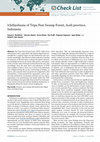
The Tripa Peat Swamp Forest (TPSF) suffers from deforestation due to agriculture, this habitat de... more The Tripa Peat Swamp Forest (TPSF) suffers from deforestation due to agriculture, this habitat degradation potentially has a negative impact on fish biodiversity and community assemblages. The objective of this study was to develop an inventory of the fish fauna, evaluate the spatial variation in assemblage structure, document alien species, and quantify the economic value of fish species found from the area. Fish assemblages from the main rivers and tributaries of TPSF were sampled on May to June 2013. A total of 764 individuals were sampled during the survey, constituting 34 families, 47 genera, and 73 species where 46 species are categorized as fish consumption, 17 have potential for aquaculture, and 10 species have potential for ornamental, and three are non native. Cyprinidae is the predominant fish family within the TPSF. Fish assemblages were generally characterized by small population size for each species and low similarity among sites, reflecting the distinctive nature of ...
International Journal of Disaster Risk Reduction, 2018
This paper presents a field study on the long-term effectiveness and sustainability of livelihood... more This paper presents a field study on the long-term effectiveness and sustainability of livelihood interventions following the 2004 Indian Ocean tsunami in Aceh, Indonesia. We assess the extent to which post-tsunami aid in Aceh helped beneficiaries to stabilize and restore their pre-disaster livelihoods, and/or develop new livelihoods. We draw upon qualitative data captured in 183 in-depth interviews and 38 focus group discussions involving village leaders, livelihood aid participants, and NGO workers. Our results show that livelihood assistance helped people stabilize their household finances and partially restore their pre-disaster livelihoods. Furthermore, we found that aid programs were able to help some people without pre-disaster livelihood experience to participate in part-time, ad hoc work. However, aid packages were generally not able to support the development of full-time, sustainable new livelihoods for people lacking pre-disaster training and experience. Our data suggests that it is difficult to conduct efficient and sustainable livelihood development initiatives within the time pressures and current institutional approaches to large-scale post-disaster reconstruction.
This paper presents GIS time-series land-use analysis of satellite images to quantify the recover... more This paper presents GIS time-series land-use analysis of satellite images to quantify the recovery of rice cultivation and aquaculture following the 2004 Indian Ocean tsunami in coastal communities in Aceh, Indonesia. We supplement this with qualitative data to illustrate the post-disaster challenges faced by residents, and the extent to which coastal communities have adapted to post-tsunami realities. Our analysis shows that the rehabilitation of rice cultivation and aquaculture in areas inundated by the tsunami has been limited by extensive degradation of land, diversion of labor by tsunami mortality and transition to alternative livelihoods, and re-purposing of rice fields for residential use during the reconstruction phase. This is especially prominent in areas where subsistence activities are not the primary source of livelihood. The Aceh case study shows that social, economic, and environmental factors can be stronger determinants of how coastal livelihoods rebound and change following destructive inundation events than livelihood rehabilitation aid. Additionally, our case study suggests the human impact of coastal hazards can be felt outside the physical extent of inundation.
Patterns of CO2 Flux in a Bared Tropical Peatland
Empirically perceived, carbon emission from peat land is dependent on water table 2012). Naturall... more Empirically perceived, carbon emission from peat land is dependent on water table 2012). Naturally, CO2 flux is resulted from complex dynamic processes involving organic decomposition and respiration by root and microorganism in which soil moisture, temperature and chemical content play important roles on governing the processes. This paper attempted to find relationships between CO2 flux with water content moisture, temperature and electrical conductivity by means of intensive measurements and numerical analysis.
Check List, 2015
The Tripa Peat Swamp Forest (TPSF) suffers from deforestation due to agriculture, this habitat de... more The Tripa Peat Swamp Forest (TPSF) suffers from deforestation due to agriculture, this habitat degradation potentially has a negative impact on fish biodiversity and community assemblages. The objective of this study was to develop an inventory of the fish fauna, evaluate the spatial variation in assemblage structure, document alien species, and quantify the economic value of fish species found from the area. Fish assemblages from the main rivers and tributaries of TPSF were sampled on May to June 2013. A total of 764 individuals were sampled during the survey, constituting 34 families, 47 genera, and 73 species where 46 species are categorized as fish consumption, 17 have potential for aquaculture, and 10 species have potential for ornamental, and three are non native. Cyprinidae is the predominant fish family within the TPSF. Fish assemblages were generally characterized by small population size for each species and low similarity among sites, reflecting the distinctive nature of each sampling site.
Bencana alam tsunami menjadi momentum untuk menerapkan Sistem Pembangunan Sektor Perikanan yang b... more Bencana alam tsunami menjadi momentum untuk menerapkan Sistem Pembangunan Sektor Perikanan yang berkelanjutan di Provinsi Aceh terutama untuk menjadikan Aceh lebih baik (build back better). Untuk mengawal proses implementasinya diperlukan MCS sehingga pembangunan Sektor Perikanan di Aceh dapat dilakukan sesuai dengan Code of Conduct Responsible Fisheries
The PIU report focus on the activities conducted by Project Implementation Unit (PIU) how to run ... more The PIU report focus on the activities conducted by Project Implementation Unit (PIU) how to run the program of Scientifict Studies for The Rehabilitation and Management of The Tripa Peat-Swamp Forest. The activities including preparation phase, initial survey, the real survey, reporting, and some exposes.
Hutan Pantai dan Mangrove tidak hanya memiliki nilai ekonomis (tangible benefit) bagi masyarakat ... more Hutan Pantai dan Mangrove tidak hanya memiliki nilai ekonomis (tangible benefit) bagi masyarakat lokal juga nilai konservasi dan pelindung pantai (intagible benefit). Keberadaannya di Pulau Aceh memegang peranan penting dalam mengurangi kuatnya energi gelombang tsunami. Selain itu ekosistem ini berperan dalam menunjang kelangsungan hidup dari organisme yang hidup pada habitat pesisir.
Sebagai Biokatalis mikro algae Porphyridium cruentum memiliki potensi untuk menyerap kandungan nu... more Sebagai Biokatalis mikro algae Porphyridium cruentum memiliki potensi untuk menyerap kandungan nutrien dalam limbah cair industri. Selain itu juga dapat menghasilkan biopigmen merah dan polisakarida yang bermanfaat sebagai bahan baku industri. Dengan menggunakan Bioreaktor yang dioperasikan secara Batch Culture dan Fed Batch Culture dapat diketahui tingkat Dilution Rate yang sesuai dan konsentrasi limbah yang digunakan. Valuasi ekonomi dilakukan untuk melihat bagaimana manfaat sistem ini bila diaplikasikan pada wilayah pesisir.
Disasters, Hazards & Reconstruction by Agus Halim


Uploads
Papers by Agus Halim
Disasters, Hazards & Reconstruction by Agus Halim