Outreach Activities by Alessia Berardi
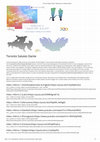
From an original idea of Elisa Brilli, George Ferzoco, and Nicholas Terpstra, and thanks to the invaluable work of Alice Martignoni and Nattapol Ruangsri (Research Assistants). Sponsored by the Department of Italian Studies, the Emilio Goggio Chair in Italian Studies at the University of Toronto, the Istituto Italiano di Cultura di Toronto, and Villa Charities.
With the participation of (alphabetical order):
A. Andrée (Professor, Centre for Medieval Studies, UofT) https://youtu.be/c7KNumdnWfU
M. Atwood (Writer and UofT Alumna) https://youtu.be/Dck_Medf07Q
S. Bancheri (Professor, Italian Studies, UofT) https://youtu.be/nFHIbUxs2JY
S. Bazzichetto (Uoft Alumnus) https://youtu.be/dCwIMv4DswQ
A. Berardi (Ph.D. Candidate, Centre for Medieval Studies, UofT) https://youtu.be/LESNnTr6eg4
E. Brilli (Professor, Italian Studies & Centre for Medieval Studies, UofT) https://youtu.be/abdojdHQBo4
A.L. Clarkson (Journalist and Stateswoman, and former Governor General of Canada) https://youtu.be/CmyAKJbUsto
B. Daigneault (Ph.D. Candidate, Centre for Medieval Studies, UofT) https://youtu.be/KJaGDS9iSTA
C. Dignard (Ph.D. Candidate, Spanish and Portuguese, UofT) https://youtu.be/1LxCv8mTCto
G. Dinkova-Bruun (Professor, Pontifical Institute) https://youtu.be/Hm4FvkFAAVc
K. Eisenbichler (Emeritus, UofT) https://youtu.be/8zKdgyaHnOk
E. Ferranti (Director Candidate Life, Massey College) https://youtu.be/tszX6lSRgfg
G. Ferzoco (Professor, University of Calgary) https://youtu.be/OGpWK_4wNg0
T. Fimognari (Undergraduate Candidate, UofT) https://youtu.be/cLcCaekbyP4
T. Fox (Ph.D. Candidate, University of Calgary & Translator and Reader in Stoney Nakoda) https://youtu.be/Dck_Medf07Q
P. Frascà (Professor, Italian Studies, UofT) https://youtu.be/p9ylx9xev_0
S. Galli (Ph.D. Candidate, Italian Studies, UofT) https://youtu.be/jQPPIWph_o8
A. Graheli (Professor, Historical Studies & Language Studies, UTM) https://youtu.be/Xi388PgrhiU
M. Jamali (Ph.D. Candidate, Italian Studies, UofT) https://youtu.be/GXG-3txDbdE
P. King (Professor, Philosophy & Centre for Medieval Studies, UofT) https://youtu.be/tOWRHgrwE14
A. Manguel (Writer) https://youtu.be/Dck_Medf07Q
A. Martignoni (Ph.D. Candidate, Italian Studies, UofT) https://youtu.be/oofMThkkxJk
A. Munteanu (Ph.D. Candidate, Linguistics, UofT) https://youtu.be/JnuzzEl95fc
M. Nunno (Translator & Reader in Anishinaabemowin) https://youtu.be/CmyAKJbUsto
W. Ohm (Ph.D. Candidate, German Studies, Uoft) https://youtu.be/zuErC-NMV98
G. Osmat (Ph.D. Candidate, Near & Middle Eastern Civilizations, UofT) https://youtu.be/IenVYWIksvA
E. Plesnik (Ph.D. Candidate, Centre for Medieval Studies, UofT) https://youtu.be/v_jAZJ7vHYw
N. Ruangsri (Ph.D. Candidate, Italian Studies, UofT), several videos
L. Sodano (Ph.D. Candidate, Italian Studies, UofT) https://youtu.be/-M5PvbjPd40
L. Somigli (Professor, Italian Studies, UofT) https://youtu.be/yonwxQsb4hc
R. Sophonpanich (Professor, Thammasat University, Translator & Reader in Thai) https://youtu.be/98QdvI2p02o
M. Stock (Professor, German Studies & Centre for Medieval Studies, UofT) https://youtu.be/8-3Y3xXEd7A
V. Tapia Cruz (Ph.D. Candidate, Spanish and Portuguese, Uoft) https://youtu.be/TSdN_DcxNrM
K. Tarves (Ph.D. Candidate, Slavic Languages and Literatures, UofT) https://youtu.be/Zr-5z6Uftw4
L. Tesi (Ph.D. Candidate, Italian Studies, UofT) https://youtu.be/t5okbQg3PDk
R. Xu (Ph.D. Candidate, Centre for Medieval Studies, UofT) https://youtu.be/AiPwjNFeJzU
A. Zambenedetti (Professor, Italian Studies, UofT) https://youtu.be/bJs4LrvvuO0
T. Zajac (UofT Alumna & Leverhulme Early Career Fellow, University of Manchester)
https://youtu.be/Os6j37jIrmQ
Articles by Alessia Berardi
Scriptorium, 2020
Le Glose super Glosas Ysaie (XIIe s.) ont été attribuées à Stephen Langton. Cependant, ce texte diffère substantiellement de l'autre commentaire de Langton sur Isaïe, généralement connu sous le nom de Moralitas. Par ailleurs, l'approche exégétique des Glose super Glosas, l'utilisation de la Glossa Ordinaria et l'attention portée à la lettre du texte sont très similaires à la méthode utilisée par Pierre Comestor dans son commentaire sur les évangiles de Jean et de Matthieu. De plus, l'étude du manuscrit Cambridge, Trinity College, B.2.15, ayant appartenu à Robert Amiclas - élève de Peter Comestor au milieu du XIIe siècle à Paris - révèle que ce manuscrit contient des extraits des Glose super Glosas Ysaie écrit par Amiclas lui-même. Grâce à ces éléments et à d'autres, il est possible de remettre en question l'origine des Glose super Glosas Ysaie, et d'éventuellement réattribuer ce texte à Pierre Comestor: les Glose super Glosas serait alors le premier exemple d'un commentaire de l'Ancien Testament écrit par Comestor, à l'exception de l'Historia Scholastica. L'étude préliminaire de la tradition de la Moralitas et des Glose super Glosas Ysaie, et la réattribution de ce dernière texte constitue une étape fondamentale vers une nouvelle compréhension des écoles du XIIe siècle.
Translations by Alessia Berardi
Egyptian Nuns in Late Antiquity as Exemplars
The Cambridge History of Monasticism in the West, 2020
Talks by Alessia Berardi
“The Latin Life of Saint Alexis: a Puzzling Heroism.” Holy Hero(in)es. Literary Constructions of Heroism in Late Antique and Early Medieval Hagiography. International Conference. Ghent University (16-18 February 2016).
“The Materia Super Liber Sententiarum: Peter Comestor and the Authority of his Master.” 2nd Toronto-Washington Colloquium for the Study of the Bible and Theology in the Middle Ages, University of Toronto (16-17 June 2016).
“Theologia as a Work in Progress: Three Twelfth-Century Notulae on the Gospel of Mark.” Annual Meeting of the Medieval Academy of America, University of Toronto (6-8 April 2017).
“Irish Provenance or Carolingian Origin? The case-study of the anonymous commentary on the Song of Songs of Orléans-Wolfenbüttel.” Medialatinitas, International Medieval Latin Congress, University of Vienna (17-22 September 2017).
“Stephen Langton’s Lectures on Isaiah.” 3rd Toronto-Washington Colloquium for the Study of the Bible and Theology in the Middle Ages, Catholic University of America, Washington, D.C. (21-22 May 2018).
“Langton’s biblical commentaries and the formation of preachers.” Lecture for the SSHRC Insight Grant group “Practices of Commentary”, University of Toronto (April 28 2023).
“Stephen Langton, Educator of Preachers.” 58th International Congress on Medieval Studies, Western Michigan University (May 11th-13th 2023).