Papers by Alex van de Ven
Research paper thumbnail of Time as Illusion: Near-Death Experiences, Relativity Theory, and Quantum Physics in the Light of Cosmic Consciousness

Time as Illusion: Near-Death Experiences, Relativity Theory, and Quantum Physics in the Light of Cosmic Consciousness, 2026

This interdisciplinary essay explores the nature of time as an illusion through the integration o... more This interdisciplinary essay explores the nature of time as an illusion through the integration of near-death experiences (NDEs), relativity theory, quantum physics, and cosmic consciousness. Drawing on empirical studies of NDEs—where individuals report simultaneous perception of past, present, and future—the essay examines how these subjective experiences align with Einstein’s block universe (where time is a relative dimension) and quantum theories of emergent time (where time arises from deeper, timeless processes). The philosophical framework of cosmic consciousness, as articulated by Bucke, Goff, and Kastrup, further suggests that time is a projection of consciousness, challenging classical linear conceptions.
The analysis synthesises these domains into a unified model where time is non-linear, dynamic, and consciousness-dependent, with implications for physics, neuroscience, and spirituality. The essay concludes by proposing future research directions, including empirical studies on veridical perceptions during NDEs and theoretical developments in unified models of time and consciousness.
Keywords: Time perception, near-death experiences (NDEs), relativity theory, quantum physics, cosmic consciousness, non-locality, panpsychism.
Research paper thumbnail of Was Jezus a Gnostic? A Comparative Analysis of the Gnostic Jesus, Hermetic Gnosticism, and Zoroastrianism

Was Jesus a Gnostic?, 2026

This study explores the radically alternative portrayal of Jesus in the Nag Hammadi texts (2nd–4t... more This study explores the radically alternative portrayal of Jesus in the Nag Hammadi texts (2nd–4th century CE), which present him not as the Messiah of orthodox Christianity but as a teacher of gnosis—a mystical, inner knowledge liberating humanity from the illusions of the material world. Through a critical analysis of primary Gnostic sources (e.g., the Gospel of Thomas and Secret Book of John), this essay examines three core questions:

The Gnostic Jesus: How does this portrayal diverge from canonical Gospels, and what are its theological implications regarding the role of gnosis, the Demiurge, and divine-human relations?
Historical Authenticity: Are these texts rooted in early traditions, or are they later constructions by Gnostic communities? Scholars like Elaine Pagels and Bart Ehrman argue for their theological rather than historical nature, while Helmut Koester suggests possible 1st-century origins for some texts.
Comparative Perspective: How does the Gnostic Jesus align with Hermetic Gnosticism (e.g., Corpus Hermeticum) and Zoroastrianism (e.g., Yasna)? All three traditions emphasize dualism (spirit/matter) and inner liberation, yet differ in their views on the material world’s nature and the soul’s role.
The essay concludes that the Gnostic Jesus represents a legitimate but marginalized spiritual tradition, offering modern seekers an integrative path to enlightenment—one centered on self-knowledge and direct divine experience, rather than institutional authority. Suggestions for further research include comparisons with Buddhism/Taoism and archaeological explorations of early Gnostic communities.
Research paper thumbnail of The Monad: A Philosophical and Theological Exploration of the Hidden God in Zoroastrianism, Gnosticism, Neoplatonism, and Early Christianity

The Monad: A Philosophical and Theological Exploration of the Hidden God in Zoroastrianism, Gnosticism, Neoplatonism, and Early Christianity, 2026

This paper explores the concept of the monad in the philosophical tradition, with a particular fo... more This paper explores the concept of the monad in the philosophical tradition, with a particular focus on Baruch Spinoza’s metaphysics and its implications for understanding unity, substance, and divine expression. Drawing on Spinoza’s Ethics and related texts, the analysis examines how the monad—often interpreted as an indivisible, self-contained unit of reality—serves as a foundational principle for his monistic system, wherein God (or Nature) is conceived as the single, infinite substance from which all things emanate.
The discussion begins by situating the monad within Spinoza’s rejection of Cartesian dualism, emphasizing instead the unity of mind and body as modes of the same divine substance. It then explores how this monistic framework challenges traditional notions of individuality and agency, proposing that true freedom arises not from autonomy but from understanding one’s place within the necessary order of Nature. This perspective aligns with Spinoza’s ethical project, where knowledge of God (or Nature) becomes the path to liberation from passive affects and external determinants.
Furthermore, the paper considers the juridical and spiritual dimensions of Spinoza’s monadology. Juridically, the monad’s unity raises questions about responsibility and justice in a deterministic universe, where human actions are necessarily determined by the infinite chain of causes. Spiritually, the monad invites a reinterpretation of divine immanence, suggesting that the sacred is not transcendent but immanent in the fabric of reality itself. This resonates with early Christian texts that emphasize divine presence in the world, offering a bridge between Spinoza’s philosophy and mystical traditions that seek unity with the divine.
Finally, the paper reflects on the contemporary relevance of Spinoza’s monadology, particularly in addressing modern crises of fragmentation and alienation. By reaffirming the interconnectedness of all existence, the monad offers a philosophical and spiritual antidote to the atomization of modern life, urging a return to holistic understanding and ethical living in harmony with the natural order.

Concepts in Spirituality: Developing Complex Notions, 2025
The concepts of spirit (pneuma/spiritus), reason/intellect (nous/logos), soul (psyche/anima), ego... more The concepts of spirit (pneuma/spiritus), reason/intellect (nous/logos), soul (psyche/anima), ego, microcosm, and astral bodies constitute the framework of a profound yet often enigmatic tradition of spiritual and philosophical reflection. These terms emerge in diverse contexts—from the Hermetic texts of Hellenistic Egypt and the Gnostic scriptures of the early Christian era to medievalmysticism and modern esotericism. While essential to the quest for self-knowledge and transcendence, their meanings shift radically across traditions, leading to interpretative challenges and conceptual ambiguity.

Research paper thumbnail of Baruch Spinoza A Critical Study of the Gospels

Baruch Spinoza’s Critical Study of the Gospels, 2025

This article examines Baruch Spinoza’s groundbreaking historical-critical approach to the Gospels... more This article examines Baruch Spinoza’s groundbreaking historical-critical approach to the Gospels in his Tractatus Theologico-Politicus (1670). Spinoza argued that the Gospels were not written by the traditional authors (Matthew, Mark, Luke, John) but by later, anonymous editors, and that the texts contained contradictions and anachronisms indicating a human, historical origin. His method, based on philological analysis, contextual research, and rejection of dogmatic presuppositions, represented a radical departure from medieval exegesis and laid the foundation for modern biblical scholarship, particularly German higher criticism (18th–19th century).
The article also analyzes the theological and political implications of Spinoza’s work. By treating the Bible as a human document, he undermined the authority of ecclesiastical institutions and advocated for freedom of thought and separation of church and state. These ideas profoundly influenced the Enlightenment and continue to be applied in contemporary biblical studies (for example, by Bart Ehrman and John Dominic Crossan). Finally, the reception of Spinoza’s work is discussed, including his excommunication (cherem), accusations of atheism, and later recognition as a pioneer of scientific biblical criticism.

The Rosicrucians as heirs to Hermetic-Gnostic thought, 2025

The Rosicrucian brotherhood emerged in Western Europe at the beginning of the 17th century. It a... more The Rosicrucian brotherhood  emerged in Western Europe at the beginning of the 17th century. It articulated an idealistic call for reformatio universalis: a comprehensive reform of knowledge, religion, morals and politics. This call for universal renewal stood in sharp contrast to the spiritual climate of the
Holy Roman Empire. In this field of tension, the Rosicrucians functioned as bearers of a hermeneutic project: the
restoration of the connection between man, nature and God through knowledge — not merely rational, but
gnostic-inner.

Abraham between history and myth, 2025

Abraham is an important figure in Christianity, Judaism and Islam. In this essay, I attempt to tr... more Abraham is an important figure in Christianity, Judaism and Islam. In this essay, I attempt to trace the origins of the myth and the significance of the personification of Abraham. Abraham appears to be a construct that has “nevertheless” come to lead an important life. He is an important link between Christianity, Judaism and Islam. Unfortunately, few people are aware of this.

Jezus as myth or historical figure, 2025
In this essay, I explore the different perspectives on the figure of Jesus of Nazareth: historica... more In this essay, I explore the different perspectives on the figure of Jesus of Nazareth: historical, philosophical and religious. How should I interpret the concept of Jesus? It does not provide definitive answers, but it does provide a greater understanding of the struggles that arise from asking questions. It is essential that we continue to ask questions in order to gain understanding.

Research paper thumbnail of Henoch: Then and Now

Henoch: Then and Now, 2025

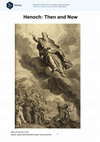
This essay explores the mythological and symbolic dimensions of Enoch as a paradigmatic figure of... more This essay explores the mythological and symbolic dimensions of Enoch as a paradigmatic figure of transformation, vision, and divine knowledge in early Jewish and later mystical traditions. Departing from the Book of Enoch and related apocryphal sources, it interprets Enoch’s ascent into the heavenly spheres as a process of metamorphosis, in which human perception expands into cosmic consciousness. The motif of Enoch’s 365 eyes is read both as a calendrical metaphor—reflecting the 365-day solar year known from the Egyptian tradition—and as an emblem of perfect vigilance and total insight into divine order.

By integrating textual, astronomical, and theological perspectives, the essay situates Enoch at the crossroads of ancient Jewish apocalyptic literature and broader Near Eastern cosmologies. It argues that the Enochic vision articulates an early synthesis of astronomy and theology, where the structure of time itself becomes a revelation of divine wisdom. Later esoteric interpretations, from kabbalistic to gnostic sources, are shown to amplify this cosmological symbolism, turning Enoch into the archetype of the “heavenly seer” who transcends human limitation through the contemplative vision of cosmic time.

Religion, philosophy and science: tension and interdependence through the centuries, 2025

Religion, philosophy and science have had a tense relationship with each other for centuries. In ... more Religion, philosophy and science have had a tense relationship with each other for centuries. In this essay, I will attempt to outline these relationships across different periods of time. Consider it part of my search for truth.

Religie, filosofie en wetenschap: spanning en wederzijdse afhankelijkheid door de eeuwen heen, 2025
Er is altijd spanning geweest tussen religie, filosofie en wetenschap. In dit essay probeer ik op... more Er is altijd spanning geweest tussen religie, filosofie en wetenschap. In dit essay probeer ik op systematische wijze de verhoudingen tussen de drie grootheden door de tijd heen te duiden.

Research paper thumbnail of My spiritual quest -an invitation

My spiritual quest -an invitation, 2025

**Abstract** *My Spiritual Quest – An Invitation* traces a personal and intellectual journey thro... more **Abstract**
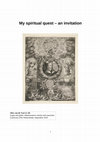
*My Spiritual Quest – An Invitation* traces a personal and intellectual journey through some of the world’s major religious and philosophical traditions—gnosticism, hermetism, Judaism, Christianity, Islam, and Buddhism—while engaging contemporary debates on mysticism, secularisation, and meaning.  Blending historical analysis with autobiographical reflection, the book explores recurring themes of transformative knowledge, the tension between mystical experience and institutional authority, and the enduring human search for truth and liberation.  Each chapter interweaves close readings of classical sources with insights from modern scholarship, showing how ancient practices of contemplation and myth-making continue to shape spiritual life in a secular age.  Rather than offering final answers, the work invites readers to embrace “epistemic humility”: the courage to live with open questions and to discover, within the plurality of traditions, their own path toward wisdom and ethical transformation.

Zeggenschap en Medezeggenschap op Rijks- en Departementaal niveau , 2017

Alex van de Ven (HvA 500738402) Begeleiding IenM mr. drs. Mieke Ziel drs. Hans Gardenier HvA dr.m... more Alex van de Ven (HvA 500738402) Begeleiding IenM mr. drs. Mieke Ziel drs. Hans Gardenier HvA dr.mr. Bregje Dijksterhuis mr. Robbert Land MBA Amsterdam/Den Haag, 22 juni 2017 V 2.0 Onderzoek Zeggenschap en Medezeggenschap op Rijks-en Departementaal niveau Deel I: Hoofdrapport