Papers by Alexander Nebrig
Jahrbuch der Deutschen Schillergesellschaft , 2025
There are numerous speech scenes in Goethe’s Wilhelm Meister’s Apprenticeship (1795/96) that have neither been examined in a coherent manner nor related to the novel’s theatre theme. Such a step would be obvious, since both arts, rhetoric and theatre, have their vanishing
point in the concept of the stage (skené), speakers must demonstrate acting skills, and at least classical theatre functions affectively. Closely linked to the protagonist’s turning away from the theatre are scenes in which Wilhelm’s often failing aspiration for public impact is expressed. He gives up this ambition as well as his theatre career and becomes a member of the secret Tower Society. Goethe conveys his critical attitude towards the stage through the speech scenes, or more precisely, through their failure, as they often show Wilhelm Meister failing his audience, achieving different goals than intended or only planning the speech but not carrying it out.
Hagestedt/Nebrig (Hg.): „Wer wird nicht einen Klopstock loben?“ J.B. Metzler, 2024
Ressource »Schriftträger« Materielle Praktiken der Literatur zwischen Verschwendung und Nachhaltigkeit, 2023
F. Jannidis (Hg.): Digitale Literaturwissenschaft. DFG-Symposion 2017, 2023
Central and Eastern European Literary Theory and the West. Ed. M. Mrugalski, Sch. Schahadat, I. Wutsdorff, 2022
Cahiers du Centre de traduction littéraire de Lausanne 58 (2018), 53–76., 2018
Deutsche Vierteljahrsschrift für Literaturwissenschaft und Geistesgeschichte, 2020
Das Wissen der Poesie, 2000
A CIP catalog record for this book has been applied for at the Library of Congress.
Thesis Chapters by Alexander Nebrig
With the onset of modernity, the study of poetry emerged as a legitimate academic discipline. Conversely, authors became connected to a specialized discipline that organized and expanded knowledge about German literature. For the first time, the studies in this volume systematically discuss this connection using the philological practice and poetology of expressionist authors and the works of Holz, Mann, Stadler, Broch, Schaeffer, and Borchardt.
With the onset of modernity, the study of poetry emerged as a legitimate academic discipline. Conversely, authors became connected to a specialized discipline that organized and expanded knowledge about German literature. For the first time, the studies in this volume systematically discuss this connection using the philological practice and poetology of expressionist authors and the works of Holz, Mann, Stadler, Broch, Schaeffer, and Borchardt.
Books by Alexander Nebrig
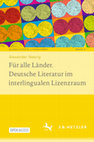
Für alle Länder. Deutsche Literatur im interlingualen Lizenzraum, 2025
Following the historical analysis that focused on the actors and the institutions of book culture, the book discusses writing strategies in the global licensing realm, as well as revealing the form, character, and structure of multilateral literature. Globalized texts address audiences of different languages and cultures. Using German literature from the 19th century to the present, six literary techniques that engage transnational audiences are analyzed: the internationalization of textual reference, the pluralization and decentering of space, the staging of mediation, the effects of multilingualism, transnational issues, and the global Novel.