Books by Beatrice Dema
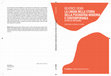
Mimesis, 2022
Tra le discipline che hanno dialogato con la psichiatria nel corso della storia, la psicopatologi... more Tra le discipline che hanno dialogato con la psichiatria nel corso della storia, la psicopatologia del linguaggio è quella ad aver ricoperto uno dei ruoli più cruciali e, allo stesso tempo, ad aver avuto meno fortuna. A distanza di oltre due secoli dai primi studi condotti in materia dai clinici di Montpellier e nonostante il corposo spazio dedicatole dai trattati psichiatrici tra il XIX e il XX secolo, l’analisi della lingua dei pazienti in ambito psichiatrico sembra infatti ancor oggi mancare di una solida legittimazione scientifica, anzitutto a causa dell’assenza di una tradizione conosciuta e condivisa che ne ricostruisca i fondamenti storico-teorici. È propriamente questa lacuna che intende contribuire a colmare il volume, il quale, grazie all’analisi dei testi (trattati, saggi, manuali, articoli, tesi) che, da Pinel fino agli anni Duemila, hanno inteso studiare la lingua della malattia mentale, si presenta come il primo contributo organico sulla storia delle teorie linguistiche in psichiatria.
Articles by Beatrice Dema
Distribuzione Messaggerie Libri SPA Sede legale: via G. Verdi 8 -20090 Assago (MI) Promozione PDE... more Distribuzione Messaggerie Libri SPA Sede legale: via G. Verdi 8 -20090 Assago (MI) Promozione PDE PROMOZIONE SRL via Zago 2/2 -40128 Bologna ISBN 978-884675864-4 www.edizioniets.com In copertina: Rielaborazione tratta dall'opera di Alberto Sughi, Andare dove? L'uomo con le valigie, 1992 COMUNICAZIONI Beatrice Dema (Università Di torino) IL DISPATRIO METAFORICO E LA GIOVANE POESIA DEGLI ANNI SETTANTA
Book Chapters by Beatrice Dema
Conference Presentations by Beatrice Dema
Nata dal crollo ideologico-istituzionale seguito al ‘68, la giovane poesia degli anni Settanta ra... more Nata dal crollo ideologico-istituzionale seguito al ‘68, la giovane poesia degli anni Settanta rappresenta indiscutibilmente un caso emblematico di come il dispatrio metaforico possa ergersi a criterio d’analisi fondamentale di un periodo, come quello post-68, ancor oggi al centro del dibattito critico. Attraverso l’approfondimento dei fenomeni chiave di questa «nuova poesia», l’intervento intende dunque dimostrare la centralità del dispatrio metaforico tra le categorie interpretative della storia letteraria italiana.
It is well known that one of the most evident aftermaths of 1968's movements was the collapse of ... more It is well known that one of the most evident aftermaths of 1968's movements was the collapse of the socio-cultural and political paradigms built in the first part of XX century. In this paper we will try to demonstrate how this collapse has deeply influenced the Italian young poetry during the Seventies, suggesting a new interpretation of this decade's literature.
It is well known that one of the main symptoms of schizophrenia is the loss of self-boundaries pe... more It is well known that one of the main symptoms of schizophrenia is the loss of self-boundaries perception. With regard to this symptom, thought disorders -especially the uncontrolled acceleration of the flow of thought, often revealed by a linguistic irrepressible force -and temporal-space alteration are strictly linked, being both causes and effects of the phenomenon. The aim of this paper is to provide an initial overview of metric mechanisms that a schizophrenic subject engages against the self's loss, in order to define and quantify her thoughts and, ultimately, herself. In creating these compensatory structures, the schizophrenic subject relies particularly on rhythmic constancies, achieved through body language -i.e. clapping or repeating movements (such as the continuing sway of the head) -or linguistic strategies. In prose writing, for example, she uses strategies such as the repetition of certain key-words and formulas or particular punctuation marks that function as the text's hinges of discourse's organization. In poetry writing, she chooses metric space as a closed container, the measure of the line as a boundary as well as metric and prosodic elements (rhyme, assonance, consonance, etc.) that guide the flow of ideas with their repetitive rhythm. Therefore, if it is true that calculation and quantification techniques are essential for an individual to improve health and well-being (as Metric Culture Conference claims) in schizophrenic subjects these metric tools are fundamental for the self's individuation -the first step toward new therapeutic perspectives.
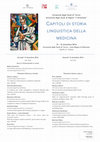
La medicina per cavalli: stratigrafia e variazione lessicale nella tradizione romanza del Liber m... more La medicina per cavalli: stratigrafia e variazione lessicale nella tradizione romanza del Liber marescalcie di Giordano Ruffo (secc. XIII-XV) EMANUELE VENTURA Università per Stranieri di Siena I volgarizzamenti tre-quattrocenteschi della Chirurgia di Bruno da Longobucco: lessico e strategie di traduzione GIUSEPPE ZARRA Università degli Studi di Roma "La Sapienza" La fortuna lessicografica del Thesaurus pauperum in volgare ELENA ARTALE -ILARIA ZAMUNER CNR, Opera del Vocabolario Italiano -OVI, Istituto Opera del Vocabolario Italiano Ricerche sul lessico medico-scientifico: gli strumenti chirurgici (secc. XIII-XIV) ROSA PIRO Università degli Studi di Napoli "L'Orientale" La lingua dell'anatomia dal Medioevo a Leonardo da Vinci Venerdì 16 dicembre 2016 Ore 9:30 PRESIDENTE SERGIO LUBELLO RITA LIBRANDI Università degli Studi di Napoli "L'Orientale" Gli operatori di definizione nella prosa scientifica in volgare (secc. XIII-XIV) ROSSELLA MOSTI OVI, Istituto Opera del Vocabolario Italiano Per una versione tardomedievale della Trotula FRANCESCO CRIFÒ Universitat des Saarlandes Note sul volgarizzamento veneziano della Chirurgia parva di Lanfranco da Milano (Class. 139)
Talks by Beatrice Dema
It is well known that one of the main symptoms of schizophrenia is the loss of self-boundaries pe... more It is well known that one of the main symptoms of schizophrenia is the loss of self-boundaries perception. With regard to this symptom, thought disorders – especially the uncontrolled acceleration of the flow of thought, often revealed by a linguistic irrepressible force – and temporal-space alteration are strictly linked, being both causes and effects of the phenomenon. The aim of this paper is to provide an initial overview of metric mechanisms that a schizophrenic subject engages against the self's loss, in order to define and quantify her thoughts and, ultimately, herself. In creating these compensatory structures, the schizophrenic subject relies particularly on rhythmic constancies, achieved through body language – i.e. clapping or repeating movements (such as the continuing sway of the head) – or linguistic strategies. In prose writing, for example, she uses strategies such as the repetition of certain keywords and formulas or particular punctuation marks that function as the text's hinges of discourse's organization. In poetry writing, she chooses metric space as a closed container, the measure of the line as a boundary as well as metric and prosodic elements (rhyme, assonance, consonance, etc.) that guide the flow of ideas with their repetitive rhythm. Therefore, if it is true that calculation and quantification techniques are essential for an individual to improve health and well-being (as Metric Culture Conference claims) in schizophrenic subjects these metric tools are fundamental for the self's individuation – the first step toward new therapeutic perspectives.
Latest Projects by Beatrice Dema
Exploring Language in Dementia and Alzheimer) is a linguistic research project focused on languag... more Exploring Language in Dementia and Alzheimer) is a linguistic research project focused on language in individuals with Alzheimer and dementia. The research is based on the linguistic analysis of spontaneous speech in patients with Alzheimer and dementia and conversation between patients and healthcare professionals/caregivers. The core aim of the project is to structure a new training program, based on linguistic data, in order to deepen the comprehension of language in patients with Alzheimer and dementia as well as to improve the interaction between patients and healthcare professionals/caregivers. AIMS: 1) To analyze the conversation between patients with Alzheimer/ dementia and healthcare professionals (patient care assistants, healthcare educators, nurses, psychologists, doctors)/caregivers, in order to identify and classify its main linguistic features; 2) Through a combined perspective, considering the language and of both patients and healthcare professionals/caregivers, to investigate and clarify some areas of ambiguity still affecting the clinical practice as well as the scientific discourse, with particular regard to: the very concept of conversation (which is mainly -if not exclusively -considered from the point of view of non-patients, when related to individuals with Alzheimer and dementia), in order to include the role and perspective of patients and thus expand its meaning and potential; the different functions of the communication between patients and healthcare professionals/caregivers.
Thesis by Beatrice Dema
Among the disciplines that have attempted to become part of the history of psychiatry, the psycho... more Among the disciplines that have attempted to become part of the history of psychiatry, the psychopathology of language is a special case. Even two centuries after the efforts of the first psycho-pathologists in Montpellier, consideration of the analysis of the patient's linguistic capacity
Il lavoro presentato intende essere la naturale prosecuzione della tesi triennale, nella quale er... more Il lavoro presentato intende essere la naturale prosecuzione della tesi triennale, nella quale era stato individuato un percorso teorico-linguistico sulla considerazione della lingua in ambito psichiatrico, che a partire da Jules Séglas, celebre psichiatra di fine Ottocento, il quale pubblicò un'opera monografica sul linguaggio dei malati psichiatrici, è giunto fino a Sergio Piro, grande psichiatria italiano che negli anni