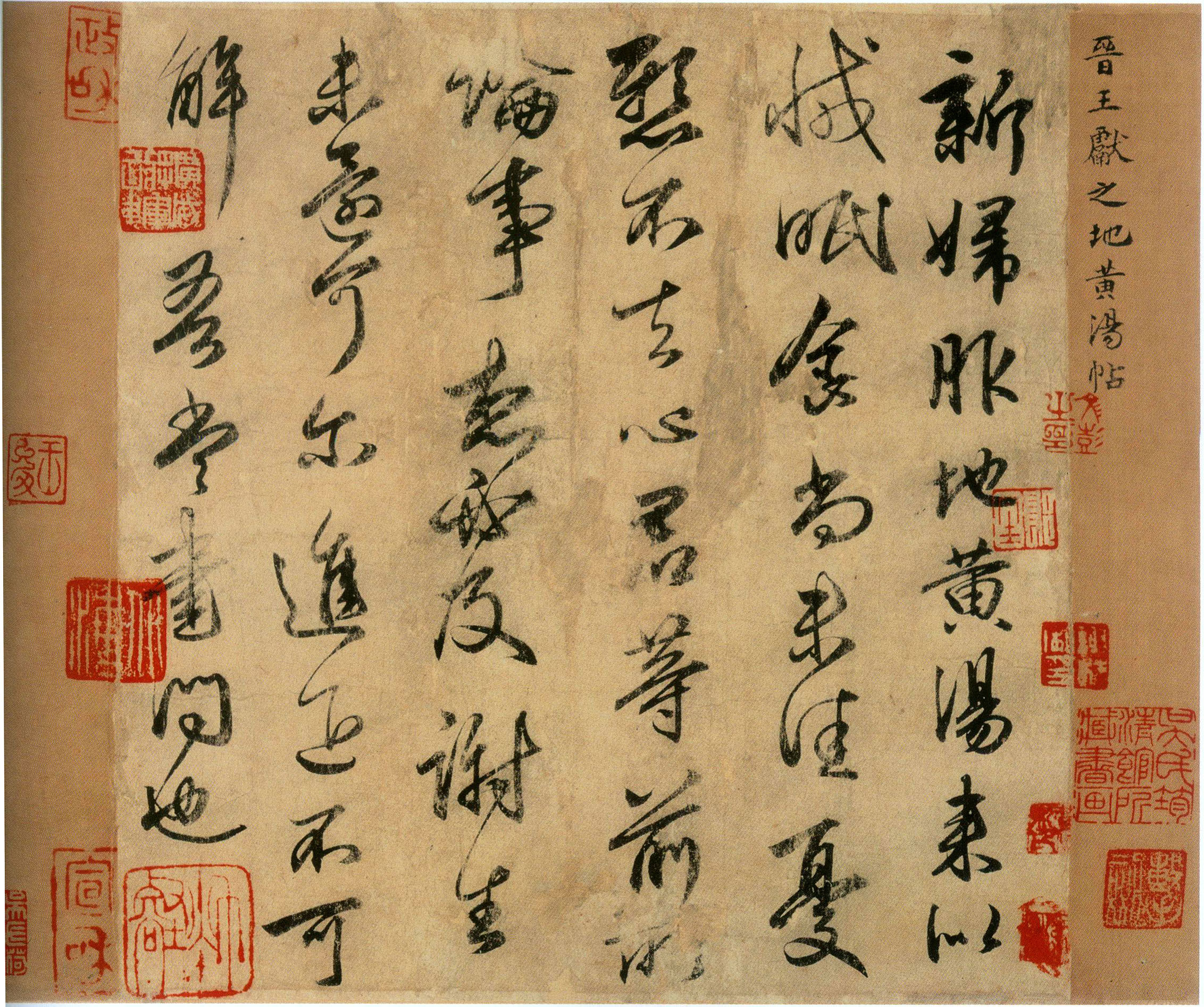
Chinese Calligraphy
Synopsis
Chinese calligraphy is the traditional art of writing Chinese characters with brush and ink, inscribed by UNESCO as Intangible Cultural Heritage in 2009.
Overview
Chinese calligraphy (书法, shūfǎ) is the traditional visual art of writing Chinese characters, primarily using a brush and ink. It has been described as "poetry without words, dance without form, painting without pictures, music without sound." Calligraphy is not merely a writing technique but one of the most esteemed art forms in Chinese culture, standing alongside painting and poetry as core elements of traditional Chinese literati cultivation.
In 2009, Chinese calligraphy was inscribed on UNESCO's Representative List of the Intangible Cultural Heritage of Humanity, cementing its status as a globally recognized cultural treasure. Today, calligraphy continues to be widely practiced across the East Asian cultural sphere — China, Japan, Korea, and Vietnam — as a vital carrier of Eastern aesthetic philosophy.
Historical Development
The history of Chinese calligraphy is inextricably linked to the evolution of Chinese characters. Over three millennia, calligraphy has evolved through five major script styles:
Oracle Bone Script (c. 1600–1046 BC, Shang Dynasty): The earliest known form of Chinese writing, inscribed on turtle plastrons and animal bones for divination purposes. First discovered in 1899 at the Yinxu site near Anyang, Henan Province. The characters feature sharp, angular lines with a natural, primitive beauty.
Bronze Script (c. 1600–256 BC, Shang-Zhou Dynasties): Inscriptions cast onto ritual bronze vessels (ding, gui, and others), also known as "zhongding wen." Compared to oracle bone script, bronze script features rounder, fuller strokes and more structured compositions. Notable examples include the inscriptions on the Mao Gong Ding and Da Yu Ding.
Seal Script (8th–3rd century BC, Spring and Autumn Period through Qin Dynasty): Divided into Large Seal Script and Small Seal Script. After unifying China, Qin Shi Huang standardized Small Seal Script as the official national writing system, overseen by Prime Minister Li Si. Seal script is characterized by uniform stroke thickness and symmetrical, elegant structures. The Mount Tai Stone Inscriptions remain the classic model for Small Seal Script.
Clerical Script (3rd century BC–3rd century AD, Qin to Eastern Han): Evolved from seal script, transforming rounded strokes into square, angular ones for faster writing. The transition from seal to clerical script, known as "libian," marked the critical turning point from ancient to modern Chinese characters. The Cao Quan Stele and Yi Ying Stele from the Eastern Han represent the pinnacle of clerical script.
Regular Script (3rd century AD–present, maturing in the Tang Dynasty): Also known as "zhengshu" or "zhenshu," this is the standard script still in use today. Regular script features upright, well-proportioned strokes and rigorous structure. The Tang Dynasty (618–907) was the golden age of regular script, producing masters such as Ouyang Xun, Yan Zhenqing, and Liu Gongquan, whose works remain definitive learning models.
Semi-Cursive Script (3rd century AD–present): A flowing script that falls between regular script and cursive script — elegant and expressive while maintaining legibility. Wang Xizhi's Lantingji Xu (Preface to the Poems Collected from the Orchid Pavilion, 353 AD), known as the "First Semi-Cursive Script under Heaven," is the supreme exemplar.
Cursive Script (2nd century BC–present): Characterized by extreme simplification and continuous strokes, prioritizing speed and expressive power. Divided into zhangcao, jincao, and kuangcao (wild cursive), the Tang Dynasty masters Zhang Xu and Huaisu are the most celebrated practitioners of wild cursive, producing works of breathtaking energy and abandon.
The Four Treasures of the Study
Calligraphy creation requires the "Four Treasures of the Study" (文房四宝):
Brush (毛笔, máobǐ): Made from animal hair (goat, wolf/weasel, or a combination). Different materials produce distinct effects — goat hair brushes are soft and ideal for cursive script; wolf hair brushes are firm and well-suited for regular script.
Ink (墨, mò): Traditional ink sticks are made from pine soot or oil soot mixed with animal glue, ground on an inkstone with water. Fine ink produces a deep, glossy black with rich tonal variations. Modern liquid ink is also widely available.
Paper (宣纸, xuānzhǐ): Xuan paper from Jing County, Anhui Province, is the premier calligraphy paper. It has excellent ink absorption, allowing full expression of brushstroke variations in thickness and moisture. Raw xuan paper (shengxuan) absorbs ink quickly, ideal for expressive styles; sized xuan paper (shuxuan) absorbs more slowly, suited for precise work.
Inkstone (砚, yàn): A stone vessel used to grind ink sticks. China's Four Famous Inkstones are the Duan Inkstone (Zhaoqing, Guangdong), She Inkstone (Shexian, Anhui), Tao Inkstone (Taozhou, Gansu), and Chengni Inkstone (Shanxi).
Masters & Masterpieces
Wang Xizhi (303–361 AD): Eastern Jin Dynasty calligrapher, revered as the "Sage of Calligraphy" (书圣). His Lantingji Xu (353 AD) is celebrated as the greatest work of semi-cursive script in Chinese history. The original is lost; Tang Dynasty copies survive.
Yan Zhenqing (709–785): Tang Dynasty master whose "Yan style" (颜体) of regular script is known for its bold, powerful strokes. His Ji Zhi Gao (Draft of a Requiem to My Nephew) is called the "Second Semi-Cursive Script under Heaven."
Su Shi (1037–1101): Northern Song Dynasty literatus and calligrapher who developed a distinctive personal style. Together with Huang Tingjian, Mi Fu, and Cai Xiang, he forms the "Four Masters of Song." His Huangzhou Hanshi Tie is ranked as the "Third Semi-Cursive Script under Heaven."
Zhao Mengfu (1254–1322): Yuan Dynasty calligrapher who excelled in all scripts, particularly regular and semi-cursive. His elegant, rounded style exerted enormous influence on subsequent generations.
Cultural Significance
In traditional Chinese culture, calligraphy is one of the "Four Arts of the Chinese Scholar" (琴棋书画 — music, chess/Go, calligraphy, and painting), an essential discipline for self-cultivation. Calligraphy is not merely a display of technical skill; it is understood as an externalization of the writer's character, emotions, and learning. As the ancient saying goes, "the handwriting reflects the person" (字如其人).
Calligraphy profoundly influenced the broader East Asian cultural sphere. Japan's shodō (書道), Korea's seoye (서예/書藝), and Vietnam's thư pháp (書法) all derive from Chinese calligraphic traditions while developing distinctive national styles.
Today, calligraphy remains embedded in education across East Asia. In mainland China, calligraphy has been incorporated into primary and secondary school curricula. In Japan and Korea, it continues to be an important component of school education. Calligraphy is not merely a cultural relic — it is a living practice, a way of life, and a discipline of spiritual cultivation.
References
- Wikipedia - Chinese calligraphy
- UNESCO - Chinese Calligraphy (Intangible Cultural Heritage, 2009)
- Baidu Baike - 书法
- Stanley-Baker - Chinese Calligraphy: The Art of Lines
- China Calligraphy Network
Stills & Gallery
Comments (0)