Olivia Northcutt-Wyly has always loved the pool. Once a competitive swimmer, she saw the pool as both a passion and a safe haven. Swimming structured her days, shaped her identity and fueled her ambitions. She trained relentlessly, often multiple times a day — even leaving school midday to practice — competing in high-level meets around her home state of Texas and the country.
All of that changed when, at 16, doctors diagnosed Northcutt-Wyly with Ehlers-Danlos syndrome, a group of inherited disorders that affect connective tissues. In her case, the disorders were accompanied by additional medical conditions, including recurring spinal canal cysts and a heart condition that caused fainting. Together, these conditions eroded her physical stability, leading to chronic pain, repeated dislocations and ultimately the need for a wheelchair.

“Going from swimming three times a day, five, six, seven days a week, to just being in bed from a surgery or recuperating, it really takes a mental toll on someone,” said Northcutt-Wyly, a who graduated in 2024 with a degree in health and human sciences from the USC Dornsife College of Letters, Arts and Sciences. “I definitely kind of lost who I was.”
Though devastating, the diagnosis sparked a new passion for debate and disability rights advocacy, which she continued to hone at USC. Currently a graduate student in public health at the Keck School of Medicine of USC, her Trojan journey eventually led her to the Swim with Mike Foundation, an organization that raises scholarship money for disabled athletes.
On Saturday, the foundation will host its 45th annual Swim with Mike event at USC, featuring multiple aquatic workouts and races, a wheelchair basketball tournament and a diving show, all at the USC Uytengsu Aquatics Center on the University Park Campus.
For Northcutt-Wyly, Swim with Mike and USC are where she found new outlets for her competitiveness in adaptive sports, and where she reunited with her first love of swimming.
“Disability, especially wheelchair use, feels very isolating,” Northcutt-Wyly said.
“I think Swim with Mike does an excellent job bringing people together.”
Diagnosis and path to USC for Swim with Mike beneficiary
To say that the diagnosis blindsided Northcutt-Wyly would be an understatement. Her symptoms began with a loss of sensation in her limbs during swim practice, which she initially brushed off as an overuse injury. Soon more serious issues followed, such as repeated joint dislocations that spread from her shoulders to her knees, hips and ankles, along with severe injuries like a torn rotator cuff. She also had unexplained complications during surgery, including a dangerous reaction to anesthesia.
“When you’re in a chair, your goal isn’t even to get back to the pool — it’s how can I go to school at this point,” she said.
When her illness forced her out of competitive swimming, Northcutt-Wyly pivoted to debate as both an outlet and an opportunity. What began as a way to stay engaged in high school evolved into a purpose, especially as she started focusing on disability access and health care policy. Debate gave her a new sense of direction and purpose, eventually earning her a full scholarship to USC.
“People are always like, ‘Oh, it’s so cool you chose this path,’ and I didn’t really have a choice,” Northcutt-Wyly said. “I knew I had to go to school, and when there’s not infrastructure there, you have to create it.”
Swim with Mike and adaptive sports
Contrary to its name, the origins of the first Swim with Mike event started far from a pool. On Jan. 2, 1981, a dirt-biking accident paralyzed Mike Nyeholt, a USC All-American and three-time NCAA champion swimmer. Friends and teammates organized a fundraiser to purchase a specialized van so Nyeholt could continue his education at USC. The event — named “Swim for Mike” at the time — was a swim-a-thon that featured USC swimmers, volunteers and donors doing laps around a pool on campus. Organizers raised $58,000, and Nyeholt decided to pay it forward and keep the event going for other disabled athletes.
Since that first fundraiser, the event has featured Olympians, celebrities and even former U.S. President Ronald Reagan. Over more than 40 years of events, the Swim with Mike Foundation has raised more than $25 million and awarded over 300 scholarships to recipients at more than 150 universities across the country.
“I think that Swim with Mike really centering around academic achievement is something that’s pretty unique and something that we need more of,” Northcutt-Wyly said.
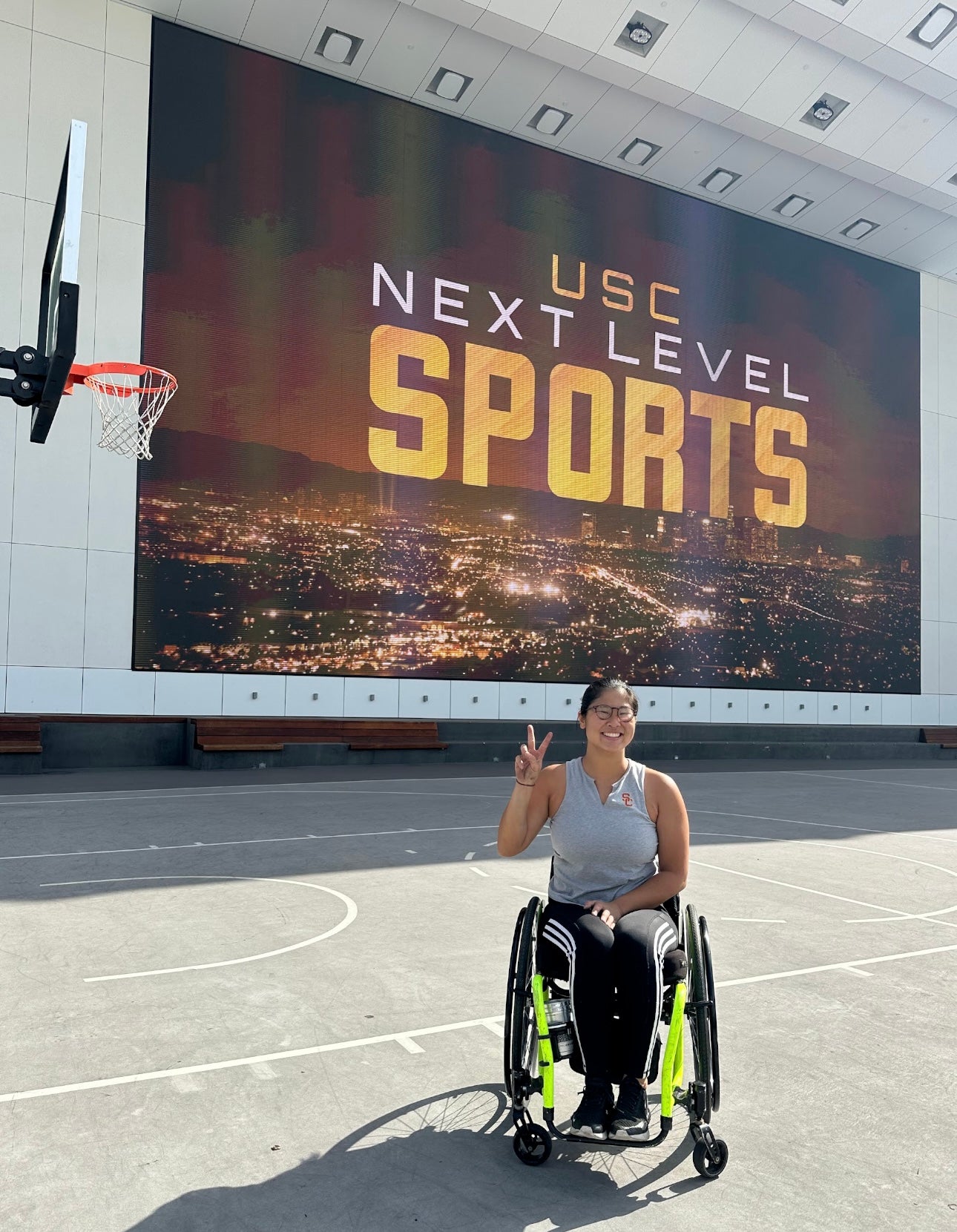
Through connections she built at USC, including adaptive sports organizations like Angel City Sports and the supportive visibility of Swim with Mike, she was introduced to wheelchair basketball and the wider world of adaptive athletics.
Coaching, mentoring and giving back
Amid all Northcutt-Wyly has overcome in her life, she is most proud of her ability to take her experiences and give back to the younger generation of adaptive sports athletes. Coaching and mentoring younger athletes has helped her take personal struggle and turn it into collective impact. By working with younger athletes with disabilities, she helps create the kind of community and opportunity she once lacked — showing them not just that adaptive sports exist, but that they can compete and create community within them.
“For them to have that sense of community and sense of pride going through school, knowing and believing in their innate ability to do things, whether that’s sports or school or whatever, I find that super important,” she said.
Beyond athletics, her advocacy stems from lived experience, pushing for accessibility, health care equity and greater awareness in academic and public spaces. For Northcutt-Wyly, these roles are not separate from her identity — they are extensions of it, allowing her to turn isolation into connection and barriers into pathways for others.
“I think sports, and team sports especially, are so important, not just for physicality, but for mental and emotional development,” Northcutt-Wyly said. “One of the coolest things is seeing athletes realize that there is something more, that they can be in a chair and not only play sports, but be athletes.”