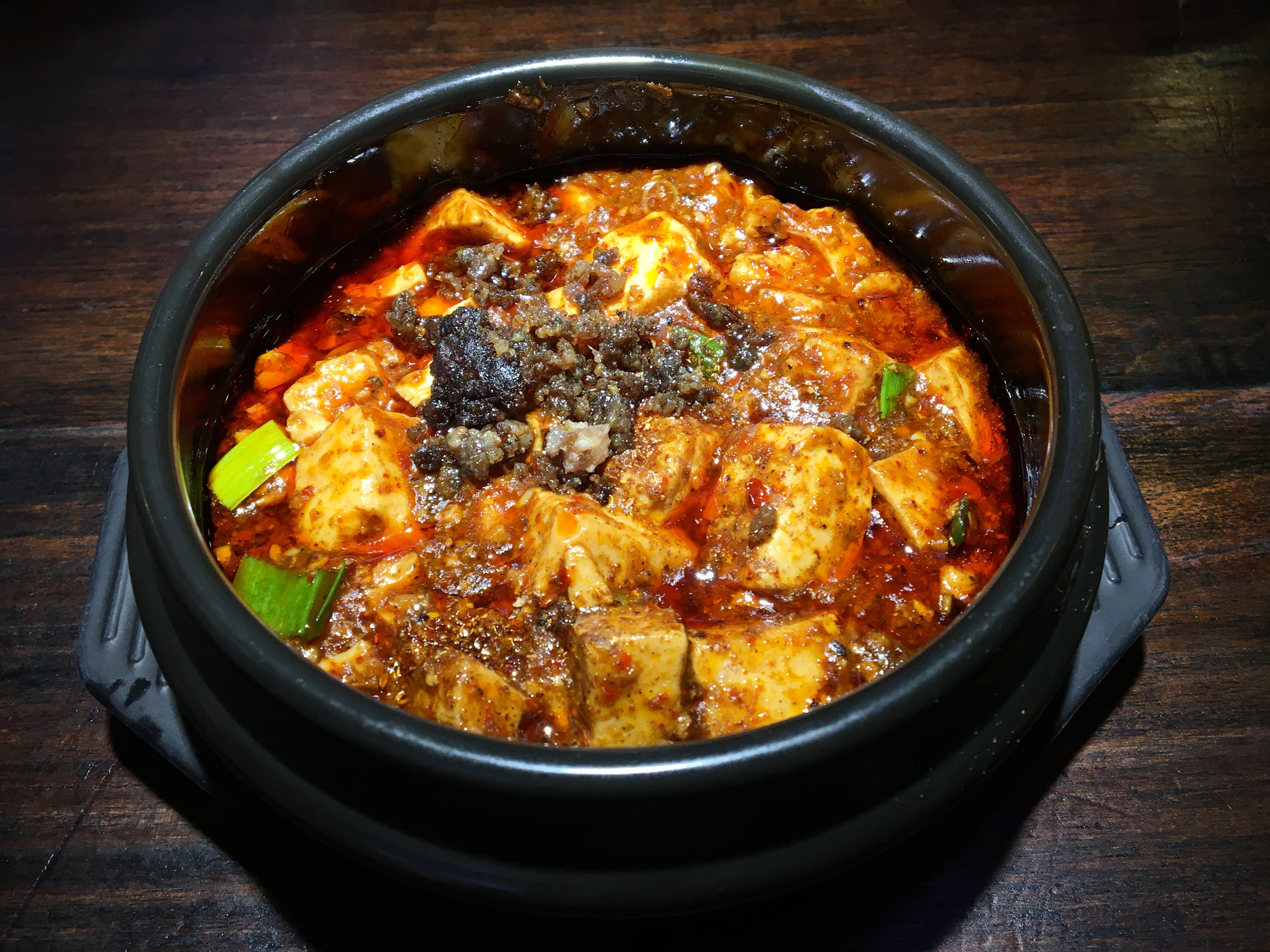
Mapo Tofu
Synopsis
Mapo tofu is Sichuan cuisine's most internationally famous dish — silky tofu in a vibrant, numbing-spicy sauce of fermented broad bean paste and Sichuan peppercorns.
Overview
Mapo Tofu (麻婆豆腐, mápó dòufu) is one of the most internationally recognized classic dishes of Sichuan cuisine. The dish features silky tofu cubes in a vibrant red, oily, and intensely flavored sauce made with doubanjiang (fermented broad bean and chili paste), douchi (fermented black beans), chili oil, and Sichuan peppercorns, accompanied by minced meat — traditionally beef. Its signature characteristic is the combination of seven qualities: numbing (麻), spicy (辣), hot temperature (烫), fresh (鲜), tender (嫩), aromatic (香), and flaky (酥).
The dish takes its name from its creator — a pockmarked woman surnamed Chen, known as "Chen Mapo." Originating from a small eatery near Wanfu Bridge in Chengdu over 160 years ago, mapo tofu has spread globally and become one of the most iconic symbols of Chinese cuisine.
History
The origins of mapo tofu trace back to the first year of the Tongzhi era of the Qing Dynasty (1862). Historical records indicate that a small restaurant called "Chen Xingsheng" near Wanfu Bridge in Chengdu was run by Chen Chunfu and his wife. Mrs. Chen, who had pockmarks on her face, was known as "Chen Mapo" (Pockmarked Grandma Chen). Wanfu Bridge was a thoroughfare for oil and rice porters, who would often stop at Chen's eatery, purchase tofu and beef, and ask Mrs. Chen to cook it for them. She would dice the tofu and braise it with minced beef, chili, and Sichuan peppercorns. The resulting dish was so flavorful that it became beloved by the workers, and "mapo tofu" was born.
In the 1920s, the Chen Mapo restaurant hired a chef named Xue Xiangshun, who refined the recipe by substituting pork with beef and adding douchi (fermented black beans), perfecting the flavor profile that defines the dish today.
The first formally published recipe for mapo tofu appeared in the "Chinese Famous Recipes" (中国名菜谱), compiled by the Food, Beverage, and Hospitality Bureau in the 1950s.
Key Ingredients & Preparation
The soul of mapo tofu lies in seven essential seasonings:
Pixian Doubanjiang: Fermented broad bean and chili paste from Pixian County, Sichuan — the single most important ingredient, providing the dish's signature red color and deep, savory flavor.
Douchi: Fermented black beans, adding saltiness and umami depth.
Sichuan Peppercorns: The source of the distinctive numbing sensation — the "ma" in "mala."
Chili Flakes and Chili Oil: Delivering intense heat and brilliant red color.
Garlic, Ginger, and Scallions: Adding aromatic complexity.
The main ingredient is soft (southern-style) tofu, cut into approximately 2cm cubes. Minced beef (traditionally beef, though pork is also used) is stir-fried until crispy, then combined with the tofu in the sauce. The dish is thickened with starch and finished with a sprinkle of ground Sichuan peppercorn and chopped scallions.
Cultural Significance
Authentic mapo tofu embodies seven Chinese characters: 麻 (numbing), 辣 (spicy), 烫 (hot), 鲜 (fresh), 嫩 (tender), 香 (aromatic), 酥 (crispy/flaky). These seven qualities capture the essence of what makes this dish extraordinary.
In Japan, mapo tofu (マーボー豆腐) has achieved near-national dish status. Chinese-Japanese chef Chen Kenmin introduced the dish to Japan, adapting it for local palates by reducing the spice level. His son, Chen Kenichi, further popularized it as his signature dish on the television program Iron Chef, cementing mapo tofu's place in Japanese food culture.
In Western countries, mapo tofu is typically adapted with significantly reduced spice levels. Many restaurants offer vegetarian versions using shiitake mushrooms or other plant-based substitutes in place of meat.
Practical Information
| Item | Details |
|---|---|
| Origin | Chengdu, Sichuan (c. 1862) |
| Founding Restaurant | Chen Mapo Tofu, Chengdu (est. 1862) |
| Flavor Profile | Numbing, spicy, aromatic — all seven qualities |
| Spiciness | ★★★★★ (authentic Sichuan version) |
| Average Cost | 20-50 yuan (casual restaurant) |
| Best Paired With | Steamed white rice (called "rice killer" in China) |
| Famous Restaurants | Chen Mapo Tofu (Chengdu flagship), authentic Sichuan restaurants worldwide |
Global Influence
Mapo tofu has transcended Chinese borders to become one of the world's most beloved Chinese dishes. In Japan, it is a household staple, with mapo tofu seasoning packets available in every supermarket. In North America and Europe, virtually every Chinese restaurant features mapo tofu on the menu.
The success of mapo tofu lies not only in its distinctive flavor but in how it embodies the Sichuan culinary philosophy of "one dish, one style; a hundred dishes, a hundred flavors." From a humble bowl of tofu in a Chengdu alleyway to a global culinary classic, mapo tofu is perhaps the finest example of Chinese food culture's soft power on the world stage.
References
- Wikipedia - Mapo tofu
- Baidu Baike - 麻婆豆腐
- China Daily - The making of mapo tofu
- Fuchsia Dunlop - Land of Plenty (2001)
- Chinese Cooking Demystified - The Complete History of Mapo Tofu (2025)
Stills & Gallery
Comments (0)