Synopsis
The Longmen Grottoes in Luoyang, Henan, are the foremost of China's Four Great Grottoes. With over 100,000 Buddhist statues in 2,100+ caves, they represent the highest achievement of Chinese stone carving art. UNESCO World Heritage since 2000.
Overview
The Longmen Grottoes (龙门石窟), located on the cliffs of Longmen Mountain and Xiangshan Mountain on both sides of the Yi River, 12 kilometers south of Luoyang City, Henan Province, are one of China's Four Great Grottoes (along with Mogao Caves, Yungang Grottoes, and Maijishan Grottoes). The Longmen Grottoes are the world's largest and most extensive repository of stone-carved Buddhist art, described by UNESCO as "the highest achievement of Chinese stone carving art," ranking first among China's major grotto complexes.
The Longmen Grottoes contain over 2,100 caves and niches, more than 100,000 Buddhist statues, and over 3,600 inscriptions and stele, mostly on the western bank of the Yi River on Longmen Mountain. Their quantity ranks first among China's major grottoes.
Carving at Longmen began around the time Emperor Xiaowen of Northern Wei moved his capital to Luoyang (493 AD) and continued on a large scale through the Eastern Wei, Western Wei, Northern Qi, Sui, Tang, Five Dynasties, and Song Dynasties — spanning over 400 years of continuous creation.
In 2000, the Longmen Grottoes were inscribed on UNESCO's World Cultural Heritage List.
History
| Period | Event |
|---|---|
| 493 AD | Emperor Xiaowen of Northern Wei moves capital to Luoyang; carving at Longmen begins |
| Northern Wei (493-534) | Early caves carved: Guyang Cave, Binyang Caves, Lotus Cave |
| Tang Dynasty (618-907) | Peak period of carving at Longmen; Fengxian Temple, Wanfo Cave and other major caves created |
| Song Dynasty onwards | Additional construction continued |
| 1961 | Designated as a Major Historical and Cultural Site Protected at the National Level |
| 2000 | Inscribed as UNESCO World Cultural Heritage |
Main Caves
| Cave | Period | Features |
|---|---|---|
| Fengxian Temple (Vairocana Buddha Niche) | Tang | The largest and most artistically refined cliff niche at Longmen; Vairocana Buddha stands 17.14m tall |
| Guyang Cave | Northern Wei | The earliest and most richly decorated cave at Longmen; 19 of the "Longmen Twenty Pieces" are here |
| Binyang Three Caves (South, Middle, North) | Northern Wei | Commissioned by Emperor Xuanwu as prayers for his parents Emperor Xiaowen and Empress Wenzhao |
| Lotus Cave | Northern Wei | Features a massive lotus ceiling carving |
| Wanfo Cave (Cave of Ten Thousand Buddhas) | Tang | Named for the 15,000 small Buddha statues carved inside |
| Kanjing Temple | Tang | The only cave of arhats (Luohan) at Longmen |
| Qianxi Temple | Tang | Cave at the northern end of Longmen |
Fengxian Temple and the Vairocana Buddha
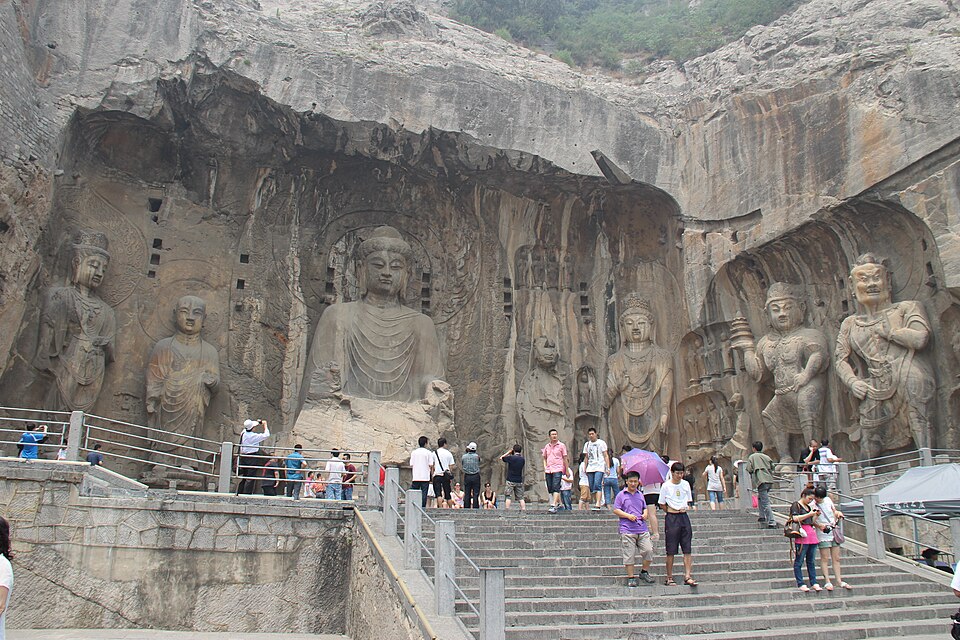
Fengxian Temple is the largest and most artistically refined cliff niche at Longmen, carved during the reign of Emperor Gaozong of Tang (approximately 672-675 AD). The Vairocana Buddha stands 17.14 meters tall in total, with a head 4 meters high and ears 1.9 meters long. Its face is full and round, making it the most representative statue at Longmen.
According to records, the Vairocana Buddha was modeled after the features of Wu Zetian (who later became China's only female emperor), representing the highest achievement of Tang Dynasty Buddhist sculptural art. The Buddha is flanked by disciples, bodhisattvas, heavenly kings, and warrior guardians — 11 statues in total — arranged with rigorous symmetry and magnificent presence.
"Longmen Twenty Pieces"
The "Longmen Twenty Pieces" (龙门二十品) refer to twenty Northern Wei dedicatory inscriptions in Guyang Cave at Longmen. They are representative works of Wei stele (魏碑) calligraphy. Wei stele is a style of regular script from the Northern Wei period, known for its方正 (square and upright), vigorous, and ancient character, holding an important place in Chinese calligraphic history. Nineteen of the "Twenty Pieces" are located in Guyang Cave, with one in Cixiang Kiln.
Artistic Value
The artistic style of the Longmen Grottoes evolved from the Northern Wei's "slender bones and clear features" to the Tang Dynasty's "full and round" aesthetics, reflecting the development of Chinese Buddhist art:
- Northern Wei Period: Buddha statues are slender and elongated, with thinner facial features, reflecting the Southern Dynasty aesthetic
- Tang Dynasty: Buddha figures are plump and rounded, with serene and majestic expressions, reflecting Tang aesthetic ideals and national strength
- Song Dynasty and later: Statues decrease in scale, and artistic style becomes more standardized
When inscribing Longmen as a World Heritage Site in 2000, UNESCO described it as "the highest achievement of Chinese stone carving art."
Practical Information
| Item | Details |
|---|---|
| Location | Longmen Town, Luolong District, Luoyang City, Henan Province |
| Best Season | Spring (Apr-May) and Autumn (Sep-Oct) |
| Suggested Visit Duration | 3-4 hours |
| Admission | Peak season (Feb-Nov) ~90 RMB, Off-season (Dec-Jan) ~60 RMB |
| Transportation | Bus Route 81 from Luoyang Railway Station direct to Longmen Grottoes |
| Nearby Attractions | White Horse Temple (China's first state-sponsored Buddhist temple), Guanlin, Luoyang Museum |
World Heritage
In 2000, the Longmen Grottoes were inscribed by UNESCO as a World Cultural Heritage Site. UNESCO's evaluation noted:
- The sculptures and inscriptions of the Longmen Grottoes represent the pinnacle of Chinese stone carving art
- The inscriptions at Longmen (particularly the "Longmen Twenty Pieces") are important examples of Wei stele calligraphy
- The Longmen Grottoes reflect the development and evolution of Chinese Buddhist art from the Northern Wei to Tang Dynasties
References
- Baidu Baike: https://baike.baidu.com/item/龙门石窟
- Wikipedia: https://zh.wikipedia.org/wiki/龙门石窟
- Longmen Grottoes Official: http://lmsk.cn/Gywm_id_5.html
- UNESCO: https://whc.unesco.org/en/list/1003/
Stills & Gallery
Comments (0)