Synopsis
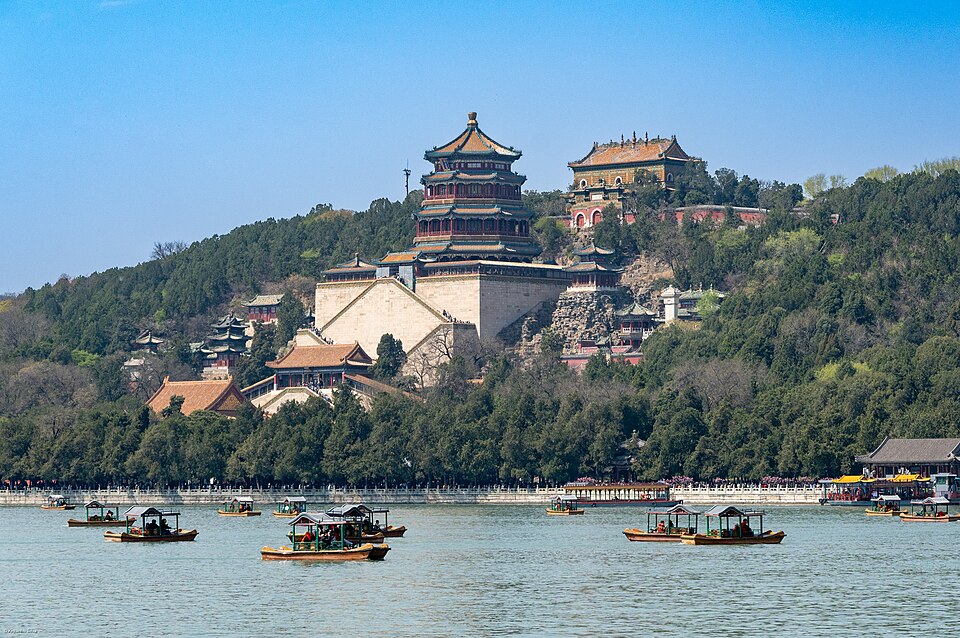
The Summer Palace is China's best-preserved large-scale imperial garden, centered on Kunming Lake and Longevity Hill. A UNESCO World Cultural Heritage Site since 1998, known as the 'Museum of Royal Gardens.'
Overview
The Summer Palace (颐和园, Yiheyuan), located in the Haidian District of northwestern Beijing, was the imperial garden of the Qing Dynasty. Covering approximately 297 hectares (3.009 square kilometers), the Summer Palace is composed primarily of Longevity Hill (Wanshou Shan) and Kunming Lake. It is one of the best-preserved large-scale imperial gardens in China, known as the "Museum of Royal Gardens."
The Summer Palace was modeled after the scenery of West Lake in Hangzhou, drawing on the design techniques and artistic concepts of southern Chinese gardens. Built on the foundation of Kunming Lake and Longevity Hill, it is renowned for its skillful integration of man-made structures with natural landscapes.
In 1998, the Summer Palace was inscribed on UNESCO's World Cultural Heritage List.
History
| Period | Event |
|---|---|
| 1750 (15th year of Qianlong) | Emperor Qianlong expanded the existing瓮山Pond to create the Garden of Clear Ripples (清漪园) as a birthday gift for his mother |
| 1860 (10th year of Xianfeng) | The Garden of Clear Ripples was burned down by Anglo-French forces during the destruction of the Old Summer Palace |
| 1886 (12th year of Guangxu) | Empress Dowager Cixi rebuilt the garden using naval funds, renaming it the Summer Palace (颐和园) as her retirement residence |
| 1900 (26th year of Guangxu) | Damaged by the Eight-Nation Alliance |
| 1902 (28th year of Guangxu) | Restored again |
| 1998 | Inscribed as UNESCO World Cultural Heritage |
Main Attractions
| Attraction | Features |
|---|---|
| Kunming Lake | Covers 220 hectares, three-quarters of the total park area — the main water body |
| Longevity Hill (Wanshou Shan) | Front hill centered on the Tower of Buddhist Incense; back hill features Tibetan-style temple architecture |
| Tower of Buddhist Incense (Foxiang Ge) | Iconic landmark, 41m high, octagonal three-story with four eaves, houses a bronze thousand-armed Guanyin |
| The Long Corridor | 728 meters long with 273 sections — the longest covered corridor in Chinese gardens, decorated with over 14,000 painted scenes |
| Seventeen-Arch Bridge | Connects the eastern shore of Kunming Lake to South Lake Island — the largest multi-arch stone bridge in Chinese classical gardens |
| Marble Boat (Shifang) | Also known as the Boat of Purity and Ease, a marble boat symbolizing "eternal stability of the empire" |
| Suzhou Street | A replica of Jiangnan water town shopping streets, built for imperial entertainment |
| Theatre of Virtue and Harmony | China's largest existing ancient theatre, 21 meters high |
| Garden of Harmonious Interests | A miniature garden modeled after Jichang Garden in Wuxi, known as the "garden within a garden" |
| Hall of Dispelling Clouds | The main hall on the front slope of Longevity Hill, where Empress Dowager Cixi held birthday celebrations |
Garden Art
The Summer Palace's landscaping artistry is reflected in several aspects:
- Mountain and Water Layout: Kunming Lake provides the water scenery, Longevity Hill provides the land view — mountain and water complement each other
- Borrowed Scenery: Incorporates distant views of Jade Spring Hill and the Western Hills into the garden vista
- Architecture-Nature Integration: Pavilions, towers, and structures complement the mountains, water, and plants
- North-South Synthesis: Combines the grandeur of northern imperial gardens with the delicacy of southern Jiangnan gardens
Practical Information
| Item | Details |
|---|---|
| Location | 19 Xinjian Gongmen Road, Haidian District, Beijing |
| Opening Hours | Peak season (Apr-Oct) 6:30-18:00, Off-season (Nov-Mar) 7:00-17:00 |
| Admission | Peak season ~30 RMB, Off-season ~20 RMB; Combined ticket (includes sub-gardens) peak ~60 RMB, off ~50 RMB |
| Suggested Visit Duration | 3-4 hours |
| Transportation | Subway Line 4, Beigongmen Station or Xiyuan Station |
| Best Season | Spring (Mar-May) for flowers, Summer (Jun-Aug) for lotus, Autumn (Sep-Nov) for red leaves |
World Heritage
In 1998, the Summer Palace was inscribed by UNESCO as a World Cultural Heritage Site. UNESCO's evaluation noted:
- The Summer Palace is a masterpiece of Chinese landscape garden design
- It achieves perfect harmony between artificial construction and natural landscape
- The Summer Palace has had a profound influence on Chinese garden design and world garden art
References
- Summer Palace Official Website: http://summerpalace.net.cn/
- Wikipedia: https://zh.wikipedia.org/wiki/颐和园
- Baidu Baike: https://baike.baidu.com/item/颐和园
- UNESCO: https://whc.unesco.org/en/list/880/
Stills & Gallery
Comments (0)