Jiuzhaigou
Synopsis
Jiuzhaigou Valley in Sichuan is a UNESCO World Natural Heritage Site famous for its multi-level waterfalls, colorful lakes, and snow-capped peaks, known as a fairyland on earth.
Overview
Jiuzhaigou Valley Scenic and Historic Interest Area (九寨沟, Jiǔzhàigōu) is a nature reserve and national park located in Jiuzhaigou County, Aba Tibetan and Qiang Autonomous Prefecture, in northern Sichuan Province, southwestern China. The valley takes its name from the nine Tibetan villages scattered along its length — "Jiuzhaigou" literally means "Valley of Nine Fortified Villages" in Chinese.
Covering 720 square kilometers (72,000 hectares), Jiuzhaigou is renowned for its multi-level waterfalls, colorful lakes, primeval forests, and snow-capped peaks. It has been inscribed as a UNESCO World Natural Heritage Site since 1992 and designated a World Biosphere Reserve in 1997. The site is also rated as a AAAAA scenic area by China National Tourism Administration — the highest rating in China's tourism classification system. In 2024, Jiuzhaigou welcomed over 5.11 million visitors, making it one of China's most popular tourist destinations.
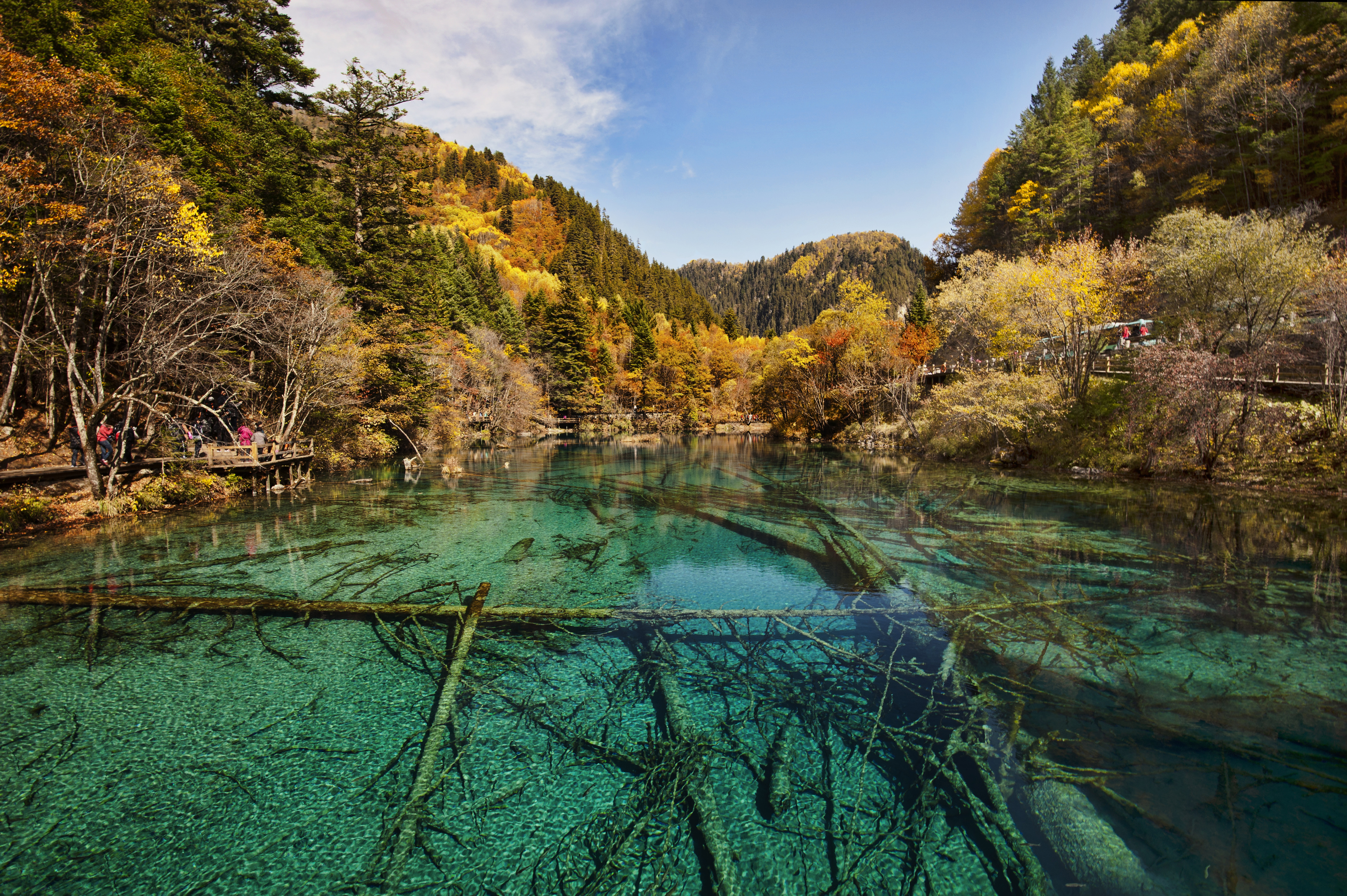
Located on the southern edge of the Min Mountains at the rim of the Tibetan Plateau, Jiuzhaigou ranges in elevation from 2,000 to 4,764 meters. The area features diverse forest ecosystems, including temperate broadleaf forests, mixed coniferous and broadleaf forests, and alpine meadows. The lakes — known locally as "haizi" — owe their stunning blue, green, and golden colors to high concentrations of calcium carbonate and other minerals, giving rise to the Chinese saying: "After visiting Jiuzhaigou, no other water scenery is worth seeing."
Key Attractions
The scenic area consists of three main valleys arranged in a "Y" shape: Shuzheng Valley, Rize Valley, and Zechawa Valley.
Shuzheng Valley is the main valley, stretching approximately 14 kilometers. It features the Shuzheng Lakes, Shuzheng Waterfall, Sparkling Lake, and Reed Lake. The Shuzheng Lakes are a chain of interconnected lakes of varying sizes, with crystal-clear water surrounded by virgin forests. Shuzheng Waterfall is the widest in Jiuzhaigou at approximately 62 meters, with water cascading through the trees in a spectacular display.
Rize Valley extends about 18 kilometers and contains the highest concentration of scenic spots. Pearl Shoal Waterfall, approximately 310 meters wide, is one of the most iconic sights — water cascades over a shoal studded with calcium deposits that sparkle like pearls. The 1986 TV adaptation of "Journey to the West" was filmed here. Five Flower Lake is perhaps the most beautiful lake in Jiuzhaigou, displaying shades of yellow, dark green, deep blue, and navy due to different mineral deposits and algae on the lake bed. From above, it resembles a blooming multi-colored flower. Nuorilang Waterfall, approximately 270 meters wide and 24.5 meters high, is one of China's widest travertine waterfalls and serves as the emblematic landmark of Jiuzhaigou.
Zechawa Valley also stretches about 18 kilometers and is home to Long Lake and Five Colour Pond. Long Lake is the largest and deepest lake in Jiuzhaigou, at an elevation of approximately 3,100 meters, stretching about 7 kilometers in length. Surrounded by snow-capped peaks, its deep blue waters create a breathtaking panorama. Five Colour Pond is the smallest lake in Jiuzhaigou but features the richest palette of colors, often described as "the essence of Jiuzhaigou."
Geography & Ecology
Jiuzhaigou lies approximately 330 kilometers north of Chengdu, the provincial capital of Sichuan, near the border with Gansu Province. The core scenic area covers 720 km², with an additional 600 km² of buffer zones. The mean annual temperature is 7.8°C, with January averaging -3.7°C and July 16.8°C. Annual precipitation totals approximately 761mm, with 80% falling between May and October.
The ecosystem is classified as temperate broadleaf and mixed forest, with nearly 300 km² of the core area covered by virgin mixed forests. In autumn, these forests transform into vibrant displays of gold, orange, and red, making fall the peak tourist season. The reserve is home to endangered species including the giant panda and golden snub-nosed monkey, as well as endemic varieties of rhododendron and bamboo.
History & Conservation
The Jiuzhaigou region has been inhabited by Tibetan and Qiang peoples for centuries. Due to its remote location and difficult terrain, this natural paradise remained largely unknown to the outside world until 1975, when forestry scientist Wu Zhonglun conducted a comprehensive survey. Deeply moved by the scenery, he wrote to the Sichuan Provincial Government and Forestry Department, urging them to protect the area and halt indiscriminate logging.
The Sichuan Forestry Department quickly issued regulations restricting logging, and the provincial government prioritized Jiuzhaigou's protection, ultimately banning all logging in the valley. The Jiuzhaigou Nature Reserve was established in 1980, and the site officially opened to tourism in 1984. It was inscribed as a UNESCO World Heritage Site in 1992 and designated a World Biosphere Reserve in 1997.
On August 8, 2017, a magnitude 7.0 earthquake struck Jiuzhaigou County, causing significant damage to several natural features including the Nuorilang Waterfall and Sparkling Lake dams. The park was closed to visitors but reopened on March 3, 2018, with limited access. Remarkably, most of Jiuzhaigou's scenic spots have since recovered — in many cases surpassing their pre-earthquake beauty.
Practical Information
| Item | Details |
|---|---|
| Location | Zhangzha Town, Jiuzhaigou County, Aba Tibetan and Qiang Autonomous Prefecture, Sichuan |
| Opening Hours | Peak season (Apr-Nov): 8:30-17:00; Off-season (Dec-Mar): 9:00-16:30 |
| Admission | Peak: 169 yuan/person; Off-season: 80 yuan/person (shuttle bus ticket sold separately) |
| Best Season | Autumn (September-November) for spectacular fall foliage |
| Transport | ~8 hours drive from Chengdu; Jiuzhai Huanglong Airport has domestic flights; Sichuan-Qinghai Railway now operational |
| Daily Capacity | 41,000 visitors (timed-entry tickets required) |
| Getting Around | Eco-friendly shuttle buses + boardwalk trails within the park |
Cultural Significance
Beyond its natural wonders, Jiuzhaigou is an important part of Tibetan cultural heritage. Seven of the original nine Tibetan villages remain populated today, with local residents earning their living through tourism and government subsidies. The Tibetan architecture, traditional lifestyle, and rich cultural practices add a profound human dimension to this natural paradise.
Together with the nearby Huanglong Scenic Area, Jiuzhaigou forms one of China's most magnificent natural landscape clusters, serving as an outstanding window into China's natural heritage and conservation efforts.
References
- Wikipedia - Jiuzhaigou
- UNESCO World Heritage - Jiuzhaigou Valley
- Baidu Baike - 九寨沟
- Jiuzhaigou Official Website - Visitor Guide
- China Meteorological Data Network - Jiuzhaigou Climate Data
Stills & Gallery
Comments (0)