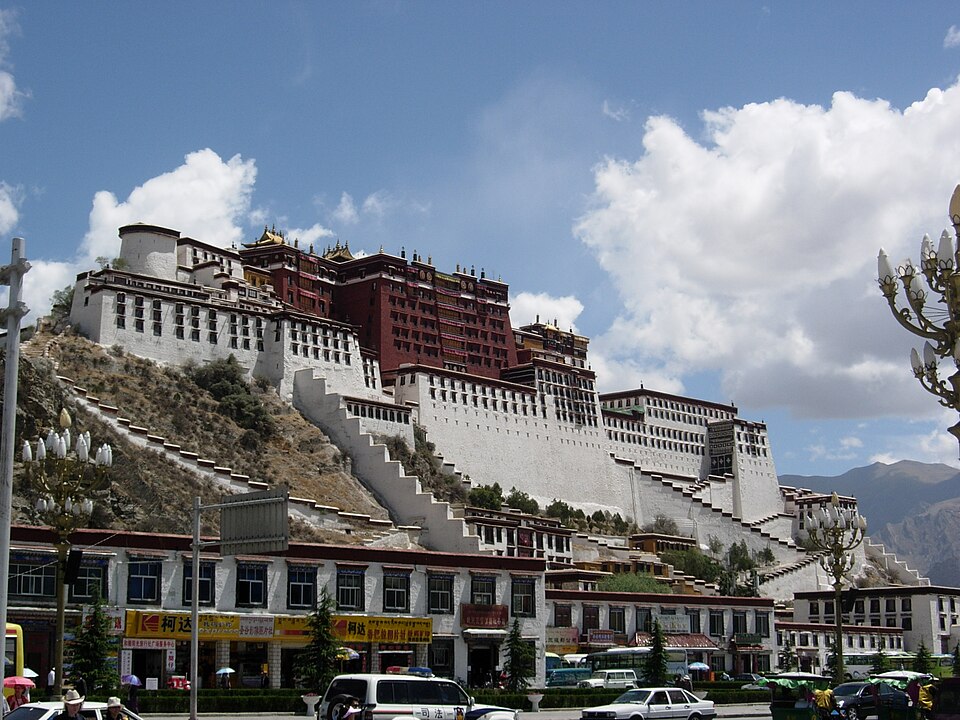
Synopsis
The Potala Palace sits atop Red Hill in Lhasa, Tibet at 3,700m elevation. Originally built in 631 AD by King Songtsen Gampo. A UNESCO World Cultural Heritage Site since 1994.
Overview
The Potala Palace (Tibetan: ཕོ་བྲང་པོ་ཏ་ལ, Wylie: pho brang po ta la) sits atop the Red Hill (Marpo Ri) in the northwest of Lhasa, the capital of the Tibet Autonomous Region of China, at an elevation of 3,700 meters. The Potala Palace was originally built in 631 AD under the direction of Songtsen Gampo, the 33rd king of the Tibetan Empire. After the collapse of the Tibetan Empire, the palace suffered severe damage from natural disasters and human conflicts. In 1645, the Fifth Dalai Lama rebuilt the Potala Palace to consolidate the theocratic Ganden Phodrang regime, and it was continuously expanded thereafter to reach its present scale.
The main building of the Potala Palace is divided into two parts: the White Palace and the Red Palace. It is a grand palace-style architectural complex that integrates palace, fortress, and temple. Built into the mountainside, the main building stands 117 meters tall, stretches 360 meters from east to west, and covers a total floor area of approximately 130,000 square meters, with about 1,000 rooms. The palace houses a vast collection of historical relics and cultural treasures.
In 1961, the Potala Palace was designated as one of the first batch of Major Historical and Cultural Sites Protected at the National Level. In 1994, the Potala Palace was inscribed on UNESCO's World Cultural Heritage List. In 2000 and 2001, the Jokhang Temple and the Norbulingka were added to the World Heritage Site as extensions of the Potala Palace.
History
| Period | Event |
|---|---|
| 631 AD | Songtsen Gampo, 33rd king of the Tibetan Empire, initiates construction of the Potala Palace |
| Mid-7th century | Princess Wencheng of the Tang Dynasty marries Songtsen Gampo and enters Tibet |
| After the collapse of the Tibetan Empire | The Potala Palace suffers severe damage from natural disasters and wars |
| 1645 | The Fifth Dalai Lama rebuilds the Potala Palace |
| 1693 | The Red Palace is completed; the Potala Palace takes its current form |
| 1961 | Designated as one of the first batch of Major Historical and Cultural Sites Protected at the National Level |
| 1994 | Inscribed as UNESCO World Cultural Heritage |
| 2000 | Jokhang Temple added as an extension to the World Heritage Site |
| 2001 | Norbulingka added as an extension to the World Heritage Site |
Architecture
The main building of the Potala Palace is divided into two parts:
| Building | Features |
|---|---|
| Red Palace (Potrang Marpo) | The religious center of the Potala Palace, housing the stupa halls of successive Dalai Lamas, Buddha halls, and sutra halls |
| White Palace (Potrang Karpo) | The winter residence of the Dalai Lama and the center of political activities, including the East Hall and the Sunshine Hall |
Red Palace
The Red Palace is located at the center of the Potala Palace with red exterior walls, serving as the religious center of the complex. It contains eight stupas of successive Dalai Lamas, the most famous being the stupa of the Fifth Dalai Lama, which stands 14.85 meters tall and is covered in gold, consuming approximately 3,721 kilograms of gold.
The Red Palace also houses a large collection of precious Buddhist art and artifacts, including Buddha statues, thangkas (Tibetan Buddhist paintings), and scriptures. The architectural styles of the eight stupa halls vary, representing the highest achievement of Tibetan Buddhist art.
White Palace
The White Palace flanks the Red Palace on both sides with white exterior walls. It served as the winter residence of the Dalai Lama and the center of political activities. The White Palace includes:
- East Hall (Shar-sde): The largest hall in the White Palace, where the Dalai Lama conducted major religious ceremonies and political activities
- Sunshine Hall (Nyima-sde): The living quarters of the Dalai Lama, named for its abundant sunlight
- Monk Official School: A training school for monk officials
Other Structures
| Structure | Description |
|---|---|
| Chakpori (Medicine Hill) | A small hill opposite the Potala Palace, the best spot for panoramic photography |
| Dragon King Pool Park (Lukhang Park) | A park behind the Potala Palace, a popular leisure spot for Lhasa residents |
Jokhang Temple
The Jokhang Temple is located in the center of Lhasa and was built in the 7th century by Songtsen Gampo to commemorate Princess Wencheng's arrival in Tibet. The Jokhang Temple is one of the most important temples in Tibetan Buddhism, housing the 12-year-old Sakyamuni Buddha statue that Princess Wencheng brought from Chang'an (modern Xi'an).
The Barkhor Street in front of the Jokhang Temple is Lhasa's most famous circumambulation path, where thousands of pilgrims walk daily in prayer.
In 2000, the Jokhang Temple was added to the World Heritage Site as an extension of the "Historic Ensemble of the Potala Palace, Lhasa."
Norbulingka
The Norbulingka, located in the western suburbs of Lhasa, was first built in the 18th century and served as the summer residence of successive Dalai Lamas. Covering approximately 360,000 square meters, the Norbulingka is Tibet's largest man-made garden, containing palaces such as the Kelsang Potrang, the Golden Potrang, and the Takten Migyur Potrang.
In 2001, the Norbulingka was added to the World Heritage Site as an extension of the "Historic Ensemble of the Potala Palace, Lhasa."
Practical Information
| Item | Details |
|---|---|
| Location | Beijing Middle Road, Chengguan District, Lhasa, Tibet Autonomous Region |
| Elevation | ~3,700m — be aware of altitude sickness |
| Best Season | May-October, with July-September being the best |
| Suggested Visit Duration | 2-3 hours |
| Admission | Peak season (May-Oct) ~200 RMB, Off-season (Nov-Apr) ~100 RMB |
| Opening Hours | 9:00-16:00 (peak season), 9:30-15:30 (off-season) |
| Restrictions | Daily visitor limits apply; advance reservation required; visit time limited to 1 hour |
| Transportation | Walking or taxi from downtown Lhasa |
World Heritage
In 1994, the Potala Palace was inscribed by UNESCO as a World Cultural Heritage Site. In 2000 and 2001, the Jokhang Temple and the Norbulingka were added as extensions. UNESCO's evaluation noted:
- The Potala Palace is an outstanding example of Tibetan architecture, integrating palace, fortress, and temple
- The history and architecture of the Potala Palace are closely connected to the history, religion, and politics of Tibet
- The Potala Palace and its subsidiary buildings are masterpieces of Tibetan culture and art
References
- Potala Palace Official: http://www.potalapalace.cn/
- Wikipedia: https://zh.wikipedia.org/wiki/布达拉宫
- Baidu Baike: https://baike.baidu.com/item/布达拉宫
- UNESCO: https://whc.unesco.org/en/list/705/
Stills & Gallery
Comments (0)