This site displays a prototype of a “Web 2.0” version of the daily Federal Register. It is not an official legal edition of the Federal Register, and does not replace the official print version or the official electronic version on GPO’s govinfo.gov.
The documents posted on this site are XML renditions of published Federal Register documents. Each document posted on the site includes a link to the corresponding official PDF file on govinfo.gov. This prototype edition of the daily Federal Register on FederalRegister.gov will remain an unofficial informational resource until the Administrative Committee of the Federal Register (ACFR) issues a regulation granting it official legal status. For complete information about, and access to, our official publications and services, go to About the Federal Register on NARA's archives.gov.
The OFR/GPO partnership is committed to presenting accurate and reliable regulatory information on FederalRegister.gov with the objective of establishing the XML-based Federal Register as an ACFR-sanctioned publication in the future. While every effort has been made to ensure that the material on FederalRegister.gov is accurately displayed, consistent with the official SGML-based PDF version on govinfo.gov, those relying on it for legal research should verify their results against an official edition of the Federal Register. Until the ACFR grants it official status, the XML rendition of the daily Federal Register on FederalRegister.gov does not provide legal notice to the public or judicial notice to the courts.
- Regulations.gov DataEnhanced Content - Regulations.gov Data

FederalRegister.gov retrieves relevant information about this document from Regulations.gov to provide users with additional context. This information is not part of the official Federal Register document.
Weighted Selection Process for Registrants and Petitioners Seeking To File Cap-Subject H–1B Petitions
- Docket ID
- USCIS-2025-0040
- Supporting Documents
- I-129-052-INS-H1BSelection-Final Rule
- I-129-052 H1B Selection Final Rule Copy Deck
- H-1B Registration Tool-020-CopyDeck-H1B Selection Final Rule
- I-129-052-FRM-H1BSelection-Final Rule
- I-129-056-FRM-TOC-H1BSelection-FinalRule
- I-129-056-INS-TOC-H1BSelection-FinalRule
- I-129-052-INS-TOC-H1BSelection
- I-129-052-INS-H1BSelection
- I-129-052-FRM-TOC-H1BSelection
- I-129-052-FRM-H1BSelection
- See all 12 supporting documents
AGENCY:
U.S. Citizenship and Immigration Services, DHS.
ACTION:
Notice of proposed rulemaking.
SUMMARY:
The U.S. Department of Homeland Security (DHS) proposes to amend its regulations governing the process by which U.S. Citizenship and Immigration Services (USCIS) selects H-1B registrations for unique beneficiaries for filing of H-1B cap-subject petitions (or H-1B petitions for any year in which the registration requirement is suspended). DHS proposes to implement a weighted selection process that would generally favor the allocation of H-1B visas to higher skilled and higher paid aliens, while maintaining the opportunity for employers to secure H-1B workers at all wage levels, to better serve the Congressional intent for the H-1B program.
DATES:
Written comments on the notice of proposed rulemaking (NPRM) must be submitted on or before October 24, 2025. Written comments on the associated information collections 1615-0144 and 1615-0009 must be submitted on or before November 24, 2025. The electronic Federal Docket Management System will accept comments before midnight Eastern time at the end of that day.
ADDRESSES:
You may submit comments on the entirety of this proposed rulemaking package, identified by DHS Docket No. USCIS-2025-0040 through the Federal eRulemaking Portal: https://www.regulations.gov. In accordance with 5 U.S.C. 553(b)(4), the summary of this rule found above may also be found at https://www.regulations.gov. Follow the website instructions for submitting comments.
Comments submitted in a manner other than via https://www.regulations.gov, including emails or letters sent to DHS or USCIS officials, will not be considered comments on the proposed rule and may not receive a response from DHS. Please note that DHS and USCIS cannot accept any comments that are hand-delivered or couriered. In addition, DHS and USCIS cannot accept comments contained on any form of digital media storage devices, such as CDs/DVDs and USB drives. USCIS is also not accepting mailed comments at this time. If you cannot submit your comment by using https://www.regulations.gov, please contact the Regulatory Coordination Division, Office of Policy and Strategy, U.S. Citizenship and Immigration Services, U.S. Department of Homeland Security, by telephone at (240) 721-3000 for alternate instructions.
FOR FURTHER INFORMATION CONTACT:
Business and Foreign Workers Division, Office of Policy and Strategy, U.S. Citizenship and Immigration Services, U.S. Department of Homeland Security, 5900 Capital Gateway Drive, Camp Springs, MD 20746; telephone (240) 721-3000 (not a toll-free call).
SUPPLEMENTARY INFORMATION:
Table of Contents
I. Public Participation
II. Background
A. Purpose and Summary of the Proposed Regulatory Action
B. Legal Authority
C. The H-1B Visa Program's Numerical Cap and Exemptions
D. Wage Requirement
E. Need for Reform and Rationale for Proposed Rule
F. Current Selection Process
III. Discussion of Proposed Rule
A. Required Information on the Registration and the Petition
B. Process for Weighting and Selecting Registrations
C. Process for Selecting Petitions in the Event of Suspended Registration
D. H-1B Cap-Subject Petition Filing Following Registration
E. Process Integrity
F. Severability
IV. Statutory and Regulatory Requirements
A. Executive Orders 12866 (Regulatory Planning and Review), 13563 (Improving Regulation and Regulatory Review), and 14192 (Unleashing Prosperity Through Deregulation)
B. Regulatory Flexibility Act of 1980
C. Unfunded Mandates Reform Act of 1995
D. Executive Order 13132 (Federalism)
E. Executive Order 12988 (Civil Justice Reform)
F. Executive Order 13175 (Consultation and Coordination With Indian Tribal Governments)
G. National Environmental Policy Act
H. Paperwork Reduction Act of 1995
Table of Abbreviations
BLS—U.S. Bureau of Labor Statistics
CBA—collective bargaining agreement
CFR—Code of Federal Regulations
CPI-U—Consumer Price Index for All Urban Consumers
DHS—U.S. Department of Homeland Security
DOD—U.S. Department of Defense
DOL—U.S. Department of Labor
ETA—Employment and Training Administration
FR—Federal Register
FY—Fiscal Year
HR—human resources
HSA—Homeland Security Act of 2002
INA—Immigration and Nationality Act
LCA—Labor Condition Application for Nonimmigrant Workers
NEPA—National Environmental Policy Act
NPRM—notice of proposed rulemaking
OES—Occupational Employment Statistics
OEWS—Occupational Employment and Wage Statistics
OFLC—Office of Foreign Labor Certification
OMB—Office of Management and Budget
OPQ—Office of Performance and Quality
OPS—Office of Policy and Strategy
PRA—Paperwork Reduction Act of 1995
PRD—Policy Research Division
Pub. L.—Public Law
PWD—prevailing wage determination
RFA—Regulatory Flexibility Act of 1980
RIA—regulatory impact analysis
RIN—Regulation Identifier Number
SBA—U.S. Small Business Administration
SCOPS—Service Center Operations
Secretary—Secretary of Homeland Security
SOC—Standard Occupational Classification
UMRA—Unfunded Mandates Reform Act 1995
U.S.C.—United States Code
USCIS—U.S. Citizenship and Immigration Services
I. Public Participation
DHS invites all interested parties to participate in this rulemaking by submitting written data, views, comments, and arguments on all aspects of this proposed rule. DHS also invites comments that relate to the economic, environmental, or federalism effects that might result from this proposed rule. Comments must be submitted in English, or an English translation must be provided. Comments that will provide the most assistance to USCIS in implementing these changes will reference a specific portion of the proposed rule, explain the reason for any recommended change, and include data, information, or authority that support such recommended change. Comments submitted in a manner other than via https://www.regulations.gov, including emails or letters sent to DHS or USCIS officials, will not be considered comments on the proposed rule and may not receive a response from DHS.
Instructions: If you submit a comment, you must include the agency name (U.S. Citizenship and Immigration Services) and the DHS Docket No. USCIS-2025-0040 for this rulemaking. Please note all submissions will be posted, without change, to the Federal eRulemaking Portal at https://www.regulations.gov, and will include any personal information you provide. Therefore, submitting this information makes it public. You may wish to consider limiting the amount of ( printed page 45987) personal information that you provide in any voluntary public comment submission you make to DHS. DHS may withhold information provided in comments from public viewing that it determines may impact the privacy of an individual or is offensive. For additional information, please read the Privacy and Security Notice available at https://www.regulations.gov.
Docket: For access to the docket and to read background documents or comments received, go to https://www.regulations.gov, referencing DHS Docket No. USCIS-2025-0040. You may also sign up for email alerts on the online docket to be notified when comments are posted or a final rule is published.
II. Background
A. Purpose and Summary of the Proposed Regulatory Action
DHS proposes to amend its regulations governing the selection process for registrations for H-1B cap subject petitions. Under the existing H-1B registration process, prospective petitioners (also known as registrants) seeking to file H-1B cap-subject petitions must first electronically register for each prospective beneficiary. USCIS then runs the H-1B selection process to randomly select unique beneficiaries based on properly submitted electronic registrations. If the unique beneficiary is randomly selected, then each registrant that registered for that beneficiary receives a registration selection notice and may file an H-1B cap-subject petition on their behalf.
DHS proposes to amend the process through which it selects registrations for unique beneficiaries to move away from a purely random selection process to a weighted selection process. This proposal would cover registrations for petitions subject to the regular cap and those asserting eligibility for the advanced degree exemption. The proposal would also change how USCIS selects petitions in circumstances where USCIS has suspended the registration process (for instance, because of technical issues with the electronic registration system).
Specifically, the proposal would weight registrations (or petitions) for selection generally based on each beneficiary's equivalent wage levels. When random selection is required because USCIS receives more registrations than USCIS projects to be needed to meet the numerical allocations, USCIS would conduct a weighted selection among the registrations for unique beneficiaries (or petitions) received generally based on the highest Occupational Employment and Wage Statistics (OEWS) wage level that the beneficiary's proffered wage would equal or exceed for the relevant Standard Occupational Classification (SOC) code in the area(s) of intended employment. The proffered wage is the wage that the employer intends to pay the beneficiary.
Under the proposed process, registrations for unique beneficiaries or petitions would be assigned to the relevant OEWS wage level and entered into the selection pool as follows: registrations for unique beneficiaries or petitions assigned wage level IV would be entered into the selection pool four times, those assigned wage level III would be entered into the selection pool three times, those assigned wage level II would be entered into the selection pool two times, and those assigned wage level I would be entered into the selection pool one time. Each unique beneficiary would only be counted once toward the numerical allocation projections, regardless of how many registrations were submitted for that beneficiary or how many times the beneficiary is entered in the selection pool. This proposed weighting and selection process would not alter the prevailing wage level associated with a given position for U.S. Department of Labor (DOL) purposes, which is informed by a comparison of the requirements for the proffered position to the normal requirements for the occupational classification.[1]
Through the proposed regulatory revisions, DHS aims to implement the numerical cap in a way that incentivizes employers to offer higher wages, or to petition for positions requiring higher skills and higher skilled aliens, that are commensurate with higher wage levels. The proposed process would favor the allocation of H-1B visas to higher skilled and higher paid aliens, while maintaining the opportunity for employers to secure H-1B workers at all wage levels.
B. Legal Authority
The Secretary of Homeland Security (Secretary)'s authority for these proposed regulatory amendments is found in various sections of the Immigration and Nationality Act (INA or the Act), 8 U.S.C. 1101 et seq., and the Homeland Security Act of 2002 (HSA), Public Law 107-296, 116 Stat. 2135, 6 U.S.C. 101 et seq. General authority for issuing this proposed rule is found in section 103(a) of the INA, 8 U.S.C. 1103(a), which authorizes the Secretary to administer and enforce the immigration and nationality laws and establish such regulations as the Secretary deems necessary for carrying out such authority, as well as section 112 of the HSA, 6 U.S.C. 112, which vests all of the functions of DHS in the Secretary and authorizes the Secretary to issue regulations.[2] Further authority for these proposed regulatory amendments is found in:
- Section 101(a)(15)(H)(i)(b) of the INA,8 U.S.C. 1101(a)(15)(H)(i)(b), which establishes the H-1B nonimmigrant classification;
- Section 214(a)(1) of the INA,8 U.S.C. 1184(a)(1), which authorizes the Secretary to prescribe, by regulation, the time and conditions of the admission of nonimmigrants;
- Section 214(c)(1) of the INA,8 U.S.C. 1184(c)(1), which, inter alia, authorizes the Secretary to prescribe how an importing employer may petition for nonimmigrant workers, including nonimmigrants described at section 101(a)(15)(H)(i)(b) of the INA, 8 U.S.C. 1101(a)(15)(H)(i)(b), as well as the form of the petition and the information that an importing employer must provide in the petition;
- Section 214(g) of the INA,8 U.S.C. 1184(g), which, inter alia, prescribes the H-1B numerical limitations, various exceptions to those limitations, and the period of authorized admission for H-1B nonimmigrants;
- Section 214(i) of the INA,8 U.S.C. 1184(i), which sets forth the definition and requirements of a “specialty occupation”;
- Section 235(d)(3) of the INA,8 U.S.C. 1225(d)(3), which authorizes “any immigration officer . . . to administer oaths and to take and consider evidence of or from any person touching the privilege of any alien or person he believes or suspects to be an alien to enter, reenter, transit through, or reside in the United States or concerning any matter which is material and relevant to the enforcement of [the INA] and the administration of [DHS]”; ( printed page 45988)
- Section 287(b) of the INA,8 U.S.C. 1357(b), which authorizes the taking and consideration of evidence “concerning any matter which is material or relevant to the enforcement of [the INA] and the administration of [DHS]”;
- Section 101(b)(1)(F) of the HSA,6 U.S.C. 111(b)(1)(F), which provides that a primary mission of DHS is to “ensure that the overall economic security of the United States is not diminished by efforts, activities, and programs aimed at securing the homeland”;
- Section 402 of the HSA,6 U.S.C. 202, which charges the Secretary with “[e]stablishing and administering rules [3] . . . governing the granting of visas or other forms of permission . . . to enter the United States” and “[e]stablishing national immigration enforcement policies and priorities”; see also HSA sec. 428, 6 U.S.C. 236; and
- Section 451(a)(3) and (b) of the HSA,6 U.S.C. 271(a)(3) and (b), transferring to USCIS the authority to adjudicate petitions for nonimmigrant status, establish policies for performing that function, and set national immigration services policies and priorities.
C. The H-1B Visa Program's Numerical Cap and Exemptions
The H-1B visa program allows U.S. employers to temporarily hire foreign workers to perform services in a specialty occupation, services related to a U.S. Department of Defense (DOD) cooperative research and development project or coproduction project, or services of distinguished merit and ability in the field of fashion modeling. See INA 101(a)(15)(H)(i)(b), 8 U.S.C. 1101(a)(15)(H)(i)(b); Immigration Act of 1990, Public Law 101-649, sec. 222(a)(2), 104 Stat. 4978 (Nov. 29, 1990); 8 CFR 214.2(h). A specialty occupation is defined as an occupation that requires the (1) theoretical and practical application of a body of highly specialized knowledge, and (2) attainment of a bachelor's or higher degree in the specific specialty (or its equivalent) as a minimum qualification for entry into the occupation in the United States. See INA 214(i)(l), 8 U.S.C. 1184(i)(l).
Congress has established limits on the number of foreign workers who may be granted initial H-1B nonimmigrant visas or status each fiscal year (FY) (commonly known as the “cap”). See INA sec. 214(g), 8 U.S.C. 1184(g). The total number of foreign workers who may be granted initial H-1B nonimmigrant status during any fiscal year may not exceed 65,000. See INA sec. 214(g), 8 U.S.C. 1184(g). Certain petitions are exempt from the 65,000 numerical limitation. 4 See INA sec. 214(g)(5) and (7), 8 U.S.C. 1184(g)(5) and (7). The annual exemption from the 65,000 cap for H-1B workers who have earned a qualifying U.S. master's or higher degree may not exceed 20,000 foreign workers. See INA sec. 214(g)(5)(C), 8 U.S.C. 1184(g)(5)(C).
D. Wage Requirement
An H-1B petitioner generally must file with DOL a Labor Condition Application for Nonimmigrant Workers (LCA) attesting, among other things, that it will pay the beneficiary a wage that is either (1) the actual wage that it pays to all other individuals with similar experience and qualifications for the specific employment in question or (2) the prevailing wage for the occupational classification in the area of intended employment based on the best information available at the time of filing the application, whichever is greater.[5] The H-1B petitioner must also attest that it will provide working conditions for the beneficiary that will not adversely affect the working conditions of workers similarly employed. See INA sec. 212(n)(1)(A)(i)-(ii), 8 U.S.C. 1182(n)(1)(A)(i)-(ii); 20 CFR part 655, subpart H. DOL regulations state that the wage requirement includes the employer's obligation to offer benefits and eligibility for benefits provided as compensation for services to the H-1B nonimmigrant on the same basis, and in accordance with the same criteria, as the employer offers to similarly employed U.S. workers. See20 CFR 655.731(c)(3). DOL regulations additionally provide that the employer must afford working conditions to the H-1B beneficiary on the same basis and in accordance with the same criteria as it affords to its U.S. workers who are similarly employed, and without adverse effect upon the working conditions of such U.S. workers. See20 CFR 655.732(a).
The LCA, certified by DOL, requires that the petitioner specify, among other information: The SOC code, the wage that an employer will pay the nonimmigrant worker, the prevailing wage rate for the job opportunity, the source of the prevailing wage rate, and the applicable prevailing wage level for the job opportunity if the OEWS survey is the source of the prevailing wage rate.[6] If there is an applicable collective bargaining agreement (CBA) that was negotiated at arms-length between a union and the employer that contains a wage rate applicable to the occupation, then the CBA must be used to determine the prevailing wage for a petitioner's job opportunity. 20 CFR 655.731(a)(2). In the absence of an applicable CBA, the petitioner generally has the option of determining the prevailing wage by one of three avenues: (1) obtaining a prevailing wage determination (PWD) issued by DOL; [7] (2) obtaining the prevailing wage from an independent authoritative source that satisfies the requirements set forth in 20 CFR 655.731(b)(3)(iii)(B); or (3) obtaining the prevailing wage from another legitimate source of wage information that satisfies the requirements set forth in 20 CFR 655.731(b)(3)(iii)(C). 20 CFR 655.731(a)(2)(ii)(A)-(C). An employer may also elect to rely on a wage determination issued pursuant to the provisions of the Davis Bacon Act, Public Law 107-217 (Aug. 21, 2002), as amended, 40 U.S.C. 276a et seq., or the McNamara-O'Hara Service Contract Act of 1965, Public Law 89-286 (Oct. 22, 1965), as amended, 41 U.S.C. 351 et seq., if applicable. 20 CFR 655.731(b)(3)(i). When using the OEWS survey to determine the prevailing wage for a particular job opportunity, the first step is to select the most relevant occupational classification by examining the employer's job opportunity and comparing it to the tasks, knowledge, and work activities generally associated with relevant ( printed page 45989) occupations to ensure that the most relevant occupational code has been selected.[8] Then, the relevant prevailing wage level is selected by comparing the requirements for the job opportunity to the occupational requirements, that is, the tasks, knowledge, skills, and specific vocational preparation (education, training, and experience) generally required for acceptable performance in that occupation.[9] DOL utilizes four prevailing wage levels classified as “entry,” “qualified,” “experienced,” and “fully competent,” respectively, relative to the occupation.[10]
E. Need for Reform and Rationale for Proposed Rule
Congressional intent behind creating the H-1B program was, in part, to help U.S. employers fill labor shortages in positions requiring highly skilled or highly educated workers.[11] A key goal of the program at its inception was to help U.S. employers obtain the temporary employees they need to meet their business needs to remain competitive in the global economy.[12] To address legitimate countervailing concerns of the adverse impact foreign workers could have on U.S. workers, Congress enacted a number of measures intended to protect U.S. workers, including the annual numerical limitations. Congress was concerned that a surplus of foreign labor could depress wages for all workers in the long run and recognized the cap as a means of “continuous monitoring of all admissions.” [13]
The demand for H-1B workers subject to the annual numerical limitations has exceeded the availability of visa numbers every year for more than a decade.[14] This high demand created a rush of simultaneous submissions at the beginning of the H-1B cap petition period, preventing application of the numerical limitations based solely on the order in which the petitions are received by USCIS. See Liu v. Mayorkas, 588 F. Supp. 3d 43, 48 (D.D.C. 2022) (discussing the high demand for H-1B visas, the operational challenges USCIS faced administering the H-1B cap because of the high demand, and the creation of the registration requirement).
Congress directed DHS to process earlier-filed petitions before later-filed petitions, see INA sec. 214(g)(3), 8 U.S.C. 1184(g)(3) (stating that aliens who are subject to the numerical limitations will be “issued visas (or otherwise provided nonimmigrant status) in the order in which the petitions are filed”),[15] but did not define what it means to “file” a petition, or how to order petitions that are filed during the same timeframe.
The Secretary has discretion to prescribe rules to fill such gaps in the INA. As noted earlier in this preamble, the Secretary has broad authority to administer and enforce the INA, establish such regulations as the Secretary deems necessary for carrying out such authority, and to prescribe the time and conditions under which an alien may be admitted to the United States as a nonimmigrant and how an importing employer may petition for nonimmigrant workers. See INA secs. 103(a), 214(a)(1), and 214(c)(1), 8 U.S.C. 1103(a), 1184(a)(1), and 1184(c)(1).
DHS has leveraged these authorities to make significant improvements to the H-1B selection process over the years in response to the high demand, consistent with the purpose and structure of the annual numerical limitations. The registration process, for instance, selects among “registrations submitted electronically over a designated period of time to ensure the fair and orderly administration of the numerical allocations.” 84 FR at 896.[16]
DHS's random selection process is a similar type of gap-filling measure. When this process was previously challenged, DHS prevailed.[17] The court observed that “[i]t is not difficult to envision a scenario where many more petitions arrive on the final receipt date than are needed to fill the statutory cap, and processing them `in order' . . . may also be random and arbitrary.” [18] This court importantly held that “Congress left to the discretion of USCIS how to handle simultaneous submissions” and “USCIS has discretion to decide how best to order those petitions.” [19] In short, DHS has authority to engage in reasoned decision making with regard to how to administer the H-1B petitioning process (including whether to require a registration process as an antecedent procedural step to be eligible to file an H-1B cap-subject petition), and how to best select among simultaneously submitted H-1B registrations or petitions.[20] Congress provided DHS ( printed page 45990) with the authority to better ensure a fair, orderly, and efficient allocation of H-1B cap numbers based on reasoned decision making, including consideration of the overall statutory scheme and purpose of the classification: the selection of highly skilled and paid nonimmigrants in the United States while protecting the wages and working conditions of U.S. workers.
DHS acknowledges that it has implemented regulations over the years that provide for a random selection from all petitions or registrations that occur within a certain timeframe. See, e.g.,70 FR 23775 (May 5, 2005), 84 FR 888 (Jan. 31, 2019). However, while the current random selection of petitions or registrations is reasonable, DHS believes it is neither the optimal, nor the exclusive method of selecting registrations or petitions toward the numerical allocations when more registrations or petitions, as applicable, are simultaneously submitted than projected as needed to reach the numerical allocations. Pure randomization does not serve the ends of the H-1B program or Congressional intent to help U.S. employers fill labor shortages in positions requiring highly skilled workers.[21] Under the current random selection process, in every fiscal year from FY 2019 through FY 2024, petitions for beneficiaries at wage level III and wage level IV were the least represented among all wage levels in cap-subject H-1B filings, both under the regular cap and the advanced-degree exemption.[22]
As discussed previously in this preamble, wage levels are used in determining a prevailing wage for a given occupation in a given location under the OEWS survey based on the education, training, and experience required for the specific position. Wage level I, which DOL has set at approximately the 17th percentile of the OEWS wage distribution for the relevant occupation in the relevant location, applies to positions requiring “entry” level workers; wage level II, set at approximately the 34th percentile, applies to positions requiring “qualified” workers; wage level III, set at approximately the 50th percentile, applies to positions requiring “experienced” workers; and wage level IV, set at approximately the 67th percentile, applies to positions requiring “fully competent” workers.[23] In other words, wage levels III and IV—the two wage levels that meet or exceed the median wage (50th percentile) of the OEWS wage distribution for a specific occupation and location—are the least represented wage levels in H-1B petitions under the current process.
DHS believes a better reasoned policy, consistent with the intent of the H-1B statutory scheme, is to utilize the numerical cap in a way that incentivizes a U.S. employer's recruitment of beneficiaries for positions requiring the highest skill levels within the visa classification or otherwise earning the highest wages in an occupational classification and area of intended employment, which generally correlate with higher skill levels. Put simply, because demand for H-1B visas has exceeded the annual supply for more than a decade,[24] DHS prefers that simultaneously submitted registrations for cap-subject H-1B visas be selected in a manner that favors beneficiaries earning the highest wages relative to their SOC codes and area(s) of intended employment.
DHS believes that salary generally is a reasonable proxy for skill level.[25] DHS data show a correlation between higher salaries and higher skill and wage levels.[26] As a position's required skill level increases relative to the occupation, so, too, may the wage level, and necessarily, the corresponding prevailing wage.[27] A proffered wage that corresponds to the prevailing wage rate reflecting a higher wage level is generally a reasonable proxy for the higher level of skill required for the position. DHS recognizes, however, that some employers may choose to offer a higher proffered wage to a certain beneficiary to be more competitive in the H-1B selection process. In that situation, while the proffered wage may not necessarily reflect the skill level required for the position in the strict sense of DOL's PWD, the proffered wage still is a reasonable reflection of the value the employer has placed on that specific beneficiary. DHS believes that an employer who offers a higher wage than required by the prevailing wage level does so because that higher wage is a clear reflection of the beneficiary's value to the employer, which, even if not related to the position's skill level per se, reflects the unique qualities the beneficiary possesses. Accordingly, the changes proposed in this rule would better ensure that the H-1B cap selection process favors relatively higher-skilled, higher-valued, or higher-paid foreign workers rather than continuing to allow numerically-limited cap numbers to be allocated predominantly to workers in lower skilled or lower paid positions. [28] ( printed page 45991) Ultimately, prioritizing in the previously described manner would incentivize employers to offer higher wages or higher skilled positions to H-1B workers and disincentivize the existing widespread use of the H-1B program to fill lower paid or lower skilled positions without effectively precluding beneficiaries with lower wage levels or entry level positions.[29]
While DHS prefers that cap-subject H-1B visas be allocated in a manner that favors beneficiaries earning the highest wages, DHS also recognizes the value in maintaining the opportunity for employers to secure H-1B workers at all wage levels. In this respect, this proposed rule differs from the wage-based selection rule that DHS finalized in 2021. On November 2, 2020, DHS proposed a rule (85 FR 69236) to amend its regulations governing the process by which USCIS selects H-1B registrations for filing of H-1B cap-subject petitions, or H-1B petitions for any year in which the registration requirement will be suspended. The rule was finalized on January 8, 2021 (2021 H-1B Selection Final Rule, 86 FR 1676), and its implementation was delayed shortly thereafter.[30] However, after the U.S. District Court for the Northern District of California vacated it,[31] the rule was subsequently withdrawn and was therefore never implemented.[32] Under the 2021 H-1B Selection Final Rule, USCIS would have ranked and selected registrations generally based on the highest Occupational Employment Statistics (OES) [33] prevailing wage level that the proffered wage equaled or exceeded for the relevant SOC code and area(s) of intended employment, beginning with level IV and proceeding in descending order with levels III, II, and I. The 2021 H-1B Selection Final Rule was expected to result in the likelihood that registrations for level I wages would not be selected, as well as a reduced likelihood that registrations for level II would be selected. 86 FR 1676, 1724 (Jan. 8, 2021). DHS believes the selection process finalized under the 2021 H-1B Selection Final Rule was a reasonable approach to facilitate the admission of higher skilled or higher paid workers. However, DHS now believes that rule did not capture the optimal approach because it effectively left little or no opportunity for the selection of lower wage level or entry level workers, some of whom may still be highly skilled.[34] Unlike the 2021 H-1B Selection Final Rule, under this proposed rule, USCIS would assign a weight to—rather than rank and select—registrations generally based on their corresponding OEWS wage level.[35] By engaging in a wage-level-based weighting of registrations for unique beneficiaries, DHS would better ensure that initial H-1B visas and status grants would more likely go to the highest skilled or highest paid beneficiaries, while not effectively precluding those at lower wage levels. Facilitating the admission of higher skilled workers “would benefit the economy and increase the United States' competitive edge in attracting the `best and the brightest' in the global labor market,” consistent with the goals of the H-1B program.[36]
F. Current Selection Process
DHS implemented the electronic H-1B registration process after determining that it could introduce a cost-saving, innovative solution to facilitate the selection of H-1B cap-subject petitions toward the annual numerical allocations. 84 FR 888 (Jan. 31, 2019). Under the current regulation, all petitioners seeking to file an H-1B cap-subject petition must first electronically submit a registration for each beneficiary on whose behalf they seek to file an H-1B cap-subject petition, unless USCIS suspends the registration requirement. 8 CFR 214.2(h)(8)(iii)(A)( 1). In February 2024, building on its programmatic experience since implementing the H-1B registration process, DHS amended its regulations to implement a beneficiary-centric selection process for H-1B registrations to ensure each beneficiary would have the same chance of being selected, regardless of the number of registrations submitted on his or her behalf, among other integrity measures. 89 FR 7456 (Feb. 2, 2024). Under this beneficiary-centric selection process, registrations are counted based on the number of unique beneficiaries who are registered. 8 CFR 214.2(h)(8)(iii)(A)( 4). Each unique beneficiary is counted once toward the random selection, regardless of how many registrations are submitted for that beneficiary. Id. A prospective petitioner whose registration is selected is eligible to file an H-1B cap-subject petition based on the selected registration during the associated filing period. 8 CFR 214.2(h)(8)(iii)(A)( 1). ( printed page 45992)
USCIS monitors the number of H-1B registrations for unique beneficiaries it receives during the announced registration period. At the conclusion of that period, if more registrations for unique beneficiaries are submitted than projected as needed to reach the numerical allocations, USCIS randomly selects from among unique beneficiaries for whom registrations were properly submitted, the number of unique beneficiaries projected as needed to reach the H-1B numerical allocations. 8 CFR 214.2(h)(8)(iii)(A)( 5) and ( 6). Under this random H-1B registration selection process, USCIS first selects from a pool of all unique beneficiaries, including those eligible for the advanced degree exemption, a sufficient number of unique beneficiaries projected as needed to reach the regular cap. Id. Then from the remaining unselected beneficiaries who are eligible for the advanced degree exemption, USCIS selects a sufficient number of unique beneficiaries projected as needed to meet this exemption. Id.
A prospective petitioner that properly registered for a beneficiary who is selected is notified of the selection and instructed that the petitioner is eligible to file an H-1B cap-subject petition for the beneficiary named in the selected registration within a filing period that is at least 90 days in duration. 8 CFR 214.2(h)(8)(iii)(D)( 3 ). When registration is required, a petitioner seeking to file an H-1B cap-subject petition is not eligible to file the petition unless the petition is based on a valid, selected registration for the beneficiary named in the petition.[37] 8 CFR 214.2(h)(8)(iii)(D)( 1).
In the event that there is an insufficient number of unique beneficiaries during the annual initial registration period to meet the number projected as needed to reach the numerical limitation, USCIS would select all of the unique beneficiaries for whom registrations were properly submitted during the initial registration period and notify all of the registrants that they may proceed with the filing of an H-1B cap-subject petition based on their selected registration(s). 8 CFR 214.2(h)(8)(iii)(A)( 5) and ( 6). USCIS would keep the registration period open beyond the initial registration period, allowing for the submission of registrations for additional beneficiaries, until it determines that a sufficient number of unique beneficiaries have registrations properly submitted on their behalf to reach the applicable numerical limitations. Id. When necessary, USCIS may randomly select the remaining number of unique beneficiaries deemed necessary to meet the applicable numerical limitation from among the registrations for unique beneficiaries received on the final registration date. Id.
The current selection process also allows for selection based solely on the submission of petitions in any year in which the registration process is suspended due to technical or other issues. 8 CFR 214.2(h)(8)(iv)(B). That process also allows for random selection in any year in which the number of petitions received on the final receipt date exceeds the number projected to meet the applicable numerical limitation. Id.
III. Discussion of Proposed Rule
DHS proposes to amend the way USCIS selects unique beneficiaries, and the registrations submitted on their behalf for H-1B cap-subject petitions (or petitions, if the registration process is suspended), including those eligible for the advanced degree exemption, as follows.
A. Required Information on the Registration and the Petition
For purposes of the weighting and selection process proposed in this rulemaking, a registrant would be required to select the box for the highest OEWS wage level (“wage level IV,” “wage level III,” “wage level II,” or “wage level I”) that the beneficiary's proffered wage generally equals or exceeds for the relevant SOC code in the area(s) of intended employment. [38] See proposed 8 CFR 214.2(h)(8)(iii)(A)( 4)( i ). The registrant would also be required to provide the appropriate SOC code of the proffered position and the area of intended employment that served as the basis for the OEWS wage level indicated on the registration, in addition to any other information required on the electronic registration form (and on the H-1B petition) as specified in form instructions. The proffered wage,[39] SOC code, and area(s) of intended employment would all be indicated on the LCA filed with the petition. While an LCA is not a requirement for registration, a valid registration must represent a bona fide job offer ( see proposed 8 CFR 214.2(h)(10)(ii)), and each prospective petitioner must make the necessary certifications ( see proposed 8 CFR 214.2(h)(8)(iii)(A)( 4)( i)), when submitting a registration, which, among other things, include that the registration is based on a bona fide job offer and that the prospective petitioner intends to file an H-1B petition on behalf of the beneficiary named in the registration if the beneficiary is selected. Therefore, DHS expects each prospective petitioner to know and be able to provide the relevant equivalent wage level and SOC code when submitting a registration.
For registrants relying on a prevailing wage that is not based on the OEWS survey, if the proffered wage were less than the corresponding level I OEWS wage, the registrant would select the “wage level I” box on the registration form. See proposed 8 CFR 214.2(h)(8)(iii)(A)( 4)( i). If the proffered wage is expressed as a range, the registrant would select the OEWS wage level that the lowest wage in the range will equal or exceed. This helps ensure fairness and prevents employers from artificially inflating a beneficiary's selection odds. If the H-1B beneficiary would work in multiple locations, or in multiple positions if the registrant is an agent, the registrant would select the box for the lowest equivalent wage level among the corresponding wage levels for each of those locations or each of those positions and would list the location corresponding to that lowest equivalent wage level as the area of intended employment. [40] Id. For example, if the beneficiary would work as a software developer (SOC code 15-1252) with a proffered wage of $175,000 in both Sacramento, California, where such wage exceeds wage level IV, and San Francisco, California, where the highest level that such wage meets or ( printed page 45993) exceeds would be wage level II, the registrant would select the “wage level II” box on the registration form and list San Francisco as the area of intended employment.[41] The proposal to require a registrant to select the lowest among the corresponding wage levels if a beneficiary would work in multiple locations, or in multiple positions if the registrant is an agent, is meant to prevent gaming of the weighted selection process. This removes a potential incentive to inflate wage levels through strategic location or position choices and helps ensure integrity of the selection process.[42]
DHS recognizes that some occupations do not have current OEWS prevailing wage information available on DOL's Office of Foreign Labor Certification (OFLC) Wage Search website.[43] In the limited instance where there is no current OEWS prevailing wage information for the proffered position, such that there are not four wage levels for the occupational classification or there are not wage data for the area of intended employment, the registrant would follow DOL guidance on PWDs to determine which OEWS wage level to select on the registration.[44] DHS expects each registrant would be able to identify the appropriate SOC code for the proffered position because all petitioners are required to identify the appropriate SOC code for the proffered position on the LCA, even when there are no applicable wage level data available or the OEWS survey is not used as the prevailing wage source on the LCA. Using the SOC code and the previously mentioned DOL guidance, all registrants would be able to determine the appropriate OEWS wage level for purposes of completing the registration, regardless of whether they were to specify an OEWS wage level or utilize the OEWS program as the prevailing wage source on an LCA.
The information required for the registration process provided in proposed 8 CFR 214.2(h)(8)(iii)(A)( 4)( i) would also be collected on the petition, regardless of whether USCIS suspends the registration requirement. Specifically, in accordance with form instructions each petitioner would be required to select the highest OEWS wage level on the petition that the beneficiary's proffered wage generally equals or exceeds for the relevant SOC code in the area(s) of intended employment. See proposed 8 CFR 214.2(h)(8)(iv)(B). If the beneficiary's proffered wage is lower than OEWS wage level I, because it is based on a prevailing wage from another legitimate source (other than OEWS) or an independent authoritative source, the petitioner must select “wage level I.” Id. If the beneficiary will work in multiple locations, or in multiple positions if the petitioner is an agent, the petitioner must select the lowest corresponding OEWS wage level that the beneficiary's proffered wage will equal or exceed. Id. Where there is no current OEWS prevailing wage information for the beneficiary's proffered position, the petitioner must select the appropriate wage level that corresponds to the requirements of the beneficiary's proffered position using DOL's prevailing wage guidance. Id. The petitioner must also provide the SOC code of the proffered position in accordance with form instructions. The OEWS wage level selected on the petition must reflect the corresponding OEWS wage level as of the date that the registration underlying the petition was submitted. However, if the registration process is suspended, the OEWS wage level selected must reflect the corresponding OEWS wage level as of the date that the petition is submitted. Petitioners must submit evidence of the basis of the wage level selected on the registration as of the date that the registration underlying the petition was submitted, or, in the case of suspended registration, as of the date the petition is submitted. Such evidence could include, but is not limited to, a printout from the DOL OFLC Wage Search website for the beneficiary's SOC code and area(s) of intended employment as of the relevant date.
B. Process for Weighting and Selecting Registrations
With regard to selection of unique beneficiaries and the registrations submitted on their behalf, because the beneficiary-centric selection process is needed to prevent unscrupulous actors from unfairly increasing the odds that a beneficiary would be selected, DHS proposes to implement a wage-based selection process that would operate in conjunction with the existing beneficiary-centric selection process. Under this process the number of registrations submitted on a beneficiary's behalf does not impact his or her chance of being selected. See proposed 8 CFR 214.2(h)(8)(iii)(A)( 4).
Specifically, USCIS would continue to count registrations based on the number of unique beneficiaries who are registered. See proposed 8 CFR 214.2(h)(8)(iii)(A)( 4). When a random selection of registrations is necessary, DHS proposes that USCIS would enter each unique beneficiary into the selection pool in a weighted manner based on an assigned OEWS wage level. USCIS would assign each unique beneficiary an OEWS wage level based on the lowest OEWS wage level among all registrations submitted on the beneficiary's behalf. See proposed 8 CFR 214.2(h)(8)(iii)(A)( 4)( ii). Under this provision, where only one registration is submitted on a beneficiary's behalf, USCIS would assign the beneficiary to the OEWS wage level entered by the registrant in accordance with the form instructions. See proposed 8 CFR 214.2(h)(8)(iii)(A)( 4)( i) and ( ii ). However, for example, a beneficiary for whom a level I registration and a level IV registration have been submitted would be assigned to wage level I for the purpose of weighted selection. The proposal to assign the beneficiary to the lowest OEWS wage level among all of the registrations submitted on his or her behalf is intended to remove an incentive for multiple registrants to submit frivolous registrations with artificially high wage levels in an attempt to unfairly increase a beneficiary's chances of selection.[45]
If more unique beneficiaries had registrations properly submitted on their behalf during the annual initial registration period than projected as needed to reach the applicable numerical allocation, USCIS would ( printed page 45994) enter each unique beneficiary into the selection pool in a weighted manner as follows: a beneficiary assigned wage level IV would be entered into the selection pool four times, a beneficiary assigned wage level III would be entered into the selection pool three times, a beneficiary assigned wage level II would be entered into the selection pool two times, and a beneficiary assigned wage level I would be entered into the selection pool one time. See proposed 8 CFR 214.2(h)(8)(iii)(A)( 4)( ii) and (5)( ii). The random selection would be computer-generated and would only select a unique beneficiary one time, regardless of how many registrations were submitted for that beneficiary or how many times the beneficiary is entered in the selection pool.
During an annual initial registration period that will last a minimum of 14 calendar days (and start at least 14 calendar days before the earliest date on which H-1B cap-subject petitions may be filed for a particular fiscal year), if there are fewer unique beneficiaries with properly submitted registrations on their behalf than projected to reach the regular cap, USCIS would select all registrations properly submitted. This would be regardless of the wage level. USCIS would thereafter continue to accept registrations until it determined a final registration date to ensure a sufficient number of unique beneficiaries projected to reach the regular cap. See proposed 8 CFR 214.2(h)(8)(iii)(A)( 5)( i). If more unique beneficiaries had registrations properly submitted on their behalf on the final registration date than needed to reach the regular cap, USCIS would select unique beneficiaries from among those registrations properly submitted on the final registration date in a weighted manner based on the beneficiary's assigned wage level as described previously. Id.
Thereafter, USCIS would complete the same weighting and selection process to meet the advanced degree exemption. If a sufficient number of unique beneficiaries had registrations properly submitted on their behalf during the annual initial registration period than projected as needed to reach the advanced degree exemption, USCIS would select unique beneficiaries who are eligible for the advanced degree exemption in a weighted manner on the basis of the beneficiary's assigned wage level. See proposed 8 CFR 214.2(h)(8)(iii)(A)( 6)( ii). During the annual initial registration period, if fewer unique beneficiaries had registrations properly submitted on their behalf than projected as needed to reach the advanced degree exemption, USCIS would select all registrations properly submitted during the annual initial registration period, regardless of wage level, and would continue to accept registrations until it were to determine a final registration date based on the submission of registrations for a sufficient number for unique beneficiaries to reach the advanced degree exemption. See proposed 8 CFR 214.2(h)(8)(iii)(A)( 6)( i). If more unique beneficiaries had registrations properly submitted on their behalf on the final registration date than are needed to reach the advanced degree exemption, USCIS would select unique beneficiaries from among those registrations properly submitted on the final registration date in a weighted manner based on the beneficiary's assigned wage level as described previously. Id.
If a beneficiary is selected, each registrant that properly submitted a registration on that beneficiary's behalf would be notified of the beneficiary's selection and would be eligible to file a petition on that beneficiary's behalf during the applicable petition filing period. See proposed 8 CFR 214.2(h)(8)(iii)(A)( 4).
C. Process for Selecting Petitions in the Event of Suspended Registration
With regard to petition selection if the electronic registration process were suspended, DHS proposes that USCIS would assign each petition to the equivalent OEWS wage level selected in accordance with form instructions. See proposed 8 CFR 214.2(h)(8)(iv)(B). In the event of suspended registration, if more petitions are received on the final receipt date than projected as needed to reach the applicable numerical limitation, USCIS would weight and select the petitions received as follows: a petition assigned to wage level IV would be entered into the selection pool four times, a petition assigned to wage level III would be entered into the selection pool three times, a petition assigned to wage level II would be entered into the selection pool two times, and a petition assigned to wage level I would be entered into the selection pool one time. See proposed 8 CFR 214.2(h)(8)(iv)(B)( 1) and ( 2).
D. H-1B Cap-Subject Petition Filing Following Registration
Unless registration is suspended, a petitioner would be eligible to file an H-1B petition for a beneficiary who may be counted under section 214(g)(1)(A) of the Act, or eligible for exemption under section 214(g)(5)(C) of the Act, only if the petition is based on a valid selected registration. See proposed 8 CFR 214.2(h)(8)(iii)(D)( 1). An H-1B petition filed on behalf of a beneficiary would have to contain and be supported by the same identifying information and position information, including SOC code, provided in the selected registration and indicated on the LCA used to support the petition. Id. Such petition would also have to include a proffered wage that equals or exceeds the prevailing wage for the corresponding OEWS wage level in the registration for the SOC code in the area(s) of intended employment. 46 Id. DHS recognizes that a beneficiary may have multiple work locations. While the electronic registration would require the registrant to list only one work location—specifically, the work location corresponding to the lowest equivalent wage level as the area of intended employment—the petition would have to list all addresses where the beneficiary will work. If the area of intended employment provided in the registration is not listed in the petition, USCIS may, in its discretion, determine that a change in the area(s) of intended employment would be permissible, provided such change is consistent with a bona fide job offer at the time of registration, as discussed in greater detail later in this preamble.
E. Process Integrity
As is currently required, the entity submitting a registration and/or petition would be required to certify the veracity of the contents of such submissions. If USCIS were to determine that the statement of facts contained on the registration or petition submission was inaccurate, fraudulent, materially misrepresents any fact, or was not true and correct, USCIS would deny the petition or, if approved, would revoke the petition approval. See8 CFR 214.2(h)(10)(ii) and (11)(iii)(A)( 2). In addition, USCIS would deny (or revoke, if approved) an H-1B cap-subject petition if it were not based on a valid selected registration for the beneficiary named or identified in the petition. See8 CFR 214.2(h)(10)(ii) and (11)(iii)(A)( 6). DHS proposes to revise 8 CFR 214.2(h)(10)(ii) to clarify that a valid registration must represent a bona fide job offer. See proposed 8 CFR 214.2(h)(10)(ii).
As stated previously, the proposed rule would require an H-1B petition filed after registration selection to contain and be supported by the same ( printed page 45995) identifying information and position information, including SOC code, provided in the selected registration and indicated on the LCA used to support the petition. See proposed 8 CFR 214.2(h)(8)(iii)(D)( 1). Such petition must also include a proffered wage that equals or exceeds the prevailing wage for the corresponding OEWS wage level in the registration for the SOC code in the area(s) of intended employment as described in 8 CFR 214.2(h)(8)(iii)(A)( 4)( i). See proposed 8 CFR 214.2(h)(8)(iii)(D)( 1). These requirements are necessary to prevent unscrupulous actors from entering information at the registration stage to increase their chance of selection without intending to employ the beneficiary under the same terms indicated at registration. DHS also expects that the area of intended employment provided at registration would be reflected as a worksite in the subsequently filed petition. However, recognizing that there are legitimate reasons that an intended work location might change between the time of registration and the time of filing the petition, DHS is proposing that USCIS may, in its discretion, find that a change in the area(s) of intended employment would be permissible, provided such change is consistent with a bona fide job offer at the time of registration. For instance, an employer with multiple offices might decide to place the beneficiary at a different office than originally intended at a wage that equals or exceeds the same equivalent wage level for the new location as that indicated on the registration. See id.
DHS also recognizes that there are legitimate reasons that a petition would list more work locations than the intended work location listed on the registration, namely, when the beneficiary would work in multiple locations or in multiple positions if the registrant is an agent and is required to list the location with the lowest corresponding wage level. Using the earlier example of the beneficiary who would work in both Sacramento, California and San Francisco, California where the registration only listed San Francisco as the area of intended employment but the petition would list both Sacramento, California and San Francisco, California as work locations, USCIS would not consider this to be a “change in the area(s) of intended employment” under proposed 8 CFR 214.2(h)(8)(iii)(D)( 1).
Additionally, under the existing registration system, petitioners must already certify that each registration they submit reflects a legitimate job offer, and this rule would revise 8 CFR 214.2(h)(10)(ii) to clarify that a valid registration must represent a bona fide job offer.[47] As such, each registrant should be able to identify the appropriate SOC code and wage level for the proffered position at the registration stage. The requirements enumerated at proposed 8 CFR 214.2(h)(8)(iii)(D)( 1) are necessary for program integrity and align with existing job offer requirements.
The proposed rule would also allow USCIS to deny a subsequent new or amended petition filed by the petitioner, or a related entity, on behalf of the same beneficiary if USCIS were to determine that the filing of the new or amended petition was part of the petitioner's attempt to unfairly increase the odds of selection during the registration (or petition, if applicable) selection process, such as by reducing the proffered wage to an amount that would be equivalent to a lower wage level than that indicated on the original registration or petition. See proposed 8 CFR 214.2(h)(10)(iii). In this context, attempting to “unfairly increase the odds of selection” generally refers to attempting to derive the benefit from the increased chance of selection associated with a higher corresponding wage level without having a bona fide job offer at the corresponding wage level selected by the registrant during registration. Additionally, a new or amended petition containing a proffered wage equivalent to a lower wage level than that indicated on the original registration or petition may reveal an attempt to “unfairly increase the odds of selection” or indicate that the registration or petition did not in fact represent a bona fide job offer, which would violate the requirement that a valid registration represents a bona fide job offer. See proposed 8 CFR 214.2(h)(10)(ii).
DHS included the previously referenced example of reducing the proffered wage to an amount that would be equivalent to a lower wage level than that indicated on the original registration or petition in the text of proposed 8 CFR 214.2(h)(10)(iii) for illustrative purposes, but it is not the only scenario that could lead to a determination that a new or amended petition was part of the petitioner's attempt to unfairly increase the odds of selection during the selection process. Similarly, if the new or amended petition included the same proffered wage but changed the work location such that the proffered wage now corresponded to a lower OEWS wage level for the new location than the level indicated on the registration, USCIS could consider that change in determining whether the new or amended petition was part of the petitioner's attempt to unfairly increase the odds of selection. On the other hand, USCIS would not deny a new or amended petition solely on the basis of a different proffered wage or location if the wage continues to meet or exceed the same OEWS wage level as listed on the original petition. USCIS would consider the totality of the circumstances when determining whether to deny a new or amended petition filed in these scenarios.
If the new or amended petition were already approved, the proposed regulation would similarly allow USCIS to revoke approval of such petition on notice if it determines that the filing of the petition is part of the petitioner's (or related entity's) attempt to unfairly increase the odds of selection during the registration or petition selection process, as applicable, such as by reducing the proffered wage to an amount that would be equivalent to a lower wage level than that indicated on the registration, or the original petition if the registration process was suspended. See proposed 8 CFR 214.2(h)(11)(iii)(A)( 8). USCIS would not, however, revoke approval solely based on a different proffered wage if that wage meets or exceeds the same corresponding OEWS wage level as listed on the original petition.
Similar to how USCIS considers “related entity” for purposes of the bar on multiple cap-subject H-1B filings under 8 CFR 214.2(h)(2)(i)(G), a “related entity” under proposed 8 CFR 214.2(h)(10)(iii) and (11)(iii)(A) may include a parent company, subsidiary, or affiliate company, but would not be limited to only those companies that are legally related to the petitioner through corporate ownership and control. Some factors relevant to relatedness may include familial ties, proximity of locations, leadership structure, employment history, similar work assignments, and substantially similar supporting documentation. USCIS would consider the totality of the circumstances when determining whether a new or subsequent petitioner is a “related entity.” [48]
( printed page 45996)F. Severability
DHS is proposing that the provisions of this rule be severable from one another as well as severable from the registration requirement more broadly and the beneficiary-centric selection methodology. Should DHS issue a final rule based on this proposed rule, and after any such rule goes into effect, if any of the revisions of that final rule to provisions in 8 CFR 214.2(h)(8), (10), and (11) are found to be invalid or unenforceable by their terms or as applied to any person or circumstance, DHS intends that they should nevertheless be construed so as to continue to give the maximum effect to the provision(s) permitted by law, unless any such provision is held to be wholly invalid and unenforceable, in which event the revision(s) should be severed from the remainder of the provisions and the holding should not affect the other provisions or the application of those other provisions. For instance, the rule's provisions for weighting and selecting registrations are intended to be severable from the rule's provisions for weighting and selecting petitions. For example, if the rule is finalized as proposed, and the provisions pertaining to weighted selection of petitions (if the registration process is suspended) are enjoined or vacated, DHS intends for those provisions to be severable, to the greatest extent possible, from the provisions pertaining to weighted selection of registrations. Because these are alternative methods of selection, depending on whether registration is required or the registration process is suspended, the provisions pertaining to weighted selection of registrations can and would be administered independently from the provisions pertaining to weighted selection of petitions. Similarly, this rule's provisions for weighting and selecting registrations and petitions (as applicable) are intended to be severable from existing regulations on H-1B registration generally and beneficiary-centric registration in particular.
Although DHS does not propose to codify a severability clause in the regulatory text, the Department wishes to emphasize its intent for the provisions of this rule to be severable. The absence of codified severability language is solely to avoid potential confusion within 8 CFR 214.2, which governs a wide range of nonimmigrant classifications beyond the H-1B program and already contains multiple other severability provisions. The absence of a proposed severability provision in the regulatory text associated with this rulemaking is intended to maintain regulatory text that is more readable and streamlined, but it should not be taken to suggest that DHS's intent regarding severability is any different here than it would be in connection with a rule containing a severability clause.
IV. Statutory and Regulatory Requirements
A. Executive Orders 12866 (Regulatory Planning and Review), 13563 (Improving Regulation and Regulatory Review), and 14192 (Unleashing Prosperity Through Deregulation)
Executive Orders 12866 (Regulatory Planning and Review) and 13563 (Improving Regulation and Regulatory Review) direct agencies to assess the costs and benefits of available regulatory alternatives and, if regulation is necessary, to select regulatory approaches that maximize net benefits. Executive Order 13563 emphasizes the importance of quantifying both costs and benefits, of reducing costs, of harmonizing rules, and of promoting flexibility. Executive Order 14192 (Unleashing Prosperity Through Deregulation) directs agencies to significantly reduce the private expenditures required to comply with Federal regulations and provides that “any new incremental costs associated with new regulations shall, to the extent permitted by law, be offset by the elimination of existing costs associated with at least 10 prior regulations.”
This rule has been designated a “significant regulatory action” that is economically significant, under section 3(f)(1) of Executive Order 12866. Accordingly, the rule has been reviewed by the Office of Management and Budget.
This rule is not an Executive Order 14192 regulatory action because it is being issued with respect to an immigration-related function of the United States. The rule's primary direct purpose is to implement or interpret the immigration laws of the United States (as described in INA sec. 101(a)(17), 8 U.S.C. 1101(a)(17)) or any other function performed by the U.S. Federal Government with respect to aliens. See OMB Memorandum M-25-20, “Guidance Implementing Section 3 of Executive Order 14192, titled `Unleashing Prosperity Through Deregulation’ ” (Mar. 26, 2025).
Summary of Changes
As discussed in the preamble, the purpose of this NPRM is to amend DHS regulations governing the process by which USCIS selects H-1B registrations for filing of H-1B cap-subject petitions (or H-1B petitions for any year in which the registration requirement will be suspended), by implementing a process in which all unique beneficiaries, while still randomly selected, would be weighted generally according to the highest OEWS wage level that the proffered wage equals or exceeds for the relevant SOC code in the area(s) of intended employment. Specifically, USCIS would weight and select each unique beneficiary (or petition, if registration is suspended) as follows: a beneficiary (or petition) assigned to wage level IV would be entered into the selection pool four times, a beneficiary (or petition) assigned to wage level III would be entered into the selection pool three times, a beneficiary (or petition) assigned to wage level II would be entered into the selection pool two times, and a beneficiary (or petition) assigned to wage level I would be entered into the selection pool one time.
For the 10-year implementation period of the rule (FY2026 through FY2035), DHS estimates the annual costs would be about $30 million. DHS estimates the annual net benefits (undiscounted) would be approximately $472 million in FY2026, $974 million in FY2027, $1,476 million in FY2028, and $1,978 million in each year from FY2029 through FY2035. DHS estimates the annualized net benefits of the rule would be about $1,642 million at 3 percent and $1,594 million at 7 percent. DHS estimates the annual transfers (undiscounted) would be approximately $858 million in FY2026, $1,717 million in FY2027, $2,575 million in FY2028, and $3,434 million in each year from FY2029 through FY2035. DHS estimates the annualized transfers of the rule would be about $2,859 million at 3 percent and $2,778 million at 7 percent.
Table 1 provides a detailed summary of estimated quantifiable and unquantifiable impacts of the proposed rule. ( printed page 45997)
| Proposed rule provisions | Description of the proposed change to provisions | Estimated costs/transfers of provisions | Estimated benefits of provisions |
|---|---|---|---|
| 1. Required Information on the Registration | A registrant would be required to select the box for the highest OEWS wage level that the beneficiary's wage generally equals or exceeds and also would be required to provide the SOC code for the proffered position and the area of intended employment that served as the basis for the OEWS wage level indicated on the registration | Quantitative: Petitioners— □ DHS estimates proposed costs would be $15 million due to the additional time burden associated with the registration tool. DHS/USCIS— □ None. Qualitative: Petitioners— □ None. DHS/USCIS— □ None. | Quantitative: Petitioners— □ None. DHS/USCIS— □ None. Qualitative: Petitioners— □ None. DHS/USCIS— □ Submission of additional wage level information, the SOC code, and area of intended employment on the electronic registration form would allow USCIS to further improve the integrity of the H-1B cap selection processes. |
| 2. Weighting and Selecting Registrations (or petitions if registration is suspended) | DHS proposes to implement a wage-based selection process that would operate in conjunction with the existing beneficiary-centric selection process for registrations. When there is random selection USCIS would enter each unique beneficiary (or petition, as applicable) into the selection pool in a weighted manner: a beneficiary (or petition) assigned wage level IV would be entered into the selection pool four times; level III, three times; level II, two times; and level I, one time | Quantitative: Petitioners— □ None. DHS/USCIS— □ None. Qualitative: Petitioners— □ None. Transfer: H-1B workers. □ Due to the proposed weighted registration selection process, DHS estimates that $858 million of wages would be transferred from wage level I H-1B workers to higher wage level H-1B workers in FY2026, $1,717 million in FY2027, $2,575 million in FY2028, and $3,434 million in each year from FY2029 through FY2035. This transfer would be a cost to the wage level I H-1B worker who would lose the wage associated with the H-1B registration. This transfer also would be a benefit to the higher wage level H-1B workers who would receive a wage associated with the H-1B registration. Petitioners— □ There would be an unquantifiable trans- | Quantitative: Petitioners and H-1B Workers— □ Total benefits of $502 million in FY2026, $1,004 million in FY2027, $1,506 million in FY2028, and $2,008 million in each year from FY2029 through FY2035 estimated in difference of wage paid to the higher wage level H-1B workers. DHS/USCIS— □ By engaging in a wage-level-based weighting of registrations for unique beneficiaries, DHS would better ensure that initial H-1B visas and status grants would more likely go to the higher skilled or higher paid beneficiaries. Facilitating the admission of higher skilled workers “would benefit the economy and increase the United States' competitive edge in attracting the `best and the brightest' in the global labor market,” consistent with the goals of the H-1B program. Qualitative: Petitioners— □ None. DHS/USCIS— □ None. |
| fer from the petitioners who would hire wage level I H-1B workers to the petitioners who would hire workers at higher wage levels. This transfer would be a cost in terms of lost producer surplus to the petitioners who registered at wage level I and were not selected due to the proposed changes. This transfer would be an unquantifiable benefit in terms of gained producer surplus to the petitioners who registered at higher wage levels and got their H-1B registrations selected due to the higher probability of getting selected. | |||
| □ There would also be an unquantified transfer and benefit from an increase in state and federal payroll taxes paid to the government by the petitioner. DHS/USCIS— □ None. | |||
| 3. Required Information on the Petition | The information required for the registration process would also be collected on the petition. Petitioners would be required to submit evidence of the basis of the wage level selected on the registration as of the date that the registration underlying the petition was submitted | Quantitative: Petitioners— □ DHS estimates this proposed cost would be $15 million due to the additional time burden associated with filing the H-1B petition. DHS/USCIS— □ None. Qualitative: Petitioners— □ None. DHS/USCIS— □ None. | Quantitative: Petitioners— □ None. DHS/USCIS— □ None. Qualitative: Petitioners— □ None DHS/USCIS— □ Submission of additional information on the petition form (including wage level information and the SOC code), and evidence of the basis of the wage level selected, would allow USCIS to further improve the integrity of the H-1B cap selection and adjudication processes. |
| ( printed page 45998) | |||
| 4. Process Integrity | The proposed rule would require an H-1B petition filed after registration selection to contain and be supported by the same identifying information and position information including OEWS wage level, SOC code, and area of intended employment provided in the selected registration and indicated on the LCA used to support the petition. The proposed rule would also allow USCIS to deny a subsequent new or amended petition or revoke an approved petition if USCIS were to determine that the filing of the new or amended petition was part of the petitioner's attempt to unfairly increase odds of selection during the registration selection process | Quantitative: Petitioners— □ None. DHS/USCIS— □ None. Qualitative: Petitioners— □ DHS estimates that the proposed rule could lead to an increase in the number of denials or revocations of H-1B petitions. DHS/USCIS— □ None. | Quantitative: Petitioners— □ None. DHS/USCIS— □ None. Qualitative: Petitioners— □ None. DHS/USCIS— □ These proposed changes would lead to improved program integrity for USCIS. |
In addition to the impacts summarized in Table 1, and as required by OMB Circular A-4, Table 2 presents the prepared accounting statement showing the costs and benefits that would result in this proposed rule.[49]
| Category | Primary estimate | Minimum estimate | Maximum estimate | Source citation |
|---|---|---|---|---|
| BENEFITS | ||||
| Annualized Monetized Benefits at 3% | $1,672 | Regulatory impact analysis (RIA). | ||
| Annualized Monetized Benefits at 7% | $1,625 | RIA. | ||
| Annualized quantified, but unmonetized, benefits | N/A | RIA. | ||
| Qualitative (unquantified) Benefits | —Submission of additional wage level information, the SOC code, and area of intended employment on the electronic registration form would allow USCIS to further improve the integrity of the H-1B cap selection processes. | RIA. | ||
| —By engaging in a wage-level-based weighting of registrations for unique beneficiaries, DHS would better ensure that initial H-1B visas and status grants would more likely go to the higher skilled or higher paid beneficiaries. Facilitating the admission of higher—skilled workers “would benefit the economy and increase the United States' competitive edge in attracting the `best and the brightest' in the global labor market,” consistent with the goals of the H-1B program. | ||||
| —The increased wages would also provide an increase in payroll taxes paid to the state and federal government. | ||||
| COSTS | ||||
| Annualized monetized costs at 3% | $30 | RIA. | ||
| Annualized monetized costs at 7% | $30 | |||
| Annualized quantified, but unmonetized, costs | N/A | RIA. | ||
| Qualitative (unquantified) costs | —DHS estimates that the proposed rule could lead to an increase in the number of denials or revocations of H-1B petitions. | RIA. | ||
| TRANSFERS | ||||
| Annualized monetized transfers at 3% | $2,859 | RIA. | ||
| Annualized monetized transfers at 7% | $2,778 | RIA. | ||
| ( printed page 45999) | ||||
| From/To | From wage level I H-1B workers and petitioners to wage level II, III, and IV H-1B workers and petitioners. | RIA. | ||
| Annualized unquantified monetized transfers | N/A | RIA. | ||
| Qualitative (unquantified) transfers | There would be an unquantifiable transfer from the petitioners who would hire wage level I H-1B workers to the petitioners who would hire workers at higher wage levels in terms of producer surplus. This transfer would be a cost in terms of lost producer surplus to the petitioners who registered at wage level I and were not selected due to the proposed changes. This transfer would be an unquantifiable benefit in terms of gained producer surplus to the petitioners who registered at higher wage levels and got their H-1B registrations selected due to the higher probability of getting selected. | RIA. | ||
| From/To | From wage level I H-1B petitioners to wage level II, III, and IV H-1B petitioners. | RIA. | ||
| Effects on State, local, or tribal governments | N/A | RIA. | ||
| Effects on small businesses | DHS estimates that the proposed rule would result in a significant economic impact on 5,193 small entities (30 percent of small entities that filed a cap-subject petition in FY 2024) due to loss of labor. | Regulatory Flexibility Act (RFA) analysis. | ||
| Effects on wages | N/A | RIA. | ||
| Effects on growth | N/A | RIA. | ||
| * Note that costs are measured in FY 2023 dollars using U.S. Bureau of Labor Statistics (BLS) wages, but benefits and transfers are measured in average of FY 2023 and FY 2024 dollars using filed LCA wages. | ||||
Background and Population
The H-1B nonimmigrant visa program allows U.S. employers to temporarily hire foreign workers to perform services in a specialty occupation, services related to a DOD cooperative research and development project or coproduction project, or services of distinguished merit and ability in the field of fashion modeling.[50] A specialty occupation is defined as an occupation that requires the (1) theoretical and practical application of a body of highly specialized knowledge and (2) attainment of a bachelor's or higher degree in the specific specialty (or its equivalent) as a minimum qualification for entry into the occupation in the United States.[51]
The number of aliens who may be issued initial H-1B visas or otherwise provided initial H-1B nonimmigrant status during any fiscal year has been capped at various levels by Congress over time, with the current numerical limit being 65,000 per fiscal year.[52] Congress has also provided for various exemptions from this annual numerical limit, including an exemption for 20,000 aliens who have earned a master's or higher degree from a U.S. institution of higher education.[53]
Under the current regulation, all petitioners seeking to file an H-1B cap-subject petition must first electronically submit a registration for each beneficiary on whose behalf they seek to file an H-1B cap-subject petition, unless USCIS suspends the registration requirement.[54] USCIS monitors the number of H-1B registrations for unique beneficiaries properly submitted during the announced registration period of at least 14 days. At the conclusion of that period, if more registrations for unique beneficiaries are submitted than projected as needed to reach the numerical allocations, USCIS randomly selects from among unique beneficiaries for whom registrations were properly submitted, the number of unique beneficiaries projected as needed to reach the H-1B numerical allocations.[55] Under this random H-1B registration selection process, USCIS first selects from a pool of all unique beneficiaries, including those eligible for the advanced degree exemption. USCIS then selects from the remaining unique beneficiaries a sufficient number projected as needed to reach the advanced degree exemption. A prospective petitioner that properly registered for a beneficiary who is selected is notified of the selection and instructed that the petitioner is eligible to file an H-1B cap-subject petition for the beneficiary named in the selected registration within a filing period that is at least 90 days in duration.[56] When registration is required, a petitioner seeking to file an H-1B cap-subject petition is not eligible to file the petition unless the petition is based on a valid, selected registration for the beneficiary named in the petition.[57]
In general, prior to filing an H-1B petition, the employer is required to obtain a certified LCA from the DOL.[58] The LCA collects information about the employer and the occupation for the H-1B worker(s). The LCA requires certain attestations from the employer, including, among others, that the employer will pay the H-1B worker(s) at least the required wage.[59]
This proposed rule would amend DHS regulations concerning the selection of electronic registrations submitted by or on behalf of prospective petitioners seeking to file H-1B cap-subject petitions (or the selection of petitions, if the registration process is suspended), which includes petitions subject to the regular cap and those asserting eligibility for the advanced degree exemption, to allow for ( printed page 46000) weighting and selection generally based on OEWS wage levels for simultaneously submitted registrations (including registrations submitted within the same window of time). When applicable, USCIS would weight and select the registrations for unique beneficiaries (or petitions) received generally based on the highest OEWS wage level that the beneficiary's proffered wage would equal or exceed for the relevant SOC code and in the area(s) of intended employment. Although the allocation of regular cap (65,000) slots and advanced degree exemption (20,000) slots are approximately 75 percent and 25 percent respectively, the multiple-stage random selection process results in an increased probability that H-1B beneficiaries with a qualifying master's degree or higher will be selected.
Table 3 shows the number of registrations received for beneficiaries without a qualifying master's degree (Non-master's), and with a qualifying master's degree or above (Master's or higher) for FY 2020 through FY 2024.[60] Table 3 includes the number of unique beneficiaries because DHS implemented a beneficiary-centric selection process for H-1B registrations in FY 2024, which is when USCIS started selecting registrations by unique beneficiary instead of selecting by registration. 89 FR 7456 (Feb. 2, 2024). Based on a 5-year annual average, DHS estimates the annual average receipts of registrations to be 465,523. The 5-year annual average of registrations received for non-master's is 299,935, the 5-year annual average of registrations received for master's or higher is 165,587, and the 5-year annual average of number of unique beneficiaries with eligible registrations is 320,711.
| Fiscal year | Number of registrations (non-master's + master's or higher) | Non-master's | Master's or higher | Number of unique beneficiaries—with eligible registrations |
|---|---|---|---|---|
| 2020 | 274,237 | 148,142 | 126,095 | 118,026 |
| 2021 | 308,613 | 161,820 | 146,793 | 235,435 |
| 2022 | 483,927 | 334,360 | 149,567 | 356,633 |
| 2023 | 780,884 | 529,530 | 251,354 | 450,354 |
| 2024 | 479,953 | 325,825 | 154,128 | 443,108 |
| 5-Year Total | 2,327,614 | 1,499,677 | 827,937 | 1,603,556 |
| 5-Year Average | 465,523 | 299,935 | 165,587 | 320,711 |
| Source: USCIS OPQ, Benefits Hub, queried 3/2025, TRK #17347. | ||||
| Registrations submitted in each fiscal year are for the beneficiaries to begin work as an H-1B nonimmigrant the following fiscal year. Cap-subject petitions filed in each fiscal year are generally for the beneficiaries to begin work as H-1B nonimmigrants the following fiscal year. | ||||
Table 4 shows the number of H-1B cap-subject petitions (Form I-129, Petition for Nonimmigrant Worker) received for non-master's and master's or higher as well as historical Form G-28 filings by attorneys or accredited representatives accompanying H-1B cap-subject petitions for FY 2020 through FY 2024. DHS notes that these forms are not mutually exclusive. Based on the 5-year average, DHS estimates 80 percent of H-1B cap-subject petitions would be filed with Form G-28.[61] Although the advanced degree exemption cap is 20,000, there are more petitions for beneficiaries with master's or higher degrees than 20,000 because some beneficiaries with master's or higher degrees are selected during the regular cap selection process.[62]
| Fiscal year | H-1B cap-subject petitions received (non-master's + master's or higher) | Non-master's | Master's or higher | Number of petitions filed with form G-28 |
|---|---|---|---|---|
| 2020 | 100,498 | 40,740 | 59,758 | 82,099 |
| 2021 | 90,104 | 40,641 | 49,463 | 72,636 |
| 2022 | 94,702 | 51,046 | 43,656 | 74,373 |
| 2023 | 92,830 | 50,533 | 42,297 | 73,751 |
| 2024 | 96,367 | 48,933 | 47,434 | 75,306 |
| 5-Year Total | 474,501 | 231,893 | 242,608 | 378,165 |
| 5-Year Average | 94,900 | 46,379 | 48,522 | 75,633 |
| Source: USCIS OPQ, CLAIMS3 and ELIS, queried 3/2025, TRK #17265. Form G-28 data from USCIS OPS, PRD, CLAIMS3 and ELIS, queried 3/2025. | ||||
In this analysis, DHS uses historical data of both registrations and received petitions to estimate the future registration and petition population. Specifically, DHS uses 5-year averages to estimate the number of registrations and H-1B cap-subject petitions received annually.
Costs, Transfers, and Benefits of the Proposed Rule
Required Information on the Registration
For purposes of the weighting and selection process proposed in this rulemaking, a registrant would be required to select the box for the highest OEWS wage level (“wage level IV,” “wage level III,” “wage level II,” or “wage level I”) that the beneficiary's proffered wage generally equals or exceeds for the relevant SOC code in the area(s) of intended employment. See proposed 8 CFR 214.2(h)(8)(iii)(A)( 4)( i). The registrant would also be required to provide the appropriate SOC code of the proffered position and the area of intended employment that served as the basis for the OEWS wage level indicated on the registration, in addition to any other information required on the electronic registration form (and on the H-1B petition) as specified in the registration form instructions.
For registrants relying on a prevailing wage that is not based on the OEWS survey, if the proffered wage were less than the corresponding level I OEWS wage, the registrant would select the “wage level I” box on the registration form. See proposed 8 CFR 214.2(h)(8)(iii)(A)( 4)( i ). If the proffered wage is expressed as a range, the registrant would select the OEWS wage level that the lowest wage in the range will equal or exceed. If the H-1B beneficiary would work in multiple locations, or in multiple positions if the registrant is an agent, the registrant would select the box for the lowest equivalent wage level among the corresponding wage levels for each of those locations or each of those positions and would list the location corresponding to that lowest equivalent wage level as the area of intended employment.[63] The proposal to require a registrant to select the lowest among the corresponding wage levels if a beneficiary would work in multiple locations, or in multiple positions if the registrant is an agent, is meant to prevent gaming of the weighted selection process.[64]
DHS recognizes that some occupations do not have current OEWS prevailing wage information available on DOL's OFLC Wage Search website.[65] In the limited instance where there is no current OEWS prevailing wage information for the proffered position, such that there are not four wage levels for the occupational classification or there are not wage data for the area of intended employment, the registrant would follow DOL guidance on PWDs to determine which OEWS wage level to select on the registration.[66] DHS expects each registrant would be able to identify the appropriate SOC code for the proffered position because all petitioners are required to identify the appropriate SOC code for the proffered position on the LCA, even when there are no applicable wage level data available or the OEWS survey is not used as the prevailing wage source on the LCA. Using the SOC code and the previously mentioned DOL guidance, all registrants would be able to determine the appropriate OEWS wage level for purposes of completing the registration, regardless of whether they were to specify an OEWS wage level or utilize the OEWS program as the prevailing wage source on an LCA.
This proposed change would add additional requirements for registrants. DHS estimates that this change would increase the time burden by 20 minutes for each registration (0.3333 hours) from 36 minutes (0.6 hours) to 56 minutes (0.9333 hours). The proposed change would offer qualitative benefits. Specifically, submission of additional wage level information and the SOC code on both an electronic registration and on Form I-129 would result in the benefit of allowing USCIS to further improve the integrity of the H-1B cap selection and adjudication processes.
Table 5 shows the number of total registrations and estimated total registrations with Form G-28 attached. Based on a 5-year annual average, DHS estimates the annual average registrations are 465,523. The estimated 5-year annual average of registrations with Form G-28 attached is 180,970.
| Fiscal year | Total registrations | Total eligible registrations | Eligible registrations with Form G-28 | Percentage of eligible registrations with Form G-28 | Estimated total registrations with Form G-28 * |
|---|---|---|---|---|---|
| (A) | (B) | (C) | (B/C) | (A × B/C) | |
| 2020 | 274,237 | 269,424 | 74,356 | 28 | 75,684 |
| 2021 | 308,613 | 301,447 | 147,350 | 49 | 150,853 |
| 2022 | 483,927 | 474,421 | 205,335 | 43 | 209,449 |
| 2023 | 780,884 | 758,994 | 249,579 | 33 | 256,777 |
| 2024 | 479,953 | 470,342 | 207,634 | 44 | 211,877 |
| 5-Year Total | 2,327,614 | 2,274,628 | 884,254 | 39 | 904,852 |
| 5-Year Average | 465,523 | 454,926 | 176,851 | 39 | 180,970 |
| Source: USCIS OPQ, Benefits Hub, queried 3/2025, TRK #17518. ( printed page 46002) | |||||
| * Estimated Total Registrations with Form G-28 is estimated using the Percentage of Eligible Registrations with Form G-28 and Total Registrations. | |||||
DHS estimates the opportunity cost of time of gathering and preparing information by multiplying the estimated increased time burden for those submitting an H-1B registration by the compensation rate of a human resources (HR) specialist, in-house lawyer, or outsourced lawyer, respectively.
In order to estimate the opportunity cost of time for completing and submitting an H-1B registration, DHS assumes that a prospective petitioner would use an HR specialist, an in-house lawyer, or an outsourced lawyer to prepare an H-1B registration.[67] DHS uses the mean hourly wage of $36.57 for HR specialists to estimate the opportunity cost of the time for preparing and submitting an H-1B registration.[68] Additionally, DHS uses the mean hourly wage of $84.84 for in-house lawyers to estimate the opportunity cost of the time for preparing and submitting an H-1B registration.[69]
DHS accounts for worker benefits when estimating the total costs of compensation by calculating a benefits-to-wage multiplier using the BLS report detailing the average employer costs for employee compensation for all civilian workers in major occupational groups and industries. DHS estimates that the benefits-to-wage multiplier is 1.45 and, therefore, is able to estimate the full opportunity cost per registration, including employee wages and salaries and the full cost of benefits, such as paid leave, insurance, retirement, etc.[70] DHS multiplied the average hourly U.S. wage rate for HR specialists and in-house lawyers by 1.45 to account for the full cost of employee benefits, for a total of $53.03 per hour for an HR specialist [71] and $123.02 per hour for an in-house lawyer.[72] DHS recognizes that a firm may choose, but is not required, to outsource the preparation of these registrations and, therefore, presents two wage rates for lawyers. To determine the full opportunity costs of time if a firm hired an outsourced lawyer, DHS multiplied the average hourly U.S. wage rate for lawyers by 2.5 for a total of $212.10 to approximate an hourly cost for an outsourced lawyer to prepare and submit an H-1B registration.[73]
DHS does not know the exact number of registrants who will choose an in-house or an outsourced lawyer but assumes it may be a 50/50 split and, therefore, provides an average. The estimated number of registrations with Form G-28 attached is 180,970 from Table 5. Table 6 shows the current total annual average cost for a lawyer to complete the registration on behalf of a prospective petitioner. The current opportunity cost of time for submitting an H-1B registration using an attorney or other representative is estimated to range from $13,357,758 to $23,030,242, with an average of $18,194,000.
| Population submitting with a lawyer | Time burden to complete H-1B registration (hours) | Cost of time | Total current opportunity cost | |
|---|---|---|---|---|
| A | B | C | D = (A × B × C) | |
| In-house lawyer | 180,970 | 0.6 | $123.02 | $13,357,758 |
| Outsourced lawyer | 180,970 | 0.6 | 212.10 | 23,030,242 |
| Average | 18,194,000 | |||
| Source: USCIS analysis. | ||||
To estimate the current remaining opportunity cost of time for an HR specialist submitting an H-1B registration without a lawyer, DHS applies the estimated public reporting time burden (0.6 hours) to the compensation rate of an HR specialist. Table 7 estimates the current total annual opportunity cost of time to HR specialists completing and submitting an H-1B registration would be approximately $9,053,907. ( printed page 46003)
| Population | Time burden to complete H-1b registration (hours) | HR specialist's opportunity cost of time | Total opportunity cost of time | |
|---|---|---|---|---|
| A | B | C | D = (A × B × C) | |
| Estimate of H-1B Registrations | 284,553 | 0.6 | $53.03 | $9,053,907 |
| Source: USCIS analysis. Note that 284,553 = 465,523 (number of total registrations)−180,970 (number of registrations filed by lawyers) from Table 5. | ||||
Table 8 shows the final estimated time burden would increase by 20 minutes (0.3333 hours) to 56 minutes (0.9333 hours) to the eligible population and compensation rates of those who may submit registrations with or without a lawyer due to changes in the instructions, adding clarifying language regarding denying or revoking approved H-1B petitions, adding passport or travel document instructional language, and providing the corresponding wage level, the appropriate SOC code of the proffered position, and the area of intended employment that served as the basis for the OEWS wage level indicated on the registration. DHS does not know the exact number of registrants who would choose an in-house or an outsourced lawyer but assumes it may be a 50/50 split and therefore provides an average. DHS estimates that these current opportunity costs of time for submitting an H-1B registration using an attorney or other representative would range from $20,777,992 to $35,823,542, with an average of $28,300,767.
| Population of registrants submitting with a lawyer | Time burden to complete H-1B registration (hours) | Cost of time | Total opportunity cost | |
|---|---|---|---|---|
| A | B | C | D = (A × B × C) | |
| In House Lawyer | 180,970 | 0.9333 | $123.02 | $20,777,992 |
| Outsourced Lawyer | 180,970 | 0.9333 | 212.10 | 35,823,542 |
| Average | 28,300,767 | |||
| Source: USCIS analysis. | ||||
To estimate the current remaining opportunity cost of time for an HR specialist submitting an H-1B registration without a lawyer, DHS applies the final estimated public reporting time burden (0.9333 hours) to the compensation rate of an HR specialist. Table 9 estimates the current total annual opportunity cost of time to HR specialists completing and submitting the H-1B registration would be approximately $14,083,353.
| Population | Time burden to complete H-1B registration (hours) | HR specialist's opportunity cost of time ($48.40/hr.) | Total opportunity cost of time | |
|---|---|---|---|---|
| A | B | C | D = (A × B × C) | |
| Estimate H-1B Registration | 284,553 | 0.9333 | $53.03 | $14,083,353 |
| Source: USCIS analysis. | ||||
DHS estimates the total additional annual cost for attorneys and HR specialists to complete and submit H-1B registrations would be approximately $15,136,213 as shown in Table 10. This table shows the current total opportunity cost of time to submit an H-1B registration and the final total opportunity cost of time.
| Average Current Opportunity Cost Time for Lawyers to Complete the H-1B Registration | $18,194,000 |
| Average Current Opportunity Cost Time for HR Specialist to Complete the H-1B Registration | 9,053,907 |
| Total (A) | 27,247,907 |
| ( printed page 46004) | |
| Average Final Opportunity Cost Time for Lawyers to Complete the H-1B Registration | 28,300,767 |
| Average Final Opportunity Cost Time for HR Specialist to Complete the H-1B Registration | 14,083,353 |
| Total (B) | 42,384,120 |
| Final Additional Opportunity Costs of Time to Complete the H-1B Registration (Total (B) minus Total (A)) | 15,136,213 |
| Source: USCIS analysis. | |
Weighting and Selecting Registrations
In the current selection process for H-1B registrations, USCIS randomly selects from among properly submitted registrations the number of unique beneficiaries projected as needed to reach the H-1B numerical allocations. This proposed rule would change the way USCIS selects unique beneficiaries, and the registrations submitted on their behalf for H-1B cap-subject petitions (or petitions, if the registration process is suspended), including those eligible for the advanced degree exemption. As proposed, USCIS would weight and select the registrations for unique beneficiaries (or petitions) received generally on the basis of the highest OEWS wage level that the beneficiary's proffered wage would equal or exceed for the relevant SOC code in the area(s) of intended employment. The proposed changes to weight and select registrations would result in the benefit of increasing the chance that registrations or petitions, as applicable, would be selected for higher paid, and presumably higher skilled or higher-valued, beneficiaries.
Congress has established the limits on certain initial H-1B nonimmigrant visas or status grants each fiscal year not to exceed 65,000 (regular cap) with an annual exemption for those who have earned a qualifying U.S. master's degree or higher from a U.S. institution of higher education not to exceed 20,000 (advanced degree exemption). USCIS monitors the number of H-1B registrations for unique beneficiaries it receives during the announced registration period. At the conclusion of the registration period, USCIS randomly selects from among properly submitted registrations a number of registrations for unique beneficiaries projected as needed to reach the H-1B numerical allocations. Although the allocation of regular cap (65,000) and advanced degree exemption (20,000) are approximately 75 percent and 25 percent respectively, the multiple-stage random selection process results in an increased probability that H-1B beneficiaries with a master's degree or higher will be selected. Table 11 shows the historical numbers of H-1B cap-subject petitions received by wage level and by the beneficiary's degree type for FY 2020 through FY 2024. Based on the 5-year annual average, DHS estimates the annual average receipts of H-1B cap-subject petitions are 94,900 per year. The 5-year annual average of non-master's degree receipts is 46,379, and the 5-year annual average of master's or higher degree receipts is 48,522.
| Fiscal year | Level I | Level II | Level III | Level IV | N/A * | All levels | |
|---|---|---|---|---|---|---|---|
| 2020 | 26,152 | 53,665 | 10,854 | 4,531 | 5,296 | 100,498 | |
| Non-master's | 6,962 | 23,380 | 5,530 | 2,881 | 1,987 | 40,740 | |
| Master's or higher | 19,190 | 30,285 | 5,324 | 1,650 | 3,309 | 59,758 | |
| 2021 | 21,990 | 49,130 | 10,515 | 4,353 | 4,116 | 90,104 | |
| Non-master's | 6,475 | 24,023 | 5,663 | 2,810 | 1,670 | 40,641 | |
| Master's or higher | 15,515 | 25,107 | 4,852 | 1,543 | 2,446 | 49,463 | |
| 2022 | 22,361 | 54,020 | 11,143 | 4,502 | 2,676 | 94,702 | |
| Non-master's | 8,570 | 32,628 | 6,140 | 2,683 | 1,025 | 51,046 | |
| Master's or higher | 13,791 | 21,392 | 5,003 | 1,819 | 1,651 | 43,656 | |
| 2023 | 26,107 | 48,656 | 10,416 | 4,205 | 3,446 | 92,830 | |
| Non-master's | 11,082 | 30,060 | 5,675 | 2,430 | 1,286 | 50,533 | |
| Master's or higher | 15,025 | 18,596 | 4,741 | 1,775 | 2,160 | 42,297 | |
| 2024 | 29,435 | 43,558 | 10,370 | 4,431 | 8,573 | 96,367 | |
| Non-master's | 11,111 | 24,782 | 5,897 | 2,734 | 4,409 | 48,933 | |
| Master's or higher | 18,324 | 18,776 | 4,473 | 1,697 | 4,164 | 47,434 | |
| 5-Year Total | 126,045 | 249,029 | 53,298 | 22,022 | 24,107 | 474,501 | |
| Non-master's | 44,200 | 134,873 | 28,905 | 13,538 | 10,377 | 231,893 | |
| Master's or higher | 81,845 | 114,156 | 24,393 | 8,484 | 13,730 | 242,608 | |
| 5-Year Average | 25,209 | 49,806 | 10,660 | 4,404 | 4,821 | 94,900 | |
| Non-master's | 8,840 | 26,975 | 5,781 | 2,708 | 2,075 | 46,379 | |
| Master's or higher | 16,369 | 22,831 | 4,879 | 1,697 | 2,746 | 48,522 | |
| Source: USCIS OPQ, CLAIMS3 and ELIS, queried 3/2025, TRK #17265. LCA data from DOL. Disclosure Files for LCA Programs (H-1B, H-1B1, E-3), FY 2018-FY 2024. DOL data downloaded from https://www.dol.gov/agencies/eta/foreign-labor/performance. | |||||||
| * N/A: Approximately 5 percent of H-1B cap-subject receipts have wage levels not available. Most N/As use an independent survey or other survey sources to determine the prevailing wage rather than using the OFLC online data center provided by DOL. | |||||||
Table 12 presents the percentage of H-1B cap-subject receipts by wage levels for the estimated 94,900 average annual receipts, based on corresponding 5-year averages for FY 2020 through FY 2024. For both non-master's degree and master's or higher degree, wage level II has the most H-1B receipts followed, in order, by level I, level III, and level IV. Master's or higher degree petitions have slightly more receipts in level I and level II as shown by the cumulative percentage of 86 percent compared to the non-master's degree petitions' cumulative percentage of 81 percent. Currently, wage level data are only collected for those beneficiaries who were selected in the registration ( printed page 46005) selection process and on whose behalf a Form I-129 for H-1B petition was filed because H-1B petitioners must obtain a certified LCA from DOL that includes the applicable wage level. An LCA is not a requirement for registration. Therefore, DHS does not have information on the number of registrations for each wage level. DHS assumes that the H-1B cap-subject petition receipts percentages by wage levels from LCA data are predictive of the H-1B registrations percentages by wage levels. However, to the extent that proffered wages may exceed the wage levels indicated on the LCA, the projections in this discussion would represent the upper bound of the impact of the proposed rule. DHS does not have a way to estimate how many registrants would select a higher wage level than required on the LCA, DHS uses LCA wage data as a reasonable proxy for registration wage data.
DHS uses the percentages of H-1B cap-subject petition receipts by wage level to estimate the distribution of registrations for beneficiaries by wage level. Table 12 shows that the distribution of current H-1B cap-subject petition receipts, 94,900, by wage level is 28 percent, 55 percent, 12 percent, and 5 percent for wage levels I, II, III, and IV, respectively. DHS uses the 5-year average of the number of unique beneficiaries with eligible registrations, 320,711 from Table 3 and applies the distribution of current H-1B cap-subject petition receipts to estimate the number of unique beneficiaries with eligible registrations by wage level shown in Table 12.
| 5-Year average | Level I | Level II | Level III | Level IV | Total |
|---|---|---|---|---|---|
| Non-master's | 9,254 | 28,238 | 6,052 | 2,834 | 46,379 |
| Total % | 20% | 61% | 13% | 6% | |
| Cumulative % | 20% | 81% | 94% | 100% | |
| Master's or higher | 17,351 | 24,201 | 5,171 | 1,799 | 48,522 |
| Total % | 36% | 50% | 11% | 4% | |
| Cumulative % | 36% | 86% | 96% | 100% | |
| Cap-Subject Total | 26,605 | 52,439 | 11,223 | 4,633 | 94,900 |
| 28% | 55% | 12% | 5% | 100% | |
| Estimated Number of Beneficiaries with Eligible Registration by Wage Level | 89,911 | 177,216 | 37,928 | 15,657 | 320,711 |
| Source: USCIS analysis. N/A counts in H-1B cap-subject receipts by wage level were redistributed among wage levels using the percent of total. For example, for wage level II, 28,238 is 26,975, the 5-year average of non-master's for level II from Table 11, plus 1,264, which is 61 percent of the total N/A count, 2,075. The 5-year annual average of number of beneficiaries with eligible registrations, 320,711, is from Table 3. The estimated number of beneficiaries with eligible registrations by wage level is estimated using percentages by wage level (level I, 28%; level II, 55%; level III, 12%; and level IV, 5%) of the 5-year average of the number of beneficiaries with eligible registrations, 320,711. | |||||
The proposed rule would change the way USCIS selects registrations for H-1B cap-subject petitions (or petitions, if the registration process is suspended), including those eligible for the advanced degree exemption. When random selection is required, USCIS would weight and select unique beneficiaries with properly submitted registrations generally based on the highest OEWS wage level that the beneficiary's proffered wage would equal or exceed for the relevant SOC code in the area(s) of intended employment. A registrant would be required to select the box for the highest OEWS wage level (“wage level IV,” “wage level III,” “wage level II,” or “wage level I”) that the proffered wage generally equals or exceeds for the relevant SOC code in the area of intended employment or otherwise select the appropriate box according to the form instructions. Registrations for unique beneficiaries or petitions would be assigned to the relevant OEWS wage level and entered into the selection pool as follows: registrations for unique beneficiaries or petitions assigned wage level IV would be entered into the selection pool four times, those assigned wage level III would be entered into the selection pool three times, those assigned wage level II would be entered into the selection pool two times, and those assigned wage level I would be entered into the selection pool one time. Each unique beneficiary would only be counted once toward the numerical allocation projections, regardless of how many registrations were submitted for that beneficiary or how many times the beneficiary is entered in the selection pool. If a beneficiary has multiple registrations, the unique beneficiary would be allotted to the lowest wage level of all registrations submitted on his or her behalf. The proposed regulatory revisions would increase the odds of being selected to file H-1B cap-subject petitions for beneficiaries with proffered wages that correspond to the higher wage levels. DHS examines the impacts of the proposed change in three different dimensions: probability of being selected, estimated number of unique beneficiaries selected by wage levels, and economic impact of the proposed change.
Under the current H-1B selection process, if more registrations for unique beneficiaries are submitted than projected as needed to reach the numerical allocations, USCIS randomly selects from among unique beneficiaries for whom registrations were properly submitted, the number of unique beneficiaries projected as needed to reach the H-1B numerical allocations.[74] Under this random H-1B registration selection process, USCIS first selects from a pool of all unique beneficiaries, including those eligible for the advanced degree exemption.[75] USCIS then selects from the remaining unique beneficiaries a sufficient number projected as needed to reach the advanced degree exemption.[76] This process allows beneficiaries who have earned a qualifying U.S. master's degree or higher a greater chance to be selected. The proposed rule would maintain this two-stage selection process to keep a higher chance of beneficiaries with a qualifying U.S. master's degree or higher of being selected. However, for the simplicity of comparing the probabilities of being selected in the current random selection process and in the proposed weighted selection process, DHS combines the pool of beneficiaries for the regular cap and the advanced degree exemption and presents the probabilities of being ( printed page 46006) selected at different wage levels in this analysis.
Table 13 compares the probabilities of being selected and corresponding estimated petition receipts by wage level for the current random selection process and proposed weighted selection process. Under the current random selection process in which every unique beneficiary has an equal chance of being selected, the probability of being selected to file an H-1B cap-subject petition for a unique beneficiary is 29.59 percent across all the wage levels. Under the proposed weighted selection, DHS estimates that the probability of being selected to file a H-1B cap-subject petition for a unique beneficiary would be 15.29 percent for level I, 30.58 percent for level II, 45.87 percent for level III, and 61.16 percent for level IV.[77] The estimated petition receipts for the current selection process and proposed selection process are shown in Table 13. DHS estimates that the percentage change in probability of being selected to file an H-1B cap-subject petition from the current to the proposed process would decrease by 48 percent for level I and would increase by 3 percent, 55 percent, and 107 percent for level II, level III, and level IV, respectively. DHS projects, based on the proposed selection process, that the probability of being selected to file an H-1B cap-subject petition would be allocated more to levels II, III, and IV, and less to level I.
| Level I | Level II | Level III | Level IV | Total | |
|---|---|---|---|---|---|
| (A) Estimated Number of Beneficiaries with Eligible Registration by Wage Level | 89,911 | 177,216 | 37,928 | 15,657 | 320,711 |
| (B) Probability of Being Selected to File H-1B Cap-Subject Petitions under Current Random Selection by Wage Level | 29.59% | 29.59% | 29.59% | 29.59% | |
| (C) Estimated Petition Receipts (Random Selection) | 26,605 | 52,439 | 11,223 | 4,633 | 94,900 |
| (D) Probability of Being Selected to File H-1B Cap-Subject Petitions under New Weighted Selection by Wage Level | 15.29% | 30.58% | 45.87% | 61.16% | |
| (E) Percentage Change in Probability of Being Selected to File H-1B Cap-Subject Petitions from Current to Proposed Selection System | −48% | 3% | 55% | 107% | |
| (F) Estimated Petition Receipts (Weighted Selection) | 15,330 | 55,089 | 16,243 | 8,239 | 94,900 |
| Source: (A) USCIS analysis. | |||||
| (B) The probability of being selected under random selection is 29.59% = (94,900 ÷ 320,711) × 100% regardless of different wage levels. | |||||
| (C) = (A) × (B). | |||||
| (D) The probability of being selected under weighted selection for level I is 15.29% = (94,900 ÷ (89,911 × 1 + 177,216 × 2 + 37,928 × 3 + 15,657 × 4)) × 100%. Level II, 30.58% = (probability of being selected for level I, 15.29%) × 2. Level III, 45.87% = 15.29% × 3. Level IV, 61.16% = 15.29% × 4. | |||||
| (E) Percentage Change in Probability for Level I = (15.29−29.59)/29.59 × 100% = −48%; for Level II, III, and IV follow the same calculation. | |||||
| (F) To estimate the petition receipts by wage level under the proposed rule, DHS simulated the selection process with estimated numbers of beneficiaries with eligible registrations by wage level. | |||||
Table 14 shows the estimated difference in H-1B cap-subject petitions by wage level from the current to the proposed selection process. DHS applies 85,000, which is the statutory limit on the number of initial H-1B visas, rather than the historical 5-year annual average of H-1B cap-subject petition receipts, which is 94,900,[78] because only approximately 85,000 beneficiaries would be granted initial H-1B status and paid the applicable required H-1B wage. The estimated number of annual H-1B cap-subject visas would decrease by 10,099 for level I petitions, and would increase by 2,373 for level II petitions, 4,496 for level III petitions, and 3,230 for level IV petitions.
| Level I | Level II | Level III | Level IV | Total | |
|---|---|---|---|---|---|
| Estimated H-1B Cap-Subject Petition Receipts (Random) | 26,605 | 52,439 | 11,223 | 4,633 | 94,900 |
| Estimated H-1B Cap-Subject Petition Receipts (Weighted) | 15,330 | 55,089 | 16,243 | 8,239 | 94,900 |
| Statutory Limit on the Number of Initial H-1B Visa | 85,000 | ||||
| Estimated H-1B Cap-Subject Visa Granted (Random) * | 23,830 | 46,968 | 10,052 | 4,150 | 85,000 |
| Estimated H-1B Cap-Subject Visa Granted (Weighted) * | 13,731 | 49,342 | 14,548 | 7,379 | 85,000 |
| Difference in Estimated H-1B cap-subject Visa Granted from Random to Weighted Selection | −10,099 | 2,373 | 4,496 | 3,230 | 0 |
| * Note that Estimated H-1B Cap-Subject Visa Granted (Random/Weighted) is equal to Estimated H-1B Cap-Subject Petition Receipts (Random/Weighted) multiplied by 85,000/94,900. This scaling is applied to each wage level. | |||||
All LCAs that are required for H-1B petitions specify SOC codes for the prospective jobs. The top two SOC major group codes, Computer and Mathematical Occupations (2-digit SOC major group code 15) and Architecture ( printed page 46007) and Engineering Occupations (2-digit SOC major group code 17), make up 81 percent of H-1B cap-subject petitions received in FY 2020-FY 2024. The top five SOC major group codes make up 96 percent of total petitions. Figure 1 breaks out the wage levels for these SOC codes. The H-1B cap-subject petitions by wage level presented in previous tables show that most of the petitions are at wage level II. As seen in Figure 1, this is driven by Computer and Mathematical Occupations. Petitions for Computer and Mathematical Occupations are overwhelmingly at wage level II, whereas petitions for Architecture and Engineering Occupations are greater at wage level I than wage level II. For the rest of the top five SOC major group codes, the number of H-1B cap-subject petitions filed at wage level II is greater than level I, but not as drastically different as Computer and Mathematical Occupations.
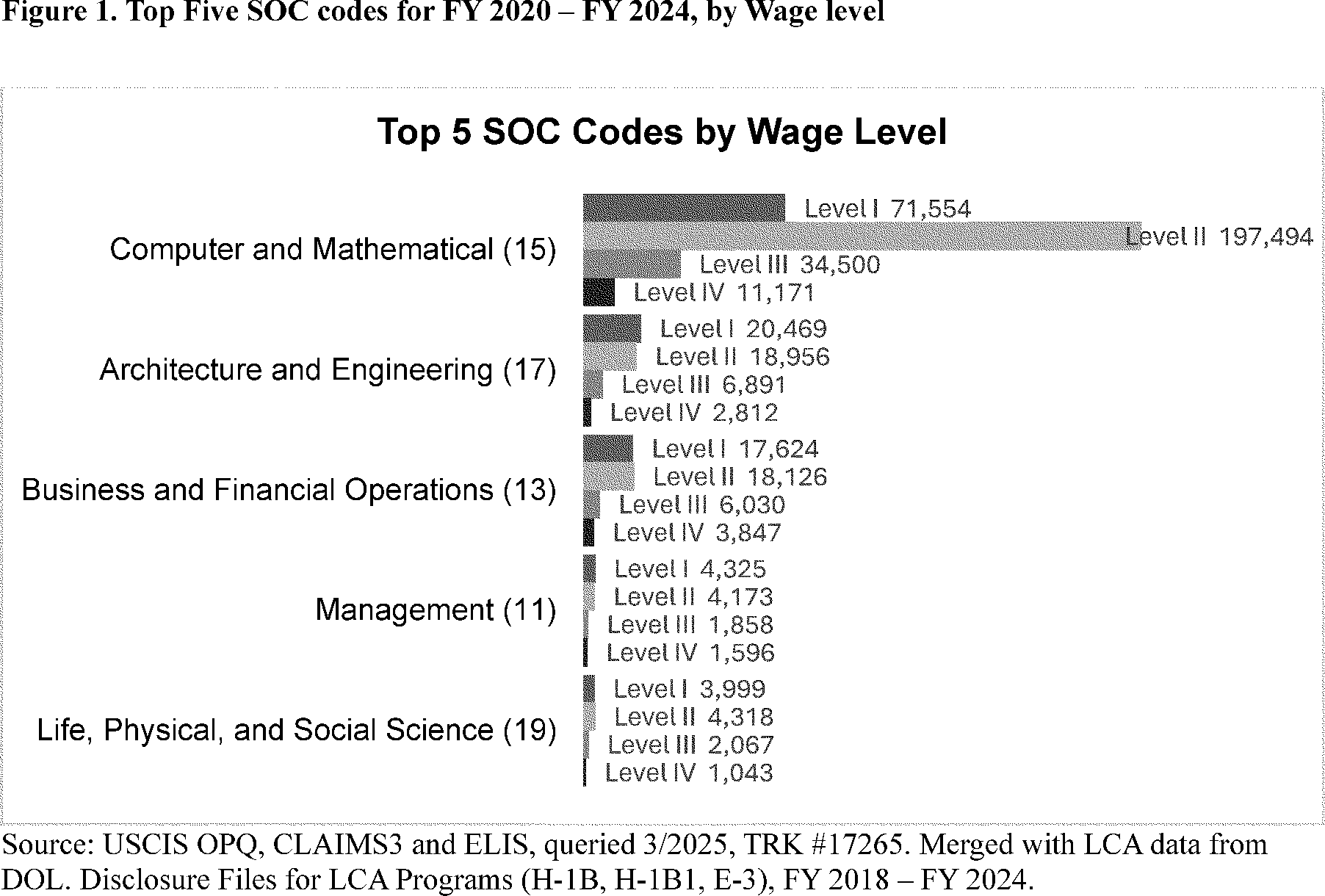
Given that the analysis estimates a 48 percent drop in selections for wage level I beneficiaries, the distribution of wage levels at the SOC code will determine the effects of the proposed rule for occupations under that SOC code. DHS examines these effects for the top two SOC major group codes (15 and 17) by breaking out the distribution into 6-digit SOC codes. The results are summarized in Figure 2 and Figure 3.
Of the 470,023 H-1B cap-subject petitions received in FY 2020-FY 2024, 69 percent (326,000) were associated with SOC major group 15 (Computer and Mathematical Occupations). This major occupation group contains 460 distinct 6-digit SOC codes, each corresponding to a different detailed occupation. Examples of detailed occupations include 15-1252 (Software Developers) and 15-2051 (Data Scientists). The top five detailed occupations make up 71 percent of the 326,000 petitions received under SOC major group 15. Figure 2 details the counts for these five detailed occupations, separated by whether they were grouped at wage level I or at one of the higher wage levels (II, III, IV). As Figure 2 shows, all detailed occupations under SOC major group 15 have counts of petitions in wage level I and in higher wage levels except 15-2041 (Statistician).
The proposed rule does not project a significant increase in the selection of higher wage level workers in the 15-2041 (Statistician) occupation.[79] SOC code 15-1299 (Computer Occupations, All Other) is also one of the notable exceptions—there were no petitions with wage level I in this category. SOC code 15-1299 is used to encompass detailed occupations that do not have a specific code within the broad group. The proposed rule would have material effects on these detailed occupations since registrations under this code would receive a large boost in probability that they are selected.
( printed page 46008)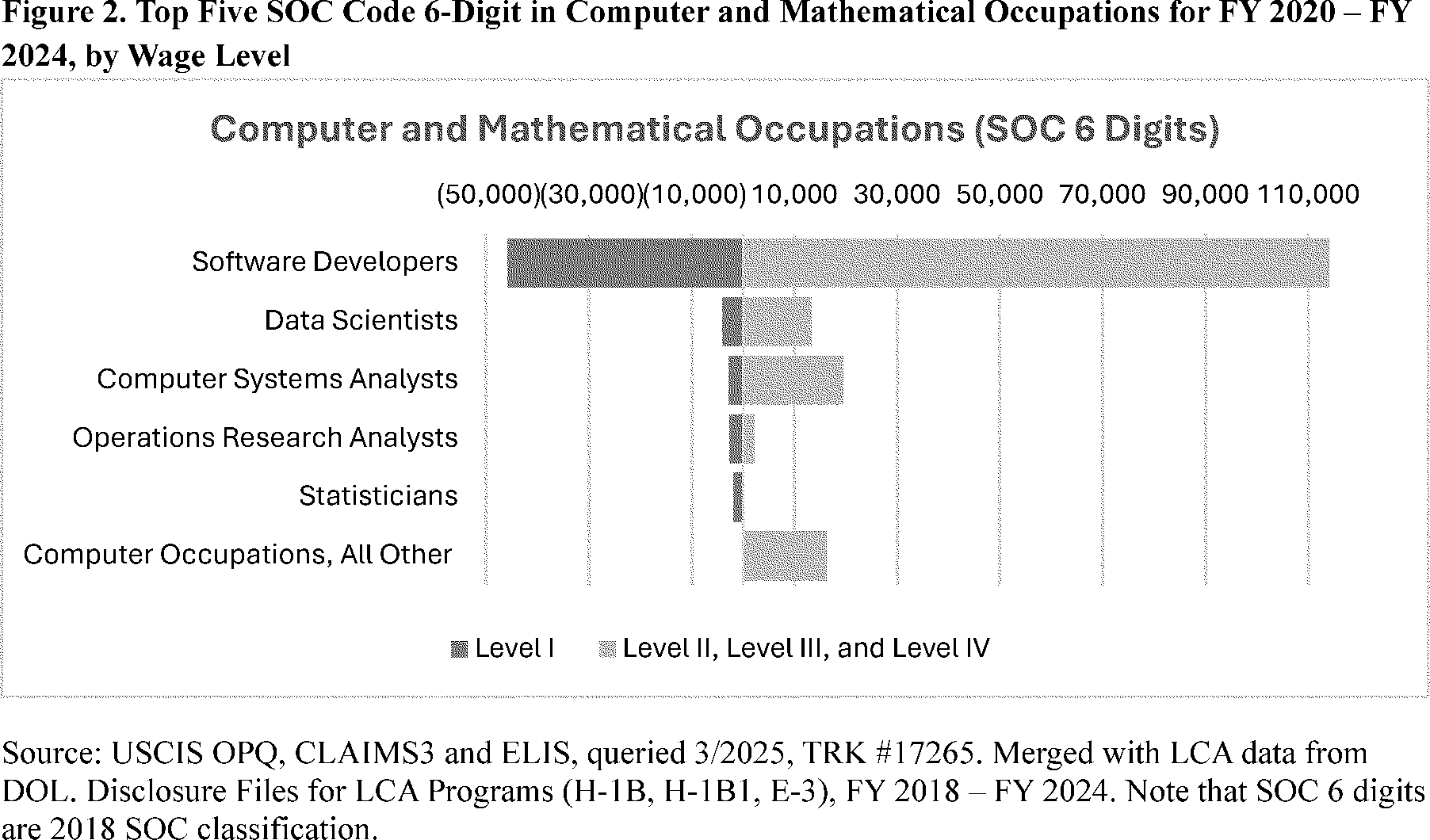
After SOC major group code 15, the major group with the next greatest number of petitioners is SOC major group code 17 (Architecture and Engineering Occupations). This major group had 52,402 petitions filed in FY 2020 through FY 2024. Figure 3 details the counts for the five detailed occupations within SOC major group code 17 that had the greatest number of petitions in FY 2020 through FY 2024. As for SOC major group code 17, many of these occupations have petition counts in wage level I and in higher wage levels. SOC code 17-2051 (Civil Engineers) and 17-1011 (Architects, Except Landscape and Naval) are also a notable exception since all the petitions under this code in the figure were wage level I. The proposed rule would reduce the number of selected H-1B registrations for Civil Engineers and Architects by up to 48 percent, assuming such registrations would be submitted at wage level I consistent with historical LCA wage level data for Civil Engineers.[80] On the other hand, the proposed rule would likely increase the number of selected H-1B registrations for SOC code 17-2072 (Electronics Engineers except Computer), SOC code 17-2131 (Materials Engineers), and 17-2100 (Engineers, All Other) since these detailed occupations are not expected to contain any wage level I registrations, assuming such registrations would be submitted at higher wage levels consistent with historical LCA wage level data for these occupations.[81]
( printed page 46009)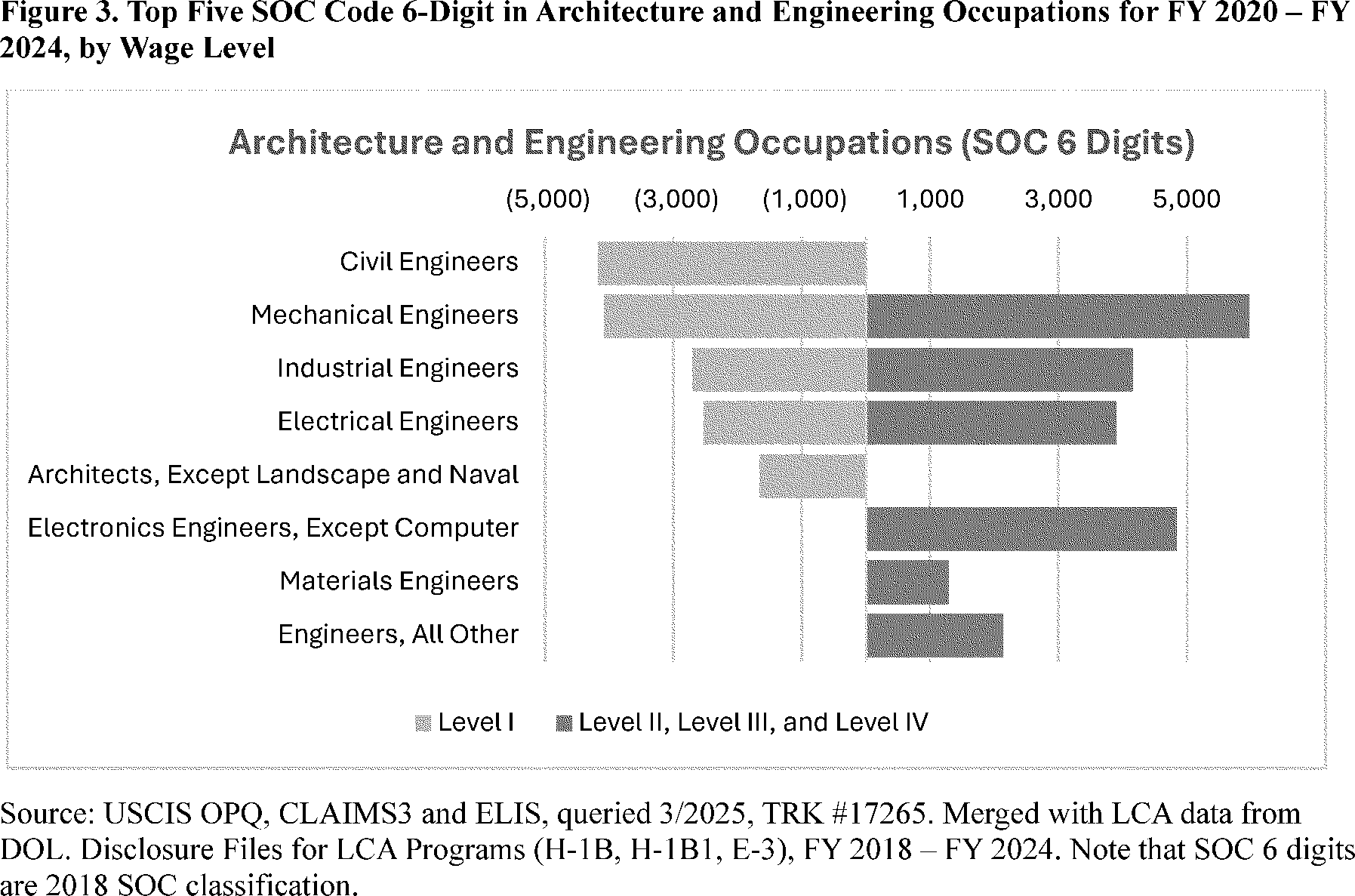
Most of the petitions are filed with the same top 6-digit SOC codes across wage levels, with several exceptions. The proposed rule projects that almost half of the registrations for beneficiaries with a proffered wage that corresponds to a wage level I typically associated with entry-level workers would not be selected but registrations for beneficiaries with a proffered wage that corresponds to a higher wage level typically associated with more experienced workers would be selected in the same occupational categories.[82] However, for certain occupations that have historically included only petitions for level I positions, such as Civil Engineers or Architects, except Landscape and Naval, the proposed rule does not project a significant increase in the selection of higher wage level workers in the same occupations.[83] Instead, the proposed rule projects increased distribution in occupations that have historically included petitions for higher wage level positions, such as Computer Occupations (all other), Electronics Engineers (except computer), Materials Engineers, or Engineers, All Other shown in Figure 2 and Figure 3. Therefore, DHS expects that the proposed rule would impact the occupational distribution of H-1B workers.
A prospective petitioner (employer) may respond to the proposed rule in several ways. An employer could choose to increase the proffered wage to increase the probability of getting its H-1B registration selected. If employers choose to increase the proffered wage, or if employers were already offering a salary corresponding to a higher wage level, then this proposed rule might result in more registrations (or petitions, if registration is suspended) with a proffered wage that would correspond to wage level II, III, or IV, and fewer registrations corresponding to wage level I. It is also possible that an employer may choose not to make any changes in response to this rule, especially those employers that were already offering a salary corresponding to a higher wage level.
Other prospective employers may leave the position vacant if the alien beneficiary they registered is not selected, because they would not be able to justify raising the proffered wage to an amount that corresponds to a higher wage level and that would have improved their chance of selection. These employers might be unable to fill their position(s). And other employers might incur additional costs to find available replacement workers, such as by seeking out and/or training other workers.[84]
The effects of this rulemaking on any given employer would depend in part on the interaction of a number of complex variables that constantly are in flux, including national, state, and local labor market conditions, economic and business factors, the type of occupations and skills involved, and the substitutability between H-1B workers and U.S. workers.
DHS acknowledges costs incurred associated with loss of output from not being able to employ the labor of H-1B beneficiaries. Costs incurred associated with loss of potential output will be discussed as a transfer later in this section. ( printed page 46010)
Table 15 shows quantified economic impacts of the proposed rule. To estimate the economic impact of the proposed rule, DHS uses the average annual salary of H-1B cap-subject workers by wage level in FY 2024. In Table 15, the average annual salary for wage level I is $85,006, for wage level II is $103,071, for wage level III is $131,454, and for wage level IV is $162,528. The estimated total annual salary paid to H-1B cap-subject workers under the current selection process in FY 2024 dollars would be $8,862,595,799. However, under the proposed weighted selection process, the estimated total annual salary paid to initial H-1B cap-subject workers would increase because there would be fewer wage level I workers and more wage level II, III, and IV workers. DHS estimates that the total annual salaries paid to H-1B workers would increase by $502,080,486 to $9,364,676,285. The $502 million increase is the estimated quantifiable economic benefit resulting from the proposed rule in the first year.
| Level I | Level II | Level III | Level IV | Total | |
|---|---|---|---|---|---|
| Estimated Annual H-1B Cap-Subject Visa Granted (Random) | 23,830 | 46,968 | 10,052 | 4,150 | 85,000 |
| Estimated Annual H-1B Cap-Subject Visa Granted (Weighted) | 13,731 | 49,342 | 14,548 | 7,379 | 85,000 |
| Difference in Estimated Annual H-1B Cap-Subject Visa Granted between Random and Weighted Selection | −10,099 | 2,373 | 4,496 | 3,230 | 0 |
| Average Annual Salary of H-1B Workers | $85,006 | $103,071 | $131,454 | $162,528 | |
| Estimated Total Annual Salary Paid to H-1B Cap-Subject Workers (Random) * | $2,025,655,768 | $4,841,088,469 | $1,321,409,280 | $674,442,282 | $8,862,595,799 |
| Estimated Total Annual Salary Paid to H-1B Cap-Subject Workers (Weighted) * | $1,167,185,470 | $5,085,685,684 | $1,912,441,622 | $1,199,363,508 | $9,364,676,285 |
| Benefits ** | $858,470,298 | $244,597,215 | $591,032,342 | $524,921,226 | $502,080,486 |
| Transfers *** | $858,470,298 | ||||
| Source: USCIS analysis. USCIS OPQ, CLAIMS3 and ELIS, queried 3/2025, TRK #17265. Merged with LCA data from DOL. Disclosure Files for LCA Programs (H-1B, H-1B1, E-3), FY 2018-FY 2024. DOL data downloaded from https://www.dol.gov/agencies/eta/foreign-labor/performance. | |||||
| Estimated Total Annual Salary Paid to H-1B Cap-Subject Workers *: Multiplying Estimated Annual H-1B Cap-Subject Petition Approved by Average Annual Salary of H-1B Workers for Random or Weighted. | |||||
| Benefit **: Difference between estimated total annual salary paid to H-1B cap-subject workers for weighted and random selection process. $502,080,486 640 = $9,364,676,285−$8,862,595,799. | |||||
| Transfer ***: Total annual salary paid to level I workers under random selection process who no longer work. This annual salary is transferred to level II, level III, and level IV workers for part of their annual salary under proposed selection process. $858,470,298 = $2,025,655,768−$1,167,185,470 204. | |||||
The maximum initial granted period of stay for the H-1B status is three years, with extensions for up to three years thereafter. Using FY2022 through FY2024 data, DHS estimates the validity period of approved H-1B cap-subject petitions to be 2.9 years for the initial period and 2.2 years for an extension.[85] Assuming all H-1B cap-subject workers stay for the initial granted period of 2.9 years and half of them extend their stay for 2.2 years, the average H-1B cap-subject worker's duration of H-1B status is approximately 4 years.[86] DHS recognizes that H-1B extensions vary across petitions and workers. For purposes of this analysis, DHS believes it appropriate to assume the average H-1B cap-subject worker's duration of H-1B status is 4 years to estimate the benefits and transfers of the proposed rule.
The estimated economic benefits in the first year when the new registration selection process is in effect is approximately $502 million. Assuming H-1B cap-subject workers work an average of four years in U.S., these benefits will accrue for three additional years. The benefits in the second year would be about $1,004 million, which includes the initial $502 million in benefits accrued from new H-1B cap-subject workers with higher wages in the first year plus an estimated $502 million in benefits accrued from H-1B cap-subject workers in the second year. Similarly, the benefits in years 3 and 4 are $1,506 million and $2,008 million reflecting granted H-1B cap-subject workers in the current and prior three years.
In addition to the $502 million in first-year benefits discussed previously, the $9.4 billion in first-year H-1B wages resulting from the proposed rule also contains a transfer from wage level I workers to wage level II, III, and IV workers. When a regulation generates a gain for one group and an equal-dollar-value loss for another group, the regulation is said to cause a transfer from the latter group to the former.[87] When H-1B allocations change from wage level I workers to higher wage level workers, the benefits of the H-1B classification are transferred from wage level I workers to higher wage level workers. For example, if a wage level IV worker whose annual salary is $160,000 is selected instead of a wage level I worker whose annual salary is $85,000, then $85,000 of benefits is transferred from the wage level I worker to the wage level IV worker (the difference of $75,000 is a benefit to the level IV worker). DHS estimates that transfers from wage level I workers to other wage level workers would be $858,470,298 in the first year under the proposed rule.
Assuming H-1B cap-subject workers work an average of four years, transfers would also accrue for three additional years. The transfers in the second year would be approximately $1,717 million and in years 3 and 4 the transfers would be about $2,575 million and $3,434 million, respectively. In years 5 and beyond, the transfers would be approximately $3,434 million. These transfers are the costs incurred associated with loss of output from not being able to employ the labor of wage level I H-1B workers for the employers who registered H-1B workers at wage level I. Whereas the transfers are a benefit to the employers who registered H-1B workers at higher wage levels because they would expect gains in output by being able to employ H-1B workers. To the extent that benefits and transfers are estimated using LCA data, and proffered wages may exceed the wage levels indicated on the LCA, the projections in this discussion would represent the upper bound of the impact of the proposed rule.
There is an unquantifiable transfer from the employers who would lose an opportunity to hire wage level I H-1B workers to the employers who would gain an opportunity to hire higher wage level workers in terms of output produced. When an employer gets into ( printed page 46011) an economic activity of hiring workers and producing output, they would expect the output to at least recover the labor cost of hiring workers. DHS is not able to quantify this producer surplus. According to this analysis, half of the employers who hire H-1B workers at wage level I would lose the opportunity to gain the surplus under the proposed rule. This gained surplus would be transferred to the employers who would have an opportunity to hire workers at higher wage levels.
By engaging in a wage-level-based weighting of registrations for unique beneficiaries, DHS would increase the chances that initial H-1B visas and status grants would go to higher skilled or higher paid beneficiaries. Facilitating the admission of higher skilled workers “would benefit the economy and increase the United States' competitive edge in attracting the `best and the brightest' in the global labor market,” [88] consistent with the goals of the H-1B program.
Required Information on the Petition
Unless registration is suspended, a petitioner may file an H-1B petition for a beneficiary who may be counted under section 214(g)(1)(A) of the Act, or eligible for exemption under section 214(g)(5)(C) of the Act, only if the petition is based on a valid registration. See8 CFR 214.2(h)(8)(iii)(A)( 1). An H-1B petition filed on behalf of a beneficiary would be required to contain and be supported by the same identifying information and position information, including SOC code, provided in the selected registration. See proposed 8 CFR 214.2(h)(8)(iii)(D)( 1). Such petition would be required to include a proffered wage that equals or exceeds the prevailing wage for the corresponding OEWS wage level in the registration for the SOC code in the area(s) of intended employment as indicated on the LCA used to support the petition. Id. Petitioners would be required to submit evidence of the basis of the wage level selected on the registration as of the date that the registration underlying the petition was submitted. Id.
This proposed change would add additional questions for petitioners for both H-1B and H-1B1 Data Collection and Filing Fee Exemption Supplement (paper and online e-file). DHS estimates that these additional questions would increase the time burden by 15 minutes for each petition (0.25 hours) for all H-1B petitions, not just H-1B cap-subject petitions, because these requirements would apply to any H-1B petitions. The proposed change would offer qualitative benefits. Specifically, submission of additional information on the petition form (including wage level information and the SOC code), and evidence of the basis of the wage level selected, would allow USCIS to further improve the integrity of the H-1B cap selection and adjudication processes.
Based on a 5-year annual average from Table 16, DHS estimates the annual average H-1B petition receipts is 423,056. The 5-year annual average of Form I-129 H-1B receipts with Form G-28 is 336,845.
| H-1B Petitions received | H-1B Petition received with Form G-28 | Percent with Form G-28 | |
|---|---|---|---|
| 2020 | 427,916 | 337,576 | 79 |
| 2021 | 398,935 | 319,570 | 80 |
| 2022 | 475,040 | 385,997 | 81 |
| 2023 | 386,952 | 304,760 | 79 |
| 2024 | 426,438 | 336,321 | 79 |
| 5-year Total | 2,115,281 | 1,684,224 | 80 |
| 5-year Annual Average | 423,056 | 336,845 | 80 |
| Source: USCIS OPS, PRD, CLAIMS3, ELIS, and National Production Dataset (NPD) queried 4/2025. | |||
DHS does not know the exact number of petitioners who will choose an in-house or an outsourced lawyer but assumes it may be a 50/50 split and therefore provides an average. Table 17 shows the additional annual average cost for a lawyer to complete the petition on behalf of a petitioner. The additional opportunity cost of time for completing and submitting an H-1B petition using an attorney or other representative is estimated to range from $10,359,668 to $17,861,206 with an average of $14,110,437.
| Population submitting with a lawyer | Time burden to complete H-1B petition (hours) | Cost of time | Total current opportunity cost | |
|---|---|---|---|---|
| A | B | C | D = (A × B × C) | |
| In-house lawyer | 336,845 | 0.25 | $123.02 | $10,359,668 |
| Outsourced lawyer | 336,845 | 0.25 | 212.10 | 17,861,206 |
| ( printed page 46012) | ||||
| Average | 14,110,437 | |||
| Source: USCIS analysis. | ||||
To estimate the current remaining opportunity cost of time for an HR specialist submitting an H-1B petition without a lawyer, DHS applies the estimated increased public reporting time burden 15 minutes (0.25 hours) to the compensation rate of an HR specialist. Table 18 estimates the current total annual opportunity cost of time to HR specialists completing and submitting an H-1B petition would be approximately $1,142,942.
| Population | Time burden to complete H-1B petition (hours) | HR specialist's opportunity cost of time | Total opportunity cost of time | |
|---|---|---|---|---|
| A | B | C | D = (A × B × C) | |
| Estimate of H-1B Petitions | 86,211 | 0.25 | $53.03 | $1,142,942 |
| Source: USCIS analysis. Note that 86,211, the number of petitions filed by an HR specialist, is 423,056, the total number of petitions, minus 336,845, the number of petitions filed with a Form G-28. | ||||
DHS estimates the additional total annual cost for attorneys and HR specialists to complete and submit an H-1B petition would be $15,253,379 as shown in Table 19.
| Additional Average Opportunity Cost of Time for Lawyers to Complete an H-1B Petition | 14,110,437 |
| Additional Average Opportunity Cost of Time for HR Specialist to Complete an H-1B Petition | 1,142,942 |
| Total | 15,253,379 |
| Source: USCIS analysis. | |
Process Integrity
DHS proposes to revise 8 CFR 214.2(h)(10)(ii) to clarify that a valid registration must represent a bona fide job offer. The proposed rule would also require an H-1B petition filed after registration selection to contain and be supported by the same identifying information and position information, including SOC code, provided in the selected registration and indicated on the LCA used to support the petition. See proposed 8 CFR 214.2(h)(8)(iii)(D)( 1). Such petition must also include a proffered wage that equals or exceeds the prevailing wage for the corresponding OEWS wage level in the registration for the SOC code in the area(s) of intended employment as described in 8 CFR 214.2(h)(8)(iii)(A)( 4)( i). Id.
The proposed rule would allow USCIS to deny a subsequent new or amended petition filed by the petitioner, or a related entity, on behalf of the same beneficiary if USCIS were to determine that the filing of the new or amended petition was part of the petitioner's attempt to unfairly increase the odds of selection during the registration (or petition, if applicable) selection process, such as by reducing the proffered wage to an amount that would be equivalent to a lower wage level than that indicated on the original registration or petition. See proposed 8 CFR 214.2(h)(10)(iii). In this context, attempting to “unfairly increase the odds of selection” generally refers to attempting to derive the benefit from the increased chance of selection associated with a higher corresponding wage level without having a bona fide job offer at the corresponding wage level attested to during registration. Additionally, a new or amended petition containing a proffered wage equivalent to a lower wage level than that indicated on the original registration or petition may reveal an attempt to “unfairly increase the odds of selection” or indicate that the registration or petition did not in fact represent a bona fide job offer, which would violate the requirement that a valid registration represents a bona fide job offer.
As is currently required, the entity submitting a registration or petition would be required to certify the veracity of the contents of such submissions. DHS estimates that the proposed rule could lead to an increase in the number of denials or revocations of H-1B petitions. DHS cannot quantify this impact. The proposed changes in process integrity would lead to improved program integrity for USCIS. ( printed page 46013)
Alternative Considered
DHS considered proposing the methodology from the 2020 H-1B Selection NPRM (85 FR 69236 (Nov. 2, 2020)) and the 2021 H-1B Selection Final Rule (86 FR 1676 (Jan. 8, 2021)). Under the 2021 H-1B Selection Final Rule, USCIS would have ranked and selected registrations generally based on the highest prevailing wage level. The rule was expected to result in the likelihood that registrations for level I wages would not be selected, as well as a reduced likelihood that registrations for level II would be selected. As discussed earlier in this preamble, DHS believes the selection process finalized under the 2021 H-1B Selection Final Rule was a reasonable approach to facilitate the admission of higher skilled or higher paid workers. However, DHS believes that rule did not capture the optimal approach because it effectively left little or no opportunity for the selection of lower wage level or entry level workers, some of whom may still be highly skilled. Accordingly, DHS is instead proposing a wage-level-based weighting of registrations for unique beneficiaries to better ensure that initial H-1B visas and status grants would more likely go to the highest skilled or highest paid beneficiaries, while not effectively precluding those at lower wage levels.
DHS requests comments on, including potential alternatives to, the proposed weighted selection process.
Total Quantified Costs, Benefits, and Transfers of the Proposed Regulatory Changes
In this section, DHS presents the total annual costs, benefits, and transfers annualized over a 10-year period of analysis. DHS summarizes the annual costs, benefits, and transfers (undiscounted) of this proposed rule in Table 20. DHS estimates the total annual cost would be $30,389,592 for FY 2026 through FY 2035. In Table 20, DHS estimates the total annual benefit would be $502,080,486 in FY2026, $1,004,160,972 in FY2027, $1,506,241,458 in FY2028, and $2,008,321,944 in each year from FY2029 through FY2035. DHS estimates annual transfers (undiscounted) would be $858,470,298 in FY2026, $1,716,940,595 in FY2027, $2,575,410,893 in FY2028, and $3,433,881,191 in each year from FY2029 through FY2035. The net benefit would be calculated by subtracting the cost from the benefit each year. 10-Year undiscounted total net benefits to the public of $16,766,840,602 are the total benefits minus total costs.[89]
| Description | Costs | Benefits | Net benefits | Transfers |
|---|---|---|---|---|
| Required Information on the Registration and the Petition | $15,136,213 | |||
| Weighting and Selecting Registrations | $502,080,486 | $858,470,298 | ||
| H-1B Cap-Subject Petition Filing Following Registration | 15,253,379 | |||
| First Year Total (FY 2026) | 30,389,592 | 502,080,486 | $471,690,894 | 858,470,298 |
| FY2027 | 30,389,592 | 1,004,160,972 | 973,771,380 | 1,716,940,595 |
| FY2028 | 30,389,592 | 1,506,241,458 | 1,475,851,866 | 2,575,410,893 |
| FY2029-FY2035 | 30,389,592 | 2,008,321,944 | 1,977,932,352 | 3,433,881,191 |
| 10 Year Total | 303,895,920 | 17,070,736,522 | 16,766,840,602 | 29,187,990,123 |
| Source: USCIS analysis. Note that costs are measured in FY 2023 dollars using BLS wages, but benefits and transfers are measured in average of FY 2023 and FY 2024 dollars using filed LCA wages. | ||||
Table 21 illustrates that over a 10-year period of analysis of the proposed rule, DHS estimates that annualized net benefits would be $1,641,672,688 discounted at 3 percent and $1,594,278,713 discounted at 7 percent. Table 21 also shows that over a 10-year period of analysis of the proposed rule, that annualized transfers would be $2,858,935,655 discounted at 3 percent and $2,777,900,203 discounted at 7 percent.
| 10-Year undiscounted | Total estimated benefits | Total estimated net benefits | Total estimated transfers | |||
|---|---|---|---|---|---|---|
| Fiscal year | $17,070,736,522 | $16,766,840,602 | $29,187,990,123 | |||
| Discounted at 3 percent | Discounted at 7 percent | Discounted at 3 percent | Discounted at 7 percent | Discounted at 3 percent | Discounted at 7 percent | |
| 2026 | $487,456,782 | $469,234,099 | $457,952,324 | $440,832,611 | $833,466,308 | $802,308,689 |
| 2027 | 946,518,024 | 877,073,082 | 917,872,919 | 850,529,636 | 1,618,381,181 | 1,499,642,410 |
| 2028 | 1,378,424,307 | 1,229,541,704 | 1,350,613,525 | 1,204,734,745 | 2,356,865,798 | 2,102,302,444 |
| 2029 | 1,784,368,035 | 1,532,139,195 | 1,757,367,276 | 1,508,955,121 | 3,050,958,962 | 2,619,691,519 |
| 2030 | 1,732,396,151 | 1,431,905,790 | 1,706,181,822 | 1,410,238,431 | 2,962,096,080 | 2,448,309,831 |
| 2031 | 1,681,938,010 | 1,338,229,710 | 1,656,487,205 | 1,317,979,842 | 2,875,821,437 | 2,288,140,029 |
| 2032 | 1,632,949,525 | 1,250,681,972 | 1,608,240,005 | 1,231,756,862 | 2,792,059,647 | 2,138,448,625 |
| 2033 | 1,585,387,888 | 1,168,861,656 | 1,561,398,063 | 1,151,174,637 | 2,710,737,522 | 1,998,550,117 |
| 2034 | 1,539,211,542 | 1,092,394,071 | 1,515,920,450 | 1,075,864,147 | 2,631,784,002 | 1,867,803,848 |
| 2035 | 1,494,380,138 | 1,020,929,039 | 1,471,767,427 | 1,005,480,511 | 2,555,130,099 | 1,745,611,073 |
| 10-year Total | 14,263,030,402 | 11,410,990,319 | 14,003,801,018 | 11,197,546,541 | 24,387,301,036 | 19,510,808,586 |
| ( printed page 46014) | ||||||
| Annualized | 1,672,062,280 | 1,624,668,305 | 1,641,672,688 | 1,594,278,713 | 2,858,935,655 | 2,777,900,203 |
| Source: USCIS analysis. 10-Year Undiscounted Total Costs would be 303,895,920 and estimated annualized costs would be 30,389,592 discounted both at 3 percent and 7 percent. | ||||||
Costs to the Federal Government
DHS is proposing to revise the regulations governing the selection of registrations for unique beneficiaries submitted by prospective petitioners (also referred to as registrants) seeking to file H-1B cap-subject petitions (or the selection of petitions, if the registration process were suspended). This proposed rule would require updates to USCIS information technology (IT) systems and additional time spent by USCIS to review newly required information during the adjudication of the petition and maintain program integrity.
The INA provides for the collection of fees at a level that will ensure recovery of the full costs of providing adjudication and naturalization services by DHS, including administrative costs and services provided without charge to certain applicants and petitioners.[90] DHS establishes USCIS fees according to the estimated cost of adjudication based on its relative adjudication burden and use of USCIS resources. Fees are established at an amount that is necessary to recover these assigned costs, such as clerical, officer, and managerial salaries and benefits, plus an amount to recover unassigned overhead ( e.g., facility rent, information technology equipment and systems) and immigration benefits provided without a fee charge. These costs would be captured in the fees collected for the benefit request from petitioners. DHS established the current fee for H-1B registrations and petitions in its FY2024 fee rule based on empirical cost estimates. DHS notes that if the proposed rule increases USCIS' costs, then the fee schedule adjustment would be determined at USCIS' next comprehensive biennial fee review.
B. Regulatory Flexibility Act of 1980
Initial Regulatory Flexibility Analysis
The RFA, Public Law 96-354, as amended by the Small Business Regulatory Enforcement Fairness Act of 1996, Public Law 104-121, 5 U.S.C. 601 through 612, requires Federal agencies to consider the potential impact of regulations on small businesses, small governmental jurisdictions, and small organizations during the development of their rules. The term “small entities” comprises small businesses, not-for-profit organizations that are independently owned and operated and are not dominant in their fields, and governmental jurisdictions with populations of less than 50,000.[91] An “individual” is not considered a small entity and costs to an individual are not considered a small entity impact for RFA purposes. In addition, the courts have held that the RFA requires an agency to perform a regulatory flexibility analysis of small entity impacts only when a rule directly regulates small entities.[92] Consequently, indirect impacts from a rule on a small entity are not considered as costs for RFA purposes. The RFA analysis for this proposed rule focuses on the population of employers who submit H-1B petitions (Form I-129, Petition for a Nonimmigrant Worker) and H-1B registrations.
1. A Description of the Reason Why the Action by the Agency Is Being Considered
DHS is proposing to amend its regulations governing H-1B specialty occupation workers. The purpose of the proposed changes is to better ensure that H-1B visas are more likely to be awarded to petitioners seeking to employ higher paid and higher skilled beneficiaries, while not effectively precluding those at lower wage levels. DHS believes these changes would disincentivize use of the H-1B program to fill relatively lower paid, lower skilled positions, better aligning the H-1B program with Congressional intent.
2. A Statement of the Objectives of, and Legal Basis for, the Proposed Rule
DHS's objectives and legal authority for this proposed rule are discussed earlier in the preamble.
3. A Description and, Where Feasible, an Estimate of the Number of Small Entities to Which the Proposed Changes Would Apply
For this analysis, DHS used internal data for employers filing H-1B cap-subject petitions for FY 2024 merged with LCA data.[93] DHS merged the internal employer data with SBA's table of size standards [94] to identify small entities and with LCA data [95] to identify wage levels for the petitions.
To determine whether an entity is small for purposes of the RFA, DHS first identified the entity's North American Industry Classification System code and then used SBA guidelines to classify the revenue or employee count threshold for each entity. Some entities were classified as small based on their annual revenue, and some by their number of employees. Approximately 20 percent of petitions were not matched using SBA table of size standards. These unmatched employers were considered small entities if their number of employees was less than 500.
Using FY 2024 internal data on actual filings of H-1B cap-subject petitions, there were 94,873 petitions filed. DHS recognized 23,452 unique entities and ( printed page 46015) was able to classify 22,453 as either small entities or not small entities. DHS determined that 76 percent of the total 22,453 unique entities that filed Form I-129 under the H-1B classification and cap-subject were small entities. See Table 22. The estimated annual number of small entities impacted by this proposed rule is 17,069.
| Unique entities | Number of small entities | Proportion of population (%) |
|---|---|---|
| 22,453 | 17,069 | 76 |
| Source: USCIS OPQ, CLAIMS3 and ELIS, queried 3/2025, TRK #17293. | ||
Table 23 shows the Top 10 NAICS Code for small entities filing H-1B cap-subject petitions for FY2024. The table shows the size standards for each NAICS code in millions of dollars or by number of employees. Of the top 10 NAICS codes three are related to the computer industry, and two are related to manufacturing. The remaining five top industries are engineering services, offices of lawyers, research and development in biotechnology, administrative management and general management consulting services, and computing infrastructure providers, data processing, web hosting, and related services.
| NAICS code | NAICS code description | Size standards in millions of dollars | Size standards in number of employees |
|---|---|---|---|
| 541511 | Custom Computer Programming Services | $34.0 | |
| 541512 | Computer Systems Design Services | 34.0 | |
| 541330 | Engineering Services | 25.5 | |
| 541519 | Other Computer Related Services | 34.0 | |
| 334413 | Semiconductor and Related Device Manufacturing | 1,250 | |
| 334111 | Electronic Computer Manufacturing | 1,250 | |
| 541110 | Offices of Lawyers | 15.5 | |
| 541714 | Research and Development in Biotechnology (except Nanobiotechnology) | 1,000 | |
| 541611 | Administrative Management and General Management Consulting Services | 24.5 | |
| 518210 | Computing Infrastructure Providers, Data Processing, Web Hosting, and Related Services | 40.0 |
Table 24 shows the number of H-1B cap-subject petitions filed by small entities for FY 2024 by wage level. Out of 94,873 H-1B petitions filed, DHS was able to classify the petitioners of 82,204 H-1B petitions as either small entities or not small entities and identify the number of petitions filed by such petitioners by wage level, as well as the percentage of petitions filed at each wage level by small entities. As shown in Table 24, more small entities filed petitions at wage levels I and II (61 percent and 47 percent) than at wage levels III and IV (25 percent and 29 percent).
| Level I | Level II | Level III | Level IV | Unknown | Total | |
|---|---|---|---|---|---|---|
| Small Entity | 16,904 | 18,056 | 2,279 | 1,136 | 410 | 38,785 |
| Not Small Entity | 10,734 | 20,075 | 6,814 | 2,762 | 3,034 | 43,419 |
| Total | 27,638 | 38,131 | 9,093 | 3,898 | 3,444 | 82,204 |
| % of Small | 61% | 47% | 25% | 29% | 12% | 47% |
| Source: USCIS OPQ, CLAIMS3 and ELIS, queried 3/2025, TRK #17293. Merged with OPQ TRK #17265 and LCA data from DOL. Disclosure Files for LCA Programs (H-1B, H-1B1, E-3), FY 2024. | ||||||
The quantifiable economic impact, represented as a percentage, for each small entity is the total quantified costs of the proposed changes divided by the entity's sales revenue. There are two sources of quantifiable costs. One is the opportunity cost of time to submit H-1B registrations or to file H-1B petitions, or both. This cost is relatively small, so it is not considered in this analysis. The other cost is the loss of output for employers who registered with wage level I but are not selected due to the change in the selection process by the proposed rule and thus are unable to file an H-1B petition. DHS estimates the loss of output as a transfer, $858,470,298, from the lost wages of wage level I workers to those higher wage level workers. The loss of output from the loss of labor is considered as a cost to employers because less output means less profit. The loss of output from the loss of labor is estimated using the wage of the lost labor, which is the wage level I average annual salary, $85,006 (Table 15). Therefore, DHS projects that the proposed rule that some small entities who filed H-1B petitions at wage level I would incur costs of approximately $85,006.[96] This ( printed page 46016) assumes, solely for purposes of the IRFA, that the employer would be unable to otherwise fill the position or perform the work. Internal data show that there are 9,428 unique small entities that filed petitions at wage level I.[97]
DHS divides $85,006 by the revenue for each entity then finds that 5,193 small entities would experience a cost increase that is greater than 1 percent of its revenue and 2,665 would experience a cost increase that is greater than 5 percent of its revenue.[98] DHS considers an impact greater than 1 percent of a small entity's revenue as significant for purposes of the RFA. As such, DHS estimates that the proposed rule would result in a significant impact on 5,193 small entities, or 30 percent of the 17,069 small entities affected by the proposed rule. DHS considers 30 percent as a substantial number. This proposed rule would also benefit small entities that are applying for higher-earning employees as they would have a greater chance of their employees being selected compared to the current lottery system.
Based on this analysis, DHS believes that the proposed changes in this proposed rule would have a significant economic impact on a substantial number of small entities that file H-1B cap-subject petitions.
4. A Description of the Projected Reporting, Recordkeeping, and Other Compliance Requirements of the Proposed Rule, Including an Estimate of the Classes of Small Entities That Will Be Subject to the Requirement and the Types of Professional Skills Necessary for Preparation of the Report or Record
The proposed selection process would result in an additional burden to employers reporting additional information, including a beneficiary's appropriate wage level, SOC code, and area of intended employment in the registration system, on the Form I-129 petition, and on the H-1B and H-1B1 Data Collection and Filing Fee Exemption Supplement to Form I-129. DHS estimates the increased burden to submit an H-1B registration is 20 minutes and the increased burden to file the Form I-129, Petition for Nonimmigrant Worker, to request H-1B classification is 15 minutes. DHS believes this would be completed by an HR specialist, in-house lawyer, or outsourced lawyer.
5. An Identification of All Relevant Federal Rules, to the Extent Practical, That May Duplicate, Overlap, or Conflict With the Proposed Rule
DHS is unaware of any duplicative, overlapping, or conflicting Federal rules, but invites the public to provide comments and information regarding any such rules.
6. A Description of Any Significant Alternatives to the Proposed Rule That Accomplish the Stated Objectives of Applicable Statutes and That Minimize Any Significant Economic Impact of the Proposed Rule on Small Entities
While the collection of additional information and the change to a weighted selection process would impose a burden on some prospective employers, USCIS found no other alternatives that achieved the stated objectives with less burden to small entities.
Under the 2021 H-1B Selection Final Rule, USCIS would have ranked and selected registrations generally based on the highest prevailing wage level. The rule was expected to result in the likelihood that registrations for level I wages would not be selected, as well as a reduced likelihood that registrations for level II would be selected. Compared to the proposed rule, DHS believes that this approach would have an even greater negative effect on small businesses hiring lower wage level or entry level workers.
As stated earlier in this analysis, this proposed rule, if finalized as proposed, would also benefit small entities that are applying for higher-earning employees who would be weighted at level IV or level III as they would have a greater chance of their employees being selected compared to the current random selection process. Thus, it is possible that any alternative that imposes a lower burden on small entities generally could also reduce those employers' chance of selection for higher wage level workers. For example, if USCIS were to artificially elevate the corresponding wage level for small businesses compared to other businesses, such an alternative could actually decrease the likelihood that those small entities' registrations with a level IV wage would be selected, relative to the selection process under the proposed rule, if other small businesses are artificially elevated to level IV equivalency based on factors other than the corresponding wage amount. Furthermore, given that 76 percent of unique cap-subject H-1B filers are small entities, and 47 percent of H-1B cap petitions in FY 2024 were filed by small entities, any alternative process that provides a different, preferential weighting scheme especially for small entities would undermine the overall utility of this proposed rule, which is to generally favor the allocation of H-1B visas to higher skilled and higher paid aliens. DHS requests comments on, including potential alternatives to, the proposed weighted selection process described in this preamble. In the RFA context, DHS seeks comments on alternatives that would accomplish the objectives of this proposed rule without unduly burdening small entities.
C. Unfunded Mandates Reform Act of 1995
The Unfunded Mandates Reform Act of 1995 (UMRA) is intended, among other things, to curb the practice of imposing unfunded Federal mandates on State, local, and Tribal governments. Title II of UMRA requires each Federal agency to prepare a written statement assessing the effects of any Federal mandate in a proposed rule, or final rule for which the agency published a proposed rule, that includes any Federal mandate that may result in a $100 million or more expenditure (adjusted annually for inflation) in any one year by State, local, and tribal governments, in the aggregate, or by the private sector.[99]
The inflation adjusted value of $100 million in 1995 is approximately $206 million in 2024 based on the Consumer Price Index for All Urban Consumers (CPI-U).[100] This proposed rule does not contain a Federal mandate as the term is defined under UMRA.[101] The requirements of title II of UMRA, therefore, do not apply, and DHS has not prepared a statement under UMRA.
( printed page 46017)D. Executive Order 13132 (Federalism)
This proposed rule would not have substantial direct effects on the States, on the relationship between the National Government and the States, or on the distribution of power and responsibilities among the various levels of government. Therefore, in accordance with section 6 of Executive Order 13132, it is determined that this proposed rule does not have sufficient federalism implications to warrant the preparation of a federalism summary impact statement.
E. Executive Order 12988 (Civil Justice Reform)
This proposed rule was drafted and reviewed in accordance with E.O. 12988, Civil Justice Reform. This proposed rule was written to provide a clear legal standard for affected conduct and was carefully reviewed to eliminate drafting errors and ambiguities, so as to minimize litigation and undue burden on the Federal court system. DHS has determined that this proposed rule meets the applicable standards provided in section 3 of E.O. 12988.
F. Executive Order 13175 (Consultation and Coordination With Indian Tribal Governments)
This proposed rule does not have “tribal implications” because it will not have substantial direct effects on one or more Indian Tribes, on the relationship between the Federal Government and Indian Tribes, or on the distribution of power and responsibilities between the Federal Government and Indian Tribes. Accordingly, E.O. 13175, Consultation and Coordination with Indian Tribal Governments, requires no further agency action or analysis.
G. National Environmental Policy Act
DHS and its components analyze proposed regulatory actions to determine whether the National Environmental Policy Act (NEPA), 42 U.S.C. 4321 et seq., applies to them and, if so, what degree of analysis is required. DHS Directive 023-01 Rev. 01 “Implementing the National Environmental Policy Act” (Dir. 023- 01 Rev. 01) and Instruction Manual 023-01-001-01 Rev. 01 (Instruction Manual) [102] establish the policies and procedures that DHS and its components use to comply with NEPA.
NEPA allows Federal agencies to establish, in their NEPA implementing procedures, categories of actions (“categorical exclusions”) that experience has shown do not, individually or cumulatively, have a significant effect on the human environment and, therefore, do not require an environmental assessment or environmental impact statement. See42 U.S.C. 4336(a)(2), 4336e(1). The Instruction Manual, Appendix A lists the DHS Categorical Exclusions.[103]
Under DHS NEPA implementing procedures, for an action to be categorically excluded, it must satisfy each of the following three conditions: (1) the entire action clearly fits within one or more of the categorical exclusions; (2) the action is not a piece of a larger action; and (3) no extraordinary circumstances exist that create the potential for a significant environmental effect.[104]
This proposed rule is limited to amending DHS's existing regulations at 8 CFR 214.2(h)(8), (10), and (11) to provide for the selection of unique beneficiaries toward the H-1B annual numerical limitations and the advanced degree exemption in a weighted manner based on the wage level listed in each H-1B registration that corresponds to the prospective petitioner's proffered wage. DHS has reviewed this proposed rule and finds that no significant impact on the environment, or any change in environmental effect, will result from the amendments being promulgated in this proposed rule.
Accordingly, DHS finds that the promulgation of this proposed rule's amendments to current regulations clearly fits within categorical exclusion A3 established in DHS's NEPA implementing procedures as an administrative change with no change in environmental effect, is not part of a larger Federal action, and does not present extraordinary circumstances that create the potential for a significant environmental effect.
H. Paperwork Reduction Act of 1995
Under the Paperwork Reduction Act of 1995 (PRA), 44 U.S.C. 3501-12, DHS must submit to OMB, for review and approval, any reporting requirements inherent in a rule unless they are exempt.
DHS and USCIS invite the general public and other Federal agencies to comment on the impact to the proposed collection of information. In accordance with the PRA, the information collection notice is published in the Federal Register to obtain comments regarding the proposed edits to the information collection instrument(s).
Comments are encouraged and will be accepted for 60 days from the publication date of the proposed rule. All submissions received must include the agency name and OMB Control Number in the body of the letter. Please refer to the ADDRESSES and I. Public Participation section of this proposed rule for instructions on how to submit comments. Comments on each information collection should address one or more of the following four points:
(1) Evaluate whether the collection of information is necessary for the proper performance of the functions of the agency, including whether the information will have practical utility;
(2) Evaluate the accuracy of the agency's estimate of the burden of the collection of information, including the validity of the methodology and assumptions used;
(3) Enhance the quality, utility, and clarity of the information to be collected; and
(4) Minimize the burden of the collection of information on those who are to respond, including through the use of appropriate automated, electronic, mechanical, or other technological collection techniques or other forms of information technology ( e.g., permitting electronic submission of responses).
H-1B Registration Tool (OMB Control No. 1615-0144)
(1) Type of Information Collection: Revision of a Currently Approved Collection.
(2) Title of the Form/Collection: H-1B Registration Tool.
(3) Agency form number, if any, and the applicable component of DHS sponsoring the collection: OMB-64; USCIS.
(4) Affected public who will be asked or required to respond, as well as a brief abstract: Primary: Business or other for-profit. USCIS uses the data collected on this form to determine which employers will be informed that they may submit a USCIS Form I-129, Petition for Nonimmigrant Worker, for H-1B classification.
(5) An estimate of the total number of respondents and the amount of time estimated for an average respondent to respond: The estimated total number of respondents for the information collection H-1B Registration Tool (Businesses) is 20,950 and the estimated hour burden per response is 0.9333 hours. The estimated total number of respondents for the information collection H-1B Registration Tool (Attorneys) is 19,339 and the estimated ( printed page 46018) hour burden per response is 0.9333 hours.
(6) An estimate of the total public burden (in hours) associated with the collection: The total estimated annual hour burden associated with this collection of information is 331,872 hours.
(7) An estimate of the total public burden (in cost) associated with the collection: The estimated total annual cost burden associated with this collection of information is $0.
Form I-129 (OMB Control No. 1615-0009)
(1) Type of Information Collection: Revision of a Currently Approved Collection.
(2) Title of the Form/Collection: Petition for Nonimmigrant Worker.
(3) Agency form number, if any, and the applicable component of DHS sponsoring the collection: I-129, E-1/E-2 Classification Supplement, Trade Agreement Supplement, H Classification Supplement, H-1B and H-1B1 Data Collection and Filing Fee Exemption Supplement, L Classification Supplement, O and P Classification Supplement, Q-1 Classification Supplement, and R-1 Classification Supplement; USCIS.
(4) Affected public who will be asked or required to respond, as well as a brief abstract: Primary: Business or other for-profit. USCIS uses Form I-129 and accompanying supplements to determine whether the petitioner and beneficiary(ies) is (are) eligible for the nonimmigrant classification. A U.S. employer, or agent in some instances, may file a petition for nonimmigrant worker to employ foreign nationals under the following nonimmigrant classifications: H-1B, H-2A, H-2B, H-3, L-1, O-1, O-2, P-1, P-2, P-3, P-1S, P-2S, P-3S, Q-1, or R-1 nonimmigrant worker. The collection of this information is also required from a U.S. employer on a petition for an extension of stay or change of status for E-1, E-2, E-3, Free Trade H-1B1 Chile/Singapore nonimmigrants and TN (United States-Mexico-Canada Agreement workers) who are in the United States.
(5) An estimate of the total number of respondents and the amount of time estimated for an average respondent to respond: The estimated total number of respondents for the information collection I-129 (paper filing) is 527,606 and the estimated hour burden per response is 2.55 hours. The estimated total number of respondents for the information collection I-129 (online electronic filing) is 45,000 and the estimated hour burden per response is 2.333 hours. The estimated total number of respondents for the information collection E-1/E-1 Classification Supplement is 12,050 and the estimated hour burden per response is 0.67 hours. The estimated total number of respondents for the information collection Trade Agreement Supplement (paper filing) is 10,945 and the estimated hour burden per response is 0.67 hours. The estimated total number of respondents for the information collection Trade Agreement Supplement (online electronic filing) is 2,000 and the estimated hour burden per response is 0.5833 hours. The estimated total number of respondents for the information collection H Classification (paper filing) is 426,983 and the estimated hour burden per response is 2.3 hours. The estimated total number of respondents for the information collection H Classification (online electronic filing) is 45,000 and the estimated hour burden per response is 2 hours. The estimated total number of respondents for the information collection H-1B and H-1B1 Data Collection and Filing Fee Exemption Supplement (paper filing) is 353,936 and the estimated hour burden per response is 1.25 hours. The estimated total number of respondents for the information collection H-1B and H-1B1 Data Collection and Filing Fee Exemption Supplement (online electronic filing) is 45,000 and the estimated hour burden per response is 1 hour. The estimated total number of respondents for the information collection L Classification Supplement is 40,358 and the estimated hour burden per response is 1.34 hours. The estimated total number of respondents for the information collection O and P Classification Supplement is 28,434 and the estimated hour burden per response is 1 hour. The estimated total number of respondents for the information collection Q-1 Classification Supplement is 54 and the estimated hour burden per response is 0.34 hours. The estimated total number of respondents for the information collection R-1 Classification Supplement is 6,782 and the estimated hour burden per response is 2.34 hours.
(6) An estimate of the total public burden (in hours) associated with the collection: The total estimated annual hour burden associated with this collection of information is 3,124,836 hours.
(7) An estimate of the total public burden (in cost) associated with the collection: The estimated total annual cost burden associated with this collection of information is $149,694,919.
List of Subjects and Regulatory Amendments
List of Subjects in 8 CFR Part 214
- Administrative practice and procedure
- Aliens
- Cultural exchange program
- Employment
- Foreign officials
- Health professionals
- Reporting and recordkeeping requirements
- Students
Accordingly, DHS proposes to amend chapter I of title 8 of the Code of Federal Regulations as follows:
PART 214—NONIMMIGRANT CLASSES
1. The authority citation for part 214 continues to read as follows:
2. Amend § 214.2 by:
a. Revising paragraphs (h)(8)(iii)(A)( 3), (h)(8)(iii)(A)( 4), (h)(8)(iii)(A)( 4)( i), (h)(8)(iii)(A)( 4)( ii), (h)(8)(iii)(A)( 5)( i), (h)(8)(iii)(A)( 5)( ii), (h)(8)(iii)(A)( 6)( i), (h)(8)(iii)(A)( 6)( ii), and (h)(8)(iii)(A)( 7);
b. Revising paragraph (h)(8)(iii)(D)( 1);
c. Revising paragraphs (h)(8)(iv)(B), (h)(8)(iv)(B)( 1), and (h)(8)(iv)(B)( 2);
d. Revising paragraph (h)(10)(ii);
e. Redesignating paragraphs (h)(10)(iii) and (h)(10)(iv) as paragraphs (h)(10)(iv) and (h)(10)(v);
f. Adding new paragraph (h)(10)(iii);
g. Revising paragraphs (h)(11)(iii)(A)( 6) and (h)(11)(iii)(A)( 7); and
h. Adding paragraph (h)(11)(iii)(A)( 8).
The revisions and additions read as follows:
(h) * * *
(8) * * *
(iii) * * *
(A) * * *
( 3) Initial registration period. The annual initial registration period will last a minimum of 14 calendar days and will start at least 14 calendar days before the earliest date on which H-1B cap-subject petitions may be filed for a particular fiscal year, consistent with paragraph (h)(2)(i)(J) of this section. USCIS will announce the start and end dates of the initial registration period on the USCIS website at www.uscis.gov for ( printed page 46019) each fiscal year. USCIS will announce the start of the initial registration period at least 30 calendar days in advance of such date.
( 4) Selecting registrations based on unique beneficiaries. Registrations will be counted based on the number of unique beneficiaries who are registered. The selection will be made via computer-generated selection based on unique beneficiary. Each unique beneficiary will only be counted once toward the numerical allocation projections, regardless of how many registrations were submitted for that beneficiary or how many times the beneficiary is entered in the selection pool as provided in paragraph (h)(8)(iii)(A)( 4)( ii) of this section. USCIS will separately notify each registrant that its registration on behalf of a beneficiary has been selected, and that the petitioner(s) may file a petition(s) for that beneficiary. A petitioner may file an H-1B cap-subject petition on behalf of a registered beneficiary only after the petitioner's properly submitted registration for that beneficiary has been selected for that fiscal year.
( i) Required information. On the registration, the registrant must select the highest Occupational Employment and Wage Statistics (OEWS) wage level that the beneficiary's proffered wage equals or exceeds for the relevant Standard Occupational Classification (SOC) code in the area(s) of intended employment. If the beneficiary's proffered wage is lower than OEWS wage level I, because it is based on a prevailing wage from another legitimate source (other than OEWS) or an independent authoritative source, the registrant must select “wage level I.” If the beneficiary will work in multiple locations, or in multiple positions if the registrant is an agent, the registrant must select the lowest corresponding OEWS wage level that the beneficiary's proffered wage will equal or exceed. If the beneficiary's proffered wage is expressed as a range, the registrant must select the OEWS wage level that the lowest wage in the range will equal or exceed. Where there is no current OEWS prevailing wage information for the beneficiary's proffered position, the registrant must select the OEWS wage level that corresponds to the requirements of the beneficiary's proffered position using the Department of Labor's prevailing wage guidance. The registrant must also provide the SOC code of the proffered position, the area of intended employment that served as the basis of the wage level selected on the registration, the beneficiary's valid passport or travel document information, and all other requested information, as well as make the necessary certifications, as specified on the registration form and instructions. Each beneficiary must only be registered under one valid passport or travel document, and if or when the beneficiary is abroad, the passport information or travel document information must correspond to the passport or travel document the beneficiary intends to use to enter the United States.
( ii) Weighted selection. If a random selection is necessary, USCIS will assign each unique beneficiary to the lowest OEWS wage level among all registrations submitted on the beneficiary's behalf and will enter each unique beneficiary into the selection pool in a weighted manner as follows: a beneficiary assigned wage level IV will be entered into the selection pool four times, a beneficiary assigned wage level III will be entered into the selection pool three times, a beneficiary assigned wage level II will be entered into the selection pool two times, and a beneficiary assigned wage level I will be entered into the selection pool one time.
( 5) * * *
( i) Fewer registrations than needed to meet the H-1B regular cap. At the end of the annual initial registration period, if USCIS determines that there are fewer unique beneficiaries on whose behalf registrations were properly submitted than needed to meet the H-1B regular cap, USCIS will notify all petitioners that have properly registered that their registrations have been selected. USCIS will keep the registration period open beyond the initial registration period, until it determines that it has received a sufficient number of registrations for unique beneficiaries to meet the H-1B regular cap. Once USCIS determines there is a sufficient number of properly registered unique beneficiaries to meet the H-1B regular cap, USCIS will no longer accept registrations for petitions subject to the H-1B regular cap under section 214(g)(1)(A) of the Act. USCIS will monitor the number of unique beneficiaries with properly submitted registrations and will notify the public of the date that USCIS has received the necessary number of registrations for unique beneficiaries (the “final registration date”). The day the public is notified will not control the applicable final registration date. If USCIS has received more registrations for unique beneficiaries on the final registration date than necessary to meet the H-1B regular cap under section 214(g)(1)(A) of the Act, USCIS will weight each unique beneficiary as described in paragraph (h)(8)(iii)(A)( 4)( ii) of this section and randomly select the number of unique beneficiaries deemed necessary to meet the H-1B regular cap.
( ii) Sufficient registrations to meet the H-1B regular cap during initial registration period. At the end of the initial registration period, if USCIS determines that there is more than a sufficient number of unique beneficiaries on whose behalf registrations were properly submitted to meet the H-1B regular cap, USCIS will no longer accept registrations under section 214(g)(1)(A) of the Act and will notify the public of the final registration date. USCIS will weight each unique beneficiary as described in paragraph (h)(8)(iii)(A)( 4)( ii) of this section and randomly select the number of unique beneficiaries deemed necessary to meet the H-1B regular cap.
( 6) * * *
( i) Fewer registrations than needed to meet the H-1B advanced degree exemption numerical limitation. If USCIS determines that there are fewer unique beneficiaries on whose behalf registrations were properly submitted than needed to meet the H-1B advanced degree exemption numerical limitation, USCIS will notify all petitioners that have properly registered that their registrations have been selected. USCIS will continue to accept registrations to file petitions for beneficiaries who may be eligible for the H-1B advanced degree exemption under section 214(g)(5)(C) of the Act until USCIS determines that there is a sufficient number of properly registered unique beneficiaries to meet the H-1B advanced degree exemption numerical limitation. USCIS will monitor the number of unique beneficiaries with properly submitted registrations and will notify the public of the date that USCIS has received the necessary number of registrations for unique beneficiaries (the “final registration date”). The day the public is notified will not control the applicable final registration date. If USCIS has received more registrations for unique beneficiaries on the final registration date than necessary to meet the H-1B advanced degree exemption numerical limitation under section 214(g)(1)(A) and 214(g)(5)(C) of the Act, USCIS will weight each unique beneficiary as described in paragraph (h)(8)(iii)(A)( 4)( ii) of this section and randomly select the number of unique beneficiaries deemed necessary to meet the H-1B advanced degree exemption numerical limitation.
( ii) Sufficient registrations to meet the H-1B advanced degree exemption numerical limitation. If USCIS determines that there is more than a sufficient number of unique ( printed page 46020) beneficiaries on whose behalf registrations were properly submitted to meet the H-1B advanced degree exemption numerical limitation, USCIS will no longer accept registrations that may be eligible for exemption under section 214(g)(5)(C) of the Act and will notify the public of the final registration date. USCIS will weight each unique beneficiary as described in paragraph (h)(8)(iii)(A)( 4)( ii) of this section and randomly select the number of unique beneficiaries deemed necessary to meet the H-1B advanced degree exemption numerical limitation.
(7) Increase to the number of beneficiaries projected to meet the H-1B regular cap or advanced degree exemption allocations in a fiscal year. Unselected properly submitted registrations for unique beneficiaries will remain on reserve for the applicable fiscal year. If USCIS determines that it needs to increase the number of registrations for unique beneficiaries projected to meet the H-1B regular cap or advanced degree exemption allocation, and select additional unique beneficiaries, USCIS will select from among the unique beneficiaries with properly submitted registrations that are on reserve a sufficient number to meet the H-1B regular cap or advanced degree exemption numerical limitation, as applicable. If all of the unique beneficiaries on reserve are selected and there are still fewer unique beneficiaries than needed to meet the H-1B regular cap or advanced degree exemption numerical limitation, as applicable, USCIS may reopen the applicable registration period until USCIS determines that it has received a sufficient number of registrations for unique beneficiaries projected as needed to meet the H-1B regular cap or advanced degree exemption numerical limitation. USCIS will monitor the number of properly registered unique beneficiaries and will notify the public of the date that USCIS has received the necessary number of registrations (the new “final registration date”). The day the public is notified will not control the applicable final registration date. When selecting additional unique beneficiaries under this paragraph (h)(8)(iii)(A)( 7), USCIS will select unique beneficiaries with properly submitted registrations in accordance with paragraphs (h)(8)(iii)(A)( 4) through ( 6) of this section. If the registration period will be reopened, USCIS will announce the start of the re-opened registration period on the USCIS website at www.uscis.gov.
(D) * * *
( 1) Filing procedures. In addition to any other applicable requirements, a petitioner may file an H-1B petition for a beneficiary who may be counted under section 214(g)(1)(A) of the Act or eligible for exemption under section 214(g)(5)(C) of the Act only if the petition is based on a valid registration, which means that the registration was properly submitted in accordance with § 103.2(a)(1) of this chapter, paragraph (h)(8)(iii) of this section, and the registration tool instructions; and was submitted by the petitioner, or its designated representative, on behalf of the beneficiary who was selected for that cap season by USCIS. A petitioner may not substitute the beneficiary named in the original registration or transfer the registration to another petitioner. An H-1B petition filed on behalf of a beneficiary must contain and be supported by the same identifying information and position information, including SOC code, provided in the selected registration and indicated on the labor condition application used to support the petition, and must include a proffered wage that equals or exceeds the prevailing wage for the corresponding OEWS wage level in the registration for the SOC code in the area(s) of intended employment as described in paragraph (h)(8)(iii)(A)( 4)( i) of this section. Petitioners must submit evidence of the basis of the wage level selected on the registration as of the date that the registration underlying the petition was submitted. Petitioners must also submit evidence of the passport or travel document used at the time of registration to identify the beneficiary. In its discretion, USCIS may find that a change in the beneficiary's identifying information in some circumstances would be permissible. Such circumstances could include, but are not limited to, a legal name change due to marriage or a change in passport number or expiration date due to renewal or replacement of a stolen passport, in between the time of registration submission and petition filing. In its discretion, USCIS may find that a change in the area(s) of intended employment would be permissible, provided such change is consistent with the requirement of a bona fide job offer at the time of registration as stated in paragraph (h)(10)(ii) of this section. USCIS may deny or revoke the approval of an H-1B petition that does not meet these requirements.
(iv) * * *
(B) Petition-based cap-subject selections in event of suspended registration process. In any year in which USCIS suspends the H-1B registration process for cap-subject petitions, USCIS will allow for the submission of H-1B petitions notwithstanding paragraph (h)(8)(iii) of this section and conduct a cap-subject selection process based on the petitions that are received. Each petitioner must select the highest OEWS wage level that the beneficiary's proffered wage equals or exceeds for the relevant SOC code in the area(s) of intended employment. If the beneficiary's proffered wage is lower than OEWS wage level I, because it is based on a prevailing wage from another legitimate source (other than OEWS) or an independent authoritative source, the petitioner must select “wage level I.” If the beneficiary will work in multiple locations, or in multiple positions if the petitioner is an agent, the petitioner must select the lowest corresponding OEWS wage level that the beneficiary's proffered wage will equal or exceed. Where there is no current OEWS prevailing wage information for the beneficiary's proffered position, the petitioner must select the appropriate wage level that corresponds to the requirements of the beneficiary's proffered position using the Department of Labor's prevailing wage guidance. If a random selection is necessary, each petition will be assigned the OEWS wage level selected in accordance with form instructions and will be entered into the selection pool in a weighted manner as follows: a petition assigned wage level IV will be entered into the selection pool four times, a petition assigned wage level III will be entered into the selection pool three times, a petition assigned wage level II will be entered into the selection pool two times, and a petition assigned wage level I will be entered into the selection pool one time. The selection will be made via computer-generated selection. Petitioners must submit evidence of the basis of the selected wage level as of the date the petition is submitted. USCIS will deny petitions indicating that they are exempt from the H-1B regular cap and the H-1B advanced degree exemption if USCIS determines, after the final receipt date, that they are not eligible for the exemption sought. If USCIS determines, on or before the final receipt date, that the petition is not eligible for the exemption sought, USCIS may consider the petition under the applicable numerical allocation and proceed with processing of the petition. If a petition is denied under this paragraph (h)(8)(iv)(B), USCIS will not return or refund filing fees.
( 1) H-1B regular cap selection in event of suspended registration process. ( printed page 46021) In determining whether there are enough H-1B cap-subject petitions to meet the H-1B regular cap, USCIS will consider all petitions properly submitted in accordance with § 103.2 of this chapter relating to beneficiaries who may be counted under section 214(g)(1)(A) of the Act, including those who may be eligible for exemption under section 214(g)(5)(C) of the Act. When calculating the number of petitions needed to meet the H-1B regular cap, USCIS will take into account historical data related to approvals, denials, revocations, and other relevant factors. USCIS will monitor the number of petitions received and will announce on its website the date that it receives the number of petitions projected as needed to meet the H-1B regular cap (the “final receipt date”). The date the announcement is posted will not control the final receipt date. If the final receipt date is any of the first five business days on which petitions subject to the H-1B regular cap may be received (in other words, if the numerical limitation is reached on any one of the first five business days that filings can be made), USCIS will weight each petition as described in paragraph (h)(8)(iv)(B) of this section and randomly select the number of petitions properly submitted during the first five business days deemed necessary to meet the H-1B regular cap.
( 2) Advanced degree exemption selection in event of suspended registration process. After USCIS has received a sufficient number of petitions to meet the H-1B regular cap and, as applicable, completed the random selection process of petitions for the H-1B regular cap, USCIS will determine whether there is a sufficient number of remaining petitions to meet the H-1B advanced degree exemption numerical limitation. When calculating the number of petitions needed to meet the H-1B advanced degree exemption numerical limitation, USCIS will take into account historical data related to approvals, denials, revocations, and other relevant factors. USCIS will monitor the number of petitions received and will announce on its website the date that it receives the number of petitions projected as needed to meet the H-1B advanced degree exemption numerical limitation (the “final receipt date”). The date the announcement is posted will not control the final receipt date. If the final receipt date is any of the first five business days on which petitions subject to the H-1B advanced degree exemption may be received (in other words, if the numerical limitation is reached on any one of the first five business days that filings can be made), USCIS will weight each petition as described in paragraph (h)(8)(iv)(B) of this section and randomly select the number of petitions properly submitted during the first five business days deemed necessary to meet the H-1B advanced degree exemption numerical limitation.
(10) * * *
(ii) Denial for statement of facts on the petition, H-1B registration, temporary labor certification, or labor condition application, or invalid H-1B registration. The petition will be denied if it is determined that the statements on the petition, the H-1B registration (if applicable), the application for a temporary labor certification, or the labor condition application were inaccurate, fraudulent, or misrepresented a material fact, including if the certifications on the registration are determined to be false. An H-1B cap-subject petition also will be denied if it is not based on a valid registration submitted by the petitioner (or its designated representative), or a successor in interest, for the beneficiary named or identified in the petition. A valid registration must represent a bona fide job offer.
(iii) Denial for attempt to unfairly increase the chance of selection. USCIS may deny a subsequent new or amended petition filed by the petitioner, or a related entity, on behalf of the same beneficiary, if USCIS determines that the filing of the new or amended petition is part of the petitioner's attempt to unfairly increase the chance of selection during the registration or petition selection process, as applicable, such as by changing the proffered wage in a subsequent new or amended petition to an amount that would be equivalent to a lower wage level than that indicated on the registration, or the original cap-subject petition if the registration process was suspended.
(11) * * *
(iii) * * *
(A) * * *
( 6) The H-1B cap-subject petition was not based on a valid registration submitted by the petitioner (or its designated representative), or a successor in interest, for the beneficiary named or identified in the petition;
( 7) The petitioner failed to timely file an amended petition notifying USCIS of a material change or otherwise failed to comply with the material change reporting requirements in paragraph (h)(2)(i)(E) of this section; or
( 8) The petitioner, or a related entity, filed a new or amended petition on behalf of the same beneficiary, if USCIS determines that the filing of the new or amended petition is part of the petitioner's (or related entity's) attempt to unfairly increase the chance of selection during the registration or petition selection process, as applicable, such as by changing the proffered wage in a subsequent new or amended petition to an amount that would be equivalent to a lower wage level than that indicated on the registration, or the original cap-subject petition if the registration process was suspended.
Kristi Noem,
Secretary, U.S. Department of Homeland Security.
Footnotes
1. DOL, Employment and Training Administration (ETA), “Prevailing Wage Determination Policy Guidance: Nonagricultural Immigration Programs” (revised Nov. 2009), https://www.dol.gov/sites/dolgov/files/ETA/oflc/pdfs/NPWHC_Guidance_Revised_11_2009.pdf.
Back to Citation2. Although several provisions of the INA discussed in this NPRM refer exclusively to the “Attorney General,” such provisions are now to be read as referring to the Secretary of Homeland Security by operation of the HSA. See 6 U.S.C. 202(3), 251, 271(b), 542 note, 552(d), 557; 8 U.S.C. 1103(a)(1), (g), 1551 note; Nielsen v. Preap, 586 U.S. 392, 397 n.2 (2019); see also6 U.S.C. 522 (“Nothing in this chapter, any amendment made by this chapter, or in section 1103 of Title 8, shall be construed to limit judicial deference to regulations, adjudications, interpretations, orders, decisions, judgments, or any other actions of the Secretary of Homeland Security or the Attorney General.”).
Back to Citation3. Section 102(e) of the HSA, 6 U.S.C. 112(e), provides that “the issuance of regulations by the Secretary shall be governed by the provisions of chapter 5 of title 5, except as specifically provided in this chapter, in laws granting regulatory authorities that are transferred by this chapter, and in laws enacted after November 25, 2002.”
Back to Citation4. Exempt petitions are petitions for (1) employment (or an offer of employment) at an institution of higher education or a related affiliated nonprofit entity, (2) employment (or an offer of employment) at a nonprofit research organization or a government research organization, or (3) H-1B workers who have earned a qualifying U.S. master's degree or higher degree. Also exempt are those petitions for beneficiaries who have previously been counted under the cap, unless eligible for a full 6-years of authorized admission when the petition is filed, and who seek to change jobs or extend their stay during their 6-year period of authorized admission, and those exempt from the 6-year period of authorized admission limitation based on section 104(c) or 106(a) and (b) of the American Competitiveness in the Twenty-First Century Act (AC21), Public Law 106-313, 114 Stat. 1254 (Oct. 17, 2000), as amended by section 11030A of the 21st Century Department of Justice Appropriations Authorization Act, Public Law 107-273, 116 Stat. 1758 (2002).
Back to Citation5. An H-1B petition for H-1B2 DOD research and development project positions or services is exempt from the LCA requirement.
Back to Citation6. DOL, ETA, Form ETA-9035 and ETA-9035e, Labor Condition Application for Nonimmigrant Workers, Items F.a.10-14 (expires Oct. 31, 2027), https://www.dol.gov/sites/dolgov/files/ETA/oflc/pdfs/Form%20ETA-9035_exp%2010.31.2027.pdf.
Back to Citation7. DOL, ETA, “Prevailing Wage Information and Resources,” https://www.dol.gov/agencies/eta/foreign-labor/wages (last visited May 2, 2025).
Back to Citation8. DOL, ETA, “Prevailing Wage Determination Policy Guidance: Nonagricultural Immigration Programs” (revised Nov. 2009), https://www.dol.gov/sites/dolgov/files/ETA/oflc/pdfs/NPWHC_Guidance_Revised_11_2009.pdf.
Back to Citation9. See id.
Back to Citation10. See id.
Back to Citation11. See H.R. Rep. 101-723(I) (1990), as reprinted in 1990 U.S.C.C.A.N. 6710, 6721.
Back to Citation12. See Bipartisan Policy Center, “Immigration in Two Acts,” at 7 (Nov. 2015), https://bipartisanpolicy.org/wp-content/uploads/2019/03/BPC-Immigration-Legislation-Brief.pdf, citing H.R. Rep. 101-723(I) supra note 10 at 6721 (“At the time [1990], members of Congress were also concerned about U.S. competitiveness in the global economy and sought to use legal immigration as a tool in a larger economic plan, stating that `it is unlikely that enough U.S. workers will be trained quickly enough to meet legitimate employment needs, and immigration can and should be incorporated into an overall strategy that promotes the creation of the type of workforce needed in an increasingly global economy.' ”).
Back to Citation13. See H.R. Conf. Rep. 101-955, at 126 (1990), as reprinted in 1990 U.S.C.C.A.N. 6784, 6790-91.
Back to Citation14. Total Number of H-1B Cap Registration Submissions and Selections, FY 2021-FY 2025, USCIS Office of Performance and Quality (OPQ), data queried 3/2025, TRK #17518; Total Number of H-1B Cap-Subject Petitions Submitted, FY 2016-FY 2020, USCIS Service Center Operations (SCOPS), June 2019. See also Congressional Research Service, “Temporary Professional Foreign Workers: Background, Trends, and Policy Issues” (June 9, 2022), https://www.congress.gov/crs-product/R47159 (“Employer petitions for new H-1B workers have routinely exceeded the statutory numerical limits—in some years exceeding limits during the first week or even on the first day that petitions are accepted by USCIS.”).
Back to Citation15. See also Registration Requirement for Petitioners Seeking to File H-1B Petitions on Behalf of Cap-Subject Aliens, 84 FR 888, 896 (Jan. 31, 2019) (noting that “a literal application of this statutory language [to issue visas or otherwise provide H-1B status in the order in which the petitions are filed, down to the second] would lead to an absurd result” because “[s]uch a literal application would necessarily mean that processing delays pertaining to a petition earlier in the petition filing order would preclude issuance of a visa or provision of status to all other H-1B petitions later in the petition filing order.” Therefore, USCIS' “longstanding approach to implementing the numerical limitation has been to project the number of petitions needed to reach the numerical limitation. . . .”).
Back to Citation16. DHS notes that the registration process, like the petition process that applies when registration is suspended, faithfully implements INA sec. 214(g)(3), 8 U.S.C. 1184(g)(3) by, among other things, ensuring that earlier-filed registrations and petitions receive priority over later ones. For instance, in addition to allowing for a more efficient administration of the annual numerical allocations, the process accounts for the possibility that DHS will receive an insufficient number of simultaneously submitted registrations during the initial registration to meet the H-1B regular cap; in such a circumstance, registration will remain open until USCIS has received a sufficient number of registrations for unique beneficiaries to meet the cap. See 8 CFR 214.2(h)(8)(iii)(A)( 5)( i); see also 84 FR at 896 (explaining that, where an insufficient number of registrations have been received during the initial registration period, USCIS would select all of the registrations properly submitted during the initial registration period, and that registrations submitted after the initial registration would continue to be selected on a rolling basis until such time as a sufficient number of registrations have been received).
Back to Citation17. See Walker Macy LLC v. USCIS, 243 F. Supp. 3d 1156 (D. Or. 2017).
Back to Citation18. Id. at 1174.
Back to Citation19. Id. at 1176.
Back to Citation20. See Loper Bright Enters. v. Raimondo, 603 U.S. 369, 395 (2024) (explaining that a statute's meaning may be that the agency is authorized to exercise a degree of discretion and empowered to prescribe rules to fill in statutory gaps based on “reasoned decision making”); see also Liu v. Mayorkas, 588 F.Supp.3d 43, 55 (D.D.C. 2022) (finding that the registration requirement does not violate the INA, is not ultra vires, and that registration is merely “an antecedent procedural step to be eligible to file an H-1B cap[-subject] petition”); Walker Macy LLC v. USCIS, 243 F. Supp. 3d 1156 (D. Or. 2017). DHS acknowledges, as DHS did in the 2020 NPRM, that in the preamble to the 2019 H-1B Registration final rule, DHS stated that prioritization of registration selection on factors other than degree level, such as salary, would require statutory changes. 85 FR at 69244 (citing 83 FR at 914). As DHS stated in the 2020 NPRM and as explained earlier in this section, however, DHS's interpretation of the statute has changed.
Back to Citation21. See H.R. Rep. 101-723(I) (1990), as reprinted in 1990 U.S.C.C.A.N. 6710, 6721 (stating “The U.S. labor market is now faced with two problems that immigration policy can help to correct. The first is the need of American business for highly skilled, specially trained personnel to fill increasingly sophisticated jobs for which domestic personnel cannot be found and the need for other workers to meet specific labor shortages.”).
Back to Citation22. USCIS OPQ, CLAIMS3 and ELIS, queried 3/2025, TRK #17265. LCA data from DOL. Disclosure Files for LCA Programs (H-1B, H-1B1, E-3), FY-2018-FY-2024. DOL data downloaded from https://www.dol.gov/agencies/eta/foreign-labor/performance.
Back to Citation23. See, e.g., Strengthening Wage Protections for the Temporary and Permanent Employment of Certain Aliens in the United States, 85 FR 63872, 63875 (Oct. 8, 2020) (later vacated); Wage Methodology for the Temporary Non-Agricultural Employment H-2B Program, 80 FR 24146, 24148 n.6 (Apr. 29, 2015); Daniel Costa & Ron Hira, Economic Policy Institute, “H-1B Visas and Prevailing Wage Level” (May 4, 2020), https://www.epi.org/publication/h-1b-visas-and-prevailing-wage-levels.
Back to Citation24. Total Number of H-1B Cap Registration Submissions and Selections, FY 2021—FY 2025, USCIS OPQ, data queried 3/2025, TRK #17518; Total Number of H-1B Cap-Subject Petitions Submitted, FY 2016-FY 2020, USCIS SCOPS, June 2019. See also Congressional Research Service, “Temporary Professional Foreign Workers: Background, Trends, and Policy Issues” (June 9, 2022), https://www.congress.gov/crs-product/R47159.
Back to Citation25. See DOL, ETA, “Wage Methodology for the Temporary Non-Agricultural Employment H-2B Program,” 76 FR 3452, 3453 (Jan. 19, 2011) (it is a “largely self-evident proposition that workers in occupations that require sophisticated skills and training receive higher wages based on those skills.”); Daniel Costa & Ron Hira, Economic Policy Institute, “H-1B Visas and Prevailing Wage Level” (May 4, 2020), https://www.epi.org/publication/h-1b-visas-and-prevailing-wage-levels. (“Specialized skills should command high wages; such skills are typically a function of inherent capability, education level, and experience. It would be reasonable to expect that these workers should receive wages higher than the median wage.”).
Back to Citation26. For example, in Computer and Mathematical Occupations, the FY 2024 national median salary of H-1B workers for Level I was $89,253; for Level II was $106,000; for Level III was $140,000; and for Level IV was $163,257. USCIS OPQ, SAS PME C3 Consolidated, VIBE, DOL OFLC TLC Disclosure Data, queried 4/2025, TRK #17347.
Back to Citation27. DOL, ETA, “Prevailing Wage Determination Policy Guidance: Nonagricultural Immigration Programs” (revised Nov. 2009), https://www.dol.gov/sites/dolgov/files/ETA/oflc/pdfs/NPWHC_Guidance_Revised_11_2009.pdf (noting that a wage level increase may be warranted if a position's requirements indicate skills that are beyond those of an entry level worker).
Back to Citation28. See Daniel Costa & Ron Hira, Economic Policy Institute, “H-1B Visas and Prevailing Wage Level” (May 4, 2020), https://www.epi.org/publication/h-1b-visas-and-prevailing-wage-levels/ (pointing to data that “all H-1B employers, but especially the largest employers, use the H-1B program either to hire relatively lower-wage workers (relative to the wages paid to other workers in their occupation) who possess ordinary skills or to hire skilled workers and pay them less than the true market value”); George Fishman, Center for Immigration Studies, “Elon Musk is Right about H-1Bs” (Jan. 9, 2025), https://cis.org/Report/Elon-Musk-Right-about-H1Bs (noting the benefit of giving preference to prospective H-1B workers who are “the best and brightest (those promised the highest salaries)”); Norm Matloff, Barron's, “Where are the `Best and Brightest?' ” (June 8, 2013), https://www.barrons.com/articles/SB50001424052748703578204578523472393388746 (“The data show that most of the foreign tech workers are ordinary folks doing ordinary work.”); Norman Matloff, Center for Immigration Studies, “H-1Bs: Still Not the Best and the Brightest” (May 12, 2008), https://cis.org/Report/H1Bs-Still-Not-Best-and-Brightest (presenting “data analysis showing that the vast majority of the foreign workers—including those at most major tech firms—are people of just ordinary talent, doing ordinary work.”); Adam Ozimek, Connor O'Brien, & John Lettieri, Economic Innovation Group, “Exceptional by Design” (Jan. 2025), https://eig.org/wp-content/uploads/2025/01/Exceptional-by-Design.pdf (“Wages are a clear expression of the value firms expect a worker to contribute, yet the H-1B gives no preference to workers with higher salary offers.”).
Back to Citation29. See Daniel Costa & Ron Hira, Economic Policy Institute, “H-1B Visas and Prevailing Wage Level” (May 4, 2020), https://www.epi.org/publication/h-1b-visas-and-prevailing-wage-levels/.
Back to Citation30. The rule was scheduled to go into effect on March 9, 2021. On February 8, 2021, DHS issued a final rule delaying the effective date of the H-1B Selection Final Rule to December 31, 2021. Modification of Registration Requirement for Petitioners Seeking to File Cap-Subject H-1B Petitions; Delay of Effective Date, 86 FR 8543 (Feb. 8, 2021).
Back to Citation31. Chamber of Commerce of the U.S. v. DHS, No. 4:20-cv-07331, 2021 WL 4198518 (N.D. Cal. Sept. 15, 2021) (vacating the rule as improperly issued but not reaching the merits of plaintiffs' alternative arguments).
Back to Citation32. Following several months of litigation, on September 15, 2021, the court vacated the rule and remanded the matter to DHS and DHS subsequently withdrew the rule. On December 22, 2021, DHS issued a final rule to withdraw the final rule published on January 8, 2021, because that rule had been vacated by a Federal district court. Modification of Registration Requirement for Petitioners Seeking to File Cap-Subject H-1B Petitions, Implementation of Vacatur, 86 FR 72516 (Dec. 22, 2021).
Back to Citation33. The 2021 H-1B Selection Final Rule referred to the OES wage level based on terminology used at the time. However, the OES program has since started using the name Occupational Employment and Wage Statistics (OEWS). See https://www.bls.gov/oes/notices/2023/occupational-employment-and-wage-statistics-oews.htm (last visited May 2, 2025).
Back to Citation34. For example, an entry level (level I) worker in an occupation classified by the Occupational Information Network (O*NET) as a Job Zone 5 occupation, which generally requires a graduate degree, may be higher skilled than a qualified (level II) worker in a Job Zone 4 occupation, which generally requires a bachelor's degree. See O*NET Online, “Job Zones Overview,” https://www.onetonline.org/help/online/zones (last visited Apr. 11, 2025). O*NET, which maintains a database of occupational information, is developed under the sponsorship of ETA. See O*NET Online, “About O*NET,” https://www.onetcenter.org/overview.html (last visited Apr. 11, 2025).
Back to Citation35. The weighted selection method proposed in this rule is similar to an “alternative” approach that DHS described (and requested public comments on) in the 2020 NPRM. 85 FR 69236, 69242 (Nov. 2, 2020). As DHS received only one responsive comment, which offered no substantive rationale in support of or against the alternative approach, DHS declined to consider it further in the final rule. 86 FR 1676, 1709 (Jan. 8, 2021).
Back to Citation36. See Muzaffar Chishti & Stephen Yale-Loehr, Migration Policy Institute, “The Immigration Act of 1990: Unfinished Business a Quarter-Century Later” (July 2016), https://www.migrationpolicy.org/sites/default/files/publications/1990-Act_2016_FINAL.pdf (“Sponsors of [the Immigration Act of 1990, which created the H-1B program as it exists today,] believed that facilitating the admission of higher-skilled immigrants would benefit the economy and increase the United States' competitive edge in attracting the `best and the brightest' in the global labor market.”).
Back to Citation37. During the initial filing period, if USCIS does not receive a sufficient number of petitions projected as needed to reach the numerical allocations, USCIS will select additional unique beneficiaries, or reopen the registration process, as applicable, to receive registrations for the number of unique beneficiaries projected as needed to reach the numerical allocations. See 8 CFR 214.2(h)(8)(iii)(A)( 7).
Back to Citation38. While wage levels on many registrations are likely to be based on the OEWS prevailing wage, in some circumstances (as discussed in this proposed rule), the registrant would derive the appropriate wage level based on the provisions of this rule. For example, where the prevailing wage is based on a private wage survey and lower than OEWS wage level I, the registrant would select level I, or where there is insufficient OEWS wage data, the registrant would derive the appropriate wage level based on the DOL 2009 Prevailing Wage Guidance.
Back to Citation39. The proffered wage is the wage that the employer intends to pay the beneficiary. On the LCA, the proffered wage is the “wage rate paid to nonimmigrant workers.” DOL, ETA, Form ETA-9035 and ETA-9035E, Labor Condition Application for Nonimmigrant Workers, Item F.a.10 (expires Oct. 31, 2027), https://www.dol.gov/sites/dolgov/files/ETA/oflc/pdfs/Form%20ETA-9035_exp%2010.31.2027.pdf.
Back to Citation40. Providing the area of intended employment that corresponds to the lowest equivalent wage level at registration would not preclude the registrant, if selected and eligible to file a petition, from listing any additional concurrent work location(s) on the petition.
Back to Citation41. See DOL, “OFLC Wage Search,” Software Developer, Sacramento, CA, https://flag.dol.gov/wage-data/wage-search (last visited Apr. 11, 2025); DOL, “OFLC Wage Search,” Software Developer, San Francisco, CA, https://flag.dol.gov/wage-data/wage-search (last visited Apr. 11, 2025).
Back to Citation42. For instance, in the case of multiple positions, if DHS were to instead require registrants to select the box for the highest corresponding OEWS wage level that the proffered wage were to equal or exceed, then a petitioner could place the beneficiary in a lower paying position for most of the time and a higher paying position for only a small percent of the time, but use that higher paying position to increase their chances of being selected in the registration process. Similarly, in the case of multiple locations, a petitioner could place the beneficiary in a higher paying locality for only a small percent of time but use that higher paying locality to increase their chances of being selected in the registration process.
Back to Citation43. OFLC, a component of DOL, administers the OFLC Wage Search for OEWS prevailing wage information at https://flag.dol.gov/wage-data/wage-search (last visited Apr. 11, 2025).
Back to Citation44. DOL, ETA, “Prevailing Wage Determination Policy Guidance: Nonagricultural Immigration Programs” (revised Nov. 2009), https://www.dol.gov/sites/dolgov/files/ETA/oflc/pdfs/NPWHC_Guidance_Revised_11_2009.pdf.
Back to Citation45. For instance, if USCIS were to instead assign a beneficiary to the highest wage level among all the registrations submitted on his or her behalf, or even an average of such wage levels, an unscrupulous employer might have an incentive to work with another entity to submit a frivolous level IV registration on the beneficiary's behalf to increase his or her chance of selection.
Back to Citation46. In circumstances where the prevailing wage is based on a private wage survey and is lower than level I, the proffered wage on the H-1B petition would need to equal or exceed the prevailing wage reflected in the private survey used by the registrant to register the beneficiary at OEWS level I.
Back to Citation47. In this context, a “legitimate job offer” and a “bona fide job offer” mean the same thing. DHS proposes to use the phrase “bona fide job offer” to more closely align with the definition of a “United States employer” at 8 CFR 214.2(h)(4)(ii), which requires that the employer have “a bona fide job offer for the beneficiary to work within the United States.”
Back to Citation48. See USCIS, Policy Memorandum, PM-602-0159, Matter of S- Inc., Adopted Decision 2018-02 (AAO Mar. 23, 2018).
Back to Citation49. OMB, “Circular A-4” (Sept. 17, 2003), trumpwhitehouse.archives.gov/sites/whitehouse.gov/files/omb/circulars/A4/a-4.pdf (last visited Aug. 1, 2025).
Back to Citation50. See INA sec. 101(a)(15)(H)(i)(b), 8 U.S.C. 1101(a)(15)(H)(i)(b); Immigration Act of 1990, Public Law 101-649, sec. 222(a)(2), 104 Stat. 4978 (Nov. 29, 1990); 8 CFR 214.2(h).
Back to Citation51. See INA sec. 214(i)(l), 8 U.S.C. 1184(i)(l).
Back to Citation52. See INA sec. 214(g)(1)(A), 8 U.S.C. 1184(g)(1)(A).
Back to Citation53. See INA sec. 214(g)(5) and (7), 8 U.S.C. 1184(g)(5) and (7). See more detailed information on cap exemptions in Footnote 4.
Back to Citation55. See 8 CFR 214.2(h)(8)(iii)(A)( 5) and ( 6).
Back to Citation56. See 8 CFR 214.2(h)(8)(iii)(D)( 3).
Back to Citation57. See 8 CFR 214.2(h)(8)(iii)(A)( 1).
Back to Citation58. See 8 CFR 214.2(h)(4)(i)(B).
Back to Citation59. See 20 CFR 655.731 through 655.735.
Back to Citation60. The terms “Non-master's” and “Master's or higher” used in this analysis refer to the beneficiary's degree type, not which cap type they were selected under.
Back to Citation61. Calculation: 75,633 5-Year Average Forms G-28 ÷ 94,900 5-Year Average Form I-129 petitions = 80 percent.
Back to Citation62. See 8 CFR 214.2(h)(8)(iii)(A)( 5).
Back to Citation63. Providing the area of intended employment that corresponds to the lowest equivalent wage level at registration would not preclude the registrant, if selected and eligible to file a petition, from listing any additional concurrent work location(s) on the petition.
Back to Citation64. For instance, in the case of multiple positions, if DHS were to instead require registrants to select the box for the highest corresponding OEWS wage level that the proffered wage were to equal or exceed, then a petitioner could place the beneficiary in a lower paying position for most of the time and a higher paying position for only a small percent of the time, but use that higher paying position to increase their chances of being selected in the registration process. Similarly, in the case of multiple locations, a petitioner could place the beneficiary in a higher paying locality for only a small percent of time but use that higher paying locality to increase their chances of being selected in the registration process.
Back to Citation65. OFLC, a component of DOL, administers the OFLC Wage Search for OEWS prevailing wage information at https://flag.dol.gov/wage-data/wage-search (last visited Apr. 11, 2025).
Back to Citation66. DOL, ETA, “Prevailing Wage Determination Policy Guidance: Nonagricultural Immigration Programs” (revised Nov. 2009), https://www.dol.gov/sites/dolgov/files/ETA/oflc/pdfs/NPWHC_Guidance_Revised_11_2009.pdf.
Back to Citation67. DHS limited its analysis to HR specialists, in-house lawyers, and outsourced lawyers to present estimated costs. However, DHS understands that not all entities employ individuals with these occupations and, therefore, recognizes equivalent occupations may also prepare and submit these registrations.
Back to Citation68. See BLS, “Occupational Employment and Wage Statistics, Occupational Employment and Wages, May 2023, 13-1071 Human Resources Specialists,” https://www.bls.gov/oes/2023/may/oes131071.htm (last updated Apr. 3, 2024).
Back to Citation69. See DOL, BLS, “Occupational Employment and Wage Statistics, Occupational Employment and Wages, May 2023, 23-1011 Lawyers,” https://www.bls.gov/oes/2023/may/oes231011.htm (last updated Apr. 3, 2024).
Back to Citation70. The benefits-to-wage multiplier is calculated as follows: (Total Employee Compensation per hour) ÷ (Wages and Salaries per hour) = ($45.42 Total Employee Compensation per hour) ÷ ($31.29 Wages and Salaries per hour) = 1.45158 = 1.45 (rounded). See BLS, Economic News Release, “Employer Costs for Employee Compensation—December 2023,” Table 1. Employer Costs for Employee Compensation by ownership [Dec. 2023], https://www.bls.gov/news.release/archives/ecec_03132024.htm (last updated Mar. 13, 2024). The Employer Costs for Employee Compensation measures the average cost to employers for wages and salaries and benefits per employee hour worked.
Back to Citation71. Calculation: $36.57 × 1.45 = $53.03 total wage rate for HR specialist.
Back to Citation72. Calculation: $84.84 × 1.45 = $123.02 total wage rate for in-house lawyer.
Back to Citation73. Calculation: $84.84 × 2.5 = $212.10 total wage rate for an outsourced lawyer.
The DHS analysis in Exercise of Time-Limited Authority to Increase the Fiscal Year 2018 Numerical Limitation for the H-2B Temporary Nonagricultural Worker Program, 83 FR 24905 (May 31, 2018), used a multiplier of 2.5 to convert in-house attorney wages to the cost of outsourced attorney wages.
The U.S. Immigration and Customs Enforcement rule “Final Small Entity Impact Analysis: `Safe-Harbor Procedures for Employers Who Receive a No-Match Letter'” at G-4 (Aug. 25, 2008), https://www.regulations.gov/document/ICEB-2006-0004-0922, also used a multiplier of 2.5 to convert in-house attorney wages to the cost of outsourced attorney based on information received in public comment to that rule. The methodology used in that analysis remains sound for using 2.5 as a multiplier for outsourced labor wages in this rule.
Back to Citation74. 8 CFR 214.2(h)(8)(iii)(A)( 5)-( 6).
Back to Citation75. Id.
Back to Citation76. Id.
Back to Citation77. Under the proposed rule, calculating weighted probability is complex due to the involvement of conditional probabilities and distributional assumptions. For this analysis, DHS uses simple weighted probabilities to approximate the expected distribution of each wage level in the sample (see Table 13), comparing probabilities of being selected. The new weighted probability distribution assumes that companies will keep their current wage rates when submitting registrations or petitions. As a result, the analysis may underestimate the number of registrations or petitions for higher-wage positions selected in the future if companies offer higher wages to improve their chance of selection.
Back to Citation78. Note that the estimated number of H-1B cap-subject petitions (94,900) exceeds the number of H-1B visas authorized under the statutory cap (approximately 85,000, after certain deductions are made for certain numerical set-asides) to allow for the possibility that some approved workers would either not seek a visa or admission, would not be issued a visa, or would not be admitted to the United States.
Back to Citation79. However, it is possible that such prospective employers already pay a wage that corresponds to a higher wage level such that the chance of selection would not be reduced under the proposed rule, or that they would choose to pay a wage that corresponds to a higher wage level in order to increase the chance of selection for workers in level I positions.
Back to Citation80. To the extent that some of these employers may already be paying a wage, or offering to pay a wage, that corresponds to a higher wage level, or may choose to do so, DHS recognizes this projected reduction represents the upper bound of estimated impact. However, because DHS does not have a way to estimate how many registrants would pay a proffered wage that corresponds to a higher wage level than the wage level required on the LCA, DHS uses the wage level selected on the LCA as a proxy for the wage level that is likely to be selected on the registration.
Back to Citation81. See the previous footnote.
Back to Citation82. Wage level I, II, III, and IV are defined as entry, qualified, experienced, and fully competent, respectively. DOL, ETA, “Prevailing Wage Determination Policy Guidance: Nonagricultural Immigration Programs” (revised Nov. 2009), https://www.dol.gov/sites/dolgov/files/ETA/oflc/pdfs/NPWHC_Guidance_Revised_11_2009.pdf.
Back to Citation83. However, it is possible that such prospective employers already pay a wage that corresponds to a higher wage level such that the chance of selection would not be reduced under the proposed rule, or that they would choose to pay a wage that corresponds to a higher wage level in order to increase the chance of selection for workers in level I positions.
Back to Citation84. DHS has not quantified this cost but notes that in the analysis accompanying the 2021 rule, DHS “assume[d] that an entity whose H-1B petition is denied will incur an average cost of $4,398 per worker (in 2019 dollars) . . . to search for and hire a U.S. worker in place of an H-1B worker during the period of this economic analysis. If petitioners cannot find suitable replacements for the labor H-1B cap-subject beneficiaries would have provided if selected and, ultimately, granted H-1B status, this final rule primarily will be a cost to these petitioners through lost productivity and profits.” 86 FR at 1724. DHS welcomes comment on whether to add such a cost to the quantified analysis for the final rule, as well as any reliable data or reasonable assumptions regarding the percentage of unselected registrants to which such a cost would apply.
Back to Citation85. Source: USCIS OPS, PRD, CLAIMS3 and ELIS queried 6/2025.
Back to Citation86. DHS assumes that half of H-1B workers who were initially subject to the H-1B numerical cap work for a total of 3 years in the United States as H-1B nonimmigrants and the other half work for a total of 5 years, such that the average is 4 years.
Back to Citation87. OMB, “Circular A-4” (Sept. 17, 2003), trumpwhitehouse.archives.gov/sites/whitehouse.gov/files/omb/circulars/A4/a-4.pdf (last visited Aug. 1, 2025).
Back to Citation88. See Muzaffar Chishti & Stephen Yale-Loehr, Migration Policy Institute, “The Immigration Act of 1990: Unfinished Business a Quarter-Century Later” (July 2016), https://www.migrationpolicy.org/sites/default/files/publications/1990-Act_2016_FINAL.pdf (“Sponsors of [the Immigration Act of 1990, which created the H-1B program as it exists today,] believed that facilitating the admission of higher-skilled immigrants would benefit the economy and increase the United States' competitive edge in attracting the `best and the brightest' in the global labor market.”).
Back to Citation89. Calculations: $16,766,840,602 Total Net Benefits for 10-year total (FY2026-FY2035) = 17,070,736,522 Total Benefits − $303,895,920 Total Costs.
Back to Citation90. See INA section 286(m), 8 U.S.C. 1356(m).
Back to Citation91. A small business is defined as any independently owned and operated business not dominant in its field that qualifies as a small business per the Small Business Act, 15 U.S.C. 632.
Back to Citation92. See U.S. Small Business Administration (SBA), “A Guide for Government Agencies: How to Comply with the Regulatory Flexibility Act.” at 22 (Aug. 2017), https://advocacy.sba.gov/wp-content/uploads/2019/06/How-to-Comply-with-the-RFA.pdf. In Aeronautical Repair Station Association, Inc. v. FAA, the D.C. Circuit made clear that an entity is not “subject to” a regulation unless the regulation “imposes responsibilities directly on” the entity. 494 F.3d 161, 177 (D.C. Cir. 2007); see also Mid-Tex Elec. Coop., Inc. v. FERC, 773 F.2d 327, 342 (D.C. Cir. 1985) (holding that the RFA's requirements apply only to “small entities that would be directly regulated” by a challenged rule).
Back to Citation93. USCIS OPQ, CLAIMS3 and ELIS, queried 3/2025, TRK #17293. LCA data from DOL. Disclosure Files for LCA Programs (H-1B, H-1B1, E-3), FY 2024. DOL data downloaded from https://www.dol.gov/agencies/eta/foreign-labor/performance (last visited Apr. 30, 2025).
Back to Citation94. SBA, “Table of Size Standards” (Mar. 17, 2023), https://www.sba.gov/document/support-table-size-standards.
Back to Citation95. DOL, Disclosure Files for LCA Programs (H-1B, H-1B1, E-3), FY 2018-FY 2024. Downloaded from https://www.dol.gov/agencies/eta/foreign-labor/performance (last visited Apr. 30, 2025).
Back to Citation96. Small entities that register with wage levels II, III, and IV would likely benefit because the proposed rule increases the probability that their registrations would be selected and that they may be authorized to employ the alien beneficiary named in their registration.
Back to Citation97. USCIS OPQ, CLAIMS3 and ELIS, queried 3/2025, TRK #17293. LCA data from DOL. Disclosure Files for LCA Programs (H-1B, H-1B1, E-3), FY 2024. DOL data downloaded from https://www.dol.gov/agencies/eta/foreign-labor/performance (last visited Apr. 30, 2025).
Back to Citation98. Id.
Back to Citation99. See 2 U.S.C. 1532(a).
Back to Citation100. See DOL, BLS, “Historical Consumer Price Index for All Urban Consumers (CPI-U): U.S. city average, all items, by month,” https://www.bls.gov/cpi/tables/supplemental-files/historical-cpi-u-202412.pdf (last visited Apr. 30, 2025). Calculation of inflation: (1) Calculate the average monthly CPI-U for the reference year (1995) and the current year (2024); (2) Subtract reference year CPI-U from current year CPI-U; (3) Divide the difference of the reference year CPI-U and current year CPI-U by the reference year CPI-U; (4) Multiply by 100 = [(Average monthly CPI-U for 2024−Average monthly CPI-U for 1995) ÷ (Average monthly CPI-U for 1995)] × 100 = [(313.689−152.383) ÷ 152.383] = (161.306 ÷ 152.383) = 1.059 × 100 = 105.86 percent = 106 percent (rounded). Calculation of inflation-adjusted value: $100 million in 1995 dollars × 2.06 = $206 million in 2024 dollars.
Back to Citation101. The term “Federal mandate” means a Federal intergovernmental mandate or a Federal private sector mandate. See 2 U.S.C. 1502(1), 658(6).
Back to Citation102. The Instruction Manual, which contains DHS's procedures for implementing NEPA, was issued on November 6, 2014, and is available at https://www.dhs.gov/ocrso/eed/epb/nepa (last updated Apr. 14, 2025).
Back to Citation103. See Appendix A, Table 1.
Back to Citation104. Instruction Manual 023-01 at V.B(2)(a)-(c).
Back to Citation[FR Doc. 2025-18473 Filed 9-23-25; 8:45 am]
BILLING CODE 9111-97-P
16,964 comments have been received at Regulations.gov.
Agencies review all submissions and may choose to redact, or withhold, certain submissions (or portions thereof). Submitted comments may not be available to be read until the agency has approved them.