Greater Boston Deepens Commitment to Health with New Center
The Greater Boston Food Bank has always seen itself as a trailblazer in prioritizing health and nutrition in food banking. It is among the earliest, if not the first, to have a physician on staff, to hire registered dietitians, and to have a nutrition policy.
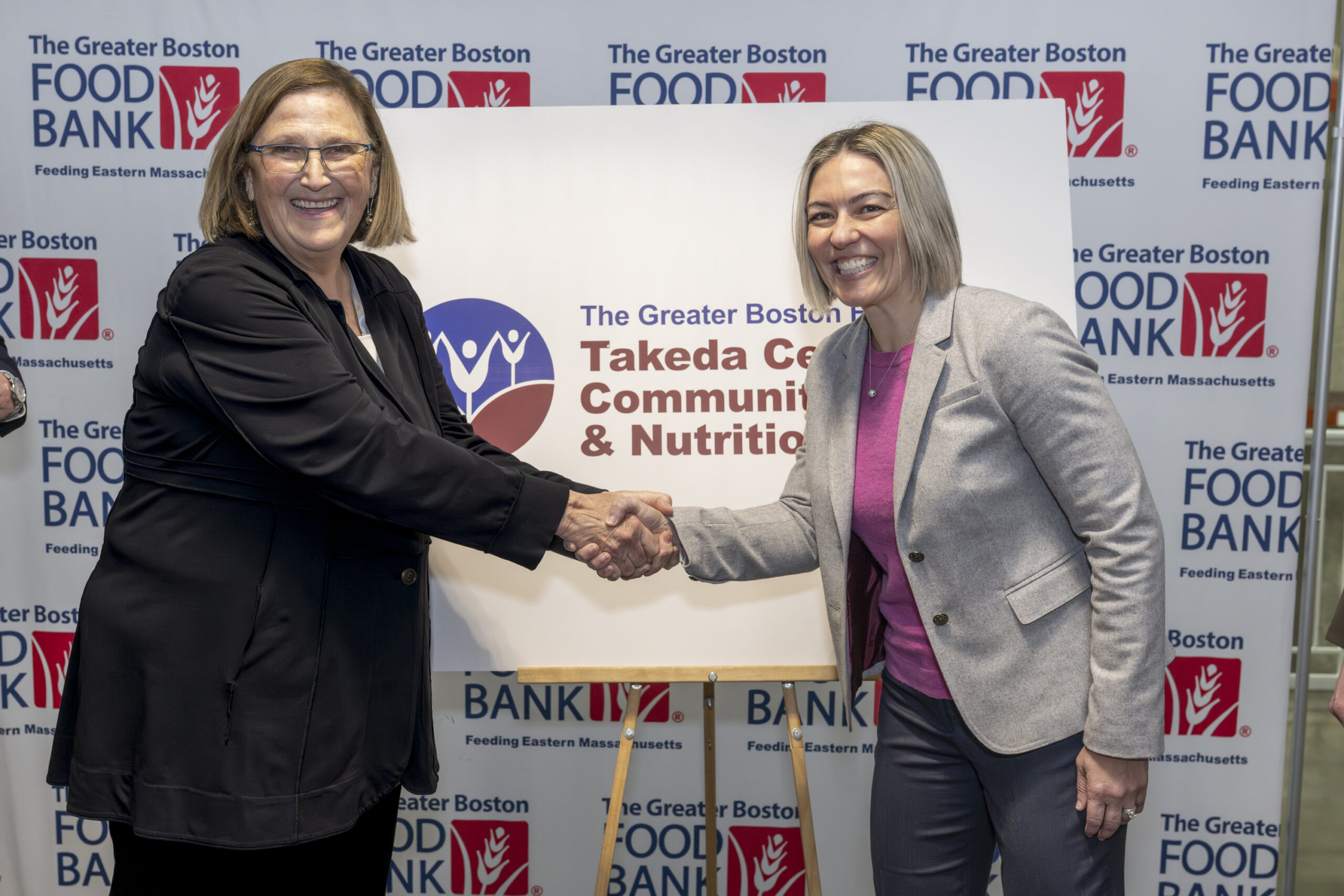
A recently announced four-year, $4 million grant from a Mass.-based biopharmaceutical company highlights its dedication to health and nutrition. The new Takeda Center for Community Health and Nutrition will showcase and strengthen all of the food bank’s community-facing initiatives that underscore the connection between food and health.
The grant – the food bank’s largest ever – is also a feather in the cap of President and CEO Catherine D’Amato, who announced only weeks ago her retirement after 30 years at the food bank. Led by D’Amato, the food bank’s forward-thinking work is now culminating in the Takeda Center.
“How do we coalesce all these things that we’ve done for years, but they were one-offs,” D’Amato asked. With the center, “now we have a more complete story to tell about the importance of community health and nutrition and the role that it plays in really trying to address food insecurity.”
The center will house the management of dozens of mobile markets that seek to expand access to fresh, nutritious produce. It will also put more people out in the field to manage agency relations, equipping pantries with the infrastructure they need to distribute healthy food. And it will include the food bank’s SNAP application assistance team.
About a year ago, the food bank began distributing nine types of medically tailored grocery boxes, another activity that will be housed in the center. The food bank’s registered dietitians perform health screenings over the phone in partnership with healthcare centers, and the food bank’s partner agencies deliver the food boxes directly to patients’ doorsteps. “We’re maximizing the partnership we have and the strength of this network that is in the community,” D’Amato said.
The creation of the center involved some revamping of the organizational chart. The leader of the center, Michele Fronk Schuckel, fills a newly created position, the Vice President of Community Health and Nutrition, following a long career in public health and healthcare. The center’s staff also includes Dr. Lauren Fiechtner, Division Chief, Gastroenterology, Hepatology and Nutrition at Mass General Brigham for Children, who also oversees the food bank’s annual statewide food access study, and two full-time registered dietitians.
For D’Amato, who has been involved in food banking since 1979, seeing healthcare providers get involved in food banking is a fitting capstone. “One of the things I’ve been saying a lot in reflection of my retirement is that this time is not about ownership, but it’s about partnership,” D’Amato said. “The Greater Boston Food Bank doesn’t have to do everything. And why would you want to? There are so many really great organizations doing really good work.” – Chris Costanzo
PHOTO, TOP: Catherine D’Amato and Rhonda Pacheco of Takeda, right, share a handshake.
Like what you’re reading?
Support Food Bank News
This article was made possible by the readers who support Food Bank News, a national, editorially independent, nonprofit media organization. Food Bank News is not funded by any government agencies, nor is it part of a larger association or corporation. Your support helps ensure our continued solutions-oriented coverage of best practices in hunger relief. Thank you!
- 2025 Food Bank Fundraising Surpasses Covid-Era Results
- Partner Insight: Sleeping Giants – The Untapped Value of Agency Co-Op Programs
- Pantry’s Nutrition Policy Meets its Growing Responsibility
- Why Are We Still Treating ‘Food is Medicine’ Like a Pilot Program?
- Book Review: Moving From Food Charity to Food Justice