Synopsis
Tai Chi is a Chinese martial art renowned for "softness overcoming hardness." Inscribed on UNESCO's Intangible Cultural Heritage list in 2020, it is practiced by hundreds of millions worldwide as both martial art and moving meditation.
Overview
Tai Chi (Chinese: 太极拳, Taijiquan) is one of China's most representative traditional martial arts and the most widely practiced form of martial arts exercise in the world. Tai Chi is known for its slow, fluid movements, deep breathing, and internal intention-guided practice. It integrates martial arts, health cultivation, and philosophy, earning the nickname "meditation in motion."
The core philosophy of Tai Chi derives from the yin-yang theory in Chinese Daoist thought, emphasizing "softness overcoming hardness," "stillness controlling movement," and "borrowing force to redirect force." It is not merely a combat technique but a form of physical and mental cultivation, widely used for health preservation, stress relief, and self-improvement.
In December 2020, Tai Chi was inscribed on UNESCO's Representative List of the Intangible Cultural Heritage of Humanity.
History
The origins of Tai Chi are subject to multiple historical theories. The most widely known legend attributes its creation to the Wudang Daoist priest Zhang Sanfeng. Influenced by literary works and films, many believe that "all Tai Chi comes from Wudang." However, this claim is disputed among scholars.
The earliest credible written record of Tai Chi's lineage appears in Li Yiyu's 1867 "Brief Introduction to Tai Chi Chuan" (太极拳小序): "Tai Chi originated with Zhang Sanfeng of the Song Dynasty. Its subtlety and ingenuity were thoroughly described by Wang Zongyue. It was later passed to Chen Wangting of Chenjiagou, Henan..."
According to martial arts historians Tang Hao and Gu Liuxin, who conducted field research in Wenxian, Henan, and consulted county records and the Chen family genealogy, the traceable lineage of Tai Chi can be traced back to Chen Wangting (c. 1600-1680) of Chenjiagou (Chen Village) in Wenxian, Henan, during the late Ming to early Qing Dynasty. Chen Wangting is revered by Chen-style Tai Chi practitioners as the founding ancestor. Chen Changxing (1771-1853) passed the family martial art to Yang Luchan (1799-1872) from Yongnian, Hebei, who later taught in Beijing, from which Tai Chi spread throughout China.
The name "Tai Chi Chuan" is generally recognized as originating from Wang Zongyue's "Tai Chi Chuan Classic" (太极拳论). Before this, Tai Chi was known as "Thirteen Postures" (十三势).
Major Styles
Tai Chi evolved into five major family styles:
| Style | Founder | Characteristics | Style |
|---|---|---|---|
| Chen Style | Chen Wangting (late Ming/early Qing) | Combines hardness and softness, includes explosive power and jumping | Oldest style, retains more martial combat features |
| Yang Style | Yang Luchan (1799-1872) | Expansive, graceful movements, even pace | Most widely practiced, best suited for health |
| Wu (Hao) Style | Wu Yuxiang (1812-1880) | Compact and small frame, focuses on internal energy flow | Emphasizes internal cultivation |
| Wu Style | Wu Jianquan (1870-1942) | Inclined yet upright, gentle movements | Known for soft neutralization |
| Sun Style | Sun Lutang (1860-1933) | Agile footwork, advancing and retreating in harmony | Integrates Xingyiquan and Baguazhang |
Philosophy
Tai Chi is deeply rooted in traditional Chinese philosophical thought:
- Yin-Yang Theory: Every movement in Tai Chi embodies the unity of opposing forces — empty and full, open and closed, hard and soft, fast and slow
- Daoist Thought: Pursuing "the Way follows nature," movements follow natural laws without force or artifice
- Softness Overcoming Hardness: Rather than opposing brute force, Tai Chi borrows and redirects force — "four ounces deflect a thousand pounds"
- Unity of Body and Mind: Emphasizes "where intention goes, qi follows; where qi goes, force follows" — the complete integration of intention, breath, and movement
Health Benefits
Modern scientific research has demonstrated multiple health benefits of Tai Chi:
- Improved balance and fall prevention: Particularly effective for older adults
- Stress reduction and mental health: Known as "moving meditation," helps alleviate anxiety and depression
- Cardiovascular health: Lowers blood pressure, improves cardiopulmonary function
- Joint flexibility: Gentle exercise suitable for all ages
- Enhanced immunity: Long-term practice helps strengthen the body's resistance
Global Impact
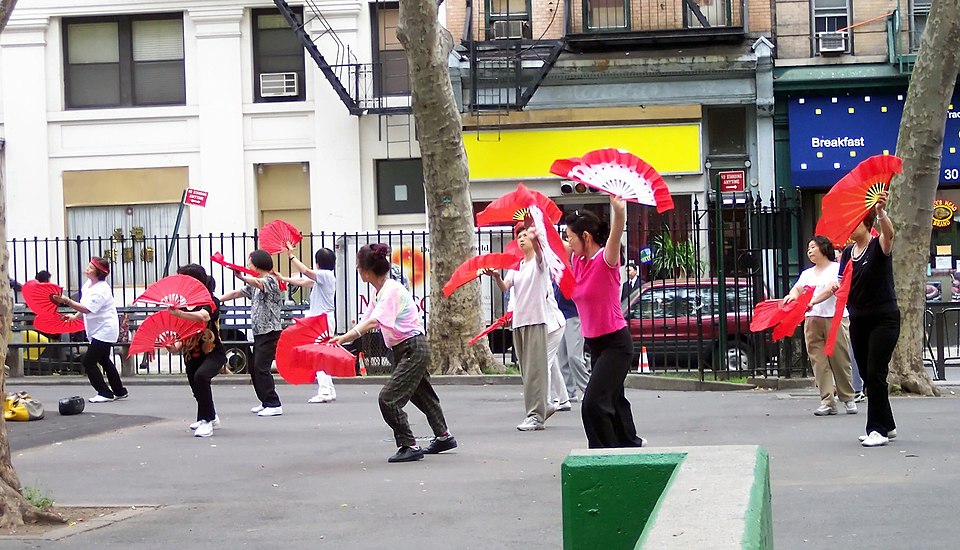
Tai Chi has become the most popular form of Chinese martial art worldwide. It is estimated that hundreds of millions of people practice Tai Chi across more than 150 countries and regions.
- China: Thousands of people practice Tai Chi daily in parks and public squares
- North America: Tai Chi is incorporated into many community centers and hospital rehabilitation programs
- Europe: Tai Chi is increasingly popular as a health and stress-relief practice
- Medical applications: Institutions such as Harvard Medical School recommend Tai Chi as a complementary treatment
As an iconic symbol of Chinese culture, Tai Chi is not merely a martial art but a philosophy of life, continuing to influence people around the world who seek physical and mental well-being.
References
- Wikipedia: https://zh.wikipedia.org/wiki/太极拳
- China Culture Research Institute: https://chiculture.org.hk/sc/china-five-thousand-years/181
- Zhihu: https://zhuanlan.zhihu.com/p/351592617
Stills & Gallery
Comments (0)