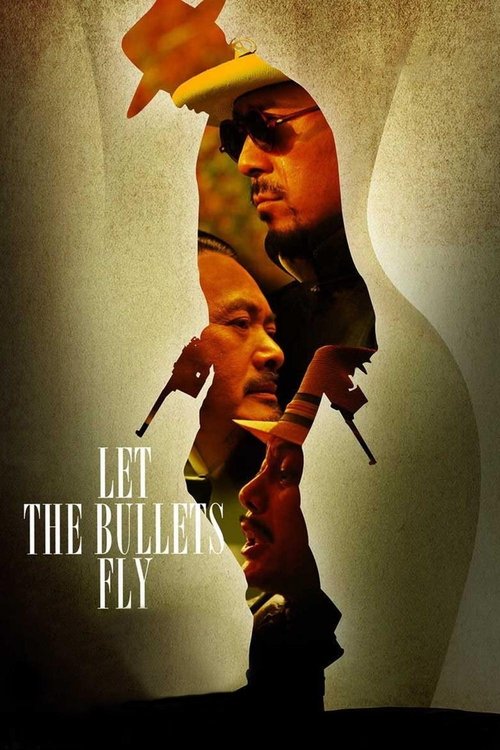
Synopsis
Directed by Jiang Wen, starring Jiang Wen, Ge You, and Chow Yun-fat. A bandit impersonates a magistrate and battles a ruthless warlord in this sharp black comedy. Douban 9.0. Box office 659M RMB.
Overview
"Let the Bullets Fly" (Chinese: 让子弹飞) is a 2010 action-comedy film directed by Jiang Wen, adapted from Ma Shitu's novel "The Official Robber" from "Ten Tales of Night Tales." The film stars Jiang Wen, Ge You, Chow Yun-fat, Carina Lau, Chen Kun, Zhou Yun, Liao Fan, and Jiang Wu. It premiered on December 16, 2010, with a runtime of 132 minutes and a production budget of approximately 150 million RMB.
Set in the southern town of Goose Town during the Republican era, the film follows bandit Zhang Mazi, who impersonates a county magistrate and engages in a thrilling power struggle with the local warlord Huang Silang. Jiang Wen crafted a work that is simultaneously entertaining and richly layered with political allegory, using sharp black comedy, rapid-fire dialogue, and a narrative of extraordinary tension.
The film achieved a rare dual triumph of box office and critical success. It grossed approximately 659 million RMB domestically, ranking as the second-highest-grossing Chinese-language film at the time. It holds a Douban rating of 9.0, higher than 98% of all comedies and 96% of all dramas, and maintains a permanent position in the Douban Top 250. The film generated unprecedented cultural discourse, with its dialogue and memes still widely quoted today. It is widely regarded as one of the greatest commercial films in Chinese cinema history and the highest-rated and highest-grossing film of Jiang Wen's career.
Plot Synopsis
During the Republican era, Ma Bangde (Ge You), who has purchased a county magistrate position, is traveling to take office with his wife (Carina Lau) and entourage when his party is ambushed by bandit Zhang Mazi (Jiang Wen) in the southern countryside. Zhang kills Ma's entourage but spares Ma himself. Zhang decides to impersonate the magistrate and travel to Goose Town to take up the post, bringing Ma along as his advisor.
Goose Town is the domain of Huang Silang (Chow Yun-fat), a ruthless warlord who has monopolized the town's economy and oppressed its people for years. Upon arriving, Zhang refuses to submit to Huang, and their rivalry rapidly escalates. From taxation disputes to opium conflicts, from assassination attempts to open confrontation, Zhang systematically dismantles Huang's power through a combination of cunning, courage, and popular appeal.
The film's core conflict extends beyond personal rivalry into a fable about power, justice, and the awakening of the masses. Zhang ultimately mobilizes the citizens of Goose Town to overthrow Huang's rule, revealing the harsh truth that "the people follow whoever wins."
Cast
| Actor | Character | Description |
|---|---|---|
| Jiang Wen | Zhang Mazi (Zhang Muzhi) | A legendary bandit who impersonates a magistrate to fight tyranny |
| Ge You | Ma Bangde | The purchased magistrate, forced to serve as Zhang's advisor |
| Chow Yun-fat | Huang Silang | The ruthless warlord who controls every aspect of Goose Town |
| Carina Lau | The Magistrate's Wife | Ma Bangde's glamorous wife |
| Chen Kun | Hu Wan | Huang Silang's loyal enforcer |
| Zhou Yun | Hua Jie | A courtesan in Goose Town who plays a pivotal role |
| Liao Fan | Lao San | One of Zhang Mazi's bandit brothers |
| Jiang Wu | Wu Zhichong | Huang Silang's muscle |
Production Features
"Let the Bullets Fly" stands apart in Chinese cinema for its distinctive production qualities:
Dialogue as Art: The film features an extraordinarily high density of dialogue, with virtually every line meticulously crafted, brimming with double meanings, metaphors, and black humor. From "I want to make money while standing up" to "Let the bullets fly for a while," numerous lines have become internet catchphrases, endlessly quoted and reinterpreted.
Pace and Editing: The narrative pacing is relentless, with the plot advancing in taut, efficient strokes and virtually no wasted shots. Jiang Wen's signature "violent aesthetics" seamlessly fuse action sequences with comedic elements, creating an unprecedented cinematic experience.
Acting Excellence: Three cinematic legends — Jiang Wen, Ge You, and Chow Yun-fat — sharing the screen in a battle of wits is regarded as one of the finest ensemble performances in Chinese film history. Jiang Wen's commanding presence, Ge You's slippery charm, and Chow Yun-fat's menacing intensity create a dynamic that is electric in its contrasts.
Political Allegory: On the surface, the film tells a straightforward story of a bandit challenging a warlord. Beneath, it is richly layered with allegory about power structures, the nature of revolution, and mass psychology. This multiplicity of interpretive possibilities is a key reason for the film's enduring relevance.
Dual Language Versions: The film was released in both Mandarin and Sichuanese dialect versions. The Sichuanese version, with its earthy linguistic charm and more grounded comedic delivery, is considered by many to be the superior version.
Cultural Impact
"Let the Bullets Fly" has generated a cultural impact of truly phenomenal proportions:
Internet Culture Phenomenon: The film's dialogue and memes have continued to proliferate across the Chinese internet for over a decade. Lines like "Make money while standing up," "Let the bullets fly for a while," and "Translate for me what you call a surprise" have become part of everyday language, widely used in social commentary, business discourse, and political metaphor.
Enduring Cultural Analysis: More than a decade after its release, audiences and scholars continue to discover new interpretive angles — from political fable to revolutionary allegory, from power structure analysis to social class critique. The film has become a cultural symbol that carries the social sentiments of different eras.
Benchmark for Chinese Commercial Cinema: The film proved that a commercial film could simultaneously achieve high artistic quality and intellectual depth, breaking down the perceived divide between art and commerce and setting a new standard for Chinese commercial filmmaking.
Jiang Wen's Pinnacle: Widely regarded as the crowning achievement of Jiang Wen's directorial career, the film synthesizes all the strengths of his previous works — brilliant direction, charismatic performance, razor-sharp dialogue, and profound thematic depth.
References
- Douban - Let the Bullets Fly https://movie.douban.com/subject/3742360/
- Baidu Baike - Let the Bullets Fly https://baike.baidu.com/item/让子弹飞/5358
- Wikipedia - Let the Bullets Fly https://en.wikipedia.org/wiki/Let_the_Bullets_Fly
Stills & Gallery
Comments (0)