Synopsis
The Terracotta Army, known as the 'Eighth Wonder of the World,' was accidentally discovered by farmers in 1974. A UNESCO World Cultural Heritage Site since 1987, it is China's most iconic archaeological discovery.
Overview
The Terracotta Army (兵马俑), located in Lintong District, Xi'an, Shaanxi Province, is the companion burial pits of the Mausoleum of the First Qin Emperor. Known as the "Eighth Wonder of the World," the Terracotta Warriors were accidentally discovered in 1974 by local farmers digging a well, revealing an archaeological treasure buried underground for over 2,000 years.
The Terracotta Army is the core component of the Emperor Qinshihuang's Mausoleum Site Museum. In 1987, the Mausoleum of the First Qin Emperor and the Terracotta Army pits were inscribed on UNESCO's World Cultural Heritage List.
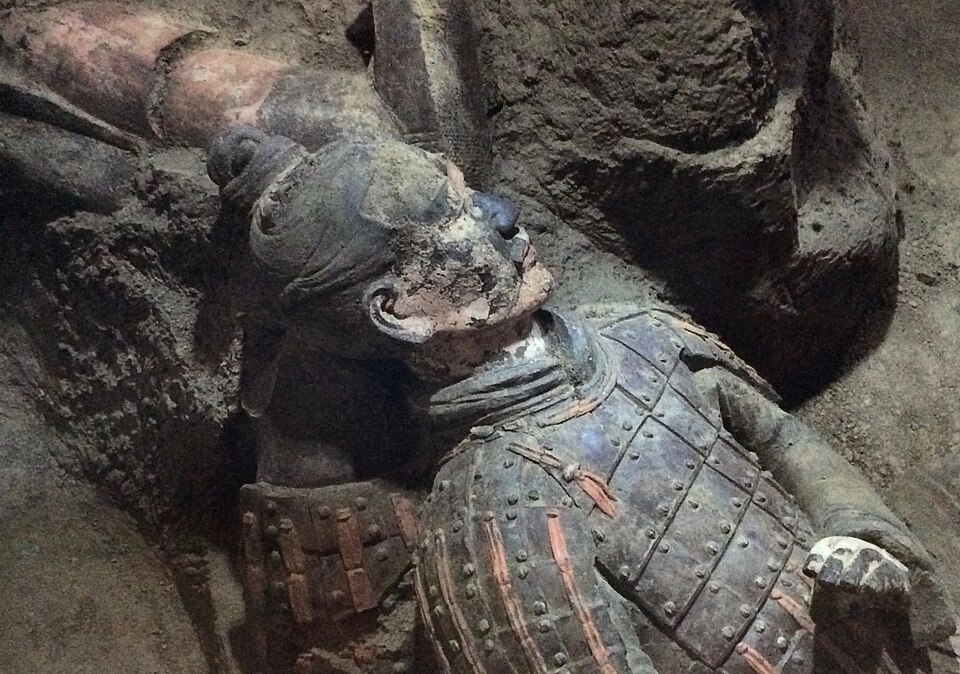
The Terracotta Warriors were created for Qin Shi Huang (259-210 BC), China's first emperor, to serve as an underground army to protect him in the afterlife. The warriors are renowned for their grand scale, exquisite craftsmanship, and realistic modeling — each warrior has a unique facial expression, hairstyle, and clothing, bringing them to life.
Discovery
On March 29, 1974, villagers including Yang Zhifa from Xiyang Village in Lintong District, Shaanxi Province, accidentally discovered terracotta fragments and bronze weapons while drilling a well approximately 1.5 kilometers east of the Qin Shi Huang Mausoleum during a drought relief effort. This discovery immediately attracted the attention of the archaeological department, leading to systematic exploration and excavation.
After more than a year of exploration and trial excavation, archaeologists confirmed this was a large-scale warrior pit, later designated as Pit No. 1. Subsequently, Pit No. 2, Pit No. 3, and a bronze chariot pit were also discovered.
The Three Warrior Pits
| Pit | Year Discovered | Area | Features | Estimated Warriors |
|---|---|---|---|---|
| Pit No. 1 | 1974 | 14,260 sq m | Largest, rectangular formation, primarily infantry and chariots | ~6,000 |
| Pit No. 2 | 1976 | ~6,000 sq m | Most diverse兵种, including cavalry, archers, chariots, infantry | ~1,300 |
| Pit No. 3 | 1976 | ~520 sq m | Smallest, believed to be the command center for Pits 1 and 2 | ~68 |
Characteristics of the Warriors
The terracotta warriors were crafted with extraordinary skill. Each warrior stands approximately 1.8 to 2 meters tall — life-size. Notable features include:
- Unique Faces: Each warrior has different facial features — round, long, fat, thin — with varied expressions
- Detailed Hair: Individual strands of hair are clearly visible, with different hairstyles including braids and topknots
- Intricate Clothing: Armor plates and clothing folds are rendered in exquisite detail
- Real Weapons: A large number of authentic bronze weapons were unearthed, including swords, halberds, spears, and crossbow triggers — many remain sharp to this day
- Original Colors: The warriors were originally painted in vibrant colors including vermilion, pink-green, and pink-purple, but the pigments rapidly deteriorated upon exposure to air
Bronze Chariots and Horses
In 1980, two sets of large painted bronze chariots and horses were discovered west of the Qin Shi Huang Mausoleum. These bronze chariots were cast at half the scale of real chariots and horses, and are known as the "Crown of Bronze." The No. 2 bronze chariot alone weighs 1,241 kilograms and consists of over 3,000 individual parts.
The Mausoleum of Qin Shi Huang
The Mausoleum of Qin Shi Huang is located approximately 1.5 kilometers west of the Terracotta pits. It is the tomb of Ying Zheng (259-210 BC), the first emperor of China. The mausoleum complex covers approximately 56 square kilometers — equivalent to 78 Forbidden Cities.
According to the Records of the Grand Historian (Shiji), the underground palace was constructed with "mercury representing the hundred rivers, the Yangtze, the Yellow Sea, and the great sea, mechanically pumped and circulated, with astronomical features above and geographical features below." Modern scientific surveys have indeed detected significant mercury anomalies in the mound area, corroborating this historical record.
The underground palace has not yet been formally excavated, primarily due to文物保护 (cultural relic protection) concerns and technical limitations.
Practical Information
| Item | Details |
|---|---|
| Location | Qinling North Road, Lintong District, Xi'an, Shaanxi Province |
| Opening Hours | Peak season (Mar-Nov) 8:30-18:00, Off-season (Dec-Feb) 8:30-17:30 |
| Admission | Peak season ~150 RMB, Off-season ~120 RMB (includes mausoleum and Terracotta Army) |
| Suggested Visit Duration | 3-4 hours |
| Transportation | Tourist Bus No. 5 (Route 306) from downtown Xi'an, approximately 1 hour |
| Best Season | Spring (March-May) and Autumn (September-November) |
World Heritage
In 1987, the Mausoleum of the First Qin Emperor and the Terracotta Army were inscribed by UNESCO as a World Cultural Heritage Site. UNESCO's evaluation noted:
- The Terracotta Army is one of the most spectacular archaeological discoveries in the world
- The warriors, with their grand scale and realistic style, possess outstanding universal value
- The Terracotta Army provides invaluable material evidence for studying Qin Dynasty military, politics, economy, and culture
References
- Emperor Qinshihuang's Mausoleum Site Museum: https://bmy.com.cn/
- Baidu Baike: https://baike.baidu.com/item/秦始皇陵兵马俑
- UNESCO: https://whc.unesco.org/en/list/441/
Stills & Gallery
Comments (0)