Papers by Juan Pablo Quimbayo Agreda
Marine Biology, 2021
The mechanisms driving the ecology and biodiversity of seamount communities are still unclear. He... more The mechanisms driving the ecology and biodiversity of seamount communities are still unclear. Here we analyzed the distribution and species traits of reef fish species recorded over seamounts, oceanic islands, and the continental shelf of the southwestern Atlantic Ocean to understand the influence of mechanisms of dispersal and establishment in these ecosystems. Species richness did not decrease with distance from the mainland, and community composition was not related to geographic position and geological history of seamounts and oceanic islands. Similarity among sites was explained by habitat heterogeneity, shallowest depth, and distance from mainland. Inter-site isolation had a significant influence on the spatial turnover of species. All species traits related to dispersal and establishment worked as ecological filters driving the composition of communities and distribution of species along seamounts and oceanic islands. We conclude that seamount communities are closely related to those of oceanic islands, with the stepping-stones (inter-site isolation) process being the most important one shaping species composition and distribution. Establishment and dispersal mechanisms, in combination with historical sea-level fluctuations, regulate the persistence of species and the similarity of communities among adjacent and environmentally similar sites.
Bulletin of Marine and Coastal Research, 2016
Varias especies de animales marinos establecen temporalmente asociaciones de caza interespecífica... more Varias especies de animales marinos establecen temporalmente asociaciones de caza interespecíficas, en las cuales especies oportunistas siguen a otras especies llamadas nucleares mientras estas buscan alimento pues disturban el substrato. Este tipo de comportamiento ha sido observado entre algunas especies de peces arrecifales en la isla Malpelo en el Pacífico colombiano. La morena Gymnothorax dovii y el jurel Caranx melampygus fueron identificados como especies nucleares mientras cazaban dentro del sitio conocido como El Arrecife. Estas especies fueron acompañadas por algunos meros Dermatolepis dermatolepis y Mycteroperca olfax, jurel Seriola rivoliana, pez corneta Aulostomus chinensis, la vieja Bodianus diplotaenia y en algunas ocasiones por el jurel Caranx melampygus, que tuvo ambos comportamientos (nuclear/seguidor). Este tipo de interacción alimentaria es un importante componente en la estructura trófica de las comunidades arrecifales que ocurren en todos los mares.
Neotropical Ichthyology, 2017
Estimating population parameters is essential for understanding the ecology of species, which ult... more Estimating population parameters is essential for understanding the ecology of species, which ultimately helps to assess their conservation status. The seahorse Hippocampus reidi is directly exposed to anthropogenic threats along the Brazilian coast, but the species still figures as Data Deficient (DD) at IUCN’s Red List. To provide better information on the ecology of this species, we studied how population parameters vary over time in a natural subtropical environment. By combing mark-recapture models for open and closed populations, we estimated abundance, survival rate, emigration probability, and capture probability. We marked 111 individuals, which showed a 1:1 sex ratio, and an average size of 10.5 cm. The population showed high survival rate, low temporary emigration probability and variable capture probability and abundance. Our models considering relevant biological criteria illuminate the relatively poorly known population ecology and life history of seahorses. It is our ...
Journal of Fish Biology, 2018
The present study describes the cleaning interactions among species of cleaner gobies Tigrigobius... more The present study describes the cleaning interactions among species of cleaner gobies Tigrigobius spp. and Elacatinus puncticulatus (family Gobiidae) and the client fish species they clean in a coral reef of Gorgona Island, Colombia. In 419 cleaning events, we observed 27 species acting as clients of Tigrigobius spp., whereas only nine were clients of E. puncticulatus. Paranthias colonus and Cephalopholis panamensis were the species most commonly cleaned by Tigrigobius spp., while Ophioblennius steindachneri and Stegastes acalpulcoensis were the clients most commonly cleaned by E. puncticulatus. The abundance (but not the body size) of clients was an important variable predicting the cleaning frequency observed for clients of Tigrigobius spp., but this was not the case for clients of E. puncticulatus. Additionally, Tigrigobius spp. preferred cleaning planktivores, sessile invertebrate feeders and territorial herbivores (Ivlev's index >0·15), whereas E. puncticulatus did not e...
Environmental Biology of Fishes, 2018
Cleaning associations are one of the most dynamic and complex mutualistic interactions of reef en... more Cleaning associations are one of the most dynamic and complex mutualistic interactions of reef environments and are often influenced by local conditions. In the Western Atlantic (WE) most studies concentrate in tropical areas, with little attention to subtropical areas. We examined an assemblage of cleaner fish and their clients on the rocky reefs of the coast of Santa Catarina state, South Brazil, the southern limit of tropical reef fishes in the WE. We recorded 150 cleaning interactions, in which four fish species and one shrimp species acted as facultative cleaners. The grunt Anisotremus virginicus and the angelfish Pomacanthus paru serviced most clients. Fifteen fish species acted as clients, among which the most frequent was the planktivorous grunt Haemulon aurolineatum (31%). Cleaning interactions occurred mostly (87%) with noncarnivorous clients and the number of interactions was not related to the abundance of the species involved. The absence of dedicated cleaner fishes at the study sites and the replacement of their roles by facultative cleaners may be related to local conditions, including cold currents and reduction of rock cover. Under these circumstances, clients take advantage of the services offered by facultative cleaners, a characteristic of temperate areas.

Ecography, 2018
Diversity patterns are determined by biogeographic, energetic, and anthropogenic factors, yet few... more Diversity patterns are determined by biogeographic, energetic, and anthropogenic factors, yet few studies have combined them into a large‐scale framework in order to decouple and compare their relative effects on fish faunas. Using an empirical dataset derived from 1527 underwater visual censuses (UVC) at 18 oceanic islands (five different marine provinces), we determined the relative influence of such factors on reef fish species richness, functional dispersion, density and biomass estimated from each UVC unit. Species richness presented low variation but was high at large island sites. High functional dispersion, density, and biomass were found at islands with large local species pool and distance from nearest reef. Primary productivity positively affected fish richness, density and biomass confirming that more productive areas support larger populations, and higher biomass and richness on oceanic islands. Islands densely populated by humans had lower fish species richness and bio...
Diversity and Distributions, 2018
AimTo present an updated database of fish species recorded on south‐western Atlantic reef environ... more AimTo present an updated database of fish species recorded on south‐western Atlantic reef environments and to explore the ecological drivers of the structure, the latitudinal gradient of biodiversity and the centre of endemism in this peripheral province.LocationSouth‐western Atlantic (SWA): Brazilian and Argentinian Provinces.MethodsA database composed of 733 fish species along 23 locations in the SWA (00°55′ N to 43°00′ S) was compiled based on primary data, literature and museum records. Cluster and beta diversity analyses were carried out to evaluate faunal overlaps among locations and subprovinces. “Target‐area‐distance effect” and “stepping stones dispersal” hypotheses for assemblage composition were tested through Mantel tests. Relationships between the distribution patterns and ecological traits of reef fish species were investigated through generalized linear mixed‐effect models.ResultsOut of the 733 fish species, 405 are SWA resident reef fishes, of which 111 (27%) are end...
PloS one, 2018
As marine ecosystems are influenced by global and regional processes, standardized information on... more As marine ecosystems are influenced by global and regional processes, standardized information on community structure has become crucial for assessing broad-scale responses to natural and anthropogenic disturbances. Extensive biogeographic provinces, such as the Brazilian Province in the southwest Atlantic, present numerous theoretical and methodological challenges for understanding community patterns on a macroecological scale. In particular, the Brazilian Province is composed of a complex system of heterogeneous reefs and a few offshore islands, with contrasting histories and geophysical-chemical environments. Despite the large extent of the Brazilian Province (almost 8,000 kilometers), most studies of shallow benthic communities are qualitative surveys and/or have been geographically restricted. We quantified community structure of shallow reef habitats from 0° to 27°S latitude using a standard photographic quadrat technique. Percent cover data indicated that benthic communities ...
Environmental Biology of Fishes, 2017
In marine ecosystems, cleaning is a mutualistic relationship in which so-called cleaners remove e... more In marine ecosystems, cleaning is a mutualistic relationship in which so-called cleaners remove ectoparasites, diseased tissue, or mucus from the body of their clients, and thus help to maintain a healthy reef community. In spite of its importance in many marine habitats, this interaction remains poorly understood, particularly at oceanic islands. Here, we present the first comprehensive study of cleaning interactions in a reef fish assemblage at Rocas, the only atoll in the South Atlantic. We recorded 318 cleaning events, in which six fish species, including two endemic ones, and two shrimp species acted as cleaners. The clients serviced by these cleaners were 21 bony fish species, one shark and one sea turtle. The cleaner wrasse Thalassoma noronhanum and the cleaner goby Elacatinus phthirophagus were the cleaners with the greatest number of events and species richness of clients. Additionally, 82% of clients in the cleaning events were nonpiscivores, and the abundance of both cleaners and clients positively influenced the number of cleaning events (R 2 = 0.4; p < 0.001). Our results indicate that Rocas atoll has a high species richness of cleaner species despite its small size and highlight the importance of studies of cleaning symbiosis, even in isolated places with low species richness, for a better comprehension of this association in reefs.
Marine Biodiversity Records, 2017
The French angelfish Pomacanthus paru (Pomacanthidae) is recognised as an important cleaner in tr... more The French angelfish Pomacanthus paru (Pomacanthidae) is recognised as an important cleaner in tropical reef environments, yet its clients remain relatively undescribed in the literature. Here, we report observations of their cleaning behaviour when interacting with different species of cryptobenthic fish clients. The study was conducted in Bahia state, northeast Brazil. In this region, French angelfish were seen cleaning four different species of cryptobenthic species, respectively, Coryphopterus glaucofraenum, Scorpaena plumieri, Labrisomus cricota, and Scartella cristata. These records show the broad spectra of clients that cleaners interact with in coral reef systems, as well as give important insights into the poorly known cryptobenthic fishes habits and ecology.
Environmental Biology of Fishes, 2016
Fish assemblages can vary across temporal and spatial scales due to changes in habitat structure ... more Fish assemblages can vary across temporal and spatial scales due to changes in habitat structure and the influence of local factors such as wave exposure, depth and anthropogenic influence. This study presents a description of species richness, functional richness, density and biomass of fish assemblages of Malpelo Island, a Marine Protected Area located in the Tropical Eastern Pacific (TEP) region and considered a World Heritage site. Underwater visual censuses (n = 103) from two years and a local checklist were used to characterize the reef fish assemblage of Malpelo Island. Our results show a numerical dominance, during both sampling years, by the planktivore species Chromis atrilobata and Apogon atradorsatus, which are regional TEP endemic species. Among the most striking results found were the high biomass values (706.2 g/m 2 ± 73.2 in 2010 and 879 g/m 2 ± 116.2 in 2015) of large-bodied TEP endemic piscivorous species and the high functional diversity represented mainly by vulnerable species. The dominance in density and biomass of regional endemic species exemplifies the high endemism level within the TEP. High levels of fish biomass and functional richness suggest that Malpelo is one of the most pristine and vulnerable sites within the TEP region. Thus, Malpelo island represents a baseline for untouched assemblages in this marine province, as well as a priority area for conservation at the national and international level. Keywords Marine protected area. Endemism. Biomass. Reef fish. Malpelo Island. Colombia Environ Biol Fish
Journal of the Marine Biological Association of the United Kingdom, 2016
Isolated oceanic islands may give rise not only to new and endemic species, but also to unique be... more Isolated oceanic islands may give rise not only to new and endemic species, but also to unique behaviours and species interactions. Multi-species fish interactions, such as cleaning, following, mob-feeding and others are understudied in these ecosystems. Here we present qualitative and quantitative observations on cleaning and mob-feeding reef fish associations at the isolated Ascension Island, South Atlantic Ocean. Cleaning interactions were dominated by juveniles of the facultative fish cleanersBodianus insularisandPomacanthus paru, with lesser contributions ofChaetodon sanctaehelenae, Thalassoma ascensionisand the cleaner shrimpLysmata grabhami. Two types of feeding mobs were consistently identified: less mobile mobs led by the surgeonfishAcanthurus bahianusandA. coeruleusand the more mobile mobs led by the African sergeantAbudefduf hoefleri. This is the first record ofA. hoeflerifrom outside of the Eastern Atlantic and also the first report of this species displaying mob-feeding...
Marine Biodiversity, 2016
Cleaning interactions are an essential feature of marine ecosystems since they help maintain a he... more Cleaning interactions are an essential feature of marine ecosystems since they help maintain a healthy community. However, knowledge on the magnitude of the cleaning interactions in the Tropical Eastern Pacific (TEP) is scarce, especially in remote places like oceanic islands. Here, we describe for the first time the cleaning interactions among reef fishes at Malpelo Island, a World Heritage site located in the TEP. In 120 cleaning events at Malpelo, we have observed five fish species acting as cleaners and nineteen acting as clients. We observed one local endemic and four regional endemic species of the TEP among the cleaners, and five elasmobranchs and fourteen ray-finned species as clients. Our results show that Johnrandallia nigrirostris was the cleaner with the largest number of events and client species, whereas Lepidonectes bimaculatus was the most specific cleaner (i.e. it has only one client species). We observed that 56 % of the cleaning interactions involved a top predator as client. Our results suggest that the role of cleaner is executed by just few fish species at Malpelo Island, and that a high number of cleaning interactions occur with top predators (groupers, snappers, sharks, and rays), which could be an indication of the good conservation status of Malpelo.
Check List, 2015
We present a checklist of 278 species of reef fishes recorded along the coastline of Santa Catari... more We present a checklist of 278 species of reef fishes recorded along the coastline of Santa Catarina state, the southernmost limit of distribution of tropical ichthyofauna on the coast of Brazil. Twelve new species records for this state are presented: Acanthurus coeruleus, Acanthurus monroviae, Apogon americanus, Cantherhines macrocerus, Chaetodon sedentarius, Chromis flavicauda, Clepticus brasiliensis, Decapterus punctatus, Gymnothorax vicinus, Herpetoichthys regius, Muraena retifera and Stegastes partitus. Stegastes partitus and H. regius are reported for the first time, respectively, from the Southwestern Atlantic and for the coastal part of this region, while Acanthurus monroviae is reported for the second time for the Southwestern Atlantic. We present habitat distribution, trophic structure and comment on biogeographic affinities of this transitional region, discussing both remarkable species presences and absences.
Quimbayo et al (2014) Feeding Association Malpelo
Marine Biodiversity Records, 2012
This work reports for the first time cleaning activity by fish and shrimps in Santa Luzia, Cape V... more This work reports for the first time cleaning activity by fish and shrimps in Santa Luzia, Cape Verde Archipelago and São Tomé Islands. Three new records of facultative cleaner fish species are presented. Facultative cleaners dominated by Labridae were the most observed cleaner fishes in the two studied islands. Multi-specific cleaning stations were prevalent in Santa Luzia, while cleaner shrimps were more observed interacting in the São Tomé Islands.
Coral Reefs, 2010
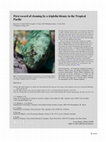
Cleaning symbiosis between fishes is an interspecific interaction in which a fish (the cleaner) s... more Cleaning symbiosis between fishes is an interspecific interaction in which a fish (the cleaner) seeks food on the body surface of other fishes (the clients) which, in turn, become free of parasites and debris (Côté 2000). About 110 reef fish species in 21 families are known as cleaners (Côté 2000), and no doubt this figure will increase with additional field studies. Here, we report for the first time cleaning by a triplefin blenny (Tripterygiidae) in the Tropical Eastern Pacific. An endemic to Malpelo Island, the twin-spot triplefin, Lepidonetes bimaculatus was observed cleaning the starry grouper, Epinephelus labriformis (Fig. 1) in August 2009 and February 2010. The cleaning interactions (n ¼ 10) were always initiated by the cleaner, which moved slowly towards and climbed on the client, which posed almost motionless on the reef. The snout and dorsal fin of the clients were the most inspected body parts, at which the blenny occasionally pounced. All interactions lasted 1-2 min. Species of Tripterygiidae feed mostly on small benthic invertebrates (Feary et al. 2009), but three species from coastal New Zealand (temperate South Western Pacific) were observed cleaning: Notoclinops segmentatus, N. caerulepunctus, and Forsterygion lapillum (Clements 2003).
Diversity patterns are determined by biogeographic, energetic, and anthropogenic factors, yet few... more Diversity patterns are determined by biogeographic, energetic, and anthropogenic factors, yet few studies have combined them into a large-scale framework in order to decouple and compare their relative effects on fish faunas. Using an empirical dataset derived from 1527 underwater visual censuses (UVC) at 18 oceanic islands (five different marine provinces), we determined the relative influence of such factors on reef fish species richness, functional dispersion, density and biomass estimated from each UVC unit. Species richness presented low variation but was high at large island sites. High functional dispersion, density, and biomass were found at islands with large local species pool and distance from nearest reef. Primary productivity positively affected fish richness, density and biomass confirming that more productive areas support larger populations, and higher biomass and richness on oceanic islands. Islands densely populated by humans had lower fish species richness and biomass reflecting anthropogenic effects. Species richness, functional dispersion, and biomass were positively related to distance from the mainland. Overall, species richness and fish density were mainly influenced by biogeographical and energetic factors, whereas functional dispersion and biomass were strongly influenced by anthropogenic factors. Our results extend previous hypotheses for different assemblage metrics estimated from empirical data and confirm the negative impact of humans on fish assemblages, highlighting the need for conservation of oceanic islands.
As marine ecosystems are influenced by global and regional processes, standardized information on... more As marine ecosystems are influenced by global and regional processes, standardized information on community structure has become crucial for assessing broad-scale responses to natural and anthropogenic disturbances. Extensive biogeographic provinces, such as the Brazilian Province in the southwest Atlantic, present numerous theoretical and methodologi-cal challenges for understanding community patterns on a macroecological scale. In particular , the Brazilian Province is composed of a complex system of heterogeneous reefs and a few offshore islands, with contrasting histories and geophysical-chemical environments. Despite the large extent of the Brazilian Province (almost 8,000 kilometers), most studies of shallow benthic communities are qualitative surveys and/or have been geographically restricted. We quantified community structure of shallow reef habitats from 0˚to 27˚S latitude using a standard photographic quadrat technique. Percent cover data indicated that benthic communities of Brazilian reefs were dominated by algal turfs and frondose macroal-gae, with low percent cover of reef-building corals. Community composition differed significantly among localities, mostly because of their macroalgal abundance, despite reef type or geographic region, with no evident latitudinal pattern. Benthic diversity was lower in the tropics , contrary to the general latitudinal diversity gradient pattern. Richness peaked at mid-latitudes , between 20˚S to 23˚S, where it was ~3.5-fold higher than localities with the lowest richness. This study provides the first large-scale description of benthic communities along the southwestern Atlantic, providing a baseline for macroecological comparisons and evaluation of future impacts. Moreover, the new understanding of richness distribution along Brazilian reefs will contribute to conservation planning efforts, such as management strategies and the spatial prioritization for the creation of new marine protected areas.
Environmental Biology of Fishes, 2018
Cleaning associations are one of the most dynamic and complex mutualistic interactions of reef en... more Cleaning associations are one of the most dynamic and complex mutualistic interactions of reef environments and are often influenced by local conditions. In the Western Atlantic (WE) most studies concentrate in tropical areas, with little attention to subtropical areas. We examined an assemblage of cleaner fish and their clients on the rocky reefs of the coast of Santa Catarina state, South Brazil, the southern limit of tropical reef fishes in the WE. We recorded 150 cleaning interactions, in which four fish species and one shrimp species acted as facultative cleaners. The grunt Anisotremus virginicus and the angelfish Pomacanthus paru serviced most clients. Fifteen fish species acted as clients, among which the most frequent was the planktivorous grunt Haemulon aurolineatum (31%). Cleaning interactions occurred mostly (87%) with non-carnivorous clients and the number of interactions was not related to the abundance of the species involved. The absence of dedicated cleaner fishes at the study sites and the replacement of their roles by facultative cleaners may be related to local conditions, including cold currents and reduction of rock cover. Under these circumstances , clients take advantage of the services offered by facultative cleaners, a characteristic of temperate areas.



Uploads
Papers by Juan Pablo Quimbayo Agreda