Books by Justin Yoo

Migration and Migrant Identities in the Middle East from Antiquity to the Middle Ages
Migration, Diasporas and Identity in the Near East from Antiquity to the Middle Ages, Dec 2018
This book brings together recent developments in modern migration theory, a wide range of sources... more This book brings together recent developments in modern migration theory, a wide range of sources, new and old tools revisited (from GIS to epigraphic studies, from stable isotope analysis to the study of literary sources) and case studies from the ancient Eastern Mediterranean which illustrate how new theories and techniques are helping to give a better understanding of migratory flows and diaspora communities in the ancient Near East. A geographical gap has emerged in studies of historical migration as recent works have focused on migration and mobility in the western part of the Roman Empire and thus fail to bring a significant contribution to the study of diaspora communities in the Eastern Mediterranean. Bridging this gap represents a major scholarly desideratum and, by drawing upon the experiences of previously neglected migrant and diaspora communities in the eastern Mediterranean from the Hellenistic period to the early medieval world, this collection of essays approaches migration studies with new perspectives and methodologies, shedding light not only on the study of migrants in the ancient world, but also on broader issues concerning the rationale for mobility and the creation and features of diaspora identities.
Edited Volumes by Justin Yoo
TRAC 2013: Proceedings of the Twenty-Second Annual Theoretical Roman Archaeology Conference, London 2013
"The twenty-third Theoretical Roman Archaeology Conference (TRAC) was held at King’s College, Lon... more "The twenty-third Theoretical Roman Archaeology Conference (TRAC) was held at King’s College, London in spring 2013. During the three-day conference nearly papers were delivered, discussing issues from a wide range of geographical regions of the Roman Empire, and applying various theoretical and methodological approaches. Sessions included those looking at Roman–Barbarian interactions; identity and funerary monuments in ancient Italy; migration and social identity in the Roman Near East; theoretical approaches to Roman small finds; formation processes of in-fills in urban sites; and new reflections on Roman glass. This volume contains a selection of papers from the conference sessions.
Table of Contents
Introduction: TRAC Past, Present and Future: Where to go from here? (Hannah Platts, John Pearce, Caroline Barron, Jason Lundock, Justin Yoo)
Hobson, M., An Historiography of the Study of the Roman Economy: economic growth, development, and neoliberalism.
Jongman, W. M., Why Modern Economic Theory Applies, Even to the Distant Roman Past.
Lulic, J., Dalmatian Silvanus: A Cognitive Approach to Reinterpretation of the Reliefs Representing Silvanus from Roman Dalmatia.
Cousins, E., Votive Objects and Ritual Practice at the King’s Spring at Bath.
Dicus, K., Resurrecting Refuse at Pompeii: The Use-Value of Urban Refuse and its Implications for Interpreting Archaeological Assemblages.
Marchiori, G., Decline, Migration and Revival: Kom al-Ahmer and Kom Wasit, a History of a Forgotten City.
Ball, J., Small Finds and Roman Battlefields: The Process and Impact of Post-Battle Looting.
Prior, J. D, Methods and Difficulties in Quantifying Archaeological Vessel Glass Assemblages.
Podavitte, C., Pompeian–red Ware in Roman London: Insights on Pottery Consumption in Colonial Environments.
Vucetic, S., Roman Sexuality or Roman Sexualities? Looking at Sexual Imagery on Roman Terracotta Mould-made Lamps.
Heeren, S., The material culture of small rural settlements in the Batavian area: a case study on discrepant experience, creolisation, Romanisation or globalisation?
APPENDICES (on CD)
Appendix I. A revised classification and chronology for daggers and knives, by Stuart Needham
Appendix II. The role and use of daggers in british early bronze age society: insights from their chemical composition, by Peter Bray
Appendix III. Animal bone and antler, by Mark Maltby
Appendix IV. Identification of Bronze Age pommels and other osseous objects, by Sonia O’Connor
Appendix V. The study and analysis of jet and jet-like materials: methods and results, by Mary Davis, Duncan Hook, Mick Jones, Alison Sheridan and Lore Troalen
Appendix VI. Stone: PXRF analysis, magnetic susceptibility and petrography, by Rob Ixer, Philip Potts, Peter Webb and John Watson
Appendix VII. Necklaces: additional data, by Alison Sheridan and Ann Woodward "
Bulletin of the Council for British Research in the Levant
Bulletin of the Council for British Research in the Levant
Panel Sessions by Justin Yoo
Migration and social identity in the Roman Near East: from method to practice (200 BC – AD 700)
"The recent publication of Mark Handley’s Dying on Foreign Shores: Travel and Mobility in the Lat... more "The recent publication of Mark Handley’s Dying on Foreign Shores: Travel and Mobility in the Late Antique West (2012) attests to the continued scholarly interest, after more than a century of debate, in the topic of travel and migration as illuminated by the epigraphic evidence. The emphasis given to inscriptions and literary sources to address questions of social identity, expatriate communities, migration, and cultural transmission, however, has favoured a focus on the élite, military expansion, or trade, whose interpretation tends to incorporate out-dated perspectives of cultural relativism and diffusion. Archaeologists working with material culture are faced with equally serious methodological problems when addressing migration. As Jane Waldbaum said about evidence of Greek presence in the Levant (Waldbaum 1997): ‘how many sherds make a Greek?’, i.e. the study of material culture can only tell us so much about the reasons for such migration, and certainly does not help us understand the identity of the migrants or their own perception of ‘self.’
This panel hopes to discuss both theoretical approaches to the study of migration and cultural transmission and case studies focusing on communities of migrants in the Roman provinces of the Near East and the Levant. We are particularly interested in exploring how the material evidence may be able to shed light on self-perception and representation within migrant communities."
Posters by Justin Yoo
Mobility and migration have been long-standing concerns for historians and archaeologists alike: ... more Mobility and migration have been long-standing concerns for historians and archaeologists alike: whether approached from the point of view of ancient colonialism, trade patterns, or diaspora identities, the study of these topics has been associated with a distinguished branch of scholarship. The emergence of international migration and globalized diasporas in our own time has fuelled an ever growing interest in this discipline with new theoretical perspectives. This poster outlines some of the ways in which new theories and techniques are helping to gain a better understanding of migratory flows and diaspora communities in the Near East.
Papers by Justin Yoo
Introduction: TRAC Past, Present and Future: Where to go from here?
TRAC 2013 Proceedings of the Twenty-Third Annual THEORETICAL ROMAN ARCHAEOLOGY CONFERENCE which took place at King’s College London 4–6 April 2013 edited by Hannah Platts, John Pearce, Caroline Barron, Jason Lundock, Justin Yoo, 2014
'Since its inaugural conference at Newcastle University in 1991, the Theoretical Roman Archaeolog... more 'Since its inaugural conference at Newcastle University in 1991, the Theoretical Roman Archaeology Conference has been a yearly research and collaboration event in the calendar of many Roman archaeologists. The successful completion of its twenty-third annual meeting at King’s College London from 4th – 6th April 2013 demonstrates the vitality of this conference, as well as emphasising its longevity. It is with the seeming durability of TRAC in mind that the editors of the current proceedings wish, like previous editors, to take the opportunity to consider the conference composition, and, for transparency’s sake, to explain the editorial process and comment on the evolution and ‘state of the nation’ of TRAC. This allows us to present, as far as is practicable, the contextualising information requested by previous reviewers of the conference proceedings (e.g. Laurence 2006; Gardner 2012). We decline here the invitations of the Newcastle editors to review previous volumes (Duggan et al. 2012), but in reflecting on the 2013 conference, we find ourselves repeating some observations made by earlier editors and reviewers, as well as raising matters for consideration in succeeding conferences and their associated publications.....'
Reviews by Justin Yoo
Talks by Justin Yoo
Mercenaries, Merchants, Migrants and Marauders: Greeks in Late and Persian Period Egypt
New Kingdom Economy: Evidence of redistribution or heightened biases?
What is the evidence for the New Kingdom economy being redistributive? Little archaeological evid... more What is the evidence for the New Kingdom economy being redistributive? Little archaeological evidence is used to support ancient eco- nomic studies in classics, where the bulk of exploratory economic models originated, and conversely, little social theory is used in Egyptological economic studies. While ancient economy has not been excessively ex- plored for Egypt, it is fortunate to have an abundance of both textual and archaeological records than can be used to examine economic questions from various perspectives. A better synthesis of approaches—utilising both textual and archaeological records—is being explored in late phases of Egyptological economic study and it is proposed here that the same be done for the New Kingdom. This paper will explore the evidence for redistribution in the New Kingdom economy, and also discuss that the focus on elite records may distort our understanding of this economic system.
New Kingdom Economy: Liminality vs Limiting Foci
Egyptology has been beholden to arbitrary classificatory chronologies/dynasties and culturally di... more Egyptology has been beholden to arbitrary classificatory chronologies/dynasties and culturally diffusive events that create perceptual boundaries that influence interpretation. They help reinforce the heightened biases that pervade Egyptology—e.g., the focus on certain periods and favoring kings/elite culture over the disenfranchised. This paper will focus on New Kingdom economy, and how disciplinary boundaries (archaeology/philology) and hyper-focus on the palace/temple complex, has obfuscated evidence of economic activity on the fringes of its society. This liminal material record is ignored due to the subjective biases of modern day Egyptologists who are bound to demarcations of both time and space.
Conference Papers by Justin Yoo
Panel Organizer and Chair: Matthew Skuse
Panelists:
Matthew Skuse - 'Scarabs, Sailors, and Seas... more Panel Organizer and Chair: Matthew Skuse
Panelists:
Matthew Skuse - 'Scarabs, Sailors, and Seaside Sanctuaries: Pre-Naukratis Evidence for Archaic Greek Interactions with Egypt'
Hannah Ringheim - 'Greek Mercenaries in Saite Egypt during the 7th and 6th Centuries B.C.: Revisiting the Archaeological Evidence in the Nile Delta'
Kira Hopkins - 'Herodotean Influences on Saite Egypt'
Justin Yoo - 'The Statue of Pedon: A Re-Assessment and Re-Analysis from both sides of a Disciplinary Divide'
Panel Abstract:
Traditionally, discussions of Greek interactions with Egypt in the Archaic Period have been dominated by the consideration of a small number of common features – mercenaries, merchants, royal gifts, and Naukratis - the features which Herodotus describes to us, and which have appeared validated by archaeological finds at Naukratis and Tel Defenneh. Naturally, however, Herodotus cannot be expected to have provided a complete or unproblematic picture of Graeco-Egyptian interactions. This panel brings together different disciplines (Ancient History, Archaeology, and Egyptology) in order to demonstrate how the utilisation of a broader range of evidence and approaches can challenge, and contribute new perspectives to, the conventional and largely Herodotean narrative of Graeco-Egyptian interactions in the Archaic Period. The panel begins by considering evidence for archaic Greek interactions with Egypt which pre-date the foundation of Naukratis and Psammetichus I’s use of Greek mercenaries (SKUSE). The ensuing two papers (RINGHEIM, HOPKINS) scrutinise, in turn, modern and ancient accounts of Greek mercenaries in Egypt against archaeological evidence. The final paper (YOO) concludes the panel by demonstrating the benefits of a holistic, interdisciplinary approach through the discussion of a specific object, an Egyptian statue used as a votive by a Greek mercenary. Together, these papers will highlight some of the new findings which can be drawn from the consideration of classical texts and material culture in parity.
Full abstracts of all papers: http://www.ed.ac.uk/files/atoms/files/final_abstracts_list_ca2016.pdf
Recent & Upcoming Conference Talks by Justin Yoo
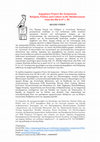
by Panagiotis Kousoulis, Grigorios Kontopoulos, Electra Apostola, Anna Kalaitzaki, Matthew L Skuse, Virginia Webb, Alexandra Villing, Dominique Barcat, Aurelia Masson-Berghoff (Masson), Fani Seroglou, Natasha (Anastasia) Psarologaki, Justin Yoo, Dalit Regev, Georges Mavroudis, and Giorgos Bourogiannis The Aegyptiaca Symposium is the second international colloquium in the Ex Oriente Lux series and ... more The Aegyptiaca Symposium is the second international colloquium in the Ex Oriente Lux series and it was born out of the interdisciplinary research project Aegyptiaca: Ecumene and Economy in the Horizon of Religion, which is coordinated by the University of the Aegean (Department of Mediterranean Studies), the University of Bonn (Institute of Egyptology) and the University οf Thessaly (Department of History, Archaeology and Social Anthropology) since 2007. The Project and the Symposium focuse on the Egyptian and egyptianised material from archaic Greece and on the re-evaluation of the Egyptian cross-cultural interactivity with the Aegean world and the Early Iron Age eastern Mediterranean in the sphere of economy and religion.
Aegyptiaca Project website: http://aegeanegyptology.gr/the-aegyptiaca-project-ecumene-…/
Conference Presentations by Justin Yoo
The Current State of Egyptology: An International Survey and Discussion
This paper suggests that Egyptology has reached a critical juncture in which the opening of the f... more This paper suggests that Egyptology has reached a critical juncture in which the opening of the field to other areas, such as anthropology and sociology, is critical in revitalising and safeguarding the future of the discipline. Discourse beyond disciplinary boundaries is becoming increasingly important in academia, due to wider changes in university structures, employment, and funding opportunities. Given the current importance of these issues, the authors wanted to determine how these aspects have impacted the identities, research, and careers of those who are currently entering the discipline. The authors designed and implemented an international survey to gauge the current state of Egyptology from the point of view of PhD students and early career researchers. The aim of this survey was to determine how these individuals perceived the scope and role of Egyptology, its prospects as a discipline, its integration in the humanities and social sciences, and the role of their own research and experience. The survey results are discussed alongside the authors proposal that a more reflexive Egyptology, one that engages critically with other disciplines, is needed to help reinvigorate the field and open new lines of enquiry for future research.



Uploads
Books by Justin Yoo
Edited Volumes by Justin Yoo
Table of Contents
Introduction: TRAC Past, Present and Future: Where to go from here? (Hannah Platts, John Pearce, Caroline Barron, Jason Lundock, Justin Yoo)
Hobson, M., An Historiography of the Study of the Roman Economy: economic growth, development, and neoliberalism.
Jongman, W. M., Why Modern Economic Theory Applies, Even to the Distant Roman Past.
Lulic, J., Dalmatian Silvanus: A Cognitive Approach to Reinterpretation of the Reliefs Representing Silvanus from Roman Dalmatia.
Cousins, E., Votive Objects and Ritual Practice at the King’s Spring at Bath.
Dicus, K., Resurrecting Refuse at Pompeii: The Use-Value of Urban Refuse and its Implications for Interpreting Archaeological Assemblages.
Marchiori, G., Decline, Migration and Revival: Kom al-Ahmer and Kom Wasit, a History of a Forgotten City.
Ball, J., Small Finds and Roman Battlefields: The Process and Impact of Post-Battle Looting.
Prior, J. D, Methods and Difficulties in Quantifying Archaeological Vessel Glass Assemblages.
Podavitte, C., Pompeian–red Ware in Roman London: Insights on Pottery Consumption in Colonial Environments.
Vucetic, S., Roman Sexuality or Roman Sexualities? Looking at Sexual Imagery on Roman Terracotta Mould-made Lamps.
Heeren, S., The material culture of small rural settlements in the Batavian area: a case study on discrepant experience, creolisation, Romanisation or globalisation?
APPENDICES (on CD)
Appendix I. A revised classification and chronology for daggers and knives, by Stuart Needham
Appendix II. The role and use of daggers in british early bronze age society: insights from their chemical composition, by Peter Bray
Appendix III. Animal bone and antler, by Mark Maltby
Appendix IV. Identification of Bronze Age pommels and other osseous objects, by Sonia O’Connor
Appendix V. The study and analysis of jet and jet-like materials: methods and results, by Mary Davis, Duncan Hook, Mick Jones, Alison Sheridan and Lore Troalen
Appendix VI. Stone: PXRF analysis, magnetic susceptibility and petrography, by Rob Ixer, Philip Potts, Peter Webb and John Watson
Appendix VII. Necklaces: additional data, by Alison Sheridan and Ann Woodward "
Panel Sessions by Justin Yoo
This panel hopes to discuss both theoretical approaches to the study of migration and cultural transmission and case studies focusing on communities of migrants in the Roman provinces of the Near East and the Levant. We are particularly interested in exploring how the material evidence may be able to shed light on self-perception and representation within migrant communities."
Posters by Justin Yoo
Papers by Justin Yoo
Reviews by Justin Yoo
Talks by Justin Yoo
Conference Papers by Justin Yoo
Panelists:
Matthew Skuse - 'Scarabs, Sailors, and Seaside Sanctuaries: Pre-Naukratis Evidence for Archaic Greek Interactions with Egypt'
Hannah Ringheim - 'Greek Mercenaries in Saite Egypt during the 7th and 6th Centuries B.C.: Revisiting the Archaeological Evidence in the Nile Delta'
Kira Hopkins - 'Herodotean Influences on Saite Egypt'
Justin Yoo - 'The Statue of Pedon: A Re-Assessment and Re-Analysis from both sides of a Disciplinary Divide'
Panel Abstract:
Traditionally, discussions of Greek interactions with Egypt in the Archaic Period have been dominated by the consideration of a small number of common features – mercenaries, merchants, royal gifts, and Naukratis - the features which Herodotus describes to us, and which have appeared validated by archaeological finds at Naukratis and Tel Defenneh. Naturally, however, Herodotus cannot be expected to have provided a complete or unproblematic picture of Graeco-Egyptian interactions. This panel brings together different disciplines (Ancient History, Archaeology, and Egyptology) in order to demonstrate how the utilisation of a broader range of evidence and approaches can challenge, and contribute new perspectives to, the conventional and largely Herodotean narrative of Graeco-Egyptian interactions in the Archaic Period. The panel begins by considering evidence for archaic Greek interactions with Egypt which pre-date the foundation of Naukratis and Psammetichus I’s use of Greek mercenaries (SKUSE). The ensuing two papers (RINGHEIM, HOPKINS) scrutinise, in turn, modern and ancient accounts of Greek mercenaries in Egypt against archaeological evidence. The final paper (YOO) concludes the panel by demonstrating the benefits of a holistic, interdisciplinary approach through the discussion of a specific object, an Egyptian statue used as a votive by a Greek mercenary. Together, these papers will highlight some of the new findings which can be drawn from the consideration of classical texts and material culture in parity.
Full abstracts of all papers: http://www.ed.ac.uk/files/atoms/files/final_abstracts_list_ca2016.pdf
Recent & Upcoming Conference Talks by Justin Yoo
Aegyptiaca Project website: http://aegeanegyptology.gr/the-aegyptiaca-project-ecumene-…/
Conference Presentations by Justin Yoo