Synopsis
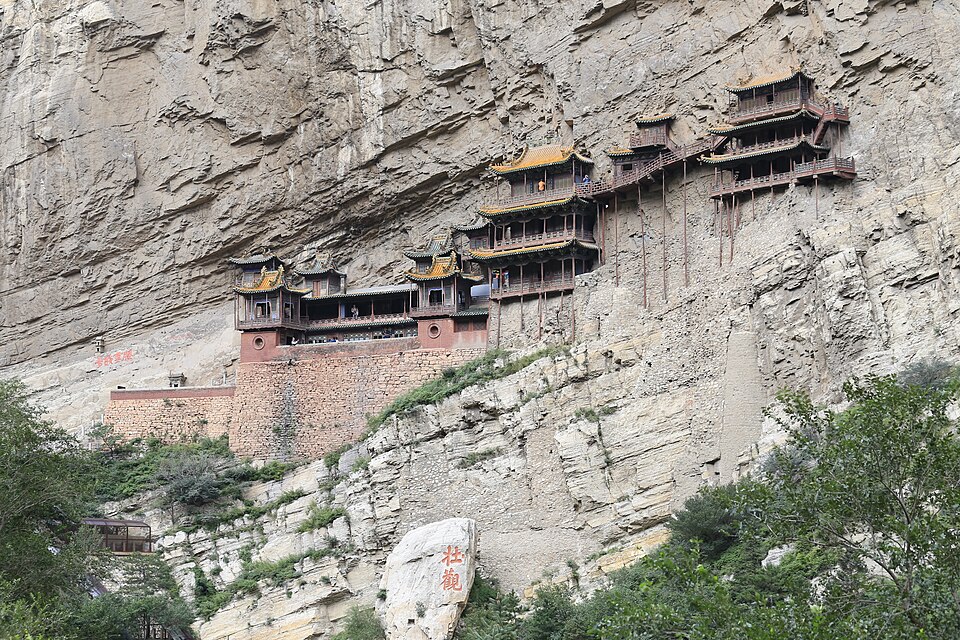
Built in 491 AD on a cliff face, the Hanging Temple is supported by just 27 wooden beams. It is China's earliest temple integrating Confucianism, Buddhism, and Taoism. Named by TIME as one of the world's top 10 most bizarre buildings.
Overview
The Hanging Temple (悬空寺, Xuankong Si), located on the western side of Cuiping Peak in Jinlong Gorge, Hengshan Mountain, Hunyuan County, Datong City, Shanxi Province, is a temple complex integrating Confucianism, Buddhism, and Taoism. The Hanging Temple was first built in the 15th year of the Taihe era of the Northern Wei Dynasty (491 AD), with a history of over 1,500 years.
The entire temple is built halfway up Cuiping Mountain, approximately 50-60 meters above the ground. The cultural building area covers 472 square meters, with a front platform of 726 square meters. The temple is supported by 27 wooden beams inserted into the cliff face, appearing to hang in mid-air when viewed from afar — hence the name "Hanging Temple." The complex consists of 40 rooms in a wooden frame structure, with main buildings connected by corridors and plank roads.
The Hanging Temple is famous for its architectural features of "wonder, suspension, and ingenuity." It is China's earliest surviving temple integrating the three teachings (Confucianism, Buddhism, and Taoism), and is the "first scenic spot" among the Eighteen Views of Hengshan Mountain.
History
| Period | Event |
|---|---|
| 15th year of Taihe, Northern Wei (491) | Hanging Temple founded |
| Jin-Yuan Dynasties | Repairs carried out |
| Ming-Qing Dynasties | Current buildings reconstructed during Ming-Qing period |
| 1982 | Designated as a Major Historical and Cultural Site Protected at the National Level |
| 2010 | Named by TIME Magazine as one of the "World's Top 10 Most Bizarre Buildings" |
Architecture
The architectural features of the Hanging Temple can be summarized in three characters:
| Feature | Description |
|---|---|
| Wonder (奇) | Remarkable location — the temple is built on a cliff face, surrounded by mountains on three sides |
| Suspension (悬) | Suspended structure — the main buildings are supported by 27 wooden beams inserted into the rock, appearing to hang in mid-air |
| Ingenuity (巧) | Ingenious design — using mechanical principles, wooden beams are inserted deep into the rock, fixed at the upper end and supported by pillars below |
The Hanging Temple's layout consists of three parts:
- South Tower: Primarily Taoist buildings, including the Sanqing Hall and Yuhuang Pavilion
- North Tower: Primarily Buddhist buildings, including the Sansheng Hall and Guanyin Hall
- Long Line Bridge: The aerial plank walkway connecting the South and North Towers — the most distinctive feature of the Hanging Temple
Notably, although the temple appears to be supported by wooden pillars, the main load-bearing elements are actually the wooden beams inserted into the rock face (similar to modern cantilever beams). The pillars below serve only as auxiliary support. This ingenious mechanical design has allowed the Hanging Temple to stand for over 1,500 years.
Integration of Three Teachings
The Hanging Temple is China's earliest surviving temple integrating Confucianism, Buddhism, and Taoism, with statues from all three faiths.
On the highest level of the temple, there is a hall called the "Three Teachings Hall" (Sanjiao Dian), where Confucius (founder of Confucianism) is enshrined in the center, flanked by Shakyamuni (founder of Buddhism) on the left and Laozi (founder of Taoism) on the right. This arrangement of three teachings sharing one hall is extremely rare in Chinese temples.
The integration of three teachings at the Hanging Temple reflects the inclusive tradition of ancient Chinese culture and the historical background of ethnic integration and cultural exchange during the Northern Wei period.
Practical Information
| Item | Details |
|---|---|
| Location | Tangzhuangzi Village, Yong'an Town, Hunyuan County, Datong City, Shanxi Province |
| Best Season | Year-round; April-October is best |
| Suggested Visit Duration | 1-2 hours |
| Admission | Peak season (Apr-Oct) ~115 RMB (including climbing fee), Off-season (Nov-Mar) ~60 RMB |
| Transportation | Tourist bus from Datong ~1.5 hours; or take public bus to Hunyuan then transfer |
| Nearby Attractions | Hengshan Mountain Scenic Area, Yungang Grottoes (~17 km from Datong) |
Cultural Significance
The Hanging Temple holds a special place in Chinese culture and architectural history:
- Architectural Marvel: Named by TIME Magazine in 2010 as one of the "World's Top 10 Most Bizarre Buildings"
- Religious Integration: China's earliest surviving temple integrating Confucianism, Buddhism, and Taoism
- Literary Impact: The Tang Dynasty poet Li Bai visited the Hanging Temple and left the characters "spectacular" (壮观), now carved on the stone wall in front of the temple
- Historical Testimony: The Hanging Temple demonstrates the superb level of ancient Chinese architectural technology since the Northern Wei period
References
- Baidu Baike: https://baike.baidu.com/item/悬空寺
- Wikipedia: https://zh.wikipedia.org/wiki/悬空寺
- Hengshan Scenic Area: https://www.byhs.net.cn/culture_detial/77.html
- Zhihu: https://zhuanlan.zhihu.com/p/741469898
Stills & Gallery
Comments (0)