Synopsis
Mount Emei is one of China's Four Sacred Buddhist Mountains and the bodhimanda of Samantabhadra Bodhisattva. The Leshan Giant Buddha is the world's largest stone-carved Buddha statue at 71m tall. A UNESCO dual World Heritage Site since 1996.
Overview
Mount Emei and the Leshan Giant Buddha are located in southwestern Sichuan Province, China, in the transition zone between the Sichuan Basin and the Qinghai-Tibet Plateau. The heritage site comprises Mount Emei, with an elevation of 3,099 meters, and the Leshan Giant Buddha, standing 71 meters tall. The site is renowned for its subt montane vegetation, Buddhist cultural relics, and cliff-carved stone art.
Mount Emei is one of China's Four Sacred Buddhist Mountains (along with Mount Wutai, Mount Putuo, and Mount Jiuhua). As the bodhimanda (sacred site) of Samantabhadra Bodhisattva (Puxian), it has profound religious significance and is known as "Emei, the most elegant mountain under heaven."
On December 6, 1996, Mount Emei and the Leshan Giant Buddha were inscribed on UNESCO's World Cultural and Natural Heritage List (dual designation).
Mount Emei
Mount Emei is located in Emeishan City, Leshan, Sichuan Province. It is one of China's most famous Buddhist sacred sites. Buddhist temples were first built here during the Eastern Han Dynasty, and after the Tang Dynasty, it became the center of Samantabhadra (Puxian) worship.
Four Wonders of Mount Emei
| Wonder | Features |
|---|---|
| Sea of Clouds | Spectacular cloud seas, especially at the Golden Summit |
| Sunrise | Sunrise at the Golden Summit is one of Mount Emei's most famous views |
| Buddha's Light | Also called "Emei Precious Light," an optical phenomenon created by sunlight refracting through cloud mist |
| Holy Lanterns | At night, lights from below can sometimes be seen from the Golden Summit, called "ten thousand lamps facing Samantabhadra" |
Main Attractions
| Attraction | Features |
|---|---|
| Golden Summit (Jinding) | Highest point of Mount Emei (3,099m), features the 48-meter-tall Ten Directions Samantabhadra golden statue |
| Wannian Temple | One of the oldest temples on Mount Emei, houses a Song Dynasty bronze statue of Samantabhadra riding an elephant |
| Baoguo Temple | First major temple upon entering Mount Emei |
| Qingyin Pavilion | Located at the confluence of two streams below Niuxin Mountain, a tranquil setting |
| One-Line Sky | A narrow gorge where only a sliver of sky is visible between the walls |
| Monkey Area | Habitat of wild macaques on Mount Emei — visitors can observe them up close in the ecological monkey area |
| Ninety-Nine Bends | The steep mountain path from Qingyin Pavilion to Jiulao Cave, with 99 sharp turns |
| Elephant Washing Pool | Legend says Samantabhadra washed his elephant here |
Leshan Giant Buddha
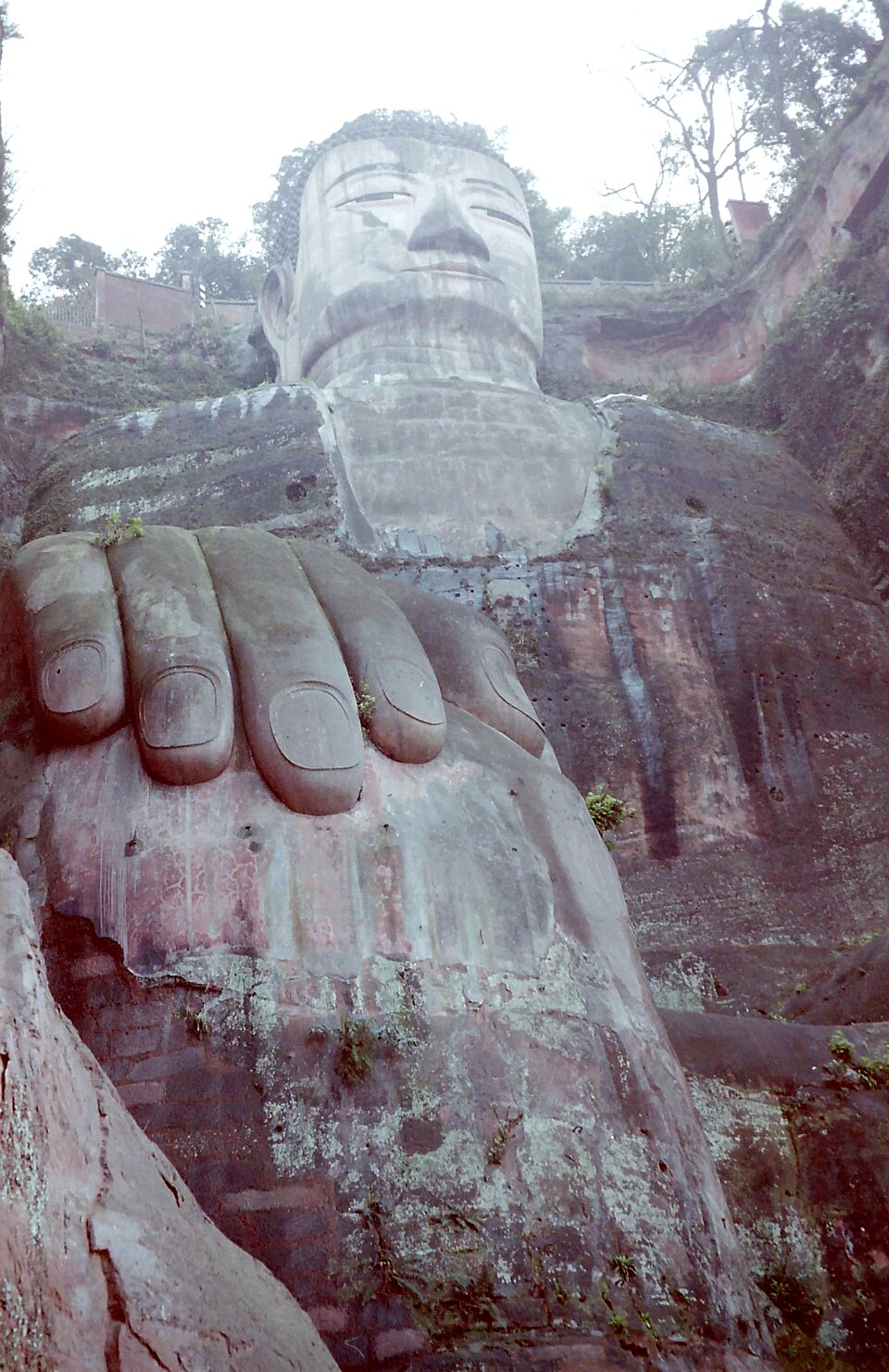
The Leshan Giant Buddha is located about 40 kilometers northeast of Mount Emei in Leshan City, at the confluence of the Minjiang, Qingyi, and Dadu rivers. Carving began in the early Kaiyuan era of Emperor Xuanzong of Tang (713 AD) and took 90 years to complete, finishing in the 19th year of the Zhenyuan era of Emperor Dezong of Tang (803 AD).
The Leshan Giant Buddha stands 71 meters tall, making it the largest stone-carved Maitreya Buddha statue in the world. The Buddha sits against the mountain, facing the confluence of three rivers. Its head is 14.7 meters high and 10 meters wide, ears are 7 meters long, and the instep is 8.5 meters wide — large enough to seat over a hundred people.
The Buddha was initiated by the Tang Dynasty monk Haitong. According to legend, the turbulent waters at the confluence of the three rivers frequently caused boat wrecks and loss of life. Monk Haitong initiated the carving of the Great Buddha to calm the waters and save sentient beings.
Practical Information
| Item | Details |
|---|---|
| Location | Leshan, Sichuan Province |
| Best Season | Spring (Apr-May) and Autumn (Sep-Nov) |
| Recommended Duration | Mount Emei 2 days, Leshan Giant Buddha half day |
| Mount Emei Ticket | Peak season ~160 RMB, Off-season ~110 RMB |
| Leshan Giant Buddha Ticket | ~80 RMB |
| Golden Summit Cable Car | Up ~65 RMB, Down ~55 RMB |
| Transportation | Chengdu to Leshan high-speed rail ~1 hour; Leshan to Emeishan by bus ~30 minutes |
World Heritage
In 1996, Mount Emei and the Leshan Giant Buddha were inscribed by UNESCO as a World Cultural and Natural Heritage Site (dual designation). UNESCO's evaluation noted:
- Mount Emei possesses one of China's most complete vertical vegetation profiles
- Mount Emei is an important center of Chinese Buddhist culture, with numerous precious Buddhist artifacts and buildings
- The Leshan Giant Buddha is the largest stone-carved Buddha statue in the world, representing the highest achievement of Tang Dynasty stone-carving art
Mount Emei and the Leshan Giant Buddha, along with Mount Huangshan, Mount Tai, and Mount Wuyi, are among China's few World Cultural and Natural Heritage Sites (dual designation).
References
- Baidu Baike: https://baike.baidu.com/item/峨眉山-乐山大佛
- Sichuan Culture Network: https://www.scwmw.cn/topic/zt2025/whyc/202507/t20250708_1362725.htm
- UNESCO: https://whc.unesco.org/en/list/779
Stills & Gallery
Comments (0)