Papers by Lilian Guerrero
Estudios lingüísticos y filológicos en lenguas indígenas mexicanas Celebración de los 30 años del Seminario de Lenguas Indígenas, 2021
Esta investigación fue posible gracias al apoyo del proyecto UNAM-DGAPA-PAPIIT (IN400919) y el pr... more Esta investigación fue posible gracias al apoyo del proyecto UNAM-DGAPA-PAPIIT (IN400919) y el proyecto Fondo Sectorial de Investigación para la Educación (CONACyT A1-S-24378). Agradezco sinceramente los comentarios y sugerencias de dos dictaminadores anónimos a la versión preliminar de este manuscrito.
Locative and existential predication: On forms, functions and neighboring domains. Chris Lasse Däbritz, Josefina Budzisch & Rodolfo Basile (eds.), 45–88. Berlin: Language Science Press., 2025
Prior typological studies dealing with locative/existential constructions have ignored languages ... more Prior typological studies dealing with locative/existential constructions have ignored languages spoken in Mexico outside the Mesoamerican area. The present study fills this gap and examines constructions that code figure-ground relationships in Southern Uto-Aztecan languages. The aim of this chapter is threefold: to establish the number of locative predicates in each language under analysis, to determine the typology of locative predications in this language family, and to look at the semantic properties of locative predicates in one of these languages (Yaqui). I show that Southern Uto-Aztecan languages display not only a rich inventory of locative predicates, but also variation in the use of postural ('sit', 'stand', 'lie'), general locative ('be located'), existential ('exist'), and positional verbs ('be inserted', 'be stacked', 'be leaning', and so on). Furthermore, I propose that, because Southern Uto-Aztecan languages typically use postural verbs in locative descriptions, they are examples of the locative type in Stassen's (1997) typology of locative predication, and the small-set language type in Ameka & Levinson's (2007) typology. There are two major exceptions to this pattern. On the one hand, Mayo and some Nahuatl languages can be characterized as single-set language type since they only use a general locative verb. On the other hand, Yaqui is a good example of intermediate-set language type, since it uses postural, general locative, existential, and positional verbs in locative constructions. After a thorough discussion of relevant Yaqui data, I reveal that the selection of locative/existential verbs is semantically motivated by the animacy, number, and shape of the figure, the properties of the ground, and spatial configurations. I also demonstrate that, at least in Yaqui, there is no syntactic or pragmatic evidence for a dedicated existential or locative-existential construction; only locative constructions are documented.
Reflexive constructions in the world’s languages. Katarzyna Janic, Nicoletta Puddu y Martin Haspelmath (eds). Berlin: Language Science Press, pp. 701-730, 2023
coreferential participants within the same clause can be expressed by reflexive pronouns or nonre... more coreferential participants within the same clause can be expressed by reflexive pronouns or nonreflexive personal pronouns. Reflexive pronouns express agent-patient and agent-beneficiary coreference; when noncoreferential, the patient and the beneficiary take accusative case. Nonreflexive personal pronouns express the coreference between the agent and several other semantic roles (e.g., theme, interlocutor, recipient, source, location); when noncoreferential, these participants take oblique case. The agent-possessor coreference alternates: it is usually expressed by nonreflexive pronouns but, under certain circumstances, it is reflexive-marked. These patterns suggest that the use of reflexive pronouns in Yaqui is syntactically conditioned, i.e., reflexive pronouns cannot be combined with postpositions and cannot serve as adnominal modifiers.
Amerindia, 2020
This paper revisits possessive constructions in Yaqui (Uto-Aztecan; Mexico). Previous studies hav... more This paper revisits possessive constructions in Yaqui (Uto-Aztecan; Mexico). Previous studies have described Yaqui internal and verbal possessive constructions. The former makes use of juxtaposition, pronominal possession, and genitive phrases, and the latter shows possessive verbs taking the possessor as nominative subject and the possessee as accusative object. This study complements previous works with observations based on corpus data, and introduces a new, complex construction in Yaqui grammar: external possessive constructions. In external possession, the possessee can be coded as an accusative or locative argument, whereas the possessor can be coded as a nominative, accusative, dative or locative argument; dative and locative marking correspond to oblique core arguments. Locative external possessors have been barely documented outside European languages.

RASAL Lingüística, 2024
El yaqui (yutoazteca; México) tiene varios mecanismos morfológicos para codificar cambios de voz,... more El yaqui (yutoazteca; México) tiene varios mecanismos morfológicos para codificar cambios de voz, entre ellos el morfema-wa, hasta ahora poco analizado. Este estudio examina las características básicas de las cláusulas con-wa del yaqui a partir de datos de textos y discute algunos aspectos de su estructura e interpretación. Los datos muestran que las cláusulas con-wa funcionan tanto como pasivas promocionales como no promocionales en virtud del estatus del argumento pacientivo, marcado nominativo en las pasivas promocionales y acusativo en las no promocionales. Con pacientes plurales la distinción de caso se neutraliza y es imposible distinguir entre las dos funciones. Las cláusulas con-wa también ocurren con verbos intransitivos y dicendi, resultando en pasivas no promocionales. En todos los casos, la omisión del argumento A es obligatoria. Este tipo de cláusulas son más frecuentes en historias de vida que en otros géneros discursivos, y típicamente se asocian con un participante P que funciona como tópico continuo afectado por la acción de los agentes omitidos, cuya identidad sin embargo se recupera inferencialmente y coincide con figuras de autoridad.
Lingüística, Jan 6, 2012
Lingüística 27, junio 2012 the corpus follow the same discourse tendencies exhibited by canonical... more Lingüística 27, junio 2012 the corpus follow the same discourse tendencies exhibited by canonical transitive clauses, contributing empirical evidence to recent claims supporting the argument status of sources, goals and locations associated with motion verbs in other languages (Beavers, Levin y Tham 2010).
Vocesdisonantes04 (1), 2023
Este trabajo presenta un panorama general a los estudios del espacio y movimiento en las lenguas ... more Este trabajo presenta un panorama general a los estudios del espacio y movimiento en las lenguas del mundo y se centra en 3 instrumentos para la recolección de datos lingüísticos.
Lingüística, 2012
En este artículo se aborda el estudio de la interfaz entre gramática y discurso en las construcci... more En este artículo se aborda el estudio de la interfaz entre gramática y discurso en las construcciones de movimiento en un corpus de narrativas yaquis, a partir del modelo de Estructura Argumental Preferida (EAP, Du Bois 1987, 2003). La EAP ha develado fuertes tendencias interlingüísticas que afectan el tipo de realización léxica de los argumentos verbales. En el presente trabajo, estas tendencias son utilizadas como una herramienta a partir de la cual aportar evidencia adicional sobre el estatus gramatical de las frases ...
It has been reported that the Seri people, or Comcaac, were in close contact with both the Yaqui ... more It has been reported that the Seri people, or Comcaac, were in close contact with both the Yaqui and O’odham peoples during the last few centuries, although, there appears to have been considerably less contact in the last few decades (Marlett ms.). While Seri is categorized as a language isolate, Yaqui and O’odham belong to the Uto-Aztecan family. As part of an attempt to better understand the level of contact between the Seri, a semi-nomadic huntergatherer group, and the neighboring indigenous communities that are sedentary agriculturalists, Beals (1961) compared the Seri kinship system with the kinship systems of four Uto-Aztecan language communities ‒Tarahumara, Huichol, Cora and the Cahita languages.1 His work shows many similarities between these systems, including, for instance, the fact that all of the groups consolidate cousins with siblings (Beals 1961: 133) and that the Seri kinship system shows many similar distinctions as the Cahita one, for example in the distinctions ...
Anuario de Letras. Lingüística y Filología, 2021
Estudios tipológicos previos han observado que las cláusulas temporales, a diferencia de otras cl... more Estudios tipológicos previos han observado que las cláusulas temporales, a diferencia de otras cláusulas adverbiales, pueden aparecer antes o después de la cláusula principal y esa variación se observa entre lenguas y en una misma lengua. Para el caso del español, varios estudios han sugerido que las cláusulas temporales tienden a ocupar la posición inicial. En este trabajo extendemos las premisas de los estudios tipológicos al análisis de las cláusulas temporales que se introducen con cuando. En datos de uso encontramos que la posición antepuesta es la preferida en lengua oral, pero ambas posiciones son igualmente comunes en lengua escrita. Exploramos algunas motivaciones semánticas, sintácticas y pragmáticas que, en conjunto, pueden influir en esa variación de orden: la naturaleza semántica de cuando, iconicidad de secuencia, longitud y complejidad sintáctica, así como progresión pragmática. Abstract Previous typological studies have shown that temporal clauses, unlike other adverbial clauses, can occur before or after the main clause, and this order variation has been observed across languages and within the same language. In the case of Spanish, some studies have found that temporal clauses tend to occur at the beginning of the clause. In this paper, we extend the assumptions of typological studies into the analysis of temporal clauses introduced by cuando 'when'. Based in used data, we found that the initial position is preferred in oral data, while both positions are equally common in writing data. We examine some semantic, syntactic, and pragmatic motivations that, together, may explain this order variation: the semantic nature of cuando, sequential iconicity, length, and syntactic complexity, as well as pragmatic order.
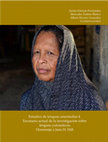
Estudios en Lenguas Amerindias 4. Escenario actual de la investigación sobre lenguas yuto-aztecas. Homenaje a Jane H. Hill. Z, 2019
El objetivo de este estudio es describir las construcciones locativas básicas en dos lenguas yuto... more El objetivo de este estudio es describir las construcciones locativas básicas en dos lenguas yutoaztecas habladas en el Occidente de México, el wixárika (huichol) y el o’dam (tepehuano del sureste). Entre los rasgos que comparten estas dos lenguas es el uso de un conjunto de verbos de postura ‘sit’, ‘stand’ y ‘lie’; estos verbos son de los pocos que dan cuenta del número de la figura, ya sea por supleción o por reduplicación; además, funcionan como clasificadores de entidades inanimadas pues su distribución está motivada por las propiedades físicas inherentes de la figura y/o por la superposición, proximidad, adhesión, y contención de la figura en el fondo. A pesar de las similitudes, también se detectan asociaciones entre la figura y el verbo de postura que no coinciden entre las dos lenguas.
Folia Linguistica, 2021
Typological studies have tended to take for granted the default interpretation for English and im... more Typological studies have tended to take for granted the default interpretation for English and imposed 'simultaneity' as the basic meaning of when-clauses for all languages. This in opposition to the approach taken in reference grammars, which generally report temporal linkage markers like when as encoding one or several meanings. Data from languages other than English show that comparative studies should also be open to the possibility that when-clauses do not always, or only, denote simultaneity. To support this claim and argue against the default interpretation of simultaneity, in this study I explore the range of temporal meanings of when-clauses across languages and provide evidence from Spanish and Yaqui corpora. Unlike English, corpus-based studies show that Spanish equivalent cuando-clauses equally introduce simultaneous and sequential readings, while Yaqui o-/kai-clauses predominantly express sequential meanings. Furthermore, a convenience sample of 28 unrelated languages reveals that, if there is a when-clause in a language, it can locate the event of the adverbial clause earlier, later, or around the same time as the main clause. The analysis of the semantic side of when-clauses demonstrates that there are language-specific tendencies regarding their temporal meanings. On these grounds, I propose that a better understanding of when-clauses can be arrived at by classifying them as 'unspecific' temporal clauses. This categorization would motivate a richer analysis of new data and a systematic comparison between unspecific, simultaneous and sequential clauses. Finally, I advance a four-way classification regarding general vs. specific markers, and the temporal relations they encode, two of which account for most languages analyzed.
Lenguas yutoaztecas: historia, estructuras y contacto lingüístico. Homenaje a Karen Dakin, 2020
El objetivo del presente estudio es completar los estudios previos sobre construcciones posesivas... more El objetivo del presente estudio es completar los estudios previos sobre construcciones posesivas en yaqui con datos de corpus y ofrecer una descripción de construcciones posesivas a partir de la naturaleza del elemento poseído. Para ello, se exploran las correlaciones (y restricciones) entre el tipo de construcción (posesión interna, posesión verbal, posesión externa) y la relación posesiva (términos de parentesco, partes del cuerpo, parte-todo, parte-locativo, tipo-clase, asociación, pertenencia).
Lingüística Mexicana, 2019
In Yaqui and Wixarika, suppletion is found in the pronominal, adjectival, nominal and verbal syst... more In Yaqui and Wixarika, suppletion is found in the pronominal, adjectival, nominal and verbal systems; in some cases, suppletion is total; in others, it is partial. In the pronominal system, the accusative / genitive form supple for some grammatical persons; within adjectives and nouns, suppletion is motivated by animacy; verbal suppletion encodes number and, in a couple of cases, tempo-aspectual values. The inventory of sup-pletive forms is larger and more complex in Wixarika, in comparison with Yaqui, which shows suppletion for some stative, inchoative and causative verbs. In all cases, the suppletive alternatives are characterized as an exceptional , non-canonical and unpredicted pattern in their grammars.
Lingüíistica Mexicana, 2019
El objetivo de este Dossier es explorar las formas supletivas en verbos, nominales, pronombres y... more El objetivo de este Dossier es explorar las formas supletivas en verbos, nominales, pronombres y algunos otros elementos en 5 lenguas yutoaztecas sureñas: pima bajo, tepehuano del sureste (o'dam), tarahumara (ralámuli ra’aichaala de Munérachi), yaqui y huichol (wixárika)
Applying and Expanding Role and Reference Grammar. R. Kailuweit, L. Künkel y E. Staudinger (eds). ), pp. 263-280. Freiburgo: University Library Freiburg, 2018
In Yaqui, purpose, reason and temporal relations are expressed by multiple syntactic structures. ... more In Yaqui, purpose, reason and temporal relations are expressed by multiple syntactic structures. The aim of this paper is to explore whether Yaqui syntactic linkages are compatible (or not) with the cross-linguistic predictions made by the Interclausal semantic relations hierarchy. This Hierarchy (Van Valin 2005: 209) predicts a scale where purpose outranks reason and reason outranks temporally ordered events. However, Yaqui does not conform to the expected rankings. In this language, purpose relations make use of the tightest syntactic linkages, while reason relations are expressed by the loosest syntactic structure. However, in terms of syntactic bonding and semantic integration, simultaneous and sequential temporal expressions are placed right in the middle of purpose and reason.
Argument selectors: A new perspective on grammatical relations, 2019
This paper describes a number of selectors for grammatical relations in Yaqui. The main selectors... more This paper describes a number of selectors for grammatical relations in Yaqui. The main selectors discussed in the paper include case marking, word order, suppletion, passive and valency-increasing mechanisms, control and ana-phoric constructions. The study reveals two crucial aspects: Yaqui is a good example of a language where grammatical relations can be characterized as a construction-specific category, and the distinction between core and non-core arguments is essential to determine the selected argument in particular constructions.
Diverse Scenarios of Syntactic Complexity. A. Álvarez, Z. Estrada y C. Chamoreau. , 2019
In this paper, I examine the form and function of Yaqui adverbial subordinators. In contrast to r... more In this paper, I examine the form and function of Yaqui adverbial subordinators. In contrast to relative and complement subordinators, which are always final and bound, adverbial subordinators can occur in both positions, clause-final and clause-initial; the former are bound morphemes, and the latter are free particles. The adverbial markers in initial position differ from any other subordinators in two ways: they have lexical content and do not demand structural dependent features inside the linked unit. Among the final subordinators,-kai and-o are not only the most productive markers in the sample, but they also introduce several adverbial relations including manner, purpose, temporal, concessive and conditional meanings. In fact, these two subordinating morphemes show a consistent , though not obligatory distribution: while-kai is used when the main and dependent subjects are the same,-o often occurs when the subjects are different. The contrasts observed among the adverbial clauses taking final subordinators and those introduced by initial subordinators suggest that the latter may be somewhat new in the Yaqui grammar. As new adverbial clause linkage markers, they adopt the structural features of coordination instead of subordination.
International Journal of American Linguistics, 2017
This paper examines the syntactic structures that express purpose and causal adverbial relations ... more This paper examines the syntactic structures that express purpose and causal adverbial relations in the Yaqui language. Yaqui displays considerable structural variation when expressing purpose and cause, and each of the linked units exhibits different degrees of syntactic and semantic integration with the main unit. In use, purpose clauses express the agent's intention to bring about another event, whereas causal clauses express several related meanings, from cause-effect to reason and explanation, and even consequence. Importantly, Yaqui purpose clauses display two undescribed kinds of variation in typo-logically common patterns: they demand argument sharing and a special lexical coding. These constraints are not found in causal clauses. The contrasts observed between these two semantically related adverbial clauses favor the analysis of Yaqui purpose clauses as a kind of referential control construction.



Uploads
Papers by Lilian Guerrero