New by Liran Razinsky
AI and Society, 2026
This essay examines how the rapidly expanding algorithmic, data-driven mode of understanding huma... more This essay examines how the rapidly expanding algorithmic, data-driven mode of understanding humans affects modes of subjectivity. Through a critical, theoretical framework, the paper explores the hyper-individuation that results from the personalization of information, services, and environments, and from the fact that algorithmic decisions, predictions, and recommendations are individually tailored, creating a world adapted only to us. In this societal model—this is the paper’s main focus—others will be erased from our phenomenal world. First, I briefly examine how the supposed hyper-individuation is deceptive and hollow, and leads, paradoxically, to disindividuation: The algorithmic mediation of our world does not perceive or address the subject as such and induces instead an irreducible dispersion and abstraction of the person. I then explore the disappearance of others in this hyper-individuated, algorithmically mediated existence and argue that such friction-free existence does not allow us to become human subjects in the full sense. The hyper-individuation is also deceptive in that while recommendations and predictions are maximally tailored to a specific subject, one is nevertheless “understood” through the data of others. The relationship of oneself to the other, therefore, undergoes acute changes. For while the presence of others persists under algorithmic mediation, it is reshuffled, averaged, decomposed, and then recomposed to become unidentifiable and unrecognizable. This new algorithmically processed alterity does not give our selfhood full space to develop.
Psychoanalysis, Culture & Society, 2025
The paper aims to explore some consequences for psychic life of a growing transparency to the alg... more The paper aims to explore some consequences for psychic life of a growing transparency to the algorithmic gaze. Due to the massive collection of data and its analysis with machine-learning algorithms, more and more can be known about one's thoughts, intentions, and emotional states. The paper asks what kind of subjective experience can result from a situation of having a transparent mind. It also argues that such transparency has its limits, limits set by the irreducible opacity of the psyche to itself due to its multilayered complexity.
Subjectivity, 2023
The paper explores the widely circulated idea that algorithms will soon be able to know people “b... more The paper explores the widely circulated idea that algorithms will soon be able to know people “better than they know themselves.” I address this idea from two perspectives. First I argue for the particular subjective qualities of experience and self-understanding issuing from our engagement with the world and the constitutive role of our reflexive relation to ourselves. These are not “known” by the algorithms. I then address our fundamental opacity to ourselves and the biased, partial, and limited nature of human self-understanding. Our failure to know ourselves is however essential to our subjectivity and therefore, to know a subject in a perfect way that bypasses these limitations is actually not to know them. Taken together, both directions show that while algorithmic knowledge of humans can be vast, and can outperform their own knowledge, it remains foreign to their subjectivity and cannot be said to be better than self-understanding.
Lit: Literature Interpretation Theory. Special issue Politics of Literature, Politics of the Archive, edited by Tom Chadwick and Pieter Vermeulen, 2020
Total Recall (Bell and Gemmell, 2009) is a non-fiction book proposing a vision of a complete digi... more Total Recall (Bell and Gemmell, 2009) is a non-fiction book proposing a vision of a complete digital archive of everything we do, see or hear. Cameras and devices would constantly record out experience, creating a digital copy of one’s memory. I read this vision as a contemporary form of autobiography, expressing fantasies of self-representation, mostly the will for erasing the gap between one’s representation and oneself. The vision attempts to create a representation of oneself that would be identical to oneself and capture one’s past experience. Yet this dreamt-of faithful self-representation – direct, ongoing, automatic, objective – merely constitutes further proof of the difficulty inherent in autobiography. The outcome of the attempt to create the most exact representation, would be a dataset from which precisely the subject is absent. The perspective of literary autobiography thus helps shed light on new and evolving contemporary practices.
Clio: A Journal of Literature, History, and the Philosophy of History, 2019
Elias Khoury’s novel Gate of the Sun (Bāb al-shams, 1998) deals with the memory of the Palestinia... more Elias Khoury’s novel Gate of the Sun (Bāb al-shams, 1998) deals with the memory of the Palestinian defeat of 1948 and the work of memory and narrative. The paper addresses the question of how can a national story be told in a way that will not render it monolithic and not erase traumatic voices. Bāb al-shams is an attempt to narrate the Palestinian national epos – thus consolidating national consciousness – while staying true to its catastrophic and traumatized core. It is an attempt to tell a national story, but in a way that remains open, pluralistic, decentralized and avoids monolithic closure. We explore the intetrtext of One Thousand and One Nights as an axis which allows that complexity of the narrative and supports the political agenda Khūrī’s novel presents. We linger on issues of generativity, pluralistic narration, repetition and non-linearity in the narration. The novel, however also displays an inverse agenda, for it also points to the negative aspects of storytelling, i.e. the danger of stories, and the deadening action of language and storytelling. While the context of storytelling within the novel contributes to a successful narration of the Palestinian story, in other ways, explored in our paper, it works against it.
Journal of Modern Literature, 2021
Psychoanalysis and autobiography are both projects of self understanding. In both, the attempt to... more Psychoanalysis and autobiography are both projects of self understanding. In both, the attempt to understand oneself reaches a limit. What is the nature of the limit to self-knowledge? The first chapter, "Mors" of Michel Leiris's Scraps (Fourbis), the second volume of his The Rules of the Game (La règle du jeu), richly explores the limits encountered in the attempt to understand oneself, and the circumstances in which it runs into opacity. There are two kinds of obstacles to self-knowledge, and both can be read in Freud's famous metaphor of the navel of the dream. We could either think of a well-hidden, inaccessible nucleus of meaning or of a network that spreads infinitely, its edges impossible to trace. These two images of obstacles each support a certain structure of meaning and inquiry. Leiris's text oscillates between the two models.
Books and edited volumes by Liran Razinsky

Writing and Life, Literature and History: On Jorge Semprun: Special issue of Yale French Studies
Jorge Semprun’s life (1923-2011) spans the twentieth century; he had the strange and difficult op... more Jorge Semprun’s life (1923-2011) spans the twentieth century; he had the strange and difficult opportunity of living through several of its key moments, mostly its dark sides. He fled Spain during the civil war, was a member of the resistance in France, was tortured by the Gestapo and prisoned in Buchenwald, then, after the war, a clandestine organizer of the Communist party of resistance to Franco in Spain for years, then a harsh critic of communism. He became one of the most important voices in the literature of the camps, with texts such as Le grand Voyage (The Long Voyage) (1963) and L’écriture ou la vie (Literature or Life) (1994).
The new volume of Yale French Studies constitutes an overall assessment of Semprun’s work. Including both new perspectives and pieces by authors who have written widely on Semprun, this volume is a refreshing and dynamic look at one of the twentieth-century’s most interesting literary voices.
Although Semprun is probably best known for his testimonial writing on Buchenwald, his oeuvre is diverse and polymorphous. The current volume deals with all the genres of his writing, some of them—the screen plays, the novels and the essays—only rarely studied, thus hopefully allowing the fuller scope and plurality of his work to emerge. Contributions to the volume also deal with texts ranging from Semprun’s earliest work—Le Grand Voyage (1963)—to his posthumous writings and study both his texts written in French and those written in Spanish. The introduction to the volume serves as a general introduction to Semprun’s work. The volume will be of interest to anyone interested in Semprun’s work.
Freud, Psychoanalysis and Death
Was 'death' a lacuna at the heart of Sigmund Freud's work? Liran Razinsky argues that the questio... more Was 'death' a lacuna at the heart of Sigmund Freud's work? Liran Razinsky argues that the question of death is repressed, rejected and avoided by Freud, therefore resulting in an impairment of the entire theoretical structure of psychoanalysis. Razinsky supports his claim through a series of close readings of psychoanalytic texts (including not just Freud, but Klein, Kohut, Jung and Lacan among others) that explore psychoanalysis' inattention to this fundamental human concern. The readings are combined to form an overall critique of psychoanalysis – one that remains sympathetic but calls for a rethinking of the issue of death. In presenting a fresh and persuasive interpretation of the Freudian corpus, this book will be of interest to scholars of Freud's thought and psychoanalysis, literary scholars, analysts, clinicians and to all those curious about death's psychic life.
Writing the Holocaust Today: Critical Perspectives on Jonathan Littell's The Kindly Ones
Originally written in French, The Kindly Ones (2006) is the first major work of the Jewish-Americ... more Originally written in French, The Kindly Ones (2006) is the first major work of the Jewish-American author Jonathan Littell. Its extraordinary critical and commercial success, spawning a series of heated debates, has made this publication one of the most significant literary phenomena of recent years.
Taking the Holocaust as its central topic, The Kindly Ones is a disturbing novel: disturbing in its use of explicit sexual descriptions, in its construction of a perverted psychic world, in its combination of accurate historical descriptions and myths, and in its repeated suggestion that Nazism does not, in fact, lie outside the spectrum of humanness. Due to its striking monumental proportions and the author’s provocative choice to recount historical events from the perpetrator’s perspective, this opus marks a significant shift within Holocaust literature.
In this volume, fourteen leading literary scholars and historians from eight different countries closely study this unsettling work. They examine the disconcerting aspects of the novel including the use of the Nazi viewpoint, analyze the aesthetics of the novel and its contradictions, and explore its relations with several literary traditions. They outline Littell’s use of historical details and materials and study the novel’s reception. This compilation of essays is essential to anyone intrigued by The Kindly Ones or by the Holocaust and who wishes to gain a better understanding of them.
Table of Contents:
Introduction
The Book’s Provocation
Georges Nivat: Adelphic Incest in Musil, Nabokov, and Littell
Peter Kuon: From ‘Kitsch’ to ‘Splatter’: The Aesthetics of Violence in The Kindly Ones
Liran Razinsky: The Similarity of Perpetrators
Cyril Aslanov: Visibility and Iconicity of the German Language in The Kindly Ones
The Perpetrator’s Point of View
Catherine Coquio: ‘Oh my human brothers, let me tell you how it happened.’ (Who is the Perpetrator Talking To?)
Luc Rasson: How Nazis Undermine their Own Point of View
Aurélie Barjonet: Manufacturing Memories: Textual and Mnemonic Weaving in The Kindly Ones
Memory & Intertexts
Martin von Koppenfels: The infamous ‘I’: Notes on Littell and Céline
Leona Toker: The Kindly Ones and the ‘Scorched-Earth’ Principle
Sandra Janßen: The Perpetrator as a Totalitarian Subject: Allegiance and Guilt in The Kindly Ones
Historical Perspectives
Jeremy Popkin: A Historian’s View of The Kindly Ones
Hans-Joachim Hahn: ‘Morality’ and ‘Humanness’: Reading Littell with Speer, Fest, Syberberg and Others
The Reception of the Novel
Wolfgang Asholt: A German Reading of the German Reception of The Kindly Ones
Helena Duffy: La bienveillance de la critique polonaise. An Analysis of the Polish Reception of Les Bienveillantes
Index
Papers by Liran Razinsky
This paper explores the autobiographical desire for a complete, comprehensive representation of o... more This paper explores the autobiographical desire for a complete, comprehensive representation of oneself, a recording of a life that includes everything about oneself. It does so through a brief look at some such examples from French literature, but mostly through an in-depth analysis of a recent book, Total Recall (Bell and Gemmell, 2009), representative of many similar technological endeavors today, which puts forth a vision of a complete digital recording of one’s experiences to create a sort of digital archive of one’s memories. My paper questions this aspiration for totality, ranging from its more abstract aspects to the actual technicalities of the vision.
Writing the Holocaust Today
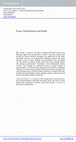
Was "death" a lacuna at the heart of Sigmund Freud's work? Liran Razinsky argues that the questio... more Was "death" a lacuna at the heart of Sigmund Freud's work? Liran Razinsky argues that the question of death is repressed, rejected and avoided by Freud, therefore resulting in an impairment of the entire theoretical structure of psychoanalysis. Razinsky supports his claim through a series of close readings of psychoanalytic texts (including not just Freud, but Klein, Kohut, Jung and Lacan, among others) that explore psychoanalysis' inattention to this fundamental human concern. The readings are combined to form an overall critique of psychoanalysis-one that remains sympathetic but calls for a rethinking of the issue of death. In presenting a fresh and persuasive interpretation of the Freudian corpus, this book will be of interest to scholars of Freud's thought and psychoanalysis, literary scholars, analysts, clinicians and all those curious about death's psychic life. liran razin sk y is a Lecturer in the Department of Hermeneutics and Cultural Studies at Bar-Ilan University, Israel. He works in both French and comparative literature, and critical theory, as well as in theoretical psychoanalysis.
What are the stakes of writing and publishing, of moving from intimate writing to the public sphe... more What are the stakes of writing and publishing, of moving from intimate writing to the public sphere? Examining this question in the case of Freud’s Interpretation of Dreams, read here as an autobiographical text, this paper explores the intricate nexus of ambition, death and writing. Freud is possessed by the possibility of becoming famous, a public persona, immortal. His route to achieving this is the publication of The Interpretation of Dreams. He aspires to greatness, and yet the very project that is supposed to secure it is fragile and insecure; the very project entails a risk. The same text that could secure one’s immortality becomes the locus of one’s absence. Publishing renders the most intimate text public and at a distance from oneself. The wish for glory cannot be assuaged through a published text, which is a public affair. One cannot make a name for oneself.
French Forum, 2018
This paper is a reading of Jorge Semprun’s Le mort qu’il faut as a double story. In this text Sem... more This paper is a reading of Jorge Semprun’s Le mort qu’il faut as a double story. In this text Semprun recounts the previously untold episode of how he switched identities with a dying inmate in Buchenwald. The text allows Semprun to dramatize and give narrative expression to two themes central to his work. First, it allows Semprun to express the idea, common to many survivors, of having already died in the camps. Second, it allows him to articulate the theme, running through his work, of the ethical necessity to speak in the name of the dead, to bear witness to another’s death.
I show how Semprun’s text is built as a version of a Doppelgänger story using common themes of that literary topos. The double, who is both me and other, allows Semprun to “die” and remain alive, and to testify to his own death as well as that of an other. Semprun can thus treat the other’s death as fundamentally his own. On a more theoretical level, the double figure in Le mort qu’il faut allows Semprun to formulate his response to the Agamben-Levi paradox of witnessing, namely that those who have survived, because they have survived, are not the real witnesses. Semprun disrupts the dichotomy of having either touched bottom or become a witness. What allows him to take such a position is the idea of virtuality. One testifies not only to what happened but also to what could have happened, and did happen to the other. The other can embody the virtual fate of the survivor. Semprun articulates in Le mort qu’il faut a sense of shared experience. Lastly, the notion of virtuality paves the way for for the possibility that fiction could convey the experience of the camps.
![Research paper thumbnail of A first Encounter with Death [Hebrew ] פגישה ראשונה עם המוות](https://attachments.academia-assets.com/57657608/thumbnails/1.jpg)
The current paper focuses on an important topos of autobiographical writing on childhood in the 2... more The current paper focuses on an important topos of autobiographical writing on childhood in the 20th century: the experience of encountering the concept of death for the first time. In analyzing a series of examples from Benjamin, Freud, de Beauvoir and mostly Michel Leiris, I examine the way the scene of becoming aware to human transience is shaped and the way it functions within the autobiographical endeavor. I claim such scenes are one possible textual representation of emerging subjectivity and of taking leave from childhood. I stress ,for example the dynamic of truth and lie in these scenes.
The center of the paper is the role of such scenes play in autobiographies. Given that the author’s future death remains the never-written horizon of every autobiography and under one perspective, its unattainable condition of success, a constant menace of never being able to capture the essence of oneself, I suggest to see the description of a childhood scene where death as a possibility was first encountered as a possible replacement for the absent place of death in autobiography. The retrospective description of a childhood scene of encountering death is uniting the present narrator and the past narrated self.
Paper appeared in a special issue of the Journal Dapim (Haifa University Press on Children and Literature, Edited by Vered Lev Kenaan and Dennis Sobolev.
A version of this paper will soon be available in French.
This paper offers a reading of Maupassant's Le Horla by focusing on the questions of human body a... more This paper offers a reading of Maupassant's Le Horla by focusing on the questions of human body and bodily existence. After pointing to several aspects of the narrator's narcissism at the beginning of the novella, the text will follow the dissolution of that narcissistic position. If to begin with the narrator, despising the body, is detached from any bodily dimension and is seemingly a pure mind and gaze, with the help of his double, the Horla, he gradually discovers bodily existence. This breaking up from the fascination of the image constitutes an advance towards experiencing himself. The full passage is therefore from the narcissism of the image, of the exterior, from empty representation, to a true feeling of oneself, of one's existence, through one's vital bodily essence: from the emptiness of the image and the privileging of sight to the fullness of dynamic experience. Through the transparent presence of the other the narrator finds himself.
Yale French Studies: Literature and History: Around Suite française and Les Bienveillantes (special issue), Edited by Richard J. Golsan and Philip Watts, , 2012
This is the introduction to my book Freud, Psychoanalysis and Death (Cambridge UP 2013).
This paper argues that psychoanalysis should open itself more to dialogue with the humanities. It... more This paper argues that psychoanalysis should open itself more to dialogue with the humanities. It shows why this is the case and analyzes the forces that go against such openness. It explores the affinities of psychoanalysis and the humanities and their common interests. It begins by addressing the direct contributions of specific research in the humanities on psychoanalysis. It then looks at the more general benefits possible were there improved dialogue with the humanities and, finally, at psychoanalysis' affinity with a specific part of the humanities, namely, its critical ethos.



Uploads
New by Liran Razinsky
Books and edited volumes by Liran Razinsky
The new volume of Yale French Studies constitutes an overall assessment of Semprun’s work. Including both new perspectives and pieces by authors who have written widely on Semprun, this volume is a refreshing and dynamic look at one of the twentieth-century’s most interesting literary voices.
Although Semprun is probably best known for his testimonial writing on Buchenwald, his oeuvre is diverse and polymorphous. The current volume deals with all the genres of his writing, some of them—the screen plays, the novels and the essays—only rarely studied, thus hopefully allowing the fuller scope and plurality of his work to emerge. Contributions to the volume also deal with texts ranging from Semprun’s earliest work—Le Grand Voyage (1963)—to his posthumous writings and study both his texts written in French and those written in Spanish. The introduction to the volume serves as a general introduction to Semprun’s work. The volume will be of interest to anyone interested in Semprun’s work.
Taking the Holocaust as its central topic, The Kindly Ones is a disturbing novel: disturbing in its use of explicit sexual descriptions, in its construction of a perverted psychic world, in its combination of accurate historical descriptions and myths, and in its repeated suggestion that Nazism does not, in fact, lie outside the spectrum of humanness. Due to its striking monumental proportions and the author’s provocative choice to recount historical events from the perpetrator’s perspective, this opus marks a significant shift within Holocaust literature.
In this volume, fourteen leading literary scholars and historians from eight different countries closely study this unsettling work. They examine the disconcerting aspects of the novel including the use of the Nazi viewpoint, analyze the aesthetics of the novel and its contradictions, and explore its relations with several literary traditions. They outline Littell’s use of historical details and materials and study the novel’s reception. This compilation of essays is essential to anyone intrigued by The Kindly Ones or by the Holocaust and who wishes to gain a better understanding of them.
Table of Contents:
Introduction
The Book’s Provocation
Georges Nivat: Adelphic Incest in Musil, Nabokov, and Littell
Peter Kuon: From ‘Kitsch’ to ‘Splatter’: The Aesthetics of Violence in The Kindly Ones
Liran Razinsky: The Similarity of Perpetrators
Cyril Aslanov: Visibility and Iconicity of the German Language in The Kindly Ones
The Perpetrator’s Point of View
Catherine Coquio: ‘Oh my human brothers, let me tell you how it happened.’ (Who is the Perpetrator Talking To?)
Luc Rasson: How Nazis Undermine their Own Point of View
Aurélie Barjonet: Manufacturing Memories: Textual and Mnemonic Weaving in The Kindly Ones
Memory & Intertexts
Martin von Koppenfels: The infamous ‘I’: Notes on Littell and Céline
Leona Toker: The Kindly Ones and the ‘Scorched-Earth’ Principle
Sandra Janßen: The Perpetrator as a Totalitarian Subject: Allegiance and Guilt in The Kindly Ones
Historical Perspectives
Jeremy Popkin: A Historian’s View of The Kindly Ones
Hans-Joachim Hahn: ‘Morality’ and ‘Humanness’: Reading Littell with Speer, Fest, Syberberg and Others
The Reception of the Novel
Wolfgang Asholt: A German Reading of the German Reception of The Kindly Ones
Helena Duffy: La bienveillance de la critique polonaise. An Analysis of the Polish Reception of Les Bienveillantes
Index
Papers by Liran Razinsky
I show how Semprun’s text is built as a version of a Doppelgänger story using common themes of that literary topos. The double, who is both me and other, allows Semprun to “die” and remain alive, and to testify to his own death as well as that of an other. Semprun can thus treat the other’s death as fundamentally his own. On a more theoretical level, the double figure in Le mort qu’il faut allows Semprun to formulate his response to the Agamben-Levi paradox of witnessing, namely that those who have survived, because they have survived, are not the real witnesses. Semprun disrupts the dichotomy of having either touched bottom or become a witness. What allows him to take such a position is the idea of virtuality. One testifies not only to what happened but also to what could have happened, and did happen to the other. The other can embody the virtual fate of the survivor. Semprun articulates in Le mort qu’il faut a sense of shared experience. Lastly, the notion of virtuality paves the way for for the possibility that fiction could convey the experience of the camps.
The center of the paper is the role of such scenes play in autobiographies. Given that the author’s future death remains the never-written horizon of every autobiography and under one perspective, its unattainable condition of success, a constant menace of never being able to capture the essence of oneself, I suggest to see the description of a childhood scene where death as a possibility was first encountered as a possible replacement for the absent place of death in autobiography. The retrospective description of a childhood scene of encountering death is uniting the present narrator and the past narrated self.
Paper appeared in a special issue of the Journal Dapim (Haifa University Press on Children and Literature, Edited by Vered Lev Kenaan and Dennis Sobolev.
A version of this paper will soon be available in French.