Synopsis
During the Warring States period, assassin Nameless approaches the King of Qin claiming to have killed three rival assassins, but layers of deception reveal a deeper story about sacrifice and the vision of a unified China.
Overview
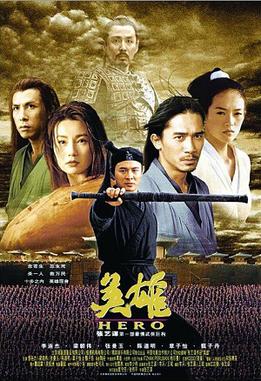
"Hero" (英雄, Yīngxióng) is a 2002 Chinese wuxia epic film directed, co-written, and produced by Zhang Yimou. The screenplay was co-written by Li Feng, Wang Bin, and Zhang Yimou, with martial arts choreography by Ching Siu-tung and Tung Wai. The film features an all-star cast including Jet Li, Tony Leung Chiu-wai, Maggie Cheung, Zhang Ziyi, Donnie Yen, and Chen Daoming. The musical score was composed by Tan Dun, the theme song performed by Faye Wong, and cinematography by Christopher Doyle.
The film was the first Chinese mainland production to surpass 100 million yuan at the domestic box office, grossing 250 million yuan in China and setting a then-record for Chinese cinema. Worldwide, it earned $177.4 million, making it one of the highest-grossing Chinese-language films of all time. Upon its North American release in 2004, it topped the US box office for two consecutive weeks — the first Chinese-language film ever to do so. The film was nominated for Best Foreign Language Film at the 75th Academy Awards.
Synopsis
During the late Warring States period, seven rival states vie for dominance, with the Qin state emerging as the most powerful. The King of Qin (Chen Daoming) has thus become the target of repeated assassination attempts. Skilled assassins Broken Sword (Tony Leung), Flying Snow (Maggie Cheung), and Long Sky (Donnie Yen) have all tried and failed to kill him. In response, the King has emptied his palace to eliminate blind spots and decreed that no one may approach within one hundred paces.
Nameless (Jet Li), a Qin prefect, arrives at the palace claiming to have killed all three assassins. As a reward, he is permitted to approach the King within ten paces. Nameless recounts how he first defeated Long Sky before the Qin army, then traveled to a calligraphy school in Zhao state where Broken Sword and Flying Snow were in hiding. Exploiting the emotional rift between the lovers, Nameless claims he ultimately killed Flying Snow before the Qin forces.
The King, however, doubts Nameless's account. He reconstructs an alternative version: the three assassins willingly sacrificed themselves so Nameless could get close enough to strike. Nameless confirms he possesses the "Death at Ten Paces" technique but reveals a deeper truth — Broken Sword had once held the King's life in his hands three years earlier but chose to spare him, understanding that only the King could unite China and end the centuries of warfare. Broken Sword had written the characters "All Under Heaven" (天下) in the sand, urging Nameless to reconsider.
Moved by Broken Sword's wisdom about "a warrior without the desire to kill," Nameless abandons his mission. Though the King is reluctant, he orders Nameless's execution to uphold the Qin law. In the final scene, the King honors Nameless with a hero's funeral, and text on screen reveals that this King would become Qin Shi Huang — the first emperor of a unified China.
Cast
| Actor | Role | Description |
|---|---|---|
| Jet Li | Nameless | Qin prefect, master of the "Death at Ten Paces" technique |
| Tony Leung Chiu-wai | Broken Sword | Master swordsman who once infiltrated the King's palace |
| Maggie Cheung | Flying Snow | Skilled assassin, Broken Sword's lover |
| Zhang Ziyi | Fading Moon | Broken Sword's loyal apprentice |
| Donnie Yen | Long Sky | Master spearman |
| Chen Daoming | King of Qin | Ambitious Qin ruler who would become the First Emperor |
Production & Artistic Vision
With a budget of $31 million, "Hero" was one of the most expensive Chinese film productions of its time. Zhang Yimou collaborated with cinematographer Christopher Doyle to divide the film visually into five color-coded narrative sections, each dominated by a particular hue: red for passion and jealousy, blue for reason and calm deliberation, green for idealism and memory, black for mystery and authority, and white for truth and purity.
The film employs a Rashomon-style multi-perspective narrative, with each version of the story gradually approaching the truth. Costume design by Japanese designer Emi Wada featured actors in pure solid colors, creating striking visual compositions. The fight choreography by Ching Siu-tung elevated wuxia action to poetic aesthetic heights.
Filming locations included the Populus euphratica forests of Ejin Banner in Inner Mongolia, Jiuzhaigou in Sichuan Province, and Hengdian World Studios.
Reception & Impact
"Hero" is widely regarded as the landmark film that inaugurated the era of Chinese commercial blockbusters, launching the产业化 (industrial-scale) production model for Chinese cinema. American critic Roger Ebert wrote that the film "for the first time gives the wuxia genre the quality of poetry." The New York Times devoted two full pages to covering the US release, calling the film "as classic as China's 'Dream of the Red Chamber,' and an uncrowned king of the American Oscars."
In August 2004, following Quentin Tarantino's advocacy, Miramax Films finally released the film in American theaters. It debuted at #1 at the North American box office, earning $53.7 million in the US and $177.4 million worldwide. The film received an Academy Award nomination for Best Foreign Language Film, won the Silver Bear for Outstanding Artistic Achievement at the 53rd Berlin International Film Festival, and numerous other international honors.
The success of "Hero" marked the arrival of Chinese wuxia cinema on the global mainstream stage, paving the way for subsequent international releases of films like "House of Flying Daggers" and "Curse of the Golden Flower."
References
- Wikipedia - Hero (2002 film)
- Wikipedia (Chinese) - 英雄 (电影)
- Roger Ebert - Hero review
- The New York Times - Hero US release coverage
- Box Office Mojo - Hero box office data
Stills & Gallery
Comments (0)