Conference Announcements by Nadine Holzmeier

IMC 2019 - International Medieval Congress Leeds, session 1548 Transmitting Knowledge, I: Didactics and Canonisation
This first of three sessions focusses on the question of how knowledge was created in specific so... more This first of three sessions focusses on the question of how knowledge was created in specific social environments and how the circulation of knowledge defined, shaped, and separated social communities. We will take a closer look at different secular and ecclesiastical groups, for example social elites, such as aristocrats or knights, monastic communities, philosophical or intellectual circles. We are interested in processes of canonisation and different narrative concepts of poetry, as well as the interaction of teaching and learning with processes of identity building.
Date/Time: Thursday 4 July 2019: 09.00-10.30
Sponsor: Arbeitskreis mediävistischer NachwuchswissenschaftlerInnen (AmN), Universität Rostock
Organiser: Nadine Ulrike Holzmeier, Historisches Institut, Universität Rostock
Moderator/Chair Felicitas Schmieder, Historisches Institut, FernUniversität Hagen
Paper 1548-a "Learning to be Noble: Moral Education in High Medieval Europe"
Claudia Wittig, Henri Pirenne Institute for Medieval Studies, Universiteit Gent
Paper 1548-b "Knowledge Transfer and Identity-Building in High Medieval Monasteries"
Micol Long, Vakgroep Geschiedenis, Universiteit Gent
Paper 1548-c "Paths into Periphery: Editions of Minnesongs and Processes of Canonisation"
Doreen Brandt, Seminar für Deutsche Philologie, Georg-August-Universität Göttingen
Paper 1548-d "Forms of Transmission and Narrative Concepts of German Love Poetry in the Late Middle Ages"
Annika Bostelmann, Institut für Germanistik, Universität Rostock
IMC 2019 - International Medieval Congress Leeds, Session: 1648 Transmitting Knowledge, II: Politics and Religion
This second of three sessions takes a closer look at the interplay of politics and communication.... more This second of three sessions takes a closer look at the interplay of politics and communication. The central question is how information about political events, economic strategies, or ecclesiastical reforms, was transformed into specific sets of knowledge, and how this knowledge was communicated to a wider audience via different media depending on the social context of the intended audience. Papers in this session will bring together case studies dealing with examples from monastery reforms, merchant's knowledge and the interplay between identity building and memorial culture.
Date/Time: Thursday 4 July 2019: 11.15-12.45
Sponsor: Arbeitskreis mediävistischer NachwuchswissenschaftlerInnen (AmN), Universität Rostock
Organiser: Nadine Ulrike Holzmeier, Historisches Institut, Universität Rostock
Moderator/Chair: Claudia Wittig, Henri Pirenne Institute for Medieval Studies, Universiteit Gent
Paper 1648-a "The Role of Monastery Reforms and Liturgy for the Urban Foundation of Monastery: St Annen of Lübeck in 1515"
Claudia Höhle, Hochschule für Musik und Theater, Rostock
Paper 1648-b "A Merchant's Knowledge of Mediterranean Politics: Pegolotti's Practica della mercatura"
Christoph Dartmann, Historisches Seminar, Universität Hamburg
Paper 1648-c "The Heinricos de Gueibelinga: Reign and Power in Continuing Memory"
Tanja Wolf, Stadtarchiv Waiblingen / Historisches Institut, FernUniversität Hagen
IMC 2017 - International Medieval Congress Leeds, Session 1748: Transmitting Knowledge, III: 'Accessing Materiality'
This third of three sessions takes the step from the Middle Ages to the present. The aim of this ... more This third of three sessions takes the step from the Middle Ages to the present. The aim of this session is to discuss the possibilities and chances of digital methods in accessing and presenting the materiality of medieval source materials. The case studies discuss projects for digitalising medieval maps, multi-layered manuscripts, and medieval literature. The focus is not just on questions and problems of digitalising medieval sources, but also on the possible advantages or new research questions resulting from digital methods, including technical questions resulting from the different medieval source materials.
Date/Time: Thursday 4 July 2019: 14.15-15.45
Sponsor :Arbeitskreis mediävistischer NachwuchswissenschaftlerInnen (AmN), Universität Rostock
Organiser: Nadine Ulrike Holzmeier, Historisches Institut, Universität Rostock
Moderator/Chair: Daniel Syrbe, Institute for Historical, Literary & Cultural Studies, Universiteit Radboud, Nijmegen
Paper 1748-a "Sense and Sensibility: Digitised Medieval Maps"
Gerda Brunnlechner, Historisches Institut, FernUniversität Hagen
Paper 1748-b "Transmitting Materiality in Digital Editions"
Hellmut Braun, Institut für Germanistik, Universität Rostock
Paper 1748-c "Harvesting Library Catalogues to Build a Digital Network of Medieval Manuscripts: An ERC-Funded Project on Patristic Sermons in the Middle Ages"
Shari Boodts, Institute for Historical, Literary & Cultural Studies, Radboud University, Nijmegen
Conference Presentations by Nadine Holzmeier
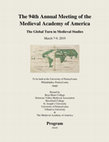
The 94th Annual Meeting of the Medieval Academy of America. The Global Turn in Medieval Studies, 2019
The idea of three distinct continents is ancient and biblical, and by both traditions seems to be... more The idea of three distinct continents is ancient and biblical, and by both traditions seems to be deeply inscribed into medieval Christian thinking, not the least since the re-organization of the world necessitated by the Flood was done on its basis. But not only were the boundaries - geographical, cultural - of the separate continents defined quite differently if at all in antiquity and the Middle Ages, a closer look at medieval attempts to describe a world order also shows that continents 1. weren’t frequently used at all and 2. if they were the usage differed considerably from what has seemed obvious to modern historians. So we plan for the session a selective threefold approach to the problem: Tracing the idea of continents from pagan antiquity into the early Christian Middle Ages, looking at a Latin European late medieval attempt to structure the whole known world, and focusing on Latin medieval “Europa” in relation to the modern concept of the continent. The session is looking at a specific problem of medieval geographies from the point of view of medieval authors, framed by considerations how modern needs - which you may or may not call eurocentric - have shaped medievalists’ approaches and their restrictive view on the geographies of the medieval. Starting from the conviction that approaches to the medieval are shaped by the personal background (continental, national, cultural etc) of the medievalist it wants to discuss and problematic approaches by European historians in an American scholarly environment.
"The historiographical work of Paulinus Minorita and its political value"; THE MAKING OF POLITICAL THOUGHT - Ruptures, Trends, and Patterns between Henry VII and Louis IV the Bavarian. Colloque international / International Congress 27-28.09. 2018, Universitè de Strasbourg
"Zwischen zwischen Jerusalem und Rom. Zur Verbindung von Kartographie und Historiographie bei Paulinus Minorita" 7. Kartenhistorisches Nachwuchskolloquium. 11./12.5. 2018, Universität Kassel
Abstract:
Der Vortrag thematisiert Formen des Zusammenspiels von Historiographie und Kartographie... more Abstract:
Der Vortrag thematisiert Formen des Zusammenspiels von Historiographie und Kartographie in spätmittelalterlicher Weltchronistik am Beispiel der Chronologia Magna des Paulinus Minorita. In dieser Chronik wird Wissen von der Welt vermittelt, bezogen auf ihre chronologisch/geschichtlichen Aspekte aber auch auf ihre räumliche Beschaffenheit. Es wird der Versuch gemacht, verschiedene räumliche Bezugspunkte kartographisch darzustellen und diese in unterschiedlicher Weise in das diagrammatische Gesamtkonzept der Chronik zu integrieren. Am Umgang mit Rom einerseits und der Darstellung des Heiligen Landes andererseits, sollen im Rahmen des Beitrages zwei Darstellungsstrategien in ihrer jeweiligen Form und Funktion exemplarisch dargestellt werden.
Weltgeschichte als Diagramm – Chronologia Magna des Paolino Veneto“. Forschungskolloquium zur mittelalterlichen Geschichte WS 2017/2018, Mittelalterliche Geschichte II/Prof. Dr. Johannes Helmrath, Humboldt Universität Berlin, Berlin, 10.1.2018
“Weltwissen visualisieren. Diagrammatische Strukturen in spätmittelalterlicher Weltchronistik”. 33. Deutscher Orientalistentag, Friedrich Schiller Universität Jena, Jena, 18. – 22.9.2017
„Time and Space in the Chronologia Magna of Paolino Veneto“. VIII International Conference: The Medieval Chronicle, Lissabon, 12.7.2017
Illustrating Religious Power: The Presentation of Papacy in Paolino Veneto´s Chronologia Magna“. International Medieval Congress Leeds, University of Leeds, Leeds, 3. – 6.7.2017
Visualising Time and Space. Use and Development of Tabular and Synoptic Forms in Medieval World Historiography“. 52nd International Congress on Medieval Studies 2017, University of Western Michigan, Kalamazoo, 11. – 14.5.2017
„Neuordnung durch Visualisierung – Weltwissen zwischen didaktischer Aufbereitung und elitärem Expertenwissen“. „Geheimnis und Verborgenes im Mittelalter“, 17. Symposium des Mediävistenverbandes, Rheinische Wilhelms-Universität Bonn, Bonn, 19. – 22.3.2017
"Weltgeschichte als Diagramm - Die "Chronologia Magna" des Paulinus Minorita", Nachwuchs-Workshop: "Neue Tendenzen in der Italienforschung in Mittelalter und Renaissance" Kunsthistorisches Institut Florenz/Max Planck Institut, Florenz 7.11. -9.11.2016
"Depicting the Holy Land in Late Medieval Historiography", International Medieval Congress Leeds, 4.- 7. July 2016
Using the example of the Chronologia Magna, written by Paulino Veneto in the first half 14th cent... more Using the example of the Chronologia Magna, written by Paulino Veneto in the first half 14th century, the paper will analyse the presentation of the Holy Land in the wider context of late medieval world historiography. The Chronologia Magna is of central relevance in the development of this literary genre, because it is on the cusp of dualistic world history writing and a new mode of world historiography, which is multi-dimensional in a political as well as in a religious sense. Paulinus in his presentation of world history also integrates non-European/non-Christian rulers in the same tabular lines he is using for European Christian rulers. This changing perception also has an impact on the perception the Holy Land.
"Die "Chronologia Magna" des Paulinus Minorita - Ein Werkstattbericht", Vortrag im Rahmen der Reihe "Verandagespräche" am Deutschen Historischen Institut Rom (DHI), Rome 22. February 2016
"Writing History in an Expanded World: Forms and Developments of Late Medieval World History Writing", International Medieval Congress Leeds, 6.- 9. July 2015
"Libre de Evast E Blanquerna" - Form and Function of Didacticism in a 13th Century utopian Novel" - "Aut prodesse volunt aut delectare poetare" - Didactic literature in the European High Middle Ages. Venice International University, June 4-6 2015
This paper will focus on the novel Libre de Evast E Blanquerna, written by the catalan philosophe... more This paper will focus on the novel Libre de Evast E Blanquerna, written by the catalan philosopher and theologian Ramon Llull.The novel was written between 1273 and 1285 in the vernacular language catalan and describes the life journey of it´s main character Blanquerna, whose search for asceticism had led him through several stages up to the Holy See.
Blanquerna is an untopian novel with epic and semon-like elements and text-parts. In the novel, Llull figured out his idea of a perfect world, characterized by a strong number symbolism and several stilistic changes. Beside the utopian character it enqueues as well in the tradition of other ascetic novels, like Baarlam and Josaphat for example. Simultaneously he pursue a didactic targed, which became obvious in the structure: In the prologue he figuered out, that the whole novel was mainly an instruction book for his own son.
The mission of the muslims was the central topic in the life and work of Ramon Llull. His idea was that mission have to work only with logic persuasion, this is also a subject in the novel Blanquerna. Therefore didactic aspects played in general an important role in his whole work. This paper will cover the way in which the didactic concept became obvious, which didactic structure come to bear and whether and in what matter this structure worked reinforcing for the central subjects of the novel.
"Late Medieval World Chronicles between temporal and spatial access" Seventh International Medieval Chronicle Conference, University of Liverpool 7th-10th July 2014
"Between 'Global' and 'Local': The Visibility of Power in Medieval World Chronicles" International Medieval Congress, University of Leeds, 7. -10. July 2014
Medieval worldchronicles have played a strong role not only in the imagination of the past; they ... more Medieval worldchronicles have played a strong role not only in the imagination of the past; they have also depicted contemporary ideas of power and empire in relationship to tradition and space. By using different examples this paper will thematise the relationship between the 'global' and the 'local' in medieval worldchronicles. Another important point will be the apparent stronger need for worldchronicles in the High Middle Ages and it´s connection to the political contexts also on a local level.


Uploads
Conference Announcements by Nadine Holzmeier
Date/Time: Thursday 4 July 2019: 09.00-10.30
Sponsor: Arbeitskreis mediävistischer NachwuchswissenschaftlerInnen (AmN), Universität Rostock
Organiser: Nadine Ulrike Holzmeier, Historisches Institut, Universität Rostock
Moderator/Chair Felicitas Schmieder, Historisches Institut, FernUniversität Hagen
Paper 1548-a "Learning to be Noble: Moral Education in High Medieval Europe"
Claudia Wittig, Henri Pirenne Institute for Medieval Studies, Universiteit Gent
Paper 1548-b "Knowledge Transfer and Identity-Building in High Medieval Monasteries"
Micol Long, Vakgroep Geschiedenis, Universiteit Gent
Paper 1548-c "Paths into Periphery: Editions of Minnesongs and Processes of Canonisation"
Doreen Brandt, Seminar für Deutsche Philologie, Georg-August-Universität Göttingen
Paper 1548-d "Forms of Transmission and Narrative Concepts of German Love Poetry in the Late Middle Ages"
Annika Bostelmann, Institut für Germanistik, Universität Rostock
Date/Time: Thursday 4 July 2019: 11.15-12.45
Sponsor: Arbeitskreis mediävistischer NachwuchswissenschaftlerInnen (AmN), Universität Rostock
Organiser: Nadine Ulrike Holzmeier, Historisches Institut, Universität Rostock
Moderator/Chair: Claudia Wittig, Henri Pirenne Institute for Medieval Studies, Universiteit Gent
Paper 1648-a "The Role of Monastery Reforms and Liturgy for the Urban Foundation of Monastery: St Annen of Lübeck in 1515"
Claudia Höhle, Hochschule für Musik und Theater, Rostock
Paper 1648-b "A Merchant's Knowledge of Mediterranean Politics: Pegolotti's Practica della mercatura"
Christoph Dartmann, Historisches Seminar, Universität Hamburg
Paper 1648-c "The Heinricos de Gueibelinga: Reign and Power in Continuing Memory"
Tanja Wolf, Stadtarchiv Waiblingen / Historisches Institut, FernUniversität Hagen
Date/Time: Thursday 4 July 2019: 14.15-15.45
Sponsor :Arbeitskreis mediävistischer NachwuchswissenschaftlerInnen (AmN), Universität Rostock
Organiser: Nadine Ulrike Holzmeier, Historisches Institut, Universität Rostock
Moderator/Chair: Daniel Syrbe, Institute for Historical, Literary & Cultural Studies, Universiteit Radboud, Nijmegen
Paper 1748-a "Sense and Sensibility: Digitised Medieval Maps"
Gerda Brunnlechner, Historisches Institut, FernUniversität Hagen
Paper 1748-b "Transmitting Materiality in Digital Editions"
Hellmut Braun, Institut für Germanistik, Universität Rostock
Paper 1748-c "Harvesting Library Catalogues to Build a Digital Network of Medieval Manuscripts: An ERC-Funded Project on Patristic Sermons in the Middle Ages"
Shari Boodts, Institute for Historical, Literary & Cultural Studies, Radboud University, Nijmegen
Conference Presentations by Nadine Holzmeier
Der Vortrag thematisiert Formen des Zusammenspiels von Historiographie und Kartographie in spätmittelalterlicher Weltchronistik am Beispiel der Chronologia Magna des Paulinus Minorita. In dieser Chronik wird Wissen von der Welt vermittelt, bezogen auf ihre chronologisch/geschichtlichen Aspekte aber auch auf ihre räumliche Beschaffenheit. Es wird der Versuch gemacht, verschiedene räumliche Bezugspunkte kartographisch darzustellen und diese in unterschiedlicher Weise in das diagrammatische Gesamtkonzept der Chronik zu integrieren. Am Umgang mit Rom einerseits und der Darstellung des Heiligen Landes andererseits, sollen im Rahmen des Beitrages zwei Darstellungsstrategien in ihrer jeweiligen Form und Funktion exemplarisch dargestellt werden.
Blanquerna is an untopian novel with epic and semon-like elements and text-parts. In the novel, Llull figured out his idea of a perfect world, characterized by a strong number symbolism and several stilistic changes. Beside the utopian character it enqueues as well in the tradition of other ascetic novels, like Baarlam and Josaphat for example. Simultaneously he pursue a didactic targed, which became obvious in the structure: In the prologue he figuered out, that the whole novel was mainly an instruction book for his own son.
The mission of the muslims was the central topic in the life and work of Ramon Llull. His idea was that mission have to work only with logic persuasion, this is also a subject in the novel Blanquerna. Therefore didactic aspects played in general an important role in his whole work. This paper will cover the way in which the didactic concept became obvious, which didactic structure come to bear and whether and in what matter this structure worked reinforcing for the central subjects of the novel.