Conference Presentations by Nur Abdullah
Proceeding for ILTC 2019, 2019
Interruption in conversation does not necessarily have to be negative as it could also be viewed ... more Interruption in conversation does not necessarily have to be negative as it could also be viewed as something positive such as for maintaining and progressing a conversation (Amalia, 2016; Li, 2001). This paper explored interruption practices in a Malaysian television (TV) talk show called the DOPStv (Deen of Peace Studios), an Islamic lifestyle talk
show. The data was collected from the online YouTube videos in which the series on ‘couple talk’ was selected as the TV talk show represented a multi-party interaction where more than two speakers were involved in the talk. Using the conversation analysis approach, this study analyzed how interruption was managed by the participants in the TV talk show. The findings suggested that the participants in the DOPStv talk show utilized the use of nonverbal cues as resources for cooperative interruption such as to provide assistance, agreement and clarification in a multi-party interaction.
Proceeding of ILTC 2019, 2019
News interview is regarded as a form of institutional talk where the interaction process between ... more News interview is regarded as a form of institutional talk where the interaction process between the participants differs from an ordinary conversation in which the course of interaction in news interviews is an exchange of question-and-answer (Clayman & Heritage, 2002). This paper aims to explore evasion practices used by Dato’ Seri Najib Razak in an exclusive interview episode ‘101 East’ broadcasted live by Al Jazeera Channel on 26th October 2018. The data was collected from the online YouTube videos in which the participants in the 101 East were between the host interviewer, Mary Jolley, and the guest interviewee, Dato’ Seri Najib Razak. Using conversation analysis approach, this study analyzed how the interviewee evaded from answering controversial questions in the interview. The findings suggest that language, gestures and movement were used by the interviewee as evasion strategies to avoid from answering questions and to terminate
topics in the interview. The organization of gestures and movement used by the interviewee as evasion strategies in this study were forewarning, interruption, final thanks and body movement.
Papers by Nur Abdullah
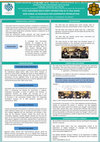
Interruption in conversation does not necessarily have to be negative as it could also be viewed ... more Interruption in conversation does not necessarily have to be negative as it could also be viewed as something positive such as for maintaining and progressing a conversation (Amalia, 2016; Li, 2001). This paper explored interruption practices in a Malaysian television (TV) talk show called the DOPStv (Deen of Peace Studios), an Islamic lifestyle talk show. The data was collected from the online YouTube videos in which the series on ‘couple talk’ was selected as the TV talk show represented a multi-party interaction where more than two speakers were involved in the talk. Using the conversation analysis approach, this study analyzed how interruption was managed by the participants in the TV talk show. The findings suggested that the participants in the DOPStv talk show utilized the use of non-verbal cues as resources for cooperative interruption such as to provide assistance, agreement and clarification in a multi-party interaction.

Investigating cultures of PhD supervision: a holliday’ian small culture approach
The complexity and multidimensional characters of PhD supervision have been well researched from ... more The complexity and multidimensional characters of PhD supervision have been well researched from a variety of perspectives in English medium literature ranging from different supervisory roles to mismatch expectation between students and supervisors. As supervision involves personal relationships between supervisors and their students, which develop over a significant period of time (three years and more), increased cultural diversity within the student groups will add to the complexities of establishing supervisory cultures, more generally. Hence, the relevance of supervision and the development of supervisory cultures would be more prominent in a competitive and multicultural context such as in Malaysian higher institution. In this paper, we draw on Adrian Holliday’s ‘small cultures’ notion (1999) to show how PhD supervision cultures can be best understood as dynamic, emergent, meaning-making processes through which, students and supervisors make sense of, and operate meaningfully...
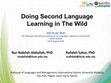
The focus of this study is to investigate what do international students do ‘in the wild’, that i... more The focus of this study is to investigate what do international students do ‘in the wild’, that is, in a mundane, everyday, out-of-classroom second language talk. In face-to-face interactions, spoken language involves not only verbal but also a mutual collaboration with other non-linguistics resources, such as gaze, gestures and bodily behaviour (Goodwin, 1981). This study aims to add to the growing body of second language (L2) research which goes ‘beyond the language classroom’, outside educational settings (Firth and Wagner, 1997; Wagner, 2004) particularly among L2 speakers who do not share the first language. The data for this study consists of casual conversation among international university students having dinner at a cafe which is video-recorded. Using conversation analysis or sometimes referred to as ‘CA-SLA’ (Kasper and Wagner, 2011), this study aims to explore how participants with different language background exploit language and other non-linguistic resources in secon...
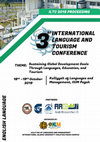
Kulliyyah of Languages and Management, International Islamic University Malaysia, Pagoh, Oct 18, 2019
News interview is regarded as a form of institutional talk where the interaction process between ... more News interview is regarded as a form of institutional talk where the interaction process between the participants differs from an ordinary conversation in which the course of interaction in news interviews is an exchange of question-and-answer (Clayman & Heritage, 2002). This paper aims to explore evasion practices used by Dato' Seri Najib Razak in an exclusive interview episode '101 East' broadcasted live by Al Jazeera Channel on 26 th October 2018. The data was collected from the online YouTube videos in which the participants in the 101 East were between the host interviewer, Mary Jolley, and the guest interviewee, Dato' Seri Najib Razak. Using conversation analysis approach, this study analyzed how the interviewee evaded from answering controversial questions in the interview. The findings suggest that language, gestures and movement were used by the interviewee as evasion strategies to avoid from answering questions and to terminate topics in the interview. The organization of gestures and movement used by the interviewee as evasion strategies in this study were forewarning, interruption, final thanks and body movement.
Studies on face-to-face interactions have demonstrated how spoken language involves not only verb... more Studies on face-to-face interactions have demonstrated how spoken language involves not only verbal but also a mutual collaboration with embodied actions. Embodied actions, such as gaze, gestures, body posture and physical movement are part and parcel of the details of ordered social interaction, and they can be significant resources in interaction (Hazel et al., 2014). This study has investigated the embodied actions displayed in word search phenomenon in L2 interaction. Word search is regarded as a type of self-initiation repair in which the progressivity of the speaker's indebted to the Kulliyyah of Languages and Management and the International Islamic University of Malaysia for giving me the opportunity to make a step forward to pursue my PhD and providing me with further support during my research. I wish to thank my close friend Anna Zareena for helping me get through the difficult times, providing the emotional support, and going out with me for coffee breaks. My thanks also go to my friends Somporn,
Environment-Behaviour Proceedings Journal
This paper examines the significance of a rural area, Panchor village town, as a potential nature... more This paper examines the significance of a rural area, Panchor village town, as a potential nature tourism site in the Muar district of Johor, Malaysia. The objectives of the study were (1) to evaluate local community support and (2) to assess local community involvement. Based on qualitative analysis of an interview and open-ended responses in the questionnaire, three interconnected themes were: (1) community attachment, (2) economic gains and (3) environmental attitude. The findings revealed that river-based tourism development could stimulate the socio-economic status and the sustainability of rural areas. This study also discussed implications and limitations of the research. Keywords: Community Attachment; Economic Gains; Environmental Attitude; River-based Tourism eISSN: 2398-4287© 2020. The Authors. Published for AMER ABRA cE-Bsby e-International Publishing House, Ltd., UK. This is an open access article under the CC BYNC-ND license (http://creativecommons.org/licenses/by-n...



Uploads
Conference Presentations by Nur Abdullah
show. The data was collected from the online YouTube videos in which the series on ‘couple talk’ was selected as the TV talk show represented a multi-party interaction where more than two speakers were involved in the talk. Using the conversation analysis approach, this study analyzed how interruption was managed by the participants in the TV talk show. The findings suggested that the participants in the DOPStv talk show utilized the use of nonverbal cues as resources for cooperative interruption such as to provide assistance, agreement and clarification in a multi-party interaction.
topics in the interview. The organization of gestures and movement used by the interviewee as evasion strategies in this study were forewarning, interruption, final thanks and body movement.
Papers by Nur Abdullah