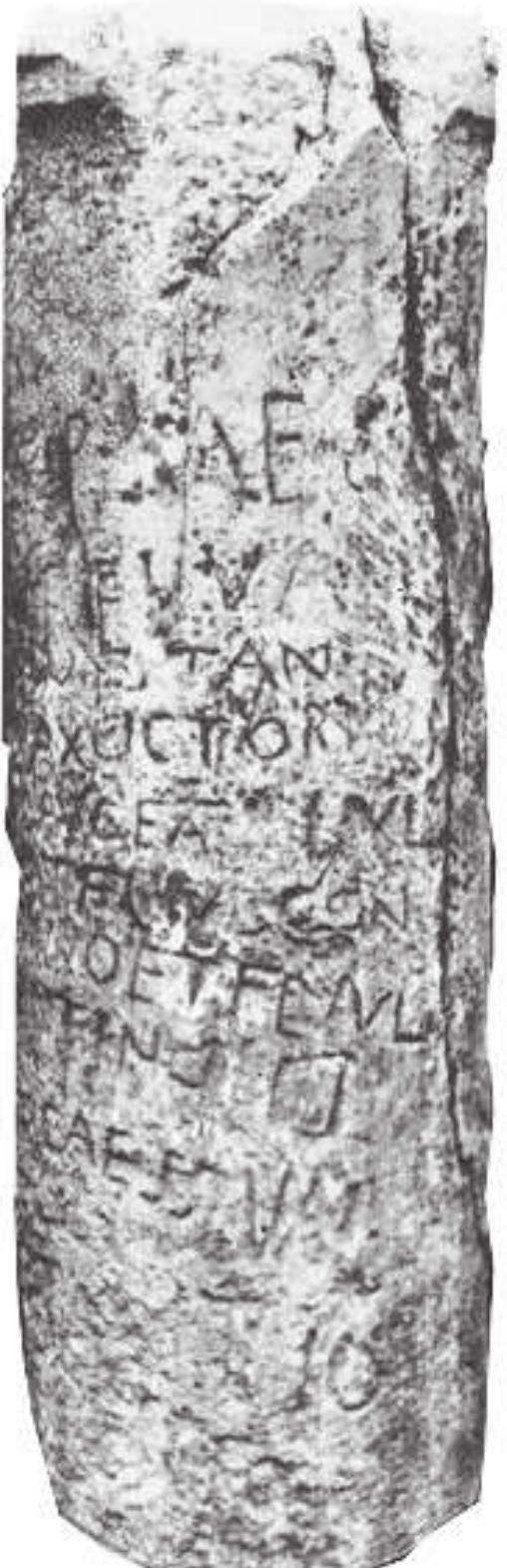
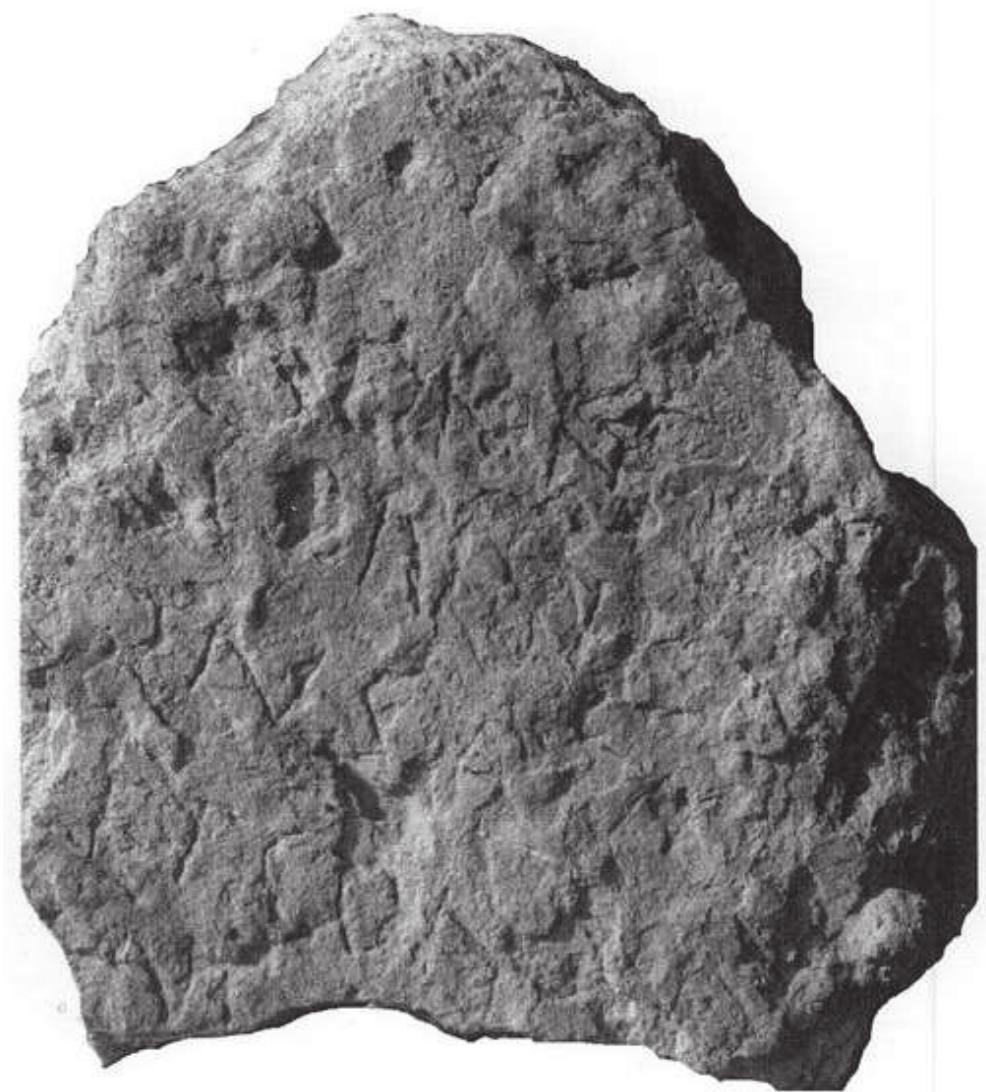
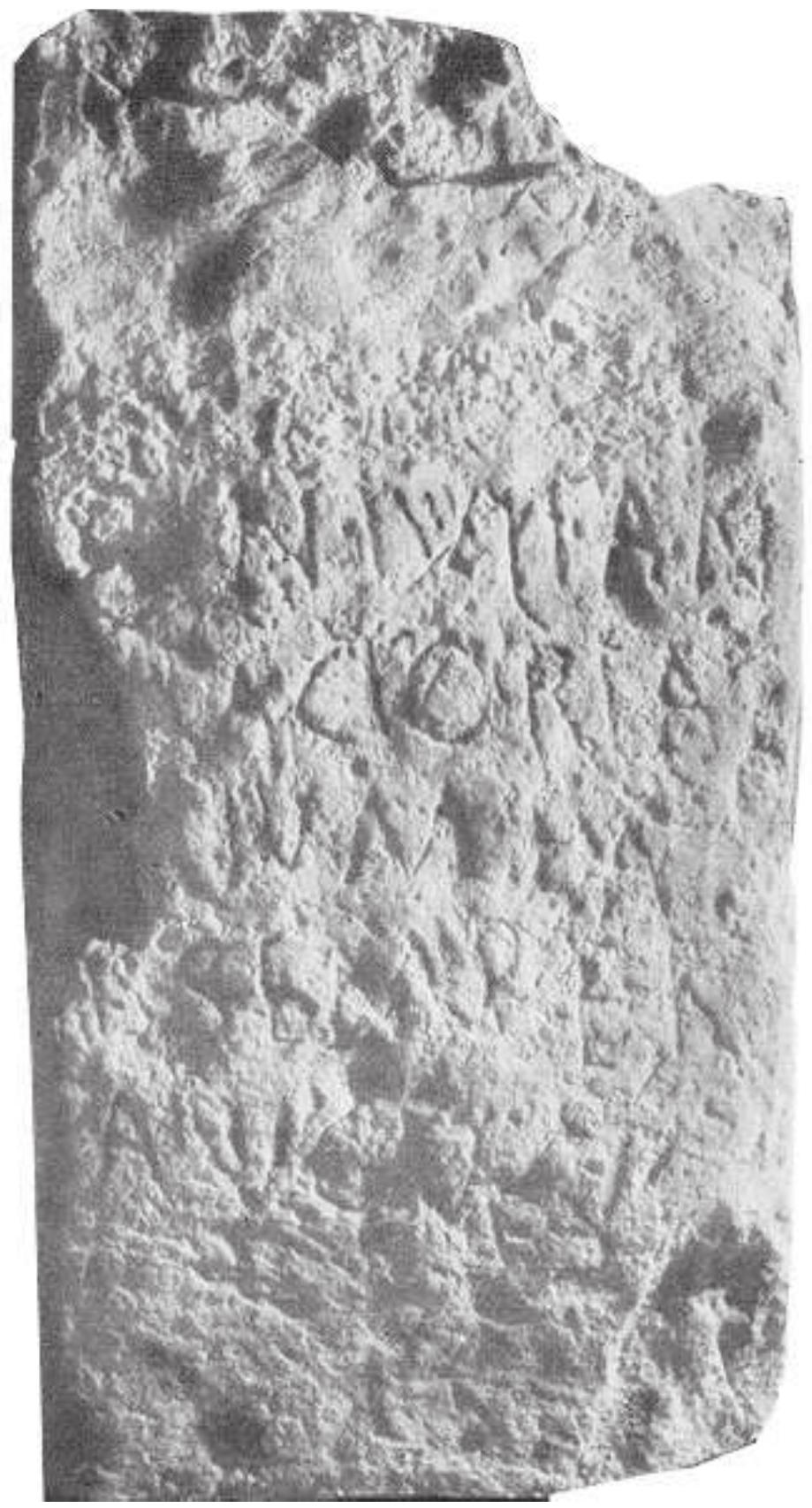
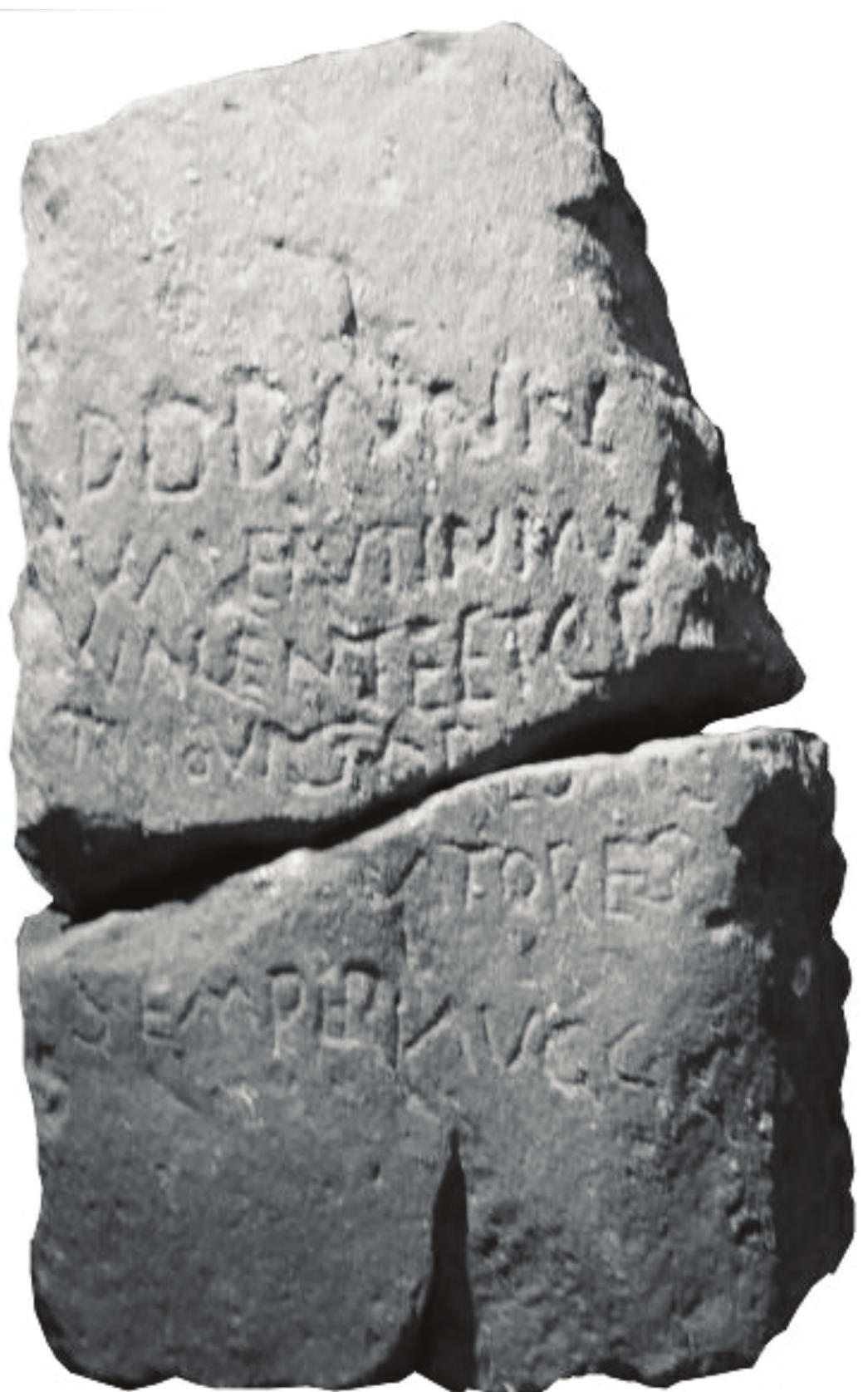
The Roman roads at the Lower Danube and the milestone dedication

2024, Dacia

Last updated

Abstract

Milestones are traditionally considered the clearest evidence of the construction and repair of Roman roads throughout the Empire. However, there are other interpretations, according to which the inscriptions on some ancient milestones represent only the expression of the loyalty of the local authorities to the emperor, the milestones losing their basic function in Late Antiquity, namely, to indicate the distance between two localities and to help the traveler during the journey. We are talking, above all, about the milestones dated to the second half of the 3rd century AD and the beginning of the next one. In the present paper, the information provided by the inscription texts on the late Roman milestones is analyzed, in order to see to what extent this interpretation is valid or not for the Lower Danube area.
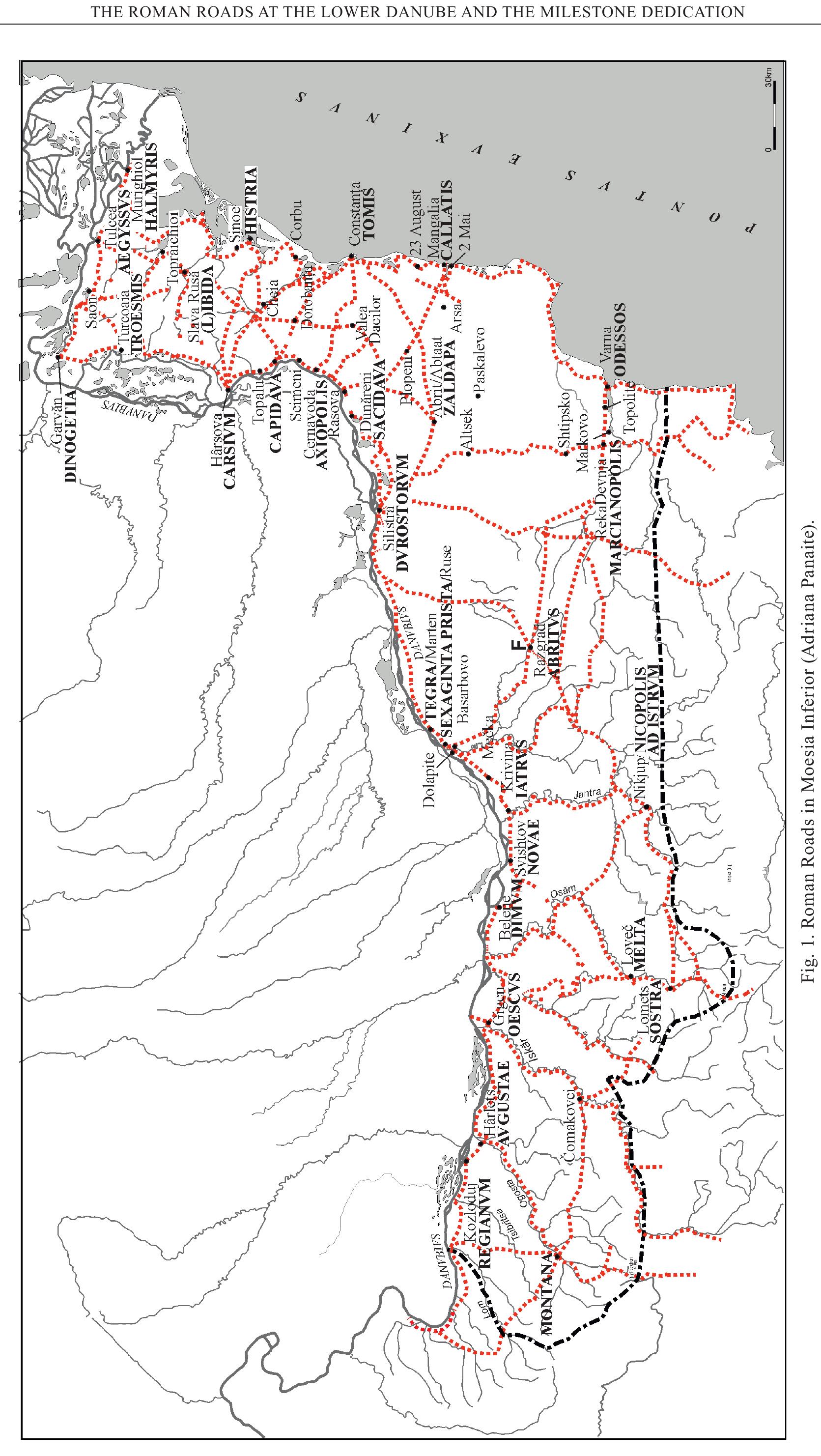
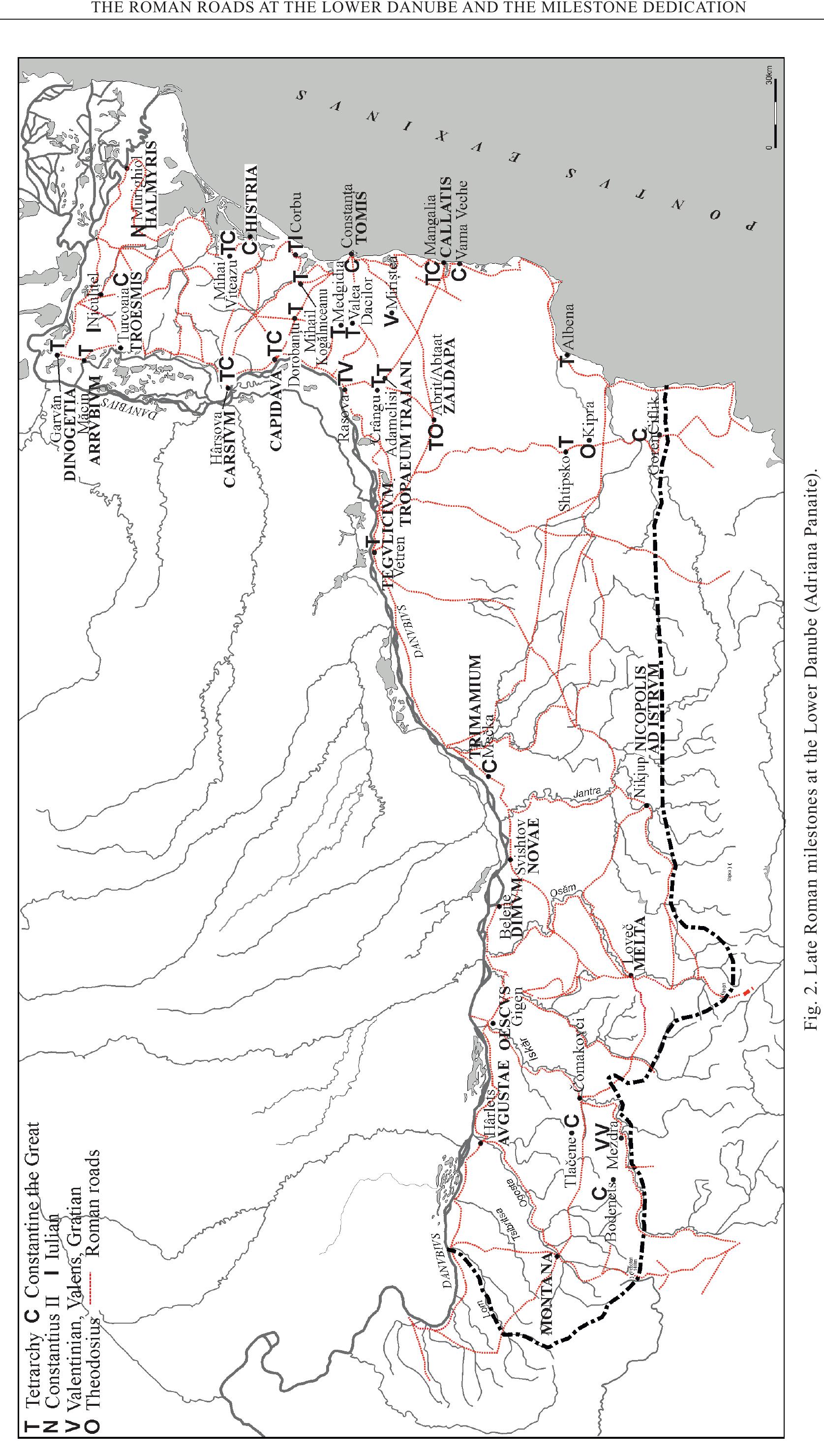
DACIA REVUE D’ARCHÉOLOGIE ET D’HISTOIRE ANCIENNE NOUVELLE SÉRIE LXVIII 2024 ACADÉMIE ROUMAINE INSTITUT D’ARCHÉOLOGIE « VASILE PÂRVAN » DACIA R E V U E D ’ A R C H É O L O G I E ET D’ H I STOIR E A NC IEN N E NOUVELLE SÉRIE LXVIII 2024 EDITURA ACADEMIEI ROMÂNE RÉDACTION Rédacteur en chef : EUGEN NICOLAE Rédacteur en chef adjoint : LIANA OŢA Collège de rédaction : MARIA ALEXANDRESCU VIANU (Bucureşti), DOUGLASS W. BAILEY (San Francisco), MIHAI BĂRBULESCU (Cluj-Napoca), PIERRE DUPONT (Lyon), SVEND HANSEN (Berlin), ANTHONY HARDING (Exeter), RADU HARHOIU (Bucureşti), VUJADIN IVANIŠEVIĆ (Beograd), ATTILA LÁSZLÓ (Iaşi), MONICA MĂRGINEANU-CÂRSTOIU (Bucureşti), VIRGIL MIHAILESCU-BÎRLIBA (Iaşi), JEAN-PAUL MOREL (Aix-en-Provence), CONSTANTIN C. PETOLESCU (Bucureşti), IOAN PISO (Cluj-Napoca), ADAM RABINOWITZ (Austin, Texas), CLAUDE RAPIN (Paris), WOLFRAM SCHIER (Berlin), VICTOR SPINEI (Iaşi) Comité de rédaction : IRINA ACHIM, CRISTINA-GEORGETA ALEXANDRESCU, IULIAN BÎRZESCU, ADINA BORONEANŢ, DANIELA MARCU ISTRATE, ANDREI MĂGUREANU, GHEORGHE ALEXANDRU NICULESCU, ADRIANA PANAITE, ANCA-DIANA POPESCU, DANIEL SPÂNU, AUREL VÎLCU Secrétaires de rédaction : RALUCA KOGĂLNICEANU, SILVIU ILIUȚĂ Rédaction éditoriale : MONICA STANCIU Informatique éditoriale : OFELIA COŞMAN Toute commande sera adressée à : EDITURA ACADEMIEI ROMÂNE, Calea 13 Septembrie nr. 13, sector 5, 050711, Bucureşti, România ; Tél. 4021-318 8146, 4021-318 8106, Fax 4021-318 2444, E-mail : [email protected] ORION PRESS IMPEX 2000 S.R.L., P. O. Box 77–19, sector 3, Bucureşti, România ; Tél./Fax : 4021-610 6765, 4021-210 6787, Tél. 0311 044 668, E-mail : [email protected] S.C. MANPRESS DISTRIBUTION S.R.L., Piaţa Presei Libere, nr. 1, Corp B, Etaj 3, Cam. 301–302, sector 1, Bucureşti, Tel.: 4021 314 63 39, fax: 4021 314 63 39, E-mail: [email protected], [email protected], www.manpress.ro SORIRORI SOLUTIONS, Tel.: 0040765262077, 0040765166433; Internet: http://www.sorirori.ro; E-mail: sorin. [email protected], [email protected] Les manuscrits. ainsi que toute correspondence les concernant, seront adressés à la Rédaction : Institut d’Archéologie « Vasile Pârvan », 11, rue Henri Coandă, 010667 Bucarest, Roumanie, E-mail : [email protected] Toute correspondance concernant les périodiques proposés en échange sera adressée à la Bibliothèque : Institut d’Archéologie « Vasile Pârvan », 11, rue Henri Coandă, 010667 Bucarest, Roumanie, Tél./Fax 4021 212 88 62, E-mail : [email protected]. © 2 0 2 4 , E D I T U R A A C A D E M I E I www.ear.ro R O M Â N E ACADÉMIE ROUMAINE INSTITUT D’ARCHÉOLOGIE « VASILE PÂRVAN » DACIA LXVIII, 2024 R E V U E D ’A R C H É O L O G I E E T D ’ H I S T O I R E A N C I E N N E JOURNAL OF ARCHAEOLOGY AND ANCIENT HISTORY Z E I T S C H R I F T F Ü R A R C HÄO L O G I E U N D G E S C H I C H T E D E S A LT E RT U M S SOMMAIRE CONTENTS I N H A L T CONSTANTIN C. PETOLESCU, La revue Dacia fête son centenaire (1924-2024) .......................................... 7 ÉTUDES ALAIN TUFFREAU, ROXANA DOBRESCU, SANDA BALESCU, Nouveaux regards sur quelques gisements paléolithiques situés à la périphérie des Carpates roumaines ................................................................ OLIVER DIETRICH, Break or continuity? Bronze Age figurines in southeastern Europe beyond the Žuto Brdo – Gârla Mare culture ................................................................................................................................ DRAGOȘ MĂNDESCU, The spur from Valea Stânii. On horses and men in Early Iron Age Ferigile group ..... LIVIA BUZOIANU, Timbres amphoriques attribués à Héraclée du Pont découverts en Dobroudja ................. GABRIEL MIRCEA TALMAȚCHI, Considerations regarding the presence of autonomous coins from Mesambria in the Istro-Pontic territory ................................................................................................. MARKO DIZDAR, ASJA TONC, The Late La Tène bronze vessels in the south-eastern Carpathian Basin ..... OCTAVIAN MUNTEANU, VASILE IARMULSCHI, DANIEL SPÂNU, Zarubincy-type fibulae: A return to regional and supra-regional connections ............................................................................................... CHRISTIAN GUGL, CRISTINA-GEORGETA ALEXANDRESCU, Archaeological research in Troesmis in 2010-2017: An overview ........................................................................................................................ ADRIANA PANAITE, The Roman roads at the Lower Danube and the milestone dedication........................... VIRGIL MIHAILESCU-BÎRLIBA , About bracelets and necklaces with “pouches” ....................................... ERWIN GÁLL, FLORIN MĂRGINEAN, MIHÁLY HUBA HŐGYES, VIKTÓRIA HORVÁTH, LEVENTE DACZÓ, Thinking in Space! Why are funerary sites absent in eastern parts of Transylvania in the 7th-11th centuries? .................................................................................................................................. CRISTINA PARASCHIV-TALMAȚCHI, CONSTANTIN ȘOVA, Aspects on the evolution of the early medieval settlement from Oltina – Capul Dealului through the lens of the two decades of archaeological research ................................................................................................................................................. 19 43 85 149 177 193 221 255 269 299 323 383 NOTES ET DISCUSSIONS ATTILA LÁSZLÓ, Transylvanian archaeologists, contributors to the first volume of the journal Dacia .......... 419 DRAGOȘ MĂNDESCU, CRISTIAN EDUARD ȘTEFAN, MONICA MĂRGĂRIT, DRAGOȘ ALEXANDRU MIREA, Note on a Bronze Age blade from Sălătrucu, Argeș County ...................................................... 437 THIBAUT CASTELLI, DRAGOȘ HĂLMAGI, Un Péparéthien à Istros .......................................................... TOBIAS HIRSCH, FLORIAN FEIL, Drei hellenistische Dekrete aus Istros ..................................................... CONSTANTIN C. PETOLESCU, FLORIAN MATEI-POPESCU, Un nouveau procurateur de Dacia Apulensis ............................................................................................................................................... ADRIAN BĂTRÎNA, An archaeological source on archiereus costume in Moldavia in the first half of the 15th century ............................................................................................................................................ 449 461 467 473 COMPTES RENDUS Miglena Stamberova, Fibulite na Drevna Trakija (V – I v. pr. Xr.) / The Fibulae in Ancient Thrace (5th – 1st century BC), Disertacii tom 16 / Dissertationes volume 16, Sofia, 2023, 551 pages, 38 plates, 10 maps, ISBN 978-619-254-348-0 (Daniel Spânu) .............................................................................................. 487 ABRÉVIATIONS.............................................................................................................................................................. 491 THE ROMAN ROADS AT THE LOWER DANUBE AND THE MILESTONE DEDICATION ADRIANA PANAITE* Keywords: Roman roads, milestone, dedication, Moesia Inferior, Scythia Abstract: Milestones are traditionally considered the clearest evidence of the construction and repair of Roman roads throughout the Empire. However, there are other interpretations, according to which the inscriptions on some ancient milestones represent only the expression of the loyalty of the local authorities to the emperor, the milestones losing their basic function in Late Antiquity, namely, to indicate the distance between two localities and to help the traveller during the journey. We are talking, above all, about the milestones dated to the second half of the 3rd century AD and the beginning of the next one. In the present paper, the information provided by the inscription texts on the late Roman milestones is analysed, in order to see to what extent this interpretation is valid or not for the Lower Danube area. Cuvinte‑cheie: drumuri romane, stâlp miliar, dedicație, Moesia Inferior, Scythia Rezumat: În mod tradițional stâlpii miliari sunt considerați cele mai clare dovezi ale construcției și reparației drumurilor romane pe tot cuprinsul Imperiului. Există însă și alte interpretări, potrivit cărora inscripțiile de pe unele borne antice reprezintă doar expresia loialității autorităților locale față de împărat, miliarii pierzându-și în epoca antichității târzii funcția de bază, mai exact aceea de a indica distanța între două localități și de a-l ajuta pe călător să se orienteze în spațiu. Este vorba, mai ales, despre miliarii datați în a doua jumătate a secolului al III-lea și începutul celui următor. Autoarea analizează informațiile din sursele scrise și epigrafice avute la dispoziție, pentru a vedea în ce măsură această interpretare este valabilă sau nu pentru zona Dunării de Jos. The construction of an extensive Roman road network was the first sign of Roman control over an area. Roads became one of the most visible landmarks of Roman occupation. In his book about the roads of Roman Italy, Laurence1 emphasizes the role of the infrastructure in the making of a province, writing “What made a province Roman was the road system”. Provincial roads were built by the army and, first of all, to ensure the rapid movement of military * “Vasile Pârvan” Institute of Archaeology of the Romanian Academy, Bucharest; e‑mail: [email protected]. 1 Laurence 1999, p. 199. DACIA N.S., tome LXVIII, Bucarest, 2024, p. 269‑298 270 ADRIANA PANAITE 2 units and logistics, but also to improve trade as well as security and services sprung up along the major routes to provide infrastructural support. At the same time, roads are one of the main elements of the Roman landscape throughout the Empire, because “the road was a device of power that produced a distinctly Roman space across Europe and the Mediterranean” 2. Moreover, Laurence emphasizes, elsewhere, that “it is land transport that characterizes the Roman Empire and creates a materiality that is distinctive” 3. For the study of Roman roads, milestones are our main source of information, enabling the reconstruction of their course and direction and, presumably, of their chronology. Placed, by definition, every mile (approx. 1480 m) along the major Roman roads, the milestones4 constitute an expression of general politics, whether it concerns the movements of emperors, economic or military programs. This is the traditional interpretation in a large part of the scientific literature, alongside which there is another one, according to which the milestones, especially those dated to Late Antiquity, do not at all reflect construction, repair, or generally maintenance works of traffic routes, and are often mere dedications paying tribute to the reigning emperors. Initially practical aids for travellers that provided useful information about distances, they gradually lose this function and become real political tools serving as symbols of Roman power. The scholarly community, however, is divided between those who hold to the traditional view and those who do not. The problems of interpretation of the evidence of milestones were discussed by many researchers, for different parts of the Roman Empire5. Analysing the pattern of the surviving milestones in the province of Palestine, Isaac and Roll 6 suggested that the milestones were concentrated in areas of habitation, less in the desert areas, and assume that the milestones were set up for usage by the military7. Other researchers focused their attention on the texts of inscriptions from Late Antiquity. Starting from the analysis of two milestones in the province of Baetica, Sillières talks about the transition from the proper milestone to the dedication milestone, a gradual process, which is finalised in the era of Tetrarchy. He is of the opinion that the milestones are losing their original function, and because they are placed on the sides of the roads, this seems to prove that the road had gradually replaced the forum as a place of political expression8. At the same time, the author emphasises that it is the imperial power who decides the disposition of the milestones along the roads, and it is the latter’s officials who choose their texts and then effectively set up the stones9. The renewal and preservation of the milestones caused the viewpoint to be focused on the centralised power, because they no longer can be connected with works on roads or providing 2 Laurence 1999, p. 199. For the transformation of the landscape of Moesia Inferior as a result of its inclusion into the Roman Empire, see Panaite 2023. 3 Laurence 2024, p. 19. 4 Kolb 2004; Kolb 2011. 5 Salama 1987; Banzi 1999; Basso 2008; Witschel 2002, etc. 6 Isaac, Roll 1982. 7 Isaac, Roll 1982, p. 91‑98; Isaac 1990, p. 304‑309. 8 Sillières 1976. 9 Sillières 1976, p. 358. 3 THE ROMAN ROADS AT THE LOWER DANUBE AND THE MILESTONE DEDICATION 271 practical information to the travellers. According to Laurence10, we should see the milestones as means of communication to the traveller by those with authority to set up the stones. As a consequence, we can look at the milestones as instruments of propaganda or means of asserting loyalty to an emperor. Covering a large part of the Roman Empire and based on a very rich bibliography, Sauer’s survey of the milestones dated between the middle of the 3rd century and the period of Constantine the Great11 analyses particular situations in Britannia, Hispania, Gallia, Africa, Numidia, etc. At the end of his very comprehensive study, Sauer arrives to the conclusion that “the function of milestones changed over time and varied from province to province. Notably from the AD 230s onwards they served increasingly often as a medium to express political loyalty and less and less often will have been set up on the occasion of actual road maintenance. There are marked differences between provinces in the start and peak periods of honorific milestone production; while in some of them milestones had a strong tradition and gradually assumed a new role, in others, notably the British provinces, they only became popular after they had largely lost their original purpose”12. On the contrary, in Italy, milestones appear in periods of political stability and can be seen as indicators of the assertion of stability by central authorities13. A recent and thorough analysis of the late milestones of Asia Minor14 demonstrates that last preserved inscriptions mention no distance or destination. Hence, devoid of any practical utility, they merely displayed an isolated act of allegiance from a governor to an emperor. “But however anecdotal they may appear, these last milestones expressed once again the undisputed authority of Rome in Asia Minor”15. In conclusion, the milestones of that period provide thus (more) evidence for political instability rather than maintenance of traffic infrastructure. Similar to all the investigated regions is the decrease of milestones from the later 4th century and almost its disappearance in the 5th century AD16. The causes of the disappearance of the milestones were analysed in detail by Destephen17. This process was determined by the “progressive sedentarisation of imperial power”. The foundation of the new capital – Constantinople – put an end to the official journeys of the emperors; by the end of the 4th century AD, they were limited to the regions close to the capital and, after 450, to the vicinity of Constantinople. The analysis of Roman roads in Moesia Inferior did not represent a clear research direction until recently. Articles and monographs published in recent years now give an overview of the Roman road network in the province of Moesia Inferior18. Despite the fact that few traces of the Roman roads have been discovered to date19, their routes can be reconstructed, especially on the 10 Laurence 2004, p. 47. 11 Sauer 2014. 12 Sauer 2014, p. 295. 13 Laurence 2004, p. 51. 14 Destephen 2018. 15 Destephen 2018, p. 180. 16 Laurence 2004, p. 51; Witschel 2023, p. 223, 226, 231. 17 Destephen 2016. 18 See e.g. Madžarov 2004; Madžarov 2009; Panaite 2015. 19 In the Romanian National Archaeological Repertory (https://ran.cimec.ro/drum=road) 15 segments of Roman roads are registered. For Bulgaria (the northern part of the country which was part of the province Moesia Inferior), see Madžarov 2004; Madžarov 2009; Torbatov 2000; Torbatov 2021. 272 ADRIANA PANAITE 4 basis of milestone inscriptions20, itineraries and cartographical sources21, analyses of the aerial and satellite images22 , comparing the data of them with information gathered from the field 23, as well as from patterns of human settlement and necropolis24, identified through survey research 25. We still have to rely on old descriptions of the roads, from the end of the 19 th ‑beginning of the 20 th centuries26, which might prove to be inaccurate, as a recent analysis, undertaken for a segment of the limes road between the rivers Osăm and Vit, has shown 27. The system of Roman roads in Moesia Inferior (Fig. 1) developed in stages, by incorporating and expanding existing connections, but also by establishing new routes, especially as part of the process of provincialization after the conquest of a new territory28, with the Roman army playing a decisive role29. The establishment of the road network was crucial to both the internal development of the province and the security of the frontier. Most of the milestones discovered in the Lower Danube area belong to the road along the Danube (the so‑called limes road), but there are also inscriptions associated with the other main (Black Sea coast road, central Dobrudja road, northern Balkan road) or secondary roads (connecting Danube with the Black Sea or Moesia Inferior/Scythia with neighbouring provinces). It was noted that most of them come from the territory of the (future) province of Scythia 30. On the basis of these inscriptions, we can date the completion of the construction of the limes road to Trajan’s time, the construction of the central Dobrudja route probably to Hadrian’s time, and the period of their heaviest use up to the end of the 4th or the beginning of the 5th century AD31. This chronological frame is based on the traditional assumption that the milestones actually demonstrate works of road construction or repair. In general, the scientific literature in our area of interest has not yet questioned the information provided by the milestones, no matter the period they are dated: in other words, these epigraphic monuments are indisputable evidence of road construction and maintenance activities until the end of Antiquity. 20 Panaite 2012a. 21 Panaite 2012b; Fodorean 2014. A.S. Ștefan 1971; A.S. Ștefan 1973; A.S. Ștefan 1974a; A.S. Ștefan 1974b; A.S. Ștefan 1975; A.S. Ștefan 1976; A.S. Ștefan 1977a; A.S. Ștefan 1977b; A.S. Ștefan 1977c; A.S. Ștefan 1983; A.S. Ștefan 1984; A.S. Ștefan 1986; Crăciun 2008. 22 23 Gugl, Panaite 2016; Madžarov 2004; Panaite, Miu (Bem) 2016. 24 Oltean 2013a; Oltean 2013b; Oltean, Hanson 2007; Oltean, Hanson 2013. 25 Suceveanu 1977; Bărbulescu 2001; Bâltâc 2011; Tomas 2016. 26 Škorpil 1905; Škorpil 1914; Jireček 1932; Jireček 1974. 27 Torbatov 2021. 28 Panaite 2016; Panaite 2023. 29 Duch 2015; Duch 2017. For the Roman army in Moesia Inferior, see Matei‑Popescu 2010. 30 It is still an unanswered question the problem regarding the large number of milestones discovered in Moesia Inferior and concentrated mainly in the territory of Dobrudja, in contrast to Dacia, for example, where only nine milestones are known. For the roman roads in Dacia, see Fodorean 2006. 31 The phasing of road repair and restoration clearly mirrors – with some minor discrepancies – the construction and use of fortifications in Moesia Inferior/Scythia. Cities peaked in development under Marcus Aurelius and Septimius Severus in the late 2nd and early 3rd centuries AD (Suceveanu, A. Barnea 1991, p. 33‑34), with the roads following the same pattern (Panaite 2012a, p. 131‑143; Panaite 2015). The same phenomenon can be observed in Late Antiquity, specifically during the reigns of Diocletian and Constantine and later, during the reigns of Anastasius and Justinian (Suceveanu, A. Barnea 1991, p. 205‑208). THE ROMAN ROADS AT THE LOWER DANUBE AND THE MILESTONE DEDICATION 273 Fig. 1. Roman Roads in Moesia Inferior (Adriana Panaite). 5 274 ADRIANA PANAITE 6 Usually bearing a preset text, the late milestones became more and more simplified by giving up the mention of the entire imperial titles; in most cases the inscriptions include the names of the emperors and, much less often, the distance. The main characteristic of the texts of the early inscriptions on milestones from Moesia Inferior is, on the one hand, the presence of the imperial title, in full form, especially in the nominative case, and, on the other hand, in many cases, the indication of the distance. Other elements refer to the names of governors, settlements, military units, etc. The only verb used is restituo, restituit, they restored/repaired, and appears from the time of Septimius Severus32 , being used later until the time of Gordian III. The milestones of the time of Severus Alexander and Maximinus Thrax refer specifically to the repair of roads and bridges (vias conlapsas et pontes derutos restituit)33. To exemplify the change in the epigraphic habit of the texts on the milestones from the early to the late period, going through the crisis of the 3rd century, two case studies are presented and discussed in detail: the first is Decius, in the double capacity of governor of the province of Moesia Inferior and later emperor, and the second one is represented by Aurelian. The future emperor Decius served as governor of the province of Moesia Inferior in the years 233‑23434, and during this time he was in charge of repairing roads and building fortifications35. Two milestones belonging to Durostorum – Marcianopolis and Marcianopolis – Tropaeum Traiani roads, discovered at Štipsko36 and Paskalevo37, date from this period and have similar texts, mentioning the repair of roads and bridges. The military building activity is attested by an inscription, discovered not far from Montana 38. All of them provide strong evidence on Decius’ involvement in the Severus Alexander’s program for the reinforcement of the province, as soon as information of possible barbarian attacks reached him. The emperor himself would personally come to the area to inspect the works, as evidenced by the altar erected by Decius in Montemno39 in honour of the arrival of Severus Alexander and his mother40. Decius’s gained experience could be the reason why he was appointed – immediately after the governorship in Moesia Inferior on the same position in Germania Inferior41, and a few years later in Hispania Citerior42. In this province, 32 A general change in the nature of the milestones it was noted after the Severan dynasty, cf. Laurence 2004, p. 45. 33 Panaite 2011. It is interesting to note that some milestones from Gaul, Germany and Hispania Citerior of Maximinus Thrax and his son, dated in 237, refer to the same action: repairs of roads and bridges, and they were set up in the latter province, through the agency of the governor C. Messius Q. Decius Valerianus, the future emperor, C. Messius Q. Decius Traianus cf. Sauer 2014, p. 291. 34 All dates are AD. 35 Żelazowski 2009, p. 143; Kienast, Eck, Heil 2017, p. 195. 36 CIL III, 13758. The text was reconstructed based on the milestone from Paskalevo. 37 CIL III, 12519; Kalinka 1906, no. 48. 38 Sharankov 2020, p. 309-314 (Čeljustnica). 39 Road station and a fortified military post ( praesidium) on the road Oescus – Philippopolis, north of the Haemus Mountains, next to the Troyan Pass. Montemno is represented on the Peutinger Map, and according to Sharankov (2020, p. 316) this is a corruption of Monte (H)aemo. This mountain pass (presently called Beklemeto or Trojan Pass) provided the most important road connection between Thrace and Lower Moesia. For the road Oescus – Philippopolis, see Madžarov 2004. 40 Sharankov 2020, 315‑319. Montana 2, no. 2: Imp(eratori) Caes(ari) ⟦ Marco Aur(elio)⟧ / ⟦Severo Alexandro⟧ Pio / Felici Invicto Aug(usto) / pontifici maximo / patri patriae / C(aius) Quintus Decius leg(atus) Aug(usti) / pr(o) pr(aetore) provinciarum / Moesiae itemque / Germani(a)e inferiorum / candidatus Aug(usti) / devotissimus / dicatissimusque / Numini / maiestatique / eorum(!). 41 42 Kienast, Eck, Heil 2017, p. 195. 7 THE ROMAN ROADS AT THE LOWER DANUBE AND THE MILESTONE DEDICATION 275 24 milestones of Maximinus and Maximus dated to 238 and set‑up by Decius refer – like earlier in Moesia Inferior – to road and bridge repairs 43. Very likely, we are dealing with texts (at least some of them) prepared under the supervision of the (same!) governor, appointed to the function by the emperor, and moving from one province to another. But it is still further evidence for the local establishment of the texts. Decius’ successful governorship and efforts towards the strengthening of Moesia Inferior were probably still remembered later, when he became emperor. All the milestones from Moesia Inferior dated to his time are dedications 44. Among them, the one from Sostra is – by far – the most important, because the shape of the milestone and its text differ from the standard milestones discovered so far. Dated in 249, it was erected by the city of Nicopolis ad Istrum 45. Since this is the only one on behalf of the city, the erection of such a monument must have been due to a special event, more precisely to an imperial visit, the route of which was known in advance 46. As a consequence, the erection of a milestone in honour of Decius at Sostra, where it would have been seen by the passing emperor and his entourage, seems justified. In the same year, Decius was also praised in Oescus, important fortification and city on the Danube limes, located at the end of the road coming from Philippopolis and along which Decius very probably travelled, just like Severus Alexander once did in the past47. The example of Decius is important because it demonstrates the importance of the governor as a decision‑making factor in establishing the texts engraved on the milestones, but also the spread of some formulas repeatedly copied ( pontes derutos et vias conlapsas restituit) on pillars throughout the territory of the empire. On the other hand, even if they are dedications, the stones are set‑up as a result of some repair work carried out following the destruction caused by barbarian attacks or for the imperial visits to the province 48. It also illustrates the special bond that exists between former governor emperors and the provinces they administered. In the time of Aurelian, the texts in general, using the dative, mention the emperor as the restorer of peace or the world and this is why the milestones have been seen as dedications to the emperor49. The milestones and other types of inscriptions from his time strongly support the extensive military and building activity of Aurelian on the Lower Danube. He put an end to the military anarchy, by the successful military campaigns against the Carpi and the Goths 50 and the restoration of peace. On an inscription from Callatis, Aurelian is praised as restitutor 43 Cf. Sauer 2014, p. 290‑291. 44 Panaite 2011. 45 Sharankov, Hristov 2022. 46 For a special relationship between Decius and the authorities of Nicopolis ad Istrum, see Sharankov 2020, p. 318; Sharankov, Hristov 2022, p. 73. 47 ILBR 7: reparator disciplinae militaris, firmator splendoris Romani, hostium terror and civium vindex. 48 There are 22 milestones erected during the reign of Gordian III in the provinces of Moesia Superior, Moesia Inferior and Thracia. If for the province of Moesia Superior (with only two attested milestones) the situation is difficult to assess, and in Thracia most of the milestones seem to have been mere dedications (13), the evidence from the province of Moesia Inferior (7) strongly suggests a program for the systematic repair of roads, the emperor presumably continuing measures initially taken by Maximinus Thrax (see Bartels 2014). Some of the milestones from Moesia Inferior dated during Maximinus’ reign use the phrase “miliaria nova et vias et pontes disrutas …”, which could be interpreted as another formula repeatedly copied. 49 50 Sauer 2014, p. 275‑276. Aurelian became Carpicus Maximus after he defeated the Carpi invaders inter Carsium et Sucidavam, as it appears from the inscription honouring him at Durostorum (CIL III, 12456 = ISM IV, 88). 276 ADRIANA PANAITE 8 patriae, strong evidence to large‑scale rebuilding works51. The same may be also considered for Durostorum, and some other fortifications52. This large‑scale policy of rebuilding the fortifications after the devastating attack of the barbarians could not but include the roads of the province. What draws attention is the grouping of the milestones on the limes road in two points: Sexaginta Prista (Ruse) and Capidava. It is even possible that the latter to be the region where the actual battle took place, as suggests a recent study, resuming the discussion on all the milestones discovered at Capidava and its surroundings53. Inscriptions honouring Aurelian at the Lower Danube convey the gratitude of the inhabitants for restoring the peace, the fortification and the roads after a very difficult period. His reign and that of Probus are the preparatory stage for the military and administrative transformations that will take place during the Tetrarchy and at the beginning of the 4th century AD54. Moesia Inferior/Scythia gained a special strategic importance from the mid‑3rd century onwards because of the increasing threats to the frontier of the Roman Empire and the need to maintain the road network and thus facilitate the circulation of troops and supplies. The two great roads of the province, that of the Danube limes and that of the Black Sea coast can be easily reconstructed according to the Itinerarium Antonini and Tabula Peutingeriana, with usually verifiable distances between localities55, most of them identified on the ground. Adding the existing information in the Notitia Dignitatum (Pars Orientis), one can complete the picture of the two roads with a whole series of (other) stationes and with the military units accommodated in each fortification 56. The “relative novelty” from a strategic point of view is the central Dobrudja road, oriented north‑south and parallel to the Danube limes and the Black Sea shore; it was represented neither in the Tabula Peutingeriana, nor in the Itinerarium Antonini. Its reconstruction was made mainly by using late literary and epigraphic information 57. It can be observed that only 49 inscriptions on 41 milestones (Fig. 2 and Annex) date to the Late Roman period, compared to 83 inscriptions chronologically placed during the Early Roman period 58. More than half of the inscriptions on milestones dated to the Late Roman period 59, 24 out of a total of 49, belong to the Tetrarchy, are dated between 293‑305, and were discovered at: Tegulicium/ Vetren (no. 2), Flaviana(?)/Rasova (no. 3a), Capidava (no. 4a), Carsium/Hârșova (no. 5b, 6b, 7a), Arrubium/Măcin (no. 9), Dinogetia/Garvăn (no. 10) – on the Danube road; Buteridava/Mihai Viteazu (no. 12a), Corbu (14, 15a), Callatis/Mangalia (no. 17b, 18), Albena (no. 21a) on the Black Sea coast road; vicus Hi.../Dorobanțu (no. 24b), Vicus Urb .../Medgidia (no. 25), Valea Dacilor (no. 26b), Tropaeum Traiani/Adamclisi (no. 27, the only one dated a little earlier, 286‑293), Zaldapa/Abrit 51 CIL III, 7586 = ISM III, 96. 52 E.g. Histria, Tropaeum Traiani, Dinogetia, etc. (Suceveanu, A. Barnea 1991, p. 121‑122). 53 Opriș 2021a. 54 Suceveanu, A. Barnea 1991, 154‑158. 55 Although they are seen mainly as documents without practical purpose for the Lower Danube area, they prove to be extremely accurate, contributing significantly to the reconstruction of Roman road routes. See, e.g. Fodorean 2014. 56 Ivanov 1999; Țentea et alii 2019. 57 A. Barnea 1997. 58 Panaite 2011; Panaite 2015. 59 Panaite, Alexandrescu 2009. THE ROMAN ROADS AT THE LOWER DANUBE AND THE MILESTONE DEDICATION 277 Fig. 2. Late Roman milestones at the Lower Danube (Adriana Panaite). 9 278 ADRIANA PANAITE 10 (no. 28) – on the central Dobrudja road; Štipsko (no. 32), Crângu (no. 35), vicus Clementianensis/ Mihail Kogălniceanu (no. 37, no. 38a) – on secondary roads and one with unknown discovery site (no. 41a). Two inscriptions are fragmentarily preserved, so it is not possible to propose the completion and reading of the text: Tegulicium/Vetren (no. 2) and Callatis/Mangalia (no. 18). Except for the milestones from Callatis/Mangalia (no. 17b), Tropaeum Traiani/Adamclisi (no. 27) and Carsium/ Hârșova (no. 5b) which contain the dedicatory formula Imperatores Caesares in the nominative case, all other inscriptions are dedications, which means that the names of the emperors are in the dative case. Among them, from the point of view of the dedicatory formula, two groups of inscriptions can be identified: ‑ Dominis nostris: Carsium/Hârșova (no. 7a); Corbu (no. 15a); vicus Hi…/Dorobanțu (no. 24); Zaldapa/Abrit (no. 28); Crângu (no. 35); ‑ Imperatoribus Caesaribus: Flaviana(?)/Rasova (no. 3); Capidava (no. 4a); Carsium/Hârșova (no. 6b); Arrubium/Măcin (no. 9); Dinogetia/Garvăn (no. 10); Buteridava/Mihai Viteazu (no. 12a); Corbu (no. 14); Vicus Urb.../Medgidia (no. 25); Valea Dacilor (no. 26); Štipsko (no. 32); vicus Clementianensis/Mihail Kogălniceanu (nos. 37, 38a), unknown place of discovery (no. 41a). The milestones from Albena (no. 21b) and Corbu (no. 15a) contain a compound dedication: imperatoribus dominis nostris, respectively dominis nostris imperatoribus. The Constantinian period is represented by 16 inscriptions, of which three have an unknown place of discovery (nos. 39, 40, 41b). The Black sea coast road is best configured through the milestones discovered at: Buteridava/Mihai Viteazu (no. 12b), Histria/Istria (no. 13), Tomis/ Constanța (16b), Callatis/Mangalia (no. 19), Vama Veche (no. 20), Albena (no. 21a), along with discoveries from the other traffic arteries: Trimammium/Mečka (no. 1a), Capidava (no. 4b), Carsium/Hârșova (no. 7b), Troesmis/Turcoaia (no. 8) (on the Danube road), Tlačene (no. 22) (on the northern Balkan road), Bodenec (no. 30), Goren Čiflik (no. 34) (secondary roads). The dedicatory formulas encountered previously are preserved. Most inscriptions represent dedications to emperors using the formula dominis nostris. On only one inscription it appears in the nominative case. Imperatores Caesares is used on the milestone from Capidava (no. 4b), while on the one from Trimammium/Mečka (no. 1a) the names of the emperors, mentioned separately, are in both the nominative and the dative case. For one of the milestones with an unknown place of discovery (no. 39), no completion proposal can be made, the inscription being extremely damaged. On the milestone from Albena (no. 21a) the dedicatory formula is salvis dominis nostris 60. After the reign of Constantine until the end of the 4th century AD, the number of milestones decreases significantly, only nine inscriptions having been preserved. Thus, there is an example of a milestone from Constantius II at Halmyris/Murighiol (no. 11), two milestones from the time of Julian at Corbu (no. 15b) and Niculițel (no. 23), four inscriptions from the joint reign of Valentinian, Gratian and Valens at Flaviana(?)/Rasova (no. 3b), Mezdra (no. 31a-b) and Miriştea (no. 36), one from the joint reign of Valentinian, Theodosius and Arcadius at Zaldapa/Abrit (no. 29b), the last one coming from 60 The formula is used also on other types of inscriptions in the area. E.g. building inscriptions from Iatrus (EDCS‑ID: EDCS‑16100204: Salvis [dd(ominis) nn(ostris)] / Constantio et [Constanti] / Augg(ustis) bo[no] rei [publicae natis] / [...; date: 340‑350) and Berkovica (EDCS‑ID: EDCS‑07000848: Salvis dd(ominis) nn(ostris) H[onorio et Theodosio] / iun(iore) perpetuis Au[g(ustis) 3] / [3] v(ir) inl(ustris) pr(a)ef(ectus) pr[aet(orio) Illyrici] / [6]; date: 408‑423). 11 THE ROMAN ROADS AT THE LOWER DANUBE AND THE MILESTONE DEDICATION Fig. 3. T he m i le st one f rom Me dg id ia: EDCS‑ID: EDCS‑10400125 MEDGIDIA htt ps:// db.edcs.eu/epigr/bilder.php?s_language=en&bild= $IScM‑06‑02_00620_1.jpg (accessed on 1.08.2024). 279 Fig. 4. The milestone from Mihai Viteazu: MIHAI V IT EA Z U EDCS ‑I D: EDCS ‑3020 0685 ht t ps:// db.edcs.eu/epigr/bilder.php?s_language=en&bild= $IIFDR_00167.jpg (accessed on 1.08.2024). Kipra (no. 33) and being dated to the time of the emperors Theodosius and Arcadius (383‑393). All the inscriptions are dedications to the emperors, except those from Halmyris/Murighiol (no. 11) and Mezdra (no. 31a-b). The dedicatory formula used is Dominis nostris: Halmyris/Murighiol (no. 11), the only one in nominative; Corbu (no. 15b); Niculițel (no. 23); Mezdra (nos. 31a-b); Zaldapa/Abrit (no. 29b) or salvis sominis nostris: Flaviana(?)/Rasova (no. 3b); Miriștea (no. 36); Kipra (no. 33). There are 17 reused pieces (palimpsests), among which eight are Early Roman (no. 1 Trimammium/Mečka; no. 5 Carsium/Hârșova; no. 6 Carsium/Hârșova; no. 16 Tomis/Constanța; no. 17 Callatis/Mangalia; no. 24 vicus Hi…./Dorobanțu; no. 26 Valea Dacilor; no. 29 Zaldapa/Abrit), and nine are re‑carved again during the Late Roman time (no. 3 Flaviana(?)/Rasova; no. 4 Capidava; no. 7 Carsium/Hârșova; no. 12 Buteridava/Mihai Viteazu; no. 15 Corbu; no. 21 Albena; no. 31 Mezdra; no. 38 vicus Clementianensis/Mihail Kogălniceanu; no. 41 unknown place of discovery). 280 ADRIANA PANAITE 12 With few exceptions, all the inscriptions use the dative case, so they are dedications, and no milestone contains any verb. It has long been recognised that, as time passed, the initial nominative forms of imperial names and titles, used to portray the emperor as active road builder, were increasingly superseded by the dative, implying that the monument was dedicated to the emperor, rather than having been set up on orders by the emperor. It can be said that, in general, the texts are very simple and similar, and having the same structure as those of the previous period: names of the emperors and the distances. Some imperial epithets (invictissimi61; piis felicibus 62; patres patriae 63; victores64) or formulas 65 can be noticed on some monuments; there is also an alternative use of the term principes for the Augusti66; there are some mistakes67 or other type of errors68; on the milestone from Capidava (no. 4a) Constantius and Galerius are designated as holding the consulate for the 4th time 69, and the milestone no. 8 in Troesmis mention the name of a military unit: legio I Iovia Scythica. These observations lead to the conclusion that the decision on wording was left to local authorities and this could reflect evolving fashions and traditions on a regional level. On the other hand, attention is drawn more to the monuments themselves than to the content of the inscriptions. In other words, mistakes, wording etc. matter less, what is important is the monument, which must be as visible as possible. There are four settlements where more than one milestone was discovered, the monuments belonging especially to the Tetrarchy period: Carsium, Corbu, Callatis and vicus Clementianensis. What draws attention is the use of both the dedicatory formulas Imperatores Caesares and domini nostri in the same place. Beyond their belonging to one of the main roads, no further observations can be made, because the pieces were not discovered in situ. Their presence indirectly proves the importance of these settlements, where civilian population or military units can display a loyal attitude towards the emperors; this is their public declaration of allegiance. Moreover, Carsium could be considered a milestone cluster, pointing to the strategic position of the fortification, not only for the limes system, but also for the connections with the area beyond the Danube. This concentration of milestones cannot be a coincidence, if we take into account that this particular spot is where most of the milestones in the area come from and comprises a quite complete set of emperors in power70. Another aspect that we must refer to in our analysis concerns the material from which these monuments are made. Most of the columns are made of limestone, but there are two milestones made of marble71, an expensive raw material, which was not easy to find in this area, being 61 No. 3a Flaviana(?); no. 4b Capidava; nos. 5b, 6b, 7a Carsium; no. 14 Corbu; no. 17b Callatis; no. 21 Albena; no. 25 vicus Urb ...; no. 26 Valea Dacilor; no. 28 Zaldapa; no. 35 Crângu; no. 38a vicus Clementianensis. 62 No. 15 Corbu; no. 19 Callatis; no. 21 Albena; no. 25 vicus Urb...; no. 28 Zaldapa; no. 36 Miriștea (only piis). 63 No. 28 Zaldapa. 64 No. 31 Mezdra. 65 Constantine the Great is named filio Augg(ustorum) on two inscriptions: no. 8 Troesmis and no. 20 Vama Veche. 66 No. 7a Carsium; no. 32 Štipsko. 67 No. 1 Trimammium: the use of both nominative and dative cases. 68 No. 9 Arrubium and no. 24 vicus Hi… mention only the name of the emperors without any imperial title; on no. 32 Štipsko all emperors are caesarribus (!). 69 Which could date the inscription more precisely to 302, cf. Bărbulescu, Buzoianu, Covacef 2008, p. 173-177. 70 According to Panaite 2011, there are 10 milestones discovered so far. 71 No. 25 vicus Urb... (Fig. 3) and no. 12 Buteridava (Fig. 4). 13 THE ROMAN ROADS AT THE LOWER DANUBE AND THE MILESTONE DEDICATION 281 therefore imported72. Inscriptions are carved on re‑used column spindles. It is difficult to say what was at the basis of the decision to reuse these pieces: the material itself, which is precious and suitable for an imperial dedication (and which was also identical in shape to a pillar) or the need to quickly find a “support” for the inscription. The shape of the discussed monuments is also important. Milestones have in an overwhelming proportion the form of a column, but there is also a small number of pieces that are in the form of slabs. The latter is due to its reuse as a construction material during the 6th century, as is the case with the milestones from Halmyris (Fig. 5), reused at the gate of the fortress73 or Capidava, reused in a wall belonging to edifice C 1074. There is also a third one, about which in CIL it says: “pilae formam habere”. It is possible that the monument had the form of a slab from the very beginning75, hence, another interpretation of it as a simple dedication to the ruling emperor (Fig. 6). Fig. 5. The milestone from Halmyris: EDCS‑ID: EDCS‑59600037 HALMYRIS https:// db.edcs.eu/epigr/bilder.php?s_language=en&bild=$GLIHalmyris_00004.jpg (accessed on 1.08.2024). An additional limestone slab, belonging to the Oescus – Serdica road and discovered at Riben Vir (Bulgaria) (Fig. 7), also contains a dedication, but has been interpreted as evidence of the functioning of the Roman road towards the end of the 4th century AD76. The reuse of these pieces already in the 6th century AD and the changing of shape is a proof for the milestones already having lost their significance towards the end of Late Antiquity. 72 Suceveanu, A. Barnea 1991, p. 250. 73 No. 11. 74 No. 4. 75 No. 23. 76 ILBR 187; Vladimirov 1963. 282 ADRIANA PANAITE Fig. 6. T h e m i le s t o n e f r o m Nic u l iț el: E D C S - I D: EDCS‑28500154 NICULIȚEL https://db.edcs.eu/epigr/ bi ld e r.php?s _ l a ng u a ge = e n&bi ld =$I I F DR _ 0 0269.jpg (accessed on 1.08.2024). 14 I f t he m i le s t one s d o not me nt ion any actual form of work undertaken by a specific emperor, they still, however, contain information on the distances77: 1. Tegulicium, no. 2 – m(ilia) p(assuum) X II – the milestone was most probably discovered in situ, because it indicates exactly the distance between Durostorum and Tegulicium, which is of approx. 15.5 km; 2. Flaviana(?), no. 3b – m(ilia) p(assuum) / I L / XIIII – repaired road segment, 14000 steps long (14 MP) on the Rasova – Axiopolis/ Cernavodă section; according to Opriș78 this must have been precisely the distance from Tropaeum Traiani to the limes road; 3. Carsium, no. 6b – m(ilia passuum) II – 2000 paces long (2 MP) road segment repaired, very likely north of Carsium; 4. Arrubium, no. 9 – m(ilia) p(assuum) / IIII – cer tif ies the restoration of a road segment 4000 steps long in the Arrubium – Dinogetia – Noviodunum area; 5. Corbu, no. 15b – m(ilia) [p(assuum)] / XI – the inscription includes a locality name in line 8, probably Celeris, but it is too damaged to allow a certain reading. It is very possible that this is the town mentioned (and located most often in Vadu), especially since the distance between Corbu and Vadu is approx. 16 km. But only if vicus Celeris was indeed localized at Vadu!; probably indicates a repaired road segment of 6. Tomis, no. 16b – m(ilia) p(assuum) / IIII – 4 MP, in the immediate vicinity of the fortress; 7. Callatis, no. 19 – m(ilia) p(assuum) / II (?) – the pillar can come either from Mangalia, or from the secondary road that connected Callatis with Tropaeum Traiani, a fortress whose reconstruction certainly increased the significance of the connecting road between the two, or it was put on the Callatis – Zaldapa road; 8. Tlačene, no. 22 – m(ilia) p(assuum) I – the locality is located west of Čomakovci and north of the supposed route of the northern Balkan road, on the Montana – Čomakovci segment. The distance shown probably represents a 1 MP segment of road that has been repaired; 77 Some of those milestones were previously discussed; see Panaite 2013. Opriș 2021b, p. 56. There was almost certain a road connecting Tropaeum Traiani (Adamclisi) with Flaviana(?) (Rasova), Panaite 2006, 57‑80. 78 15 THE ROMAN ROADS AT THE LOWER DANUBE AND THE MILESTONE DEDICATION 283 9. Vicus Urb.../Medgidia, no. 25 – m(ilia) p(assuum) / XX? – the distance of XX or XXI MP (approximately 30 km) represents the distance in a straight line between Medgidia and Tropaeum Traiani/ Adamclisi; 10. Valea Dacilor, no. 26b – m(ilia) p(assuum) / III(?) – the distance was either I MP or III MP. It must be put in relation with the one discovered in vicus Urb.../Medgidia and both with the central Dobrudja road, because in straight line there are about 5 km between them; 11. B o d e ne c, no. 30 – m(ili a) p(assuum) I--- – ver y likely it was discovered in situ, because the distance corresponds to the distance on the ground between Bodenec and Mezdra, both being placed on the road from Oescus to Serdica; 12. Mezd ra, no. 31a-b – X XVII m(ilia) p(assuum) – probably the indicated distance is to Serdica (Sofia); in a straight line between Mezdra and Sofia there are approx. 52 km. On the other hand, it could also indicate the distance to Čomakovci, which is approx. 36 km; 13. Štipsko, no. 32 – m(ilia) p(assuum) Fig. 7. The milestone from Riben Vir: EDCS‑ID: EDCS‑09701193 XI – the locality is on the road going R I B E N V I R h t t p s : // d b . e d c s . e u / e p i g r / b i l d e r . p h p? s _ up from Marcianopolis to Durostorum, language=en&bild=$ILBulg _00187.jpg;$ILBulg _00187_1.jpg (accessed on 1.08.2024). north of Kipra, where a milestone was also discovered. Between the two points there are about 16 km in the field. It follows, therefore, that the distance on the Štipsko milestone indicates the distance between the two localities and, also, that both milestones were discovered in situ; 14. Crângu, no. 35 – m(ilia) p(assuum) III – very probably, the milestone belongs to the road that went from Durostorum, through Tropaeum Traiani to Callatis; 15. Miriștea79, no. 36 – m(ilia) p(assuum) / VI – it could mark an inland road from Tomis to Zaldapa, used in the time of Valens, confirmed as such also by the order of localities, as it appears in Synecdemos, the travel guide compiled by Hierocles80. Bărbulescu and Câteia (1997, p. 196-197) consider that the milestone was certainly transported here from the Black Sea coast road, because the approximate distance between Callatis and Miriştea is 25 km much greater than the VI MP mentioned in the text of the inscription. 79 80 A. Barnea 1997, p. 31. 284 ADRIANA PANAITE 16 The pieces that indicate distances could attest – in our opinion – to road repairs, an activity that can be linked to the presence of the emperors in the area, either due to military confrontations with the barbarian populations, who cross the border and attack the empire, or for repair of fortifications. Especially important are those “new monuments” which are not palimpsests, and were set up along the main roads in the area. They may attest road renewal along imperial travel routes in anticipation of imperial visits. Alongside military action, legislative production constitutes one of the essential prerogatives of the emperors of the Late Empire and this activity provided precious data concerning their location at a certain moment. The concentration of the laws in particular cities attests to the frequency of the imperial stay, but the chronological and geographical distance between the laws does not allow us to know the stages of a journey. The collection of data provided by these sources makes possible to partially reconstruct the itineraries of the sovereigns between 330, the date of the foundation of Constantinople, and 450, the year of the emperors’ abandonment of travels of any kind. The distribution of laws confirms not only the preponderance of legislative documentation in the knowledge of imperial journeys during Late Antiquity but also the existence of a strategic axis that, crossing Anatolia and the Balkans, unites the Euphrates with the Danube, having the region of the Bosporus and of the Dardanelles Straits as a junction point 81. In this respect, it is worth mentioning the presence of Diocletian in Durostorum and Transmarisca 82 , which contributed, between the years 294‑303, to the stabilisation of the military and political situation in the Lower Danube83. Moreover, the defensive effort manifested through a remarkable constructive activity, mentioned by the ancient authors and confirmed by the archaeology, could only work together with the restoration of the roads in the region, mandatory components of the limes system84. Constantine was also present in the region, in 322 at Sirmium and Bononia, in 328 at Oescus, probably also for the inauguration of the Oescus – Sucidava bridge85, and then in 331 in pursuit of the Goths north of the Lower Danube86. The emperor’s presence at Oescus – Sucidava is also confirmed by a bronze medal that includes the image of the bridge and that of Constantine preceded by the goddess Victoria87. Later on, other imperial presences at the Lower Danube attested by written sources are those of Julian, Valens and Theodosius I. During the conflict with the Goths, Valens makes particular use 81 Destephen 2016, p. 160‑163. 82 Suceveanu, A. Barnea 1991, p. 157. Both fortifications were repaired, inscriptions attesting this fact, during the reign of Diocletian, date to the same year – 297, and have similar text, cf. Vulpe, Barnea 1968, p. 375‑376. For Transmarisca, see CIL III, 6151= ILS 641 and for Durostorum, ISM IV, 89. Next to them, there are also two other similar inscriptions coming from Halmyris and Donje Butorke, see Zahariade 1994. 83 Barnes 1976; Torbatov 2000, p. 61; Panaite, Alexandrescu 2009, p. 443‑444. 84 Suceveanu, A. Barnea 1991, p. 156‑157, 205‑206, 252‑257. 85 I. Barnea, Iliescu 1982, p. 106. IGLR 278, milestone from Sucidava/Celei, on the right shore of the Danube, in front of Oescus; the milestone is very important because it attests to the restoration of the road between Sucidava and Romula after the reconquest of Dacia by Constantine the Great; the milestone was found in situ, the distance of 1,000 steps corresponds to the distance from the end of the bridge and the place of discovery. For a critical review of all historical and archaeological data available up to day for the bridge of Constantine the Great at Oescus – Sucidava, see recently Opriș et alii 2022, including the results of the bathymetry carried out in 2017 through the Danube bed and those of the magnetometric survey carried out in October 2022. 86 Barnes 1982, p. 78‑80. 87 Tudor 1974, p. 152‑158; I. Barnea, Iliescu 1982, p. 107 and fig. 42/1. 17 THE ROMAN ROADS AT THE LOWER DANUBE AND THE MILESTONE DEDICATION 285 of the inner roads in the province and establishes his headquarters at Marcianopolis88. Determined by military or political‑administrative reasons, the journeys of the emperors in the area of the Lower Danube presuppose the existence of practicable, well‑maintained roads that allowed the movement of soldiers or of the entourage they were travelling with89. The last milestone discovered in the area of the Lower Danube dates from 383‑39390, but this does not mean that after this date the roads were no longer repaired. “There is no such thing as a durable maintenance‑free road. Roads cannot continue without maintenance” 91. This is clearly demonstrated by a law enacted in 423 by Honorius and Theodosius II, according to which every subject of the emperors, whatever his condition or privilege, was expected to contribute to the maintenance of public roads under the supervision of governors92 . What is important to add is instead the fact that the emperors no longer travel 93, they no longer go beyond the outskirts of Constantinople, the capital of the Empire. It follows from here, that it is no longer necessary for milestones to be placed along the roads. Since Late Antiquity, Scythia occupies a strategic position in the politics of the empire, due to its proximity to Constantinople and the constant f low of barbarian populations that threaten the borders of the Roman state. The milestones of this period represent a new form of imperial worship – the road becomes the new space of imperial propaganda. Milestones could attest road maintenance at a local level, perhaps necessary even in the worst of times. Milestones, especially those omitting any indication of distance, were not a necessary element of any efforts to keep roads in usable conditions, but they were more important as means of political allegiance during the turbulent period started in the mid‑3rd century AD. SVPPLEMENTVM EPIGRAPHICVM Late Roman milestones from the Lower Danube 1. Trimammium (Mečka/Stâlpiște – former Dikilitaš), Ruse County, Bulgaria) (a) Imp(erator) Ca[es(ar) Fl(avius) Constantinus) ……………………………in]vic(tus) [Aug(ustus) Imp(eratori) Caes(ari) Val(erio) Liciniano…. Licinio p(io) f(elici) inv(cti) aug(usti )……… (b) [Imp(eratori) Caes(ari) C(aio) Iulio Vero] / [Maximino Pio Fel(ici) In]/ [victo Aug(usto) Germ(anico)] max(imo) Dac(ico) / [max(imo) et C(aio) Iul(io) Vero] Max(i)mo / [no]biliss(imo) Caesar(i) c[ur]/ [ante(?)] Fl(avio) Luciliano / leg(ato) Aug(usti) pr(o) pr(aetore) Date: (a) 308‑324; (b) 236‑238. Bibliography: Škorpil 1914, p. 91 and notes 3 and 4; Hollenstein 1975, no. 34, 69; Velkov 1968, p. 6. 88 Vulpe, Barnea 1968, p. 392‑399; Suceveanu, A. Barnea 1991, p. 163‑168; A. Barnea 1997, p. 32, 34, 35. 89 For a typology of the imperial journeys, see Destephen 2016. 90 No. 33 Kipra. 91 Laurence 2004, p. 44. 92 After Destephen 2018, p. 179. 93 Destephen 2016, p. 159. 286 ADRIANA PANAITE 2. Tegulicium (Vetren, Silistra County, Bulgaria) 5 M(illia) P(assuum) XII Maximiano Date: 293‑305. Bibliography: Teodorescu, Mateescu 1915; Hollenstein 1975, no. 56. 3. a‑b. Flaviana (?) (Rasova, Constanța County, Romania) (a) 5 Imp(eratoribus) Caes(aribus) C(aio) Aur(elio) Val(erio) Diocletiano [et M(arco) Aur(elio) Val(erio) Maximiano] p(iis) f(elicibus) [Aug(ustis)] [invictissimis principibus et Fl(avio) Val(erio) Constantio] et [Gal(erio) Val(erio) Maximiano nobi]l[issimis Caesarib]us. (b) 5 Salvis D(ominis) n(ostris) Valentin[ia]no Valenti et Gratiano piisimis Augustis M(ilia) p(assuum) IL XIIII. Date: (a) 293‑305; (b) 367‑375. Bibliography: CIL III, 13755; IGLR 190; ISM IV, 212. 4. a‑b. Capidava (Capidava, Constanța County, Romania) (a) Imp(eratoribus) C[aes(aribus) C(aio) Au][re]l(io) Val[(erio) Diocletiano] e[t M(arco) Aur(elio) Val(erio) Maximiano] 18 P(iis) F(elicibus) inv[ic(tis) Aug(ustis)] [et M(arco) Fl(avio) Valerio] [Constantio et C(aio)] [G]a[le]ri[o Val(erio) Maximiano] IIII con(n)s(ulibus) [nob(ilissimis)] Caes(aribus). (b) Imp(eratores) C[aes(ares)] C(aius) Fl(avius) Val[(erius) Constantinus] e[t Val(erius) Licin(ianus) Licinius] P(ii) F(elices) inv[ic(ti) Aug(usti) et Fl(avius)] [Val(erius) Crispus et Lici][nia]nus [Licinius Iun(ior) et Fl(avius) C[l(audius) Constantinus] [nob(ilissimi)] Caes[(ares)]. Date: (a) 302 or 293‑305; (b) 313‑323. Bibliography: Bărbulescu, Buzoianu, Covacef 2008, p. 173‑177, 185, no. 3, Fig. 3 a‑b; AÉ 2008, 1193. 5. b. Carsium (Hârșova, Constanța County, Romania) (a) Imp(erator) C[aes(ar) L. Sep]timiu[s Severus] P(ius) Per[tinax Aug(ustus)] Arab(icus) [Adiab(enicus)] 5 Part(hicus) m(aximus) [co(n)s(ul) II trib(unicia) po]tes(tate) VI [II imp(erator) XI] pon[t(ifex) max(imus) proco(n)s(ul)] p(ater) p(atriae) et Im[p(erator)] Ca[e]s(ar) M. Au[r]el(ius) [A]nto10 [nin]us A[u]g(ustus) tri[b(unicia)] pot(estate) II et [P.] Septimi[us Geta] Ca[es(ar) Aug(ustus)] restit[u]erun(t) per C. Ovinium 15 Tertullum leg(atum) Aug(usti) pr(o) pr(aetore) <Ala II Arav(acorum)> …………<IC>………………… 19 THE ROMAN ROADS AT THE LOWER DANUBE AND THE MILESTONE DEDICATION (b) Text after CIL, also published in IGLR: [I]m[p(eratores) Caes(ares) C(aius) Aur(elius) Val(erius) Di]ocle[tian]us [et M(arcus) Aur(elius) Val(erius)] [Maximianus] Aug[(usti) in]v[ictissi-] [mi principes et Fl(avius) Val(erius)] Co[n] st[an-] tius et Gal[erius Val(erius) Maximianus] nob(ilissimi) caess(ares) C Date: (a) 200; (b) 293‑305. Bibliography: CIL III, 7603; IGLR 230 b; ISM V, 95. 6. b. Carsium (Hârșova, Constanța County, Romania) (a) Imp(eratori Cae[s(ari)] M. Antonio Gordi[ano] Pio Fel[ici in]5 victo A[ug(usto) p(ontifici) m(aximo)] trib(unicia) p[ot(estate) p(atri) p(atriae)] pr[o co(n)s(uli) pontes] et vi[as restituit pe]r C. P[e ………………] 10 leg(atum) A[ug(usti)] pr(o) [pr(aetore)] (b) Imp(eratoribus) Caes(aribus) C(aio) Aur(elio) Val(erio) Diocletian[o] [et M(arco) Aur(elio) Val(erio) Maximiano Aug(ustis) invictissi5 mis principibus et Fl(avio) Val(erio) Con]stant[io et Galerio] Val(erio) Maximiano nob(ilissimis) C(aesaribus) 10 m(ilia passuum) II 287 Date: (a) 238‑241; (b) 293‑305. Bibliog raphy: CI L I I I, 7606; IGLR 231; ISM V, 98. 7. a‑b. Carsium (Hârșova, Constanța County, Romania) (a) [D(ominis) n(ostris) C(aio) A]ur(elio) Val(erio) [Diocletiano] et M(arco) [Aur(elio) Val(erio) Ma]ximi[ano Aug(ustis) in]victis[simis pr]incipi[bus et] Fl(avio) Val(erio) [Constantio et] G(alerio) Val(erio) [Maximiano] n(o)b(ilissimis) C(aesaribus) (b) D(ominis) n(ostris) Constanti[no m]ax(imo) et Constanti[no] Date: (a) 293‑305; (b) 323‑337. Bibliography: CIL III, 7609; IGLR 232. 8. Troesmis (Turcoaia, Tulcea County, Romania) [Dd(ominis) nn(ostris) [[Val(erio)]]] [[[Licin]]]iano [[[Lic]]]inio P(io) F(elici) Invic(to) Augusto et Fl(avio) Val(erio) Constantino P(io) F(elici) Invic(to) Aug(usto) filio Augg(ustorum) leg(io) [I I]o[v(ia) Scyt(hica)] Date: 308‑323. Bibliography: CIL III, 6174; IGLR 237. 288 ADRIANA PANAITE 9. Arrubium (Măcin, Tulcea County, Romania) Imp(eratoribus) [C]aes(aribus) Ca[i]o Aur(elio) Val(erio) Diocleti5 ano et Marc(o) Aur(elio) [Va]l(erio) Maxi[m]iano e[t] [F]l(avio) Val(erio) Co[n]10 [st]antio e[t] Gal(erio) Val(erio) [M]aximiano m(ilia) p(assuum) IIII Date: 293‑305. Bibliography: CIL III, 7610; IGLR 239. 10. Dinogetia (Garvăn, Tulcea County, Romania) Impp(eratoribus) [Cae-] ss(aribus) C[aio A]ur(elio) [Val(erio) Diocle5 t]iano [et M]arc[o] A[ur(elio)] [V]al(erio) Max[i m]ia[n]o A[ugg(ustis)] [et] F[l(avio) Val(erio) Con]10 [stantio et C(aio) Val(erio)] [Maximiano nn(o)bb(ilissimis)] [C(ae)ss(aribus)......... Date: 293-305 (297-303 after Gh. Ștefan). Bibliography: Gh. Ştefan 1957; Hollenstein 1975, no. 57; IGLR 240. 11. Halmyris (Murighiol, Tulcea County, Romania) [DD(omini)] NN(ostri) Constan- 20 tius Au[g(ustus)] et Constant[inus] [Augustus] [………….] Date: 337‑340. Bibliography: GLIHalmyris, p. 26‑27, no. 4, Fig. 19. 12. a‑b. Buteridava/vicus Buteridavensis (Mihai Viteazu, Constanța County, Romania) (a) Imp(eratoribus) Caes(aribus duobus) C(aio) Aurel(io) Val(erio) [Diocletiano et M(arco) Aurel(io) Val(erio) Maximiano et F]l(avio) Val(erio) [Con]stantio et [G]alerio [M]aximi[ano] ……………………………………… (b) Dd(ominis) nn(ostris) Constantino max(imo) victori [s]emper Aug(usto) et Iul(io) [Crisp]o? et Fl(avio) Iul(io) Con[stan]tino et Fl(avio) Iul(io) [Cons]tanti<n>o [n(o)]b(ilissimis) Caes(aribus) Date: (a) 293‑305; (b) 324‑326. Bibliography: CIL III, 14463; Tocilescu 1900, p. 212, no. 41; Doruțiu-Boilă 1964, p. 133, no. 1; IGLR 167. 13. Histria (Istria, Constanța County, Romania) D(ominis) [n(ostris)] Fl(avio) Con[st]antino m[ax(imo)] vic(tori) ac trionfator 21 THE ROMAN ROADS AT THE LOWER DANUBE AND THE MILESTONE DEDICATION Semp(er) f(elici) aug(usto), F[l(avio) C] onstantio, Fl(avio) Con[sta]ntino et C[ons]tanti s(emper) Nob(ilissimis) Caes(aribus). Date: 333‑337. Bibliography: Mirčev 1953, p. 72-73, no. 4, Fig. 88; Hollenstein 1975, no. 71. 14. Corbu, Constanța County, Romania Imp(eratoribus) [Caes(aribus) C(aio) A]ur[(elio) Val(erio)] Di[ocletia]no et [M(arco) Aurel(io) Val(erio) Maximiliano invict(is) Aug(ustis) et Fl(avio) Val(erio) Constantio et Galerio Val(erio) Maximiano nob(ilissimis Caes(aribus)] M(ilia) P(assuum) Date: 293‑305. Bibl iog r aphy: Bă r bu le scu , Cât eia 1997, p. 190‑193, no. 3, Fig. 6 a‑c, 7. 5 16. b. Tomis (Constanța, Constanța County, Romania) (a) 5 P E R T C ….C AVRELIO OV……………. ……………….. T …………… (b) 5 (a) D(ominis) n(ostris) Fl(avio) Constantin[o] Max(imo) Vict(ori) semp(er) August[o et] Fl(avio) Cl(audio) Constantino et Fl(avio) Iul(io) Constant[io] nobi(lis)s(imis) Caes(aribus) B SS m(ilia) p(assuum) IIII Date: (a) 2nd‑3rd centuries; (b) 324‑337. Bibliography: Hollenstein 1975, no. 70; IGLR 6; ISM II, 112(78). 17. b. Callatis (Mangalia, Constanța County, Romania) (a) (b) D(omino) n(ostro) Iuliano victor[i] se[m]per A[ug](usto) ACEL.E M(ilia) [p(assuum)] XI Date: (a) 293‑305; (b) 360‑363. Bibl iog r aphy: CI L I I I , 7614; IGLR 82; Bărbulescu, Câteia 1997, p. 193; Conti 2004, p. 93, no. 50, pl. III, 50. 15. a‑b. Corbu, Constanța County, Romania [D(ominis) n(ostris) imp(eratoribus) C(aio) Aur(elio)] Val(erio) Dioc[letiano p(io) f(elici) Aug(usto) et M(arco) 5 Aur(elio) Val(erio) Maximiano p(io) f(elici) Au]g(usto) et [Fl(avio) Val(erio) Consta]ntio [et Galerio Val(erio) Maximian]o nobil(issimis) 10 c[aes(aribus)] 289 5 Imp(erator) [C]aesar M(arcus) Aureliu[s A]ntoninus II Imp(erator) Aug(ustus) pontife[x maxim]us tribuniciae pot[e]statis 290 ADRIANA PANAITE XVI [c]o(n)s(ul) III et imp(erator) Caesa[r L(ucius) Aur]elius Verus Armeniacus Aug(ustus) tribun[i]c[i]ae [p]ote[stat]i[s II co(n)s(ul) II] 10 [divi Hadriani nepotes] [divi Traiani Parthici] [pronepotes divi Ner][vae abnepotes. A Calla][tide --- m(ilia) p(assuum)] 19. Callatis (Mangalia, Constanța County, Romania) 5 (b) 5 Imp(eratores) C[aes(ares)] C(aius) Aur[el(ius)] Diocletianus et M(arcus) Aure[l(ius) Maximianus] invicti Aug(usti) et M(arcus) [Fl(avius) Val(erius) Constant]iu[s] [et C(aius) Galerius Valerius] [Maximianus etc]. Ddd(ominis) nnn(ostris) Fl(avio) Va[l(erio)] Constantin[o] et Val(erio)[Lic(iniano)Li]c[inio] Pp(iis) f(elicibus) Augg(ustis) et Fl(avio) Val(erio) Crispo et [Lic(iniano)] [Licinio iun(iori)] et [Fl(avio) Cl(audio)] Constantino nobiliss[i]mis Caes(aribus) m(ilia) p(assuum) II (?) Date: 317‑324. Bibliography: Bărbulescu-Munteanu, Rădulescu 1980, p. 151‑155, no. 5, Fig. 5 a‑c. 20. Vama Veche, Constanța County, Romania Date: (a) 163; (b) 293‑305. Bibl iog r aphy: A É 1963, 178; IGLR 8 4; Hollenstein 1975, nos. 26, 58; AÉ 1976, 620; A. Ștefan 1984, p. 95-100, no. 1, Fig. 1-5; AÉ 1985, 757; ISM III, 196. Dd(ominis) nn(ostris) Val(erio) [Licinio] Aug(usto) et Fla(vio) Val(erio) Constantino filio Augg(ustorum). 18. Callatis (Mangalia, Constanța County, Romania) Date: 307‑323. Bibliography: CIL III, 142152; IGLR 108. .......................... Ma[ximiano] Piis Felici[(bus)] invictis Aug(ustis) [e]t M(arco) [Fl(avio) Val(erio)] [C]ons[tantio] et Ga[lerio Val(erio)] [Maximiano] [nob(ilissimis) Caes(aribus). Date: 293‑305. Bibliography: Bărbulescu, Buzoianu, Covacef 2008, p. 177‑179, 186‑187, no. 4, Fig. 4 a‑c. 22 21. a‑b. Albena, Dobrič County, Bulgaria (a) S(alvis) d(ominis) n(ostris) L O (b) 5 Imp(eratoribus) [d(ominis)] n(ostris) C(aio)[Aur(elio) Val(erio)] D[iocletiano] et [M(arco) Aur(elio) Val(erio) Max[imiano pii]s f[elicibus invictis Aug(ustis)] et 23 THE ROMAN ROADS AT THE LOWER DANUBE AND THE MILESTONE DEDICATION Fla[v(io) Val(erio)] Cons[tantio] 10 et [Gal(erio) Val(erio) Maximiano nob(ilissimis) Caes(aribus)]. Datare: (a) 323‑337; (b) 293‑305. Bibliography: Bošnakov 1975; Hollenstein 1979; AÉ 1979, 544. 22. Tlačene, Vraca County, Bulgaria 5 DD(ominis) nn(ostris) Constantino Aug<g>(usto), Crispo, Constantino et Constantio nn(o)bb(ilissimis) Caess(aribus) m(ilia) p(assuum) I. Date: 324‑326 (after Gerov); 323‑326 (after Kalinka). Bibliografie: CIL III, 12520 (= CIL III, 14215); Kalinka 1906, no. 74; SGLI 45; ILB 159. 23. Niculițel, Tulcea County, Romania D(omino) n(ostro) Iuliano victori ac triumfato[ri] semper August[o] 291 Text in IGLR: D(ominis) n(ostris ) … Cai(o) Aurel(io) Val(erio) [Diocletiano] [et M(arco) Aurel(io) Val]eri[o] [Maximia]n[o et Fl(avio) Val(erio) Constantio et Galerio Valerio Maximiano …] Date: (a) 2nd century, probably during Hadrian’s reign (117‑138); (b) 293‑305. Bibliog r aphy: CI L I I I, 12516; IGLR 83; ISM V, 5. 25. vicus Urb .../Medgidia, Constanța County, Romania Imp(eratoribus) Cae[s(aribus duobus)] C(aio) Aur(elio) Val(erio) Diocle[tiano e]t [Marc]o [Aur(elio)] Va[l(erio) Maximi]ano P(iis) F[(elicibus) invict(is) Aug(ustis) e]t F[l(avio) Val(erio) Constant]io et Gal[erio Val(erio) Ma--] ximi[ano] nob(ilissimis) Caes(aribus) MP XX? Datare: 361‑362. Bibliografie: CIL III, 7611; IGLR 269; Conti 2004, p. 93, no. 49, pl. III/49. Date: 293‑305. Bibl iog r aphy: Bă r bu le scu , Cât eia 1997, p. 183-187, Fig. 1-3; Bărbulescu, Câteia 1998, p. 195‑196, no. 1; AÉ 1997, 1326; ISM IV, 244; ISM VI.2, 620, pl. CCIII. 24. b. vicus Hi…. (Dorobanțu, Constanța County, Romania) 26. b. Valea Dacilor, Constanța County, Romania Text according to CIL: ///SAR //RIAN PL • VAL ///////ERIO /////////////// (a) AUR CA ANT O O SEVE O REL SE 292 ADRIANA PANAITE IN ET OBB ARE IV A L MP (b) Imp(eratoribus) Ca[es(aribus)] [C](aio) Val(erio) Dioclet[iano] et Marco [Aur(elio)] Max[imiano] 5 [in]vict(is) A[ug(ustis) et] [Fl(avio)] Val(erio) Co[nstantio] [et] Galerio [Val(erio)] [Ma]xi[miano] [nob(ilissimis)] Caes(aribus) 10 MP III(?) Date: (a) 193‑235 or 285 (?); (b) 293‑305. Bibl iog r aphy: Bă r bu le scu , Cât eia 1997, p. 184‑190, no. 2, Fig. 4 a‑b, 5; AÉ 1997, 1327; Bărbulescu, Câteia 1998, p. 196-197, no. 2; ISM IV, 245; ISM VI.2, 621, pl. CCIV. 27. Tropaeum Traiani (Adamclisi, Constanța County, Romania) ….rel (?).. …Avgg… …fici…. Date: 286‑293. Bibliography: Panaite 2006, p. 67‑68; Petolescu 2007, p. 386‑387, no. 1227; ISM IV, 17; AÉ 2006, 1212. 28. Zaldapa (Abrit, former Abtaat, Dobrič County, Bulgaria) [D(ominis) n(ostris) C(aio) Val(erio) Diocleti-] 5 24 [a]no[ et C(aio) Aur(elio)] Val(erio) Maximiano p(atribus) p(atriae) P(iis) f(elicibus) invi(ctis) Aug(ustis) et Fl[avi]o Val(erio) Constantio et C(aio) Val(erio) Maximiano nob(ilissimis) ces(aribus) (sic!) Date: 293‑305. Bibliography: Mirčev 1953, p. 71-72, no. 3, Fig. 87; Hollenstein 1975, no. 59. 29. b. Zaldapa (Abrit, former Abtaat, Dobrič County, Bulgaria) (a) [I]mp(eratori) Caesari Divi Traiani Parthici filio divi Nervae nepoti Traiano Hadriano Aug(usto) [p]ontif(ici) maximo trib(unicia) [p]ot(estate) co(n)s(uli) III p(ater) p(atriae) (b) Ddd(omini) Nnn(ostris) Valentiniano Thodosio [et Arc]adio [---Date: (a) 128‑138; (b) 383‑392. Bibliography: CIL III, 14464; Kalinka 1906, no. 23; SGLI 80. 30. Bodenec, Vraca County, Bulgaria [D(ominis) N(ostris) (duobus) Con]stantino<et Licinio> Aug(ustis), Crispo, Constanti/no et Cons(antio) n(o)b(ilissimis) Caes(aribus) m(ilia) p(assuum) I--Date: 324‑326. Bibliography: CIL III, 12521; ILB 158. 25 THE ROMAN ROADS AT THE LOWER DANUBE AND THE MILESTONE DEDICATION 31. a‑b. Mezdra, Vraca County, Bulgaria Text after Luka 2004: DOMINORVM (NOS) TRORVMVALENT GRASTIANI.VALEN TINIANI.FOTURDE? DD NN VALENTI VALENTIS GRATIANI PIIS FELICIBVS SEMPER AVGVSTIS KM XXVII Text after N. Sharankov: (a) Dd(ominis) nn(ostris) Va[lentiniano] Valenti(s) [Gratiano] Piis Fe(li)cibus [semper] Augustis [----?] RM? [XXVII] (b) Dominorum n[os]trorum Valenti[s] Gratiani Valentiniani tot(o) urbe (!) victorum. Date: (a) 367‑375; (b) 375‑378 (after Sharankov). Bibliography: Mašov, Ganecovski, Todorova 2004, p. 42; Luka 2004, p. 37; N. Sharankov, personal communication. Fl(avio) Val(erio) Const]an[tio et G](alerio) 10 Va[l(erio) Ma]ximi[ano] no[b]b(ilissimis) C[a]essaribus m(ilia) p(assuum) XI Date: 293‑305. Bibliography: CIL III, 142151; AÉ 2001, 01736. 33. Kipra, Varna County, Bulgaria Salvis D(ominis) n(ostris) Theodosio et Arcadio Au{u}g(ustalis). Date: 383‑393. Bibliography: SGLI 149; Mirčev 1953, p. 70-71, no. 2, Fig. 86. 34. Goren Čiflik, Varna County, Bulgaria D(omini) n(ostri) Fl(avius) [Val(erius) Consta]ntinus Aug(ustus) [et Fl(avius) C]onstantin{us, Constan]tius, Con[stans] [nob(ilissimi) Caes(ares)]. Date: 333‑335. Bibliography: SGLI 150; Mirčev 1953, p. 73, no. 5, Fig. 89. 35. Crângu, Constanța County, Romania 32. Štipsko (former Asardžik or Hasardžik), Varna County, Bulgaria 5 5 [Impp(eratoribus) Cc(aesaribus) C(aio) Aur(elio) Val(erio) Diocletiano et M(arco) Aur(elio) Val(erio) Maximiano Augg(ustis) invictissimis principibus et 293 [DD(ominis)]NN(ostris) Dioclet[iano] et Maximi[ano] Invictis A[VG(ustis) et FL(avio) VAL(erio)] [Co]nstan[tio et Galerio Val(erio)] [Maxi]miano[n] N(o)bb(ilissimis) Caes[s(aribus)] Milia pass[uum] M(ilia) P(assuum) III Date: 293‑305. Bibliography: Panaite, Alexandrescu 2009, p. 432‑433; ISM IV, 83; AÉ 2009, 1209. 294 ADRIANA PANAITE 36. Miriștea, Constanța County, Romania Salvis DDD(ominis) nnn(ostris) Valentiniano Valenti et 5 Gratiano PPP(iis) Auggg(ustis) / / / / / / / / /A ////////// a Ca10 l[l]atide m(ilia) p(assuum) VI Date: 367‑369. Bibliography: CIL III, 12518 = CIL III, 13756; IGLR 81; ISM II, 114(80). 37. vicus Clementianensis (Mihail Kogălniceanu, Constanța County, Romania) [Imp(peratoribus) C(aesaribus) C(aio) Aurel(io) Val(erio)] [Diocleti]a[no et] [M(arco) Aurel(io)] Val(erio) [Maximia]n[o] .............. Date: 293‑305. Bibliography: Bărbulescu, Câteia, Wisoșenschi 2009, p. 415‑417, 425, no. II.2, Fig. 3 a‑c; ISM VI.2, 619, pl. CCII. 38. a‑b. vicus Clementianensis (Mihail Kogălniceanu, Constanța County, Romania) (a) 5 Imp(eratoribus) C(aesaribus) C(aio) [A]urel(io) Val(erio) Diocletiano [et] M(arco) Aurel(io) Val(erio) Maximi[ano] invict(is) Au[g(ustis) et] Fl(avio) Val(erio) Constantio 26 et G[al]erio Val(erio) [Maxi-] [miano nob(ilissmis) C(aesaribus)] [m(ilia) p(assuum)] (b) From the inscription b, placed at the top of the pillar, only a few letters can be read: C FL CAE Date: (a) 293‑305; (b) 4th century AD. Bibliography: Bărbulescu, Câteia, Wisoșenschi 2009, p. 414‑415, 423‑424, no. II.1, Fig. 2 a‑c; AÉ 2009, 1218 a‑b; ISM VI.2, 618, pl. CCII. 39. Unknown place of discovery, Dobrudja, Romania Text after IGLR 274: DPBIM [Lic]INIV[s] CONST[antinus] CO Text after Tudor 1956: …………………………….. ……… S………..C………. ……………………………. ………..E……….RM…… ………[Lic]iniu[s]……….. ………Const[antinus]….. …………..O……………… ……………………………. ……..S…………II……….. …………………………….. Date: 313‑323 (IGLR 274); maybe 317‑324 (Tudor 1956). Bibliography: Tudor 1956, p. 622‑623, no. 163; IGLR 274. 40. Unknown place of discovery, Dobrudja, Romania Text after Tudor 1956: D(ominis) N(ostris) Aug(ustis) (duobus) Fl(avio) Co[nsta]ntino Maximo ac [tri-] umfator(i) sempe[r Aug(usto)] 27 THE ROMAN ROADS AT THE LOWER DANUBE AND THE MILESTONE DEDICATION [e]t Fl(avio) Con[stanti]n[o] [et] Fl[avi]o Cons[tanti]o e[t] ………ER N…………PE PPPAI (?)………….C…………… ………O FL VAL……………………………………………… ………………………… 295 [or] i semper Augusto et Fl(avio) Iu[l(io) Crispo] [et] Fl(avio) Cl(audio) Constan[tin]o et Fl(avio) Iul(io) Con[sta]nti[o]………………………… ……………………………………… Text after IGLR 276: Text after IGLR 275: D(ominis) n(ostris) [Au]g(ustis tribus) Fl(avio) Co[n sta]ntino max(imo) semp[er] triu]umfatori C M E et Fl(avio) Constanti[n]o et Fl(avio) Constan[tio] VROCONST OF LAV Date: after 326 (Tudor 1956) or 337 (IGLR 275). Bibliography: Tudor 1956, p. 620, no. 161, Fig. 35; IGLR 275. 41. a‑b. Unknown place of discovery, Dobrudja, Romania Text after Tudor 1956: Impp(eratoribus) (duobus) C[aess(aribus) Fl(avio)] Val[e]ri[o] [Con]st[antino] m[a]x(imo) vict- (a) Imp(eratoribus) C[aes(aribus duobus)] [C(aio) Aur(elio) Dio]cl[etiano ….. etc (b) D(ominis) n(ostris duobus) [Fl(avio)] Constanti[n]o max(imo) victo[r]i semper Augusto et Fl(avio) Cl(audio) Constan[tin]o et Fl(avio) Iul(io) Con[stan]t[io] Date: (a) 293‑305; (b) 324‑326. Bibliography: Tudor 1956, p. 620, no. 160, Fig. 34; IGLR 276. BIBLIOGRAPHY Banzi 1999 – E. Banzi, I miliari come fonte topografica e storica. L’esempio della XI Regio (Transpadana) e delle Alpes Cottiae, Rome, 1999. A. Barnea 1997 – A. Barnea, Voies de communication au Bas-Danube aux IVe -VIe s. ap. J.C., in E. Popescu, T. Teoteoi (eds.), Études byzantines et post-byzantines, vol. III, Bucureşti, 1997, p. 29-42. I. Barnea, Iliescu 1982 – I. Barnea, O. Iliescu, Constantin cel Mare, București, 1982. Barnes 1976 – T.D. Barnes, Imperial Campaigns, A. D. 285-311, Phoenix 30, 1976, 2, p. 174‑193. Barnes 1982 – T.D. Barnes, The New Empire of Diocletian and Constantine, London, 1982. Bartels 2014 – J. Bartels, Meilensteine und Barbaren. Die Straßenbaupolitik auf dem Balkan unter Maximinus Thrax und Gordian III., in A. Kolb (ed.), Infrastruktur und Herrschaftsorganisation im Imperium Romanum, Berlin, 2014, p. 222‑245. Basso 2008 – P. Basso, I miliari della Cisalpina romana: considerazioni storico-epigrafiche, Verona, 2008. Bărbulescu 2001 – M. Bărbulescu, Viața rurală în Dobrogea romană, Constanța, 2001. Bărbulescu, Câteia 1997 – M. Bărbulescu, A. Câteia, Stâlpi miliari descoperiţi în Dobrogea, Pontica 30, 1997, p. 183‑198. Bărbulescu, Câteia 1998 – M. Bărbulescu, A. Câteia, Observations sur deux bornes milliaires inédites de la province de Scythie, in M. Zahariade, I.C. Opriș (eds.), The Roman frontier at the Lower Danube, 4th-6th centuries. The Second International Symposium (Murighiol/Halmyris 18-24 August 1996), Studia Danubiana, Pars Romaniae, Series Symposia I, Bucharest, 1998, p. 195‑204. 296 ADRIANA PANAITE 28 Bărbulescu, Buzoianu, Covacef 2008 – M. Bărbulescu, L. Buzoianu, Z. Covacef, Milestones from Dobruja in the Collections of the Museum for National History and Archaeology Constanţa, Pontica 41, 2008, p. 169‑187. Bărbulescu, Câteia, Wisoșenschi 2009 – M. Bărbulescu, A. Câteia, W. Wisoşenschi, Piese epigrafice şi sculpturale din teritoriul rural, Pontica 42, 2009, p. 409‑427. Bărbulescu-Munteanu, Rădulescu 1980 – M. Bărbulescu-Munteanu, A. Rădulescu, Stîlpi miliari inediţi din Scythia Minor, Pontica 13, 1980, p. 140‑157. Bâltâc 2011 – A. Bâltâc, Lumea rurală în provinciile Moesia Inferior și Thracia (secolele I-III p. Chr.), București, 2011. Bošnakov 1975 – R. Bošnakov, Novi epigrafski pametnici v Okrăžnija Muzej Tolbuhin, Vekove 4, 1975, 5, p. 84‑87. Conti 2004 – S. Conti, Die Inschriften Kaiser Julians, Stuttgart, 2004. Crăciun 2008 – C. Crăciun, Structuri antice descoperite prin fotointerpretarea imagininilor aeriene, Pontica 41, 2008, p. 357‑392. Destephen 2016 – S. Destephen, La naissance de Constantinople et la fin des voyages impériaux (IVe -Ve siècle), Antiquité Tardive 24, 2016, p. 157-169 (DOI: 10.1484/J.AT.5.112620). Destephen 2018 – S. Destephen, The late milestones of Asia Minor, Gephyra 16, 2018, p. 173‑184. Doruțiu-Boilă 1964 – E. Doruțiu-Boilă, Precizări topografice despre unele inscripții dobrogene, SCIV 15, 1964, 1, p. 131‑135. Duch 2015 – M. Duch, The impact of Roman army on trade and production in Lower Moesia (Moesia Inferior), Studia Europaea Gnesnensia 11, 2015, p. 235‑260 (DOI:10.14746/SEG.2015.11.12). Duch 2017 – M. Duch, The integration process of the lower Moesian areas, Studia Europaea Gnesnensia 16, 2017, p. 371‑397 (DOI:10.14746/seg.2017.16.18). Fodorean 2006 – F. Fodorean, Drumurile în Dacia romană, Cluj‑Napoca, 2006. Fodorean 2014 – F. Fodorean, Pannonia, Dacia şi Moesia în izvoarele geografice antice, Cluj‑Napoca, 2014. Gugl, Panaite 2016 – C. Gugl, A. Panaite, Altstraßen und Fundstellen im Umland von Troesmis, in C‑G. Alexandrescu, Ch. Gugl, B. Kainrath (eds.), Troesmis, vol. I. Forschungen von 2010-2014, Cluj‑Napoca, 2016, p. 449‑458. Hollenstein 1975 – L. Hollenstein, Zu den Meilensteinen der römischen Provinzen Thracia und Moesia Inferior, Studia Balcanica 10, 1975, p. 23‑44. Hollenstein 1979 – L. Hollenstein, Za dve miliarni koloni ot Dolna Mizija, ArhSofia 21, 1979, 2, p. 42‑46. Isaac 1990 – B. Isaac, The limits of the empire. The Roman army in the east, Oxford, 1990. Isaac, Roll 1982 – B. Isaac, I. Roll, Roman Roads in Judaea, The Legio–Scythopolis Road, vol. I. Oxford, 1982. Ivanov 1999 – R. Ivanov, Dolnodunavskata otbranitelna sistema meždu Dorticum i Durostorum ot Avgust do Mavrikii, Sofia, 1999. Jireček 1932 – K. Jireček, Voennijat păt ot Bălgrad za Carigrad i Balkanskit prohodi, Bălgarska Istoričeska Biblioteka 4, Sofia, 1932. Jireček 1974 – K. Jireček, Pătuvanija po Bălgarija, Sofia, 1974. Kienast, Eck, Heil 2017 – D. Kienast, W. Eck, M. Heil, Römische Kaisertabelle. Grundzüge einer römischen Kaiserchronologie, 6. Auf lage, Darmstadt, 2017. Kalinka 1906 – E. Kalinka, Antike Denkmäler in Bulgarien, Wien, 1906 (= Schriften der Balkankommission, Antiquarische Abteilung 4). Kolb 2004 – A. Kolb, Römische Meilensteine: Stand der Forschung und Probleme, in R. Frei‑Stolba (ed.), Siedlung und Verkehr im Römischen Reich. Römerstrassen zwischen Herrschaftssicherung und Landschaftsprägung. Akten des Kolloquiums zu Ehren von Prof. H. E. Herzig vom 28. und 29. Juni 2001 in Bern, Bern, 2004, p. 135‑155. Kolb 2011 – A. Kolb, Miliaria: ricerca e metodi. L’identificazione delle pietre miliari, in F. Pavan (ed.), I miliari lungo le strade dell’Impero. Aggiornamenti e nuove prospettive di ricerca, Verona, 2011, p. 17‑28. Laurence 1999 – R. Laurence, The Roads of Roman Italy. Mobility and Cultural Change, Abington, 1999. Laurence 2004 – R. Laurence, Milestones, Communication and Political Stability, in L. Ellis, F.L. Kidner (eds.), Travel, Communication and Geography in Late Antiquity. Sacred and Profane, Aldershot, 2004, p. 38‑49. Laurence 2024 – R. Laurence, Roads and communications, in J. Tanner, A. Gardner (eds.), Materialising the Roman empire, London, 2024, p. 19‑44 (DOI: 10.2307/jj.6914759.9). Luka 2004 – K. Luka, Antičnite pametnici v obština Mezdra, Mezdra, 2004. Madžarov 2004 – M. Madžarov, Rimskijat păt Eskus – Filipopolis. Pătin stancii i selišta, Veliko Tărnovo, 2004. Madžarov 2009 – M. Madžarov, Prinos v historijata na pătna mreja v Mezija i Trakija, Veliko Tărnovo, 2009. Mašov, Ganecovski, Todorova 2004 – S. Mašov, G. Ganecovski, K. Todorova, Sondažni proučvanja na praistoričesko selište i antična krepost Kaleto kraj Mezdra, AOR 2003, p. 41-43. Matei‑Popescu 2010 – F. Matei‑Popescu, The Roman army in Moesia Inferior, Bucharest, 2010. Mirčev 1953 – M. Mirčev, Latinski epigrafičeski pametnici ot Černomorieto, Izvestija na Varnenskoto Arheologičesko Družestvo 9, 1952, p. 69-81. Oltean 2013a – I.A. Oltean, Burial mounds and settlement patterns: a quantitative approach to their identification from the air and interpretation, Antiquity 87, 2013, p. 202‑219. Oltean 2013b – I.A. Oltean, A Lost Archaeological Landscape on the Lower Danube Roman Limes: The Contribution of Second World War Aerial Photographs, in W.S Hanson, I.A. Oltean (eds.), Archaeology from Historical Aerial and Satellite Archives, New York, 2013, p. 147‑164. 29 THE ROMAN ROADS AT THE LOWER DANUBE AND THE MILESTONE DEDICATION 297 Oltean, Hanson 2007 – I.A. Oltean, W.S. Hanson, Reconstructing the archaeological landscape of Southern Dobrogea: integrating imagery, in M. Ehlers, U. Michel (eds.), Remote Sensing for Environmental Monitoring, GIS Applications, and Geology 7 (Proceedings of SPIE 6749), 674906, 2007, https://doi.org/10.1117/12.737836 (accessed on 02.08.2024). Oltean, Hanson 2013 – I.A. Oltean, W.S. Hanson, Integrating aerial satellite imagery: discovering Roman imperial landscapes in Southern Dobrudja (Romania), in W.S. Hanson, I.A. Oltean (eds.), Archaeology from historical aerial and satellite archives, New York, 2013, p. 315‑336. Opriș 2021a – I.C. Opriș, Milestones from Capidava and the Territorium Capidavense. Aurelian’s war against the Carpi inter Carsium et Sucidavam in a new light, JAHA 8, 2021, 4, p. 62-88 (DOI: 10.14795/j.v8i4.694). Opriș 2021b – I.C. Opriș, An anonymous statio of Classis Flavia Moesica and later Flaviana. All we know for now about Roman Rasova (Constanța County, Romania), JAHA 8, 2021, 2, p. 47-64 (DOI: 10.14795/j.v8i2.652). Opriș et alii 2022 – I.C. Opriș, A.D. Ionescu, A.C. Surleanu, A.E. Stănișteanu, M. Dragomir, C.G. Simion, A.I. Cercel, V. Speriatu, C. Dobrinescu, A. Șerbănescu, V. Călina, Pons per Danuvium ductus. Date noi despre podul lui Constantin cel Mare dintre Oescus și Sucidava, CA 29, 2022, 2, p. 631‑664 (DOI: 10.46535/ca.29.2.11). Panaite 2006 – A. Panaite, Drumuri romane din teritoriul orașului Tropaeum Traiani, SCIVA 57, 2006, 1‑4, p. 57‑70. Panaite 2011 – A. Panaite, Drumurile romane în Moesia Inferior, PhD thesis, mss. Panaite 2012a – A. Panaite, Roman roads in Moesia Inferior. Epigraphical evidence, Novensia 23, 2012, p. 131‑145. Panaite 2012b – A. Panaite, Archaeological and Epigraphical sources for the reconstruction of the Roman roads network in the province of Lower Moesia, Caiete ARA 3, 2012, p. 67‑80. Panaite 2013 – A. Panaite, Milestones indicating distances from Moesia Inferior, Caiete ARA 4, 2013, p. 69‑76. Panaite 2015 – A. Panaite, Roman roads in Moesia Inferior. Archaeological and epigraphical evidence, in L. Vagalinski, N. Sharankov (eds.), Limes XXII. Proceedings of the 22nd International Congress of Roman Frontier Studies Ruse, Bulgaria, September 2012 (= Bulletin of the National Archaeological Institute 42, 2015), Sofia, 2015, p. 593‑600. Panaite 2016 – A. Panaite, A changing landscape: the organization of the Roman roads network in Moesia Inferior, in C.‑G. Alexandrescu (ed.), Troesmis – A changing landscape. Romans and the Others in the Lower Danube Region in the First Century BC – Third Century AD. Proceedings of an International Colloquium Tulcea, 7th -10 th of October 2015, Cluj‑Napoca, 2016, p. 151‑164. Panaite 2023 – A. Panaite, Roads and the Roman Landscape in Moesia Inferior, in E. Hanscam, J. Karavas (eds.), The Roman Lower Danube Frontier. Innovations in Theory and Practice, Oxford, 2023, p. 63‑88 (DOI: 10.32028/9781803276625). Panaite, Alexandrescu 2009 – A. Panaite, C.‑G. Alexandrescu, A „rediscovered” inscription from Dobrudja. Roads and milestones in Scythia (3rd – 4th centuries AD), Pontica 42, 2009, p. 429‑455. Panaite, Miu (Bem) 2016 – A. Panaite, C. Miu (Bem), Roman roads identified on aerial and satellite images within the territory of the city of Tropaeum Traiani (Moesia Inferior), Dacia N.S. 60, 2016, p. 201‑220. Petolescu 2007 – C.C. Petolescu, Cronica epigrafică a României (XXVI, 2006), SCIVA 58, 2007, 3‑4, p. 365‑388. Salama 1987 – P. Salama, Bornes milliaires d’Afrique proconsulaire. Un panorama historique du Bas-Empire romain, Collection de l’École française de Rome 101, Rome, 1987. Sauer 2014 – E. Sauer, Milestones and instability (mid-third to early fourth centuries AD), AncSoc 44, 2014, p. 257‑305 (DOI: 10.2143/AS.44.0.3044807). Sharankov 2020 – N. Sharankov, Decius as governor of Lower Moesia and Severus Alexander’s visit to the province in AD 234, ZPE 214, 2020, p. 309‑319. Sharankov, Hristov 2022 – N. Sharankov, I. Hristov, A Milestone for Emperor Trajan Decius erected by the City of Nicopolis ad Istrum at the castellum of Sostra, ArchBulg 26, 2022, 3, p. 67‑77. Sillières 1976 – P. Sillières, De la borne milliaire à la dédicace impériale. L’exemple de quelques inscriptions routières de l’Hispanie méridionale, REA 88, 1976, 1‑4 (=Hommage à Robert Etienne), p. 351‑358 (DOI: 10.3406/ rea.1986.4247). Suceveanu 1977 – Al. Suceveanu, Viaţa economică în Dobrogea romană, Bucureşti, 1977. Suceveanu, A. Barnea 1991 – A. Suceveanu, A. Barnea, La Dobroudja romaine, Bucarest, 1991. Škorpil 1905 – K. Škorpil, Nekotoroye iz dorog Vostočnoj Bolgari, Izvestija Russkogo Arheologičeskogo Instituta v Konstantinopole 10, 1905, p. 444‑502. Škorpil 1914 – K. Škorpil, Opis’ na starinite po tečenieto na reka Rusenski Lom’, Sofia, 1914. A. Ștefan 1984 – A. Ștefan, Callatis și artera rutieră litorală în secolul al II-lea e.n., StCl 22, 1984, p. 95‑107. A.S. Ştefan 1971 – A.S. Ştefan, Troesmis, consideraţii topografice, BMI 40, 1971, 4, p. 43‑52. A.S. Ştefan 1973 – A.S. Ştefan, Noviodunum, studiu de fotointerpretare arheologică, BMI 42, 1973, 1, p. 3‑14. A.S. Ștefan 1974a – A.S. Ștefan, Recherches de photo-interprétation archéologique sur le limes de la Scythie Mineure à l’époque du Bas-Empire, in D.M. Pippidi, M. Kandler (eds.), Actes du IXe Congrès International d’Etudes sur les Frontières Romaines, Mamaia 1972, Bucarest – Köln – Wien, 1974, p. 95‑108. A.S. Ștefan 1974b – A.S. Ștefan, Cercetări aerofotografice privind topografia urbană a Histriei. I. Epoca romană (sec. I–III e.n.), RMM‑MIA 43, 1974, 1, p. 39‑51. A.S. Ştefan 1975 – A.S. Ştefan, Cercetări aerofotografice privind topografia urbană a Histriei. II. Epoca romană târzie (sec. III–IV e.n.), RMM‑MIA 44, 1975, 2, p. 51‑62. 298 ADRIANA PANAITE 30 A.S. Ştefan 1976 – A.S. Ştefan, Cercetări aerofotografice privind topografia urbană a Histriei. III. Epoca romană târzie (sec. IV–VII e.n.), RMM‑MIA 45, 1976, 1, p. 43‑51. A.S. Ștefan 1977a – A.S. Ștefan, Cetățile romane de la Enisala. Studiu aerofotografic, RMM‑MIA 46, 1977, 2, p. 15‑25. A.S. Ștefan 1977b – A.S. Ștefan, Cetatea romană de la Slava Rusă (Libida?). Cercetările aerofotografice şi apărarea patrimoniului arheologic, RMM‑MIA 46, 1977, 1, p. 3‑22. A.S. Ştefan 1977c – A.S. Ştefan, Nouvelles recherches de photo-interpretation archéologique concernant la défense de la Scythie Mineure, in J. Fitz (ed.), Akten des XI Internationalen Limeskongresses, Székesfehérvár, Aug.-Sept.1976, Budapest, 1977, p. 451‑466. A.S. Ștefan 1983 – A.S. Ştefan, Cercetări aerofotografice în anii 1978-1980, MCA 15, 1981, p. 178‑192. A.S. Ştefan 1984 – A.S. Ştefan, Cetatea romană târzie de la Murighiol. Studiu aerofotografic, Peuce 9, 1974, p. 297‑310, 663‑674. A.S. Ștefan 1986 – A.S. Ștefan, Archéologie aérienne en Roumanie, numéro spécial double de Photo‑interprétation, no. 1 et 2, Paris, 1986. Gh. Ştefan 1957 – Gh. Ştefan, Un miliario di epoca di Diocleziano, Dacia N.S. 1, 1957, p. 221‑227. Teodorescu, Mateescu 1915 – D.M. Teodorescu, C.C. Mateescu, Raport Special nr. 8. Cercetări arheologice între Silistra şi Turtucaia în iulie – octombrie 1915, ACMI 1915 (1916), p. 215‑216. Tocilescu 1900 – G. Tocilescu, Fouilles et recherches archéologiques en Roumanie, Bucarest, 1900. Tomas 2016 – Agnieszka Tomas, Inter Moesos et Thraces. The rural hinterland of Novae in Lower Moesia (1st – 6 th centuries AD), Roman Archaeology 14, Oxford, 2016. Torbatov 2000 – S. Torbatov, The Roman road Durostorum-Marcianopolis, ArchBulg 4, 2000, 1, p. 59‑72. Torbatov 2021 – S. Torbatov, The Unknown Roman Limes in Bulgaria. Part 1. Between the Vit and the Osam rivers, Veliko Tărnovo, 2021. Tudor 1956 – D. Tudor, Inscripții romane inedite din Oltenia și Dobrogea, MCA 2, 1956, p. 563‑624. Tudor 1974 – D. Tudor, Les ponts romains au Bas-Danube, București, 1974. Țentea et alii 2019 – O. Țentea, I.C. Opriș, F. Matei-Popescu, A. Rațiu, C. Băjenaru, V. Călina, Frontiera romană în Dobrogea. O trecere în revistă și o actualizare, CA 26, 2019, p. 9‑82 (DOI: 10.46535/ca.26.01). Velkov 1968 – V. Velkov, Epigrafski prinosti kăm istorija na Ruse i rusensko prez rimskata epoha, IzvestijaRuse 3, 1968, p. 3‑10. Vladimirov 1963 – V. Vladimirov, Novi dani za rimskija păt Oescus-Serdica prez IV v., ArhSofia 5, 1963, 1, p. 33‑34. Vulpe, Barnea 1968 – R. Vulpe, I. Barnea, Din istoria Dobrogei, vol. II. Romanii la Dunărea de Jos, București, 1968. Witschel 2002 – C. Witschel, Meilensteine als historische Quelle? Das Beispiel Aquileia, Chiron 32, 2002, p. 325‑393. Witschel 2023 – C. Witschel, When Did ‘Late Antique Epigraphy’ Come to an End?, in V. Debiais, M. Uberti (eds.), Traversées. Limites, cheminements et créations en épigraphie, Pau, 2023, p. 207‑238. Zahariade 1994 – M. Zahariade, Inscripția de fundație din timpul primei tetrarhii de la Halmyris (Murighiol, jud. Tulcea), Pontica 27, 1994, p. 173‑186. Żelazowski 2009 – J. Żelazowski, L’attivita dei governatori nella Mesia Inferiore (86-275 D.C.) secondo le iscrizioni, Palamedes 4, 2009, p. 131‑145. ABRÉVIATIONS (A)ARMSI – Analele Academiei Române. Memoriile Secţiunii Istorice, Bucureşti ABSA – Annual of the British School at Athens, Athens ACMI – Anuarul Comisiunii Monumentelor Istorice, Bucureşti ACMIT – Anuarul Comisiunii Monumentelor Istorice. Secțiunea pentru Transilvania, Cluj ActaArchHung – Acta Archaeologica Academiae Scientiarum Hungaricae, Budapest ActaArchLodz – Acta Archaeologica Lodziensia, Łódź ActaMN – Acta Musei Napocensis. Muzeul Național de Istorie a Transilvaniei, Cluj-Napoca ActaTS – Acta Terrae Septemcastrensis. Institutul pentru Cercetarea Patrimoniului Cultural Transilvănean în Context European, Sibiu ActaUnivLodz – Acta Universitatis Lodziensis, Folia Archaeologica. Uniwersytet Łódzki ADIU – Arheologija i davnja istorija Ukrajni. Institut arheologij nacional’noj Akademij nauk Ukrajni AÉ – L’Année épigraphique, Paris Agria – Agria. Az Egri Múzeum Évkönyve – Annales Musei Agriensis. Dobó István Vármúzeum, Eger AISC – Anuarul Institutului de Studii Clasice, Cluj-Napoca AK – Antike Kunst. Vereinigung der Freunde Antiker Kunst, Basel Alba Regia – Alba Regia. Annales Musei Stephani regis, Székesfehérvár Alt-Thüringen – Alt-Thüringen. Jahresschrift des Museums für Ur- und Frühgeschichte Thüringens Aluta – Aluta. Revista Muzeului Național Secuiesc, Sfântu Gheorghe AM – Mitteilungen des Deutschen Archäologischen Instituts. Athenische Abteilung, Athen Analele Dobrogei – Analele Dobrogei. Revista Societății Culturale Dobrogene, Constanța Annales Universitatis Apulensis – Annales Universitatis Apulensis, series Historica. Universitatea „1 Decembrie 1918”, Alba Iulia AnB (S.N.) – Analele Banatului (Serie Nouă Arheologie – Istorie). Muzeul Banatului, Timişoara AncSoc – Ancient Society, Katholieke Universiteit te Leuven, Leuven AncWestEast – Ancient West & East, Leiden Angustia – Angustia. Revista Muzeului Național al Carpaților Răsăriteni, Sfântu Gheorghe Annales – Annales. Économies, Société, Civilisations, Librairie Armand Colin ANRW – Aufstieg und Niedergang der römischen Welt. Geschichte und Kultur Roms im Spiegel der neueren Forschung, Berlin – New York, 1972-1998 Antaeus – Antaeus. Communicationes ex Instituto Archaeologico Academiae Scientiarium Hungaricae, Budapest Anthropologie(Brno) – Anthropologie. International Journal of Human Diversity and Evolution, Anthropos Institute at the Moravian Museum, Brno, Czech Republic L’anthropologie – L’anthropologie. Institut de Paléontologie Humaine, Paris Antiquité Tardive – Antiquité Tardive. Revue Internationale d’Histoire et d’Archéologie (IVe-VIIe siècle), Brepols Publisher Antiquity – Antiquity. A Review of World Archaeology, Durham University, Durham AnUCraiova – Analele Universității din Craiova DACIA N.S., tome LXVIII, Bucarest, 2024, p. 491-499 492 ABRÉVIATIONS 2 AnUDC – Analele Universității „Dimitrie Cantemir”, București AnUOradea – Analele Universităţii Oradea, Oradea AnUVT – Annales d’Université “Valahia” Târgoviște. Section d’Archéologie et d’Histoire AOR – Arheologičeski otkritija i razkopki Apulum – Acta Musei Apulensis. Muzeul Naţional al Unirii, Alba Iulia Archaeologia Austriaca – Archaeologia Austriaca. Österreichische Akademie der Wissenschaften, Österreichisches Archäologisches Institut, Wien Archaeologia Lituana – Archaeologia Lituana. Vilnius University Press Archaeological and Anthropological Sciences – Archaeological and Anthropological Sciences, Springer Archaeological Reports – Archaological Reports. Society for the Promotio of Hellenic Studies and the British School at Athens Archeometriai Műhely – Archeometriai Műhely a Magyar Régészeti és Művészettörténeti Társulat interdiszciplináris kutatásokkal foglalkozó vitaülés-sorozata, Budapest ArchBulg – Archaeologia Bulgarica, Sofia ArchÉrt – Archeológiai Értesítő. A Magyar Régészeti és Művészettörténeti Társulat Tudományos Folyóirata, Budapest ArchIug – Archaeologia Iugoslavica. Arheološko društvo Jugoslavije, Beograd ArchKözl – Archaeologiai Közlemények. Magyar Tudományos Akadémia, Budapest ArchRozhledy – Archeologické Rozhledy. Archeologický ústav AV ČR, Praha Arctic Anthropology – Arctic Anthropology. University of Wisconsin Press Argesis – Argesis. Muzeul Judeţean Argeş, Piteşti ArhDelt – Ἀρχαιολογικὸν Δελτίον. Μελέτες. Athina: Tameio Archaiologikon Poron kai Apallotrioseon Arheologičeskij al’manah – Arheologičeskij al’manah. Nacional’naja Akademija Nauk Ukrainy. Institut Arheologii Krymskij filial, Doneckij Oblastnoj Kraevedčeskij Muzej ArhEvraziStepej – Arheologija Evraziskih stepej. Akademija Nauk Respubliki Tatarstan ArhMold – Arheologia Moldovei. Academia Română, Institutul de Arheologie, Iaşi ArhSbErmitaž – Arheologičeskij sbornik Gosudarstvennogo Ermitaža, Leningrad ArhSofia – Arheologija. Organ na Arheologičeskija Institut i Muzej, Sofia ArhVestLjubljana – Arheološki vestnik. Inštitut za arheologijo ZRC SAZU, Ljubljana Arheologičeskie vesti – Arheologičeskie vesti. Rossijskaja Akademija Nauk, Institut istorii material’noj kul’tury, Sankt Petersburg ArheologijaKiev – Arheologija. Nacional’na Akademija Nauk Ukrajni, Institut Arheologij NAN Ukrajni, Kijv ArheologijaSSSR – Arheologija SSSR: Svod arheologičeskih istočnikov. Akademija Nauk SSSR, Institut arheologii, Moskva BABesch – Bulletin van de Vereeniging tot Bevordering der Kennis van de Antieke Beschaving. Archaeologisch Instituut, Leiden BalcanicaBelgrad – Balcanica. Annuaire de l’Institut des Études Balkaniques. Académie Serbe des Sciences et des Arts, Belgrad Banatica – Banatica. Muzeul Banatului Montan, Reşiţa BARBrSer – British Archaeological Reports, British Series, Oxford BARIntSer – British Archaeological Reports, International Series, Oxford 3 ABRÉVIATIONS 493 BAVA – Beiträge für allgemeinen und vergleichenden Archäologie. Deutsches Archäologisches Institut, Kommission für Allgemeine und Vergleichende Archäologie, München BayVgBl – Bayerische Vorgeschichtsblätter. Kommission für bayerische Landesgeschichte bei der Bayerischen Akademie der Wissenschaften in Verbindung mit dem Bayerischen Landesamt für Denkmalpflege und der Archäologische Staatssammlung, München BCH – Bulletin de Correspondance Hellénique, Athènes – Paris BeJA – Bulgarian e-Journal of Archaeology. Association of Bulgarian Archaeologists, Sofia BerRGK – Bericht der Römisch-Germanischen Kommission des Deutschen Archäologischen Instituts, Frankfurt am Main BHAUT – Bibliotheca Historica et Archaeologica Universitatis Timisiensis, Timişoara BiblArchMold – Bibliotheca Archaeologica Moldaviae, Iași BiblIstrPont-SA – Biblioteca Istro-Pontică. Seria Arheologie. Institutul de Cercetări Eco-Muzeale „Gavrilă Simion”, Tulcea BiblMusAp – Bibliotheca Musei Apulensis. Muzeul Național al Unirii, Alba Iulia BiblThrac – Bibliotheca Thracologica, București BiblTyr – Bibliotheca Tyragetia, Chișinău BMI – Buletinul Monumentelor Istorice, Bucureşti BMJT – Buletinul Muzeului Judeţean Teleorman, Alexandria BPS – Baltic-Pontic Studies, Poznań BSNR – Buletinul Societăţii Numismatice Române, Bucureşti Bucureşti.MIM – Bucureşti. Materiale de Istorie şi Muzeografie. Muzeul Municipiului București Budapest Régiségei – Budapest Régiségei. Budapesti Törtenéti Múzeum, Budapest BulletinAFEQ – Bulletin de l’Association Française pour l’étude du quaternaire, Paris Byzantinoslavica – Byzantinoslavica. Revue internationale des Études Byzantines. Slovanský ústav Akademie věd České republiki, Praha CA – Cercetări Arheologice. Muzeul Naţional de Istorie a României, Bucureşti Caiete ARA – Caiete ARA. Arhitectură, Restaurare, Arheologie. Asociaţia ARA, Bucureşti Carpica – Carpica. Complexul Muzeal „Iulian Antonescu”, Bacău CCDJ – Cultură şi Civilizaţie la Dunărea de Jos. Muzeul Dunării de Jos, Călăraşi CEFR – Collection de l’École Française de Rome CercIst – Cercetări Istorice. Complexul Național Muzeal „Moldova”, Iaşi, Muzeul de Istorie a Moldovei, Iași Chiron – Chiron. Mitteilungen der Kommission für Alte Geschichte und Epigraphik des Deutschen Archäologischen Instituts, München CIL – Corpus Inscriptionum Latinarum, 17 volumes, Berlin, 1853ClQ – The Classical Quarterly. The Classical Association, Cambridge University Press CN – Cercetări Numismatice. Muzeul Naţional de Istorie a României, Bucureşti ComArchHung – Communicationes Archaeologicae Hungariae. Magyar Nemzeti Múzeum, Budapest Complutum – Complutum. Universidad Complutense, Madrid Corviniana – Corviniana. Acta Musei Corvinensis. Muzeul „Castelul Corvinilor”, Hunedoara Crisia – Crisia. Muzeului Ţării Crişurilor, Oradea Dacia – Dacia. Fouilles et recherches archéologiques en Roumanie, Bucureşti Dacia N.S. – Dacia (Nouvelle Série). Revue d’archéologie et d’histoire ancienne. Académie Roumaine, Institut d’Archéologie « Vasile Pârvan », Bucureşti 494 ABRÉVIATIONS 4 Danubius – Danubius. Revista Muzeului de Istorie Galați DE – E. de Ruggiero, Dizionario epigrafico di antichità romane, Roma, 1961DissArch – Dissertationes Archaeologiacae ex Instituto Archaeologico Universitatis de Rolando Eötvös nominatae, Budapest Dobroudja/Dobrudža – Dobroudja / Dobrudža. Istoričeski muzej Dobrič Documenta Praehistorica – Documenta Praehistorica. University of Ljubljana, Faculty of Arts, Department of Archaeology DolgCluj – Dolgozatok az Erdélyi Múzeum Érem- és Régiségtárából, Cluj DolgCluj S.N. – Dolgozatok az Erdélyi Múzeum Érem- és Régiségtárából. Új sorozat, Cluj-Napoca DRH A vol. I – Documenta Romaniae Historica, A. Moldova (1384–1448), vol. I (eds. C. Cihodaru, I. Caproșu, L. Șimanschi), București, 1975 DRH B vol. VII – Documenta Romaniae Historica, B. Țara Românească (1571-1575), vol. VII (eds. Ș. Ștefănescu, O. Diaconescu), București, 1988 Drobeta – Drobeta. Muzeul Regiunii Porților de Fier, Drobeta-Turnu Severin EAIVR – Enciclopedia Arheologiei şi Istoriei Vechi a României (ed. C. Preda), Bucureşti, 1994 (I, A-C), 1996 (II, D-L), 2000 (III, M-Q) EAZ – Ethnographisch-Archäologische Zeitschrift. Christian-Albrechts Universität zu Kiel EDCS – Epigraphik-Datenbank Claus/Slaby, Universität Zürich EJA – European Journal of Archaeology. European Association of Archaeologists, Cambridge University Press EphemNap – Ephemeris Napocensis. Academia Română, Institutul de Arheologie şi Istoria Artei, Cluj-Napoca EurAnt – Eurasia Antiqua. Deutsches Archäologisches Institut – Eurasien Abteilung, Berlin FBW – Fundberichte aus Baden-Württemberg, Stuttgart FI – File de Istorie. Muzeul Judeţean Bistriţa-Năsăud, Bistriţa Gallia – Gallia. Archéologie de la France Antique. CNRS Éditions Geographical Review – Geographical Review. American Geographical Society Gephyra – Gephyra. Doğu Akdeniz Bölgesi Eskiçağ Tarihi ve Kültürlerini Araștırma Dergisi / Zeitschrift für die Geschichte und Kulturen des antiken östlichen Mittelmeerraums. Akdeniz Üniversitesi, Antalya Germania – Germania. Anzeiger der Römisch-Germanischen Kommission des Deutschen Archäologischen Instituts, Frankfurt am Main Gladius – Gladius. Weapons History Journal. Hoffmeyer Institute for the Study of Ancient Weapons of the CSIC Institute of Archaeology of Mérida GlasnikBelgrad – Glasnik Srpskog Arheolośkog Društva, Beograd GlasnikSarajevo – Glasnik Zemaljskog Muzeja Bosne i Hercegovine, Sarajevo GLIHalmyris – M. Zahariade, C.-G. Alexandrescu (eds.), Greek and Latin Inscriptions from Halmyris. Inscriptions on stone, signa, and instrumenta found between 1981 and 2010, BARIntSer 2261, 2011 Godišnjak – Godišnjak. Centar za balkanološka ispitivanja. Akademija Nauka i Umjetnosti Bosne i Hercegovine, Sarajevo Godišnjak grada Beograda – Godišnjak grada Beograda. Muzej grada Beograda HambBeitrA – Hamburger Beiträge zur Archäologie. Universität Hamburg, Hamburg Hazanéző – Hazanéző. Firtos association in Korond 5 ABRÉVIATIONS 495 Heritage Science – Heritage Science. Springer Open Hesperia – Hesperia. The Journal of the American School of Classical Studies at Athens History of Religions – History of Religions. The University of Chicago Honismeret – Honismeret. A Honismereti Szövetség folyöirata IDRE – C.C. Petolescu, Inscriptiones Daciae Romanae. Inscriptions externes concernant l’histoire de la Dacie, I-II, Bucureşti, 1996-2000 IGLR – E. Popescu, Inscripțiile grecești și latine din secolele IV–XIII descoperite în România, București, 1976 IK Byzantion – A. Łajtar (ed.), Inschriften griechischer Städte aus Kleinasien. Band 58. Die Inschriften von Byzantion, Bonn, 2000 Il Mar Nero – Il Mar Nero. Annali di archeologia e storia, Roma ILB – B. Gerov, Inscriptiones Latinae in Bulgaria Repertae, Sofia, 1989 ILS – H. Dessau, Inscriptiones Latinae Selectae, Berlin, I (1892), II.1 (1902), II.2 (1906), III (1914/1916) Instrumentum – Instrumentum. Bulletin du Groupe de travail européen sur l’artisanat et les productions manufacturées dans l’Antiquité, Chauvigny IOSPE I² – V.V. Latyshev, Inscriptiones Tyrae, Olbiae, Chersonesi Tauricae, aliorum locorum a Danubio usque ad regnum Bosporanum, 2nd ed., Sankt Petersburg, 1916 IRT – J.M. Reynolds, J.B. Ward-Perkins, The Inscriptions of Roman Tripolitania, Rome, 1952 ISM I – D.M. Pippidi, Inscriptiones Scythiae Minoris Graecae et Latinae, vol. I. Inscriptiones Histriae et viciniae, București, 1983 ISM II – I. Stoian, Inscriptiones Scythiae Minoris Graecae et Latinae, vol. II. Tomis et territorium, București, 1987 ISM III – A. Avram, Inscriptiones Scythiae Minoris Graecae et Latinae, vol. III. Callatis et territorium, București, 1999 ISM IV – E. Popescu, Inscriptiones Scythiae Minoris Graecae et Latinae, vol. IV. Tropaeum – Durostorum - Axiopolis, București – Paris, 2015 ISM V – E. Doruțiu-Boilă, Inscriptiones Scythiae Minoris Graecae et Latinae, vol. V. Capidava, Troesmis, Noviodunum, București, 1980 ISM VI.2 – A. Avram, M. Bărbulescu, L. Buzoianu, Inscriptiones Scythiae Minoris Graecae et Latinae, vol. VI. Supplementa. Fasciculus alter. Tomis et territorium, București – Paris, 2018 Istros – Istros. Muzeul Brăilei „Carol I”, Brăila IzvestijaJugoiztočna – Izvestija na muzeijte ot Jugoiztočna Bălgarija, Plovdiv IzvestijaRuse – Izvestija na Narodnija Muzej Ruse IzvestijaSofia – Izvestija na Nacionalnija arheologičeski Institut, Sofia IzvestijaSeverozapadna – Izvestija na muzeijte ot Severozapadna Bălgarija, Vidin – Vraca – Montana – Pleven IzvestijaŠumen – Izvestija na Narodnija Muzej, Šumen IzvestijaVarna – Izvestija na Narodnija Muzej, Varna JAA – Journal of Anthropological Archaeology, Elsevier JAHA – Journal of Ancient History and Archaeology. Academia Română, Institutul de Arheologie și Istoria Artei Cluj-Napoca, Universitatea Tehnică Cluj-Napoca JAMT – Journal of Archaeological Method and Theory. Springer Science + Business Media, New York JAS – Journal of Archaeological Science, Elsevier 496 ABRÉVIATIONS 6 JHS – The Journal of Hellenic Studies. Society for the Promotion of Hellenic Studies, Cambridge University Press J.Hum.Evol. – Journal of Human Evolution, Elsevier JMV – Jahresschrift für mitteldeutsche Vorgeschichte. Landesamt für Denkmalpflege und Archäologie Sachsen-Anhalt (mit Landesmuseum für Vorgeschichte) in Halle (Saale) JRAI – Journal of the Royal Anthropological Institute JRGZM – Jahrbuch des Römisch-Germanischen Zentralmuseums Mainz, Mainz KölnJb – Kölner Jahrbuch. Römisch-Germanisches Museum Köln, Archäologischen Gesellschaft, Köln Konštantinove listy – Konštantinove listy / Constantine’s Letters. Constantine the Philosopher University in Nitra KSIIMK – Kratkie soobščenija o dokladah i polevyh issledovanijah Instituta istorii material’noj kul’tury, Moskva Die Kunde – Die Kunde. Zeitschrift für niedersächsische Archäologie N.F., Heidelberg Latomus – Latomus. Revue d’études latine, Société d’Études Latines de Bruxelles LED – I. Piso, R. Ardevan, C. Fenechiu, E. Beu-Dachin, Ș. Lalu, Lexicon epigraphicum Daciae, Cluj-Napoca, 2016 LGPN – Lexicon of Greek Personal Names, Oxford LGPN IV – P.M. Phraser, E. Matthews (eds.), A Lexicon of Greek Personal Names, vol. IV. Macedonia, Thrace, Northern Regions of the Black Sea, Oxford, 2005 LGPN V.A – T. Corsten (ed.), A Lexicon of Greek Personal Names, vol. V.A. Coastal Asia Minor. Pontos to Ionia, Oxford, 2010 Litua – Litua. Studii şi cercetări. Muzeul Județean Gorj „Alexandru Ștefulescu”, Târgu Jiu LSJ – H.G. Liddell, R. Scott, H.S. Jones (eds.), A Greek-English Lexicon, Oxford, Clarendon Press (9th edition), 1940 Madrider Mitteilungen – Madrider Mitteilungen. Zeitschrift der Madrider Abteilung des Deutschen Archäologischen Instituts MAGW – Mitteilungen der Anthropologischen Gesellschaft in Wien MAN – MAN. Journal of the Royal Anthropological Institute of Great Britain and Ireland, London Marisia – Marisia. Muzeul Judeţean Mureş, Târgu Mureş Marmatia – Marmatia. Arheologie – Istorie. Muzeul Județean de Istorie și Arheologie Baia Mare MBAH – Marburger Beiträge zur Antiken Handels-, Wirtschafts- und Sozial Geschichte. Seminar für Alte Geschichte, Universität Marburg Metalla – Metalla. Deutsches Bergbau-Museum Bochum MGBAEU – Mitteilungen der Berliner Gesellschaft für Anthropologie, Ethnologie und Urgeschichte, Berlin MSW – Materiały Starożytne i Wczesnośredniowieczne. Państwowe MuzeumArcheologiczne, Warszaw MCA – Materiale și Cercetări Arheologice. Academia Română, Institutul de Arheologie „Vasile Pârvan”, București MIA – Materialy i issledovanija po arheologii SSSR, Moskva Montana 2 – V. Velkov, G. Alexandrov, Epigrafski pametnici ot Montana i raiona, Montana, 1994 Mousaios – Mousaios. Buletin Ştiinţific al Muzeului Judeţean Buzău MSROA – Materiały i Sprawozdania Rzeszowskiego Ośrodka Archeologicznego, Rzeszów Musaica – Musaica Archeologica. Filozofiká fakulta, Univerzita Komenského v Bratislave 7 ABRÉVIATIONS 497 Nature – Nature. Weekly international journal, Springer Nature, UK NE – Numizmatika i epigrafika, Moskva Notae Numismaticae – Notae Numismaticae – Zapiski Numizmatyczne. Muzeum Narodowe w Krakowie Novensia – Novensia. Antiquity of Southeastern Europe Research Centre, University of Warsaw Numiz. sfragistika epigr. – Numizmatika, sfragistika i epigrafika. Bălgarska Akademija na Naukite, Nacionalen arheologičeski institut s muzej, Sofia Offa – Offa. Berichte und Mitteilungen von Archäologie, Neumünster OJA – Oxford Journal of Archaeology. School of Archaeology, University of Oxford Oltenia – Oltenia. Studii şi comunicări, Arheologie-Istorie. Muzeul Olteniei, Craiova Osječki zbornik – Osječki zbornik. Muzej Slavonije Osjiek Palamedes – Palamedes. A Journal of Ancient History. University of Warsaw Paléo – Paléo. Revue d’Archéologie Préhistorique, Les Eyzies, France PaleoAnthropology – PaleoAnthropology. Official Publication of the Paleoanthropology Society and the European Society for the Study of Human Evolution, University of Tübingen PAS – Prähistorische Archäologie in Südosteuropa. Institut für Prähistorische Archäologie, Berlin Patrimonium Apulense – Patrimonium Apulense. Direcția Județeană pentru Cultură Alba, Alba Iulia PBF – Prähistorische Bronzefunde. Akademie der Wissenschaften und der Literatur, Mainz, Seminar für Vor- und Frühgeschichte der Goethe-Universität Frankfurt a. M., Abteilung für Ur- und Frühgeschichtliche Archäologie des Historischen Seminars der Westfälischen Wilhelms-Universität, Münster Peuce – Peuce. Studii și note de istorie veche și arheologie. Muzeul Delta Dunării / Institutul de Cercetări Eco-Muzeale, Tulcea Peuce S.N. – Peuce, serie nouă. Studii şi cercetări de istorie şi arheologie. Institutul de Cercetări Eco-Muzeale „Gavrilă Simion”, Tulcea Phoenix – Phoenix. Journal of the Classical Association of Canada, Toronto Pliska – Preslav – Pliska – Preslav. Nacionalen arheologičeski institut s muzej, Bălgarskata Akademija na Naukite, Sofia Plural – Plural. History, Culture, Society. Journal of the History and Geography Department, “Ion Creangă” Pedagogical State University, Chișinău PNAS – Proceedings of the National Academy of Science of the United States of America Pontica – Pontica. Muzeul de Istorie Naţională şi Arheologie, Constanţa PPS – Proceedings of the Prehistoric Society, Cambridge University Press Preslav – Preslav. Arheologičeski institut s muzej pri Bălgarskata Akademija na Naukite – filial Šumen, Sofia Przegląd Archeologiczny – Przegląd Archeologiczny. Instytut Archeologii i Etnologii Polskiej Akademii Nauk, Warszawa PSI – Papiri della Società Italiana, Firenze PZ – Praehistorische Zeitschrift. Institut für Prähistorische Archäologie, Berlin Quartärpaläontologie – Quartärpaläontologie. Abhandlungen und Berichte des Instituts für Quartärpaläontologie, Weimar Quaternaire – Quaternaire. Revue de l’Association Française pour l’étude du Quaternaire Quaternary International – Quaternary International. International Union for Quaternary Research, Elsevier 498 ABRÉVIATIONS 8 Quaternary Science Reviews – Quaternary Science Reviews. International Journal of Earth, Climate and Life Interactions, Elsevier Radiocarbon – Radiocarbon. An International Journal of Cosmogenic Isotope Research, Cambridge University Press RCAN – Revista de cercetări arheologice și numismatice. Muzeul Municipiului București RE – Realencyclopädie der classischen Altertumswissenschaft, Stuttgart, 1893REA – Revue des Études Anciennes. Maison de l’Archéologie, Université Bordeaux Montaigne, Pessac RecMusAlcoi – Recercues de Museu d’Alcoi. Museu Arqueòlogic Municipal d’Alcoi REG – Revue des Études Grecques. L’associations pour l’Encouragement des Études grecques en France, Paris Revista Arheologică – Revista Arheologică. Academia de Științe a Moldovei, Institutul Patrimoniului Cultural, Chișinău RevBistr – Revista Bistriței. Complexul Muzeal Bistriţa-Năsăud, Bistriţa RMM-MIA – Revista muzeelor şi monumentelor – Monumente istorice şi de artă, Bucureşti RMV – Rad Мuzеја Vojvodine, Novi Sad RossArh – Rossijskaja Arheologija. Rossijskoj Akademii Nauk, Institut arheologii, Moskva SA – Sovetskaja Arheologija. Akademija Nauk SSSR, Institut arheologii, Moskva SAA – Studia Antiqua et Archaeologica. Universitatea „Alexandru Ioan Cuza”, Iaşi Saalburg Jahrbuch – Saalburg Jahrbuch. Bericht des Saalburg Museums, Bad Homburg Sargetia – Sargetia. Acta Musei Devensis. Muzeul Civilizației Dacice şi Romane, Deva SCIV(A) – Studii şi Cercetări de Istorie Veche (şi Arheologie). Academia Română, Institutul de Arheologie „Vasile Pârvan”, Bucureşti Science – Science. American Association for the Advancement of Science, Washington SEG – Supplementum Epigraphicum Graecum, Leiden 1923-1971, Amsterdam 1979SGLI – V. Beševliev, Spätgriechische und spätlateinische Inschriften aus Bulgarien, Berlin, 1964 SlovArch – Slovenská Archeológia. Archeologický ústav SAV, Nitra SMMIM – Studii și Materiale de Muzeografie și Istorie Militară. Muzeul Militar Central, București SNG Blackburn Museum – K.F. Sugden, Sylloge Nummorum Graecorum, vol. VIII. The Hart Collection Blackburn Museum, Oxford, 1989 SNG Sweden II – Sylloge Nummorum Graecorum. Sweden II. The Collection of The Royal Coin Cabinet National Museum of Monetary History Stockholm, Part 2. Thrace – Euboia, Stockholm, 1980 Social Research – Social Research. An International Quarterly. The New School for Social Research, New York SP – Studii de Preistorie. Asociația Română de Arheologie, Bucureşti Specimina Nova – Specimina Nova. Dissertationes ex Instituto Historico Universitatis Quinqueecclesiensis de Ianno Pannonio nominatae, Pécs SprawArchKraków – Sprawozdania Archeologiczne, Kraków SprawArchWarsaw – Sprawozdania Archeologiczne. Institute of Archaeology and Ethnology of the Polish Academy of Sciences, Warsaw Starinar – Starinar. Naučni časopis Arheološkog instituta u Beogradu, Beograd StCl – Studii Clasice. Societatea de Studii Clasice din România, Bucureşti StComSfGheorghe – Studii și Comunicări. Muzeul Sfântu Gheorghe StComSatuMare – Satu Mare. Studii şi Comunicări. Muzeul Judeţean Satu Mare, Satu Mare StComSibiu – Studii şi Comunicǎri. Muzeul Brukenthal, Sibiu 9 ABRÉVIATIONS 499 Strabon – Strabon. Bulletin d’information historique, Iași Stratum plus – Stratum plus. Arheologija i kulturnaja antropologija. Vysšaja Antropologičeskaja Škola, St. Peterburg-Chișinău-Odessa-București Studi di Antichità – Studi di Antichità. Rivista del Dipartimento di Beni Culturali dell’Università di Salento Studia Academica Šumenensia – Studia Academica Šumenensia. History and Archaeology of the Balkans and South Eastern Europe. „Episkop Konstantin Preslavski” University of Šumen Studia Balcanica – Studia Balcanica. Institut za balkanistika s centăr po trakologija. Bălgarska Akademija na Naukite Studia Europaea Gnesnesia – Studia Europaea Gnesnesia. Uniwersytet im. Adama Mickiewicza w Poznaniu Studia Hercynia – Studia Hercynia. Ústav pro klasickou archeologii, Filozofická fakulta Univerzity Karlovy, Praha Studii – Studii. Revistă de istorie, București Studii și Cercetări de Istorie – Studii și Cercetări de Istorie. Institutul de Istorie „George Barițiu”, Cluj Studii și Cercetări Științifice Iași – Studii și Cercetări Științifice. Filiala Iași, Academia R.P.R. SUCSH – Studia Universitatis Cibiniensis Series Historica. Universitatea „Lucian Blaga”, Sibiu Śląskie Sprawozdania Archeologiczne – Śląskie Sprawozdania Archeologiczne. Universytet Wrocławski, Instytut Arheologii SympThrac – Symposia Thracologica Székelyföld – Székelyföld. Kulturális folyöirat Terra Sebus – Terra Sebus. Acta Musei Sabesiensis. Muzeul Municipal „Ioan Raica”,Sebeș TGIM – Trudy Gosudarstvennogo Istoričeskogo Muzeja, Moskva Thraco-Dacica – Thraco-Dacica. Academia Română, Institutul de Arheologie „Vasile Pârvan”, Bucureşti Tisicum – Tisicum. A Jász-Nagykun-Szolnok Megyei Múzeumok Évkönyvei, Szolnok Transilvania – Transilvania. Complexul Muzeal Național Astra, Sibiu Trav.Inst.Spéol. – Travaux de l’Institut de spéologie « Émile Racovitza », București Tyragetia – Tyragetia. Anuarul Muzeului Naţional de Istorie a Moldovei, Chişinău UPA – Universitätsforschungen zur prähistorischen Archäologie, Bonn VAMZ – Vjesnik Arheološkog muzeja u Zagrebu, Zagreb Vekove – Vekove. Bălgarsko istoričesko družestvo, Sofia Východoslovenský Pravek – Východoslovenský Pravek. Archeologický ústav SAV, Nitra WA – Wiadomości Archeologiczne, Warszawa Wosinsky Mór Múzeum évkönyve – A Wosynski Mór Múzeum évkönyve, Szeksárd Zeitschrift für Tierzüchtung und Züchtungsbiologie – Zeitschrift für Tierzüchtung und Züchtungsbiologie = Journal of animal breeding and genetics, Berlin – Hamburg Zephyrus – Zephyrus. Revista de Preistoria i Arqueología. Universidad de Salamanca Zeszyty Naukowe Uniwersytetu Rzeszowskiego – Zeszyty Naukowe Uniwersytetu Rzeszowskiego, Seria Socjologiczno-Historyczna, Rzeszów ZfA – Zeitschrift für Archäologie, Berlin ZfE – Zeitschrift für Ethnologie. German Association for Social and Cultural Anthropology, Berlin Society for Anthropology, Ethnology and Prehistory, Berlin Ziridava – Ziridava. Studia Archaeologica. Complexul Muzeal Arad ZPE – Zeitschrift für Papyrologie und Epigraphik, Bonn
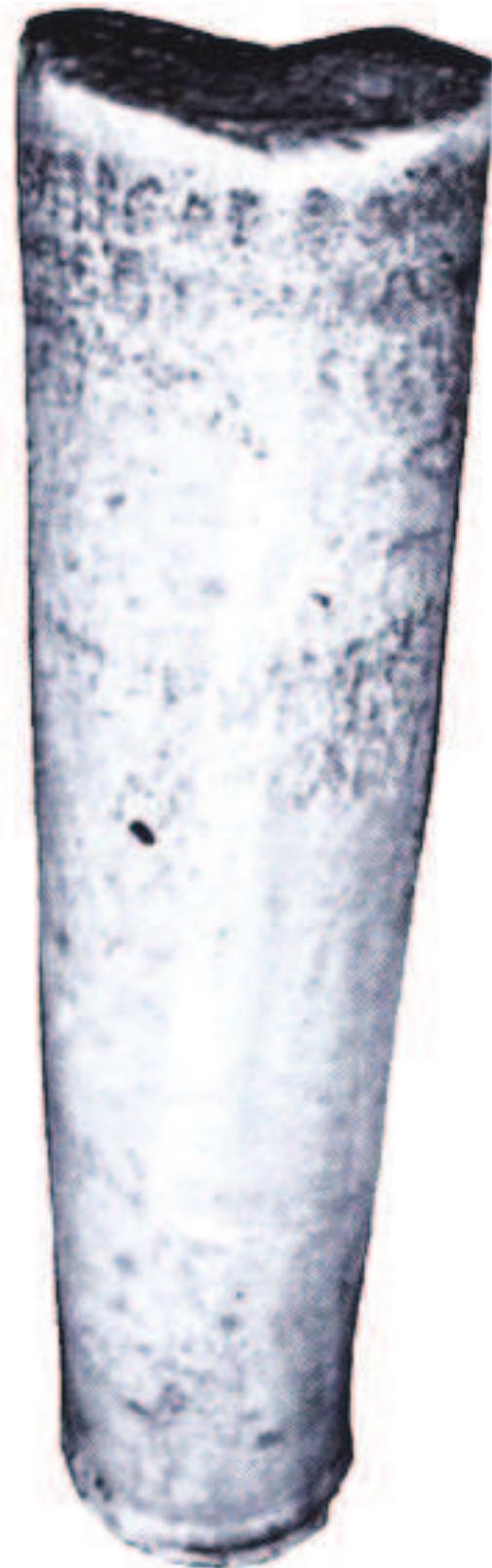
References (171)

  1. A general change in the nature of the milestones it was noted after the Severan dynasty, cf. Laurence 2004, p. 45.
  2. Panaite 2011. It is interesting to note that some milestones from Gaul, Germany and Hispania Citerior of Maximinus Thrax and his son, dated in 237, refer to the same action: repairs of roads and bridges, and they were set up in the latter province, through the agency of the governor C. Messius Q. Decius Valerianus, the future emperor, C. Messius Q. Decius Traianus cf. Sauer 2014, p. 291. 34 All dates are AD.
  3. Żelazowski 2009, p. 143; Kienast, Eck, Heil 2017, p. 195.
  4. CIL III, 13758. The text was reconstructed based on the milestone from Paskalevo.
  5. CIL III, 12519; Kalinka 1906, no. 48.
  6. Sharankov 2020, p. 309-314 (Čeljustnica).
  7. Road station and a fortified military post ( praesidium) on the road Oescus -Philippopolis, north of the Haemus Mountains, next to the Troyan Pass. Montemno is represented on the Peutinger Map, and according to Sharankov (2020, p. 316) this is a corruption of Monte (H)aemo. This mountain pass (presently called Beklemeto or Trojan Pass) provided the most important road connection between Thrace and Lower Moesia. For the road Oescus -Philippopolis, see Madžarov 2004.
  8. Sharankov 2020, 315-319.
  9. Montana 2, no. 2: Imp(eratori) Caes(ari) ⟦Marco Aur(elio)⟧ / ⟦Severo Alexandro⟧ Pio / Felici Invicto Aug(usto) / pontifici maximo / patri patriae / C(aius) Quintus Decius leg(atus) Aug(usti) / pr(o) pr(aetore) provinciarum / Moesiae itemque / Germani(a)e inferiorum / candidatus Aug(usti) / devotissimus / dicatissimusque / Numini / maiestatique / eorum(!).
  10. Kienast, Eck, Heil 2017, p. 195.
  11. No. 3a Flaviana(?); no. 4b Capidava; nos. 5b, 6b, 7a Carsium; no. 14 Corbu; no. 17b Callatis; no. 21 Albena; no. 25 vicus Urb ...; no. 26 Valea Dacilor; no. 28 Zaldapa; no. 35 Crângu; no. 38a vicus Clementianensis.
  12. No. 15 Corbu; no. 19 Callatis; no. 21 Albena; no. 25 vicus Urb...; no. 28 Zaldapa; no. 36 Miriștea (only piis).
  13. Constantine the Great is named filio Augg(ustorum) on two inscriptions: no. 8 Troesmis and no. 20 Vama Veche. 66 No. 7a Carsium; no. 32 Štipsko.
  14. No. 1 Trimammium: the use of both nominative and dative cases.
  15. 9 Arrubium and no. 24 vicus Hi… mention only the name of the emperors without any imperial title; on no. 32 Štipsko all emperors are caesarribus (!).
  16. Which could date the inscription more precisely to 302, cf. Bărbulescu, Buzoianu, Covacef 2008, p. 173-177. 70 According to Panaite 2011, there are 10 milestones discovered so far.
  17. No. 25 vicus Urb... (Fig. 3) and no. 12 Buteridava (Fig. 4).
  18. Trimammium (Mečka/Stâlpiște -former Dikilitaš), Ruse County, Bulgaria)
  19. Imp(erator) Ca[es(ar) Fl(avius) Constantinus) ……………………………in]vic(tus) [Aug(ustus) Imp(eratori) Caes(ari) Val(erio) Liciniano…. Licinio p(io) f(elici) inv(cti) aug(usti )……… (b) [Imp(eratori) Caes(ari) C(aio) Iulio Vero] / [Maximino Pio Fel(ici) In]/ [victo Aug(usto) Germ(anico)] max(imo)
  20. Dac(ico) / [max(imo) et C(aio) Iul(io) Vero] Max(i)mo / [no]biliss(imo) Caesar(i) c[ur]/ [ante(?)] Fl(avio) Luciliano / leg(ato) Aug(usti) pr(o) pr(aetore) Date: (a) 308-324; (b) 236-238. Bibliography: Škorpil 1914, p. 91 and notes 3 and 4; Hollenstein 1975, no. 34, 69; Velkov 1968, p. 6.
  21. Tegulicium (Vetren, Silistra County, Bulgaria) M(illia) P(assuum) XII Maximiano Date: 293-305. Bibliography: Teodorescu, Mateescu 1915; Hollenstein 1975, no. 56.
  22. a-b. Flaviana (?) (Rasova, Constanța County, Romania)
  23. Maximiano] p(iis) f(elicibus) [Aug(ustis)] [invictissimis principibus et Fl(avio) Val(erio) Constantio] et 5 [Gal(erio) Val(erio) Maximiano nobi]l[is- simis Caesarib]us.
  24. I L XIIII. Date: (a) 293-305; (b) 367-375. Bibliography: CIL III, 13755; IGLR 190; ISM IV, 212.
  25. a-b. Capidava (Capidava, Constanța County, Romania)
  26. Imp(eratoribus) C[aes(aribus) C(aio) Au]- [re]l(io) Val[(erio) Diocletiano] e[t M(arco) Aur(elio) Val(erio) Maximiano]
  27. P(iis) F(elicibus) inv[ic(tis) Aug(ustis)]
  28. et M(arco) Fl(avio) Valerio] [Constantio et C(aio)]
  29. C(aius) Fl(avius) Val[(erius) Constantinus] e[t Val(erius) Licin(ianus) Licinius]
  30. P(ii) F(elices) inv[ic(ti) Aug(usti) et Fl(avius)] [Val(erius) Crispus et Lici]- [nia]nus [Licinius Iun(ior) et Fl(avius) C[l(audius) Constantinus]
  31. Caes[(ares)].
  32. Date: (a) 302 or 293-305; (b) 313-323. Bibliography: Bărbulescu, Buzoianu, Covacef 2008, p. 173-177, 185, no. 3, Fig. 3 a-b; AÉ 2008, 1193.
  33. b. Carsium (Hârșova, Constanța County, Romania) (a) Imp(erator) C[aes(ar) L. Sep]- timiu[s Severus] P(ius) Per[tinax Aug(ustus)] Arab(icus) [Adiab(enicus)]
  34. Part(hicus) m(aximus) [co(n)s(ul) II trib(unicia) po]- tes(tate) VI [II imp(erator) XI] pon[t(ifex) max(imus) proco(n)s(ul)] p(ater) p(atriae) et Im[p(erator)] Ca[e]s(ar) M. Au[r]el(ius) [A]nto- 10 [nin]us A[u]g(ustus) tri[b(unicia)] pot(estate) II et [P.] Septi- mi[us Geta] Ca[es(ar) Aug(ustus)] restit[u]erun(t) per C. Ovinium 15 Tertullum leg(atum) Aug(usti) pr(o) pr(aetore) <Ala II Arav(acorum)> …………<IC>…………………
  35. a-b. Carsium (Hârșova, Constanța County, Romania) (a) [D(ominis) n(ostris) C(aio) A]ur(elio) Val(erio)
  36. et M(arco) [Aur(elio) Val(erio) Ma]ximi- [ano Aug(ustis) in]victis- [simis pr]incipi- [bus et] Fl(avio) Val(erio) [Constantio et] G(alerio) Val(erio)
  37. D(ominis) n(ostris)
  38. Constanti- [no m]ax(imo) et Constanti[no] Date: (a) 293-305; (b) 323-337. Bibliography: CIL III, 7609; IGLR 232.
  39. Troesmis (Turcoaia, Tulcea County, Romania) [Dd(ominis) nn(ostris) [[Val(
  40. o[v(ia) Scyt(hica)] Date: 308-323. Bibliography: CIL III, 6174; IGLR 237.
  41. Arrubium (Măcin, Tulcea County, Romania) Imp(eratoribus)
  42. M- arc(o) Aur(elio) [Va]l(erio) Maxi- [m]iano e[t] [F]l(avio) Val(erio) Co[n]- 10 [st]antio e[t] Gal(erio) Val(erio)
  43. aximi- ano m(ilia) p(assuum) IIII Date: 293-305. Bibliography: CIL III, 7610; IGLR 239.
  44. Dinogetia (Garvăn, Tulcea County, Romania) Impp(eratoribus) [Cae-] ss(aribus) C[aio A]ur(elio) [Val(erio)
  45. F[l(avio) Val(erio) Con]- 10 [stantio et C(aio) Val(erio)] [Maximiano nn(o)bb(ilissimis)]
  46. C(ae)ss(aribus).........
  47. Date: 293-305 (297-303 after Gh. Ștefan). Bibliography: Gh. Ştefan 1957; Hollenstein 1975, no. 57; IGLR 240.
  48. Halmyris (Murighiol, Tulcea County, Romania) [DD(omini)] NN(ostri)
  49. et Consta- nt[inus] [Augustus] [………….] XVI [c]o(n)s(ul) III et imp(erator) Cae- sa[r L(ucius) Aur]elius Verus Ar- meniacus Aug(ustus) tribu- n[i]c[i]ae [p]ote[stat]i[s II co(n)s(ul) II] 10 [divi Hadriani nepotes] [divi Traiani Parthici] [pronepotes divi Ner]- [vae abnepotes. A Calla]- [tide ---m(ilia) p(assuum)]
  50. invicti Aug(usti) et M(arcus) [Fl(avius) Val(erius) Constant]iu[s] [et C(aius) Galerius Valerius] [Maximianus etc].
  51. Date: (a) 163;
  52. Hollenstein 1975, nos. 26, 58; AÉ 1976, 620;
  53. A. Ștefan 1984, p. 95-100, no. 1, Fig. 1-5;
  54. AÉ 1985, 757; ISM III, 196.
  55. Callatis (Mangalia, Constanța County, Romania) .......................... Ma[ximiano] Piis Felici[(bus)] invictis Aug(ustis)
  56. C]ons[tantio] et Ga[lerio Val(erio)]
  57. Maximiano] [nob(ilissimis) Caes(aribus). Date: 293-305. Bibliography: Bărbulescu, Buzoianu, Covacef 2008, p. 177-179, 186-187, no. 4, Fig. 4 a-c.
  58. Callatis (Mangalia, Constanța County, Romania) Ddd(ominis) nnn(ostris) Fl(avio) Va[l(erio)] Constantin[o] et Val(erio)[Lic(iniano)Li]c[inio] Pp(iis) f(elicibus) Augg(ustis) et Fl(avio)
  59. Val(erio) Crispo et [Lic(iniano)] [Licinio iun(iori)] et [Fl(avio) Cl(audio)] Constantino nobiliss[i]mis Caes(aribus) m(ilia) p(assuum) II (?) Date: 317-324. Bibliography: Bărbulescu-Munteanu, Rădulescu 1980, p. 151-155, no. 5, Fig. 5 a-c.
  60. Vama Veche, Constanța County, Romania Dd(ominis) nn(ostris) Va- l(erio) [Licinio] Aug(usto) et F- la(vio) Val(erio) Con- stantino filio Augg(ustorum). Date: 307-323. Bibliography: CIL III, 142152; IGLR 108.
  61. a-b. Albena, Dobrič County, Bulgaria (a) S(alvis) d(ominis) n(ostris)
  62. L O (b) Imp(eratoribus) [d(ominis)] n(ostris) C(aio)[Aur(elio) Val(erio)] D[iocletiano] et [M(arco) Aur(elio) Val(erio)
  63. Max[imiano pii]s f[elicibus invictis Aug(ustis)] et
  64. Goren Čiflik, Varna County, Bulgaria D(omini) n(ostri) Fl(avius) [Val(erius) Consta]ntinus Aug(ustus) [et Fl(avius)
  65. C]onstantin{us, Consta- n]tius, Con[stans] [nob(ilissimi) Caes(ares)].
  66. Date: 333-335. Bibliography: SGLI 150; Mirčev 1953, p. 73, no. 5, Fig. 89.
  67. Crângu, Constanța County, Romania [DD(ominis)]NN(ostris) Dioclet[iano] et Maximi[ano] Invictis A[VG(ustis) et FL(avio) VAL(erio)] [Co]nstan[tio et Galerio Val(erio)]
  68. Maxi]miano[n] N(o)bb(ilissimis) Caes[s(aribus)] Milia pass[uum] M(ilia) P(assuum) III Date: 293-305. Bibliography: Panaite, Alexandrescu 2009, p. 432-433;
  69. ISM IV, 83; AÉ 2009, 1209. BIBLIOGRAPHY Banzi 1999 -E. Banzi, I miliari come fonte topografica e storica. L'esempio della XI Regio (Transpadana) e delle Alpes Cottiae, Rome, 1999.
  70. A. Barnea 1997 -A. Barnea, Voies de communication au Bas-Danube aux IV e -VI e s. ap. J.C., in E. Popescu, T. Teoteoi (eds.), Études byzantines et post-byzantines, vol. III, Bucureşti, 1997, p. 29-42.
  71. I. Barnea, Iliescu 1982 -I. Barnea, O. Iliescu, Constantin cel Mare, București, 1982. Barnes 1976 -T.D. Barnes, Imperial Campaigns, A. D. 285-311, Phoenix 30, 1976, 2, p. 174-193.
  72. Barnes 1982 -T.D. Barnes, The New Empire of Diocletian and Constantine, London, 1982. Bartels 2014 -J. Bartels, Meilensteine und Barbaren. Die Straßenbaupolitik auf dem Balkan unter Maximinus Thrax und Gordian III., in A. Kolb (ed.), Infrastruktur und Herrschaftsorganisation im Imperium Romanum, Berlin, 2014, p. 222-245.
  73. Basso 2008 -P. Basso, I miliari della Cisalpina romana: considerazioni storico-epigrafiche, Verona, 2008. Bărbulescu 2001 -M. Bărbulescu, Viața rurală în Dobrogea romană, Constanța, 2001.
  74. Bărbulescu, Câteia 1997 -M. Bărbulescu, A. Câteia, Stâlpi miliari descoperiţi în Dobrogea, Pontica 30, 1997, p. 183-198.
  75. Bărbulescu, Câteia 1998 -M. Bărbulescu, A. Câteia, Observations sur deux bornes milliaires inédites de la province de Scythie, in M. Zahariade, I.C. Opriș (eds.), The Roman frontier at the Lower Danube, 4th-6th centuries. The Second International Symposium (Murighiol/Halmyris 18-24 August 1996), Studia Danubiana, Pars Romaniae, Series Symposia I, Bucharest, 1998, p. 195-204.
  76. Bărbulescu, Buzoianu, Covacef 2008 -M. Bărbulescu, L. Buzoianu, Z. Covacef, Milestones from Dobruja in the Collections of the Museum for National History and Archaeology Constanţa, Pontica 41, 2008, p. 169-187.
  77. Bărbulescu, Câteia, Wisoșenschi 2009 -M. Bărbulescu, A. Câteia, W. Wisoşenschi, Piese epigrafice şi sculpturale din teritoriul rural, Pontica 42, 2009, p. 409-427.
  78. Bărbulescu-Munteanu, Rădulescu 1980 -M. Bărbulescu-Munteanu, A. Rădulescu, Stîlpi miliari inediţi din Scythia Minor, Pontica 13, 1980, p. 140-157.
  79. Bâltâc 2011 -A. Bâltâc, Lumea rurală în provinciile Moesia Inferior și Thracia (secolele I-III p. Chr.), București, 2011. Bošnakov 1975 -R. Bošnakov, Novi epigrafski pametnici v Okrăžnija Muzej Tolbuhin, Vekove 4, 1975, 5, p. 84-87. Conti 2004 -S. Conti, Die Inschriften Kaiser Julians, Stuttgart, 2004.
  80. Crăciun 2008 -C. Crăciun, Structuri antice descoperite prin fotointerpretarea imagininilor aeriene, Pontica 41, 2008, p. 357-392.
  81. Destephen 2016 -S. Destephen, La naissance de Constantinople et la fin des voyages impériaux (IV e -V e siècle), Antiquité Tardive 24, 2016, p. 157-169 (DOI: 10.1484/J.AT.5.112620).
  82. Destephen 2018 -S. Destephen, The late milestones of Asia Minor, Gephyra 16, 2018, p. 173-184.
  83. Doruțiu-Boilă 1964 -E. Doruțiu-Boilă, Precizări topografice despre unele inscripții dobrogene, SCIV 15, 1964, 1, p. 131-135.
  84. Duch 2015 -M. Duch, The impact of Roman army on trade and production in Lower Moesia (Moesia Inferior), Studia Europaea Gnesnensia 11, 2015, p. 235-260 (DOI:10.14746/SEG.2015.11.12).
  85. Duch 2017 -M. Duch, The integration process of the lower Moesian areas, Studia Europaea Gnesnensia 16, 2017, p. 371-397 (DOI:10.14746/seg.2017.16.18).
  86. Fodorean 2006 -F. Fodorean, Drumurile în Dacia romană, Cluj-Napoca, 2006.
  87. Fodorean 2014 -F. Fodorean, Pannonia, Dacia şi Moesia în izvoarele geografice antice, Cluj-Napoca, 2014.
  88. Gugl, Panaite 2016 -C. Gugl, A. Panaite, Altstraßen und Fundstellen im Umland von Troesmis, in C-G. Alexandrescu, Ch. Gugl, B. Kainrath (eds.), Troesmis, vol. I. Forschungen von 2010-2014, Cluj-Napoca, 2016, p. 449-458.
  89. Hollenstein 1975 -L. Hollenstein, Zu den Meilensteinen der römischen Provinzen Thracia und Moesia Inferior, Studia Balcanica 10, 1975, p. 23-44.
  90. Hollenstein 1979 -L. Hollenstein, Za dve miliarni koloni ot Dolna Mizija, ArhSofia 21, 1979, 2, p. 42-46. Isaac 1990 -B. Isaac, The limits of the empire. The Roman army in the east, Oxford, 1990.
  91. Isaac, Roll 1982 -B. Isaac, I. Roll, Roman Roads in Judaea, The Legio-Scythopolis Road, vol. I. Oxford, 1982. Ivanov 1999 -R. Ivanov, Dolnodunavskata otbranitelna sistema meždu Dorticum i Durostorum ot Avgust do Mavrikii, Sofia, 1999.
  92. Jireček 1932 -K. Jireček, Voennijat păt ot Bălgrad za Carigrad i Balkanskit prohodi, Bălgarska Istoričeska Biblioteka 4, Sofia, 1932. Jireček 1974 -K. Jireček, Pătuvanija po Bălgarija, Sofia, 1974.
  93. Kienast, Eck, Heil 2017 -D. Kienast, W. Eck, M. Heil, Römische Kaisertabelle. Grundzüge einer römischen Kaiserchronologie, 6. Auflage, Darmstadt, 2017.
  94. Kalinka 1906 -E. Kalinka, Antike Denkmäler in Bulgarien, Wien, 1906 (= Schriften der Balkankommission, Antiquarische Abteilung 4).
  95. Kolb 2004 -A. Kolb, Römische Meilensteine: Stand der Forschung und Probleme, in R. Frei-Stolba (ed.), Siedlung und Verkehr im Römischen Reich. Römerstrassen zwischen Herrschaftssicherung und Landschaftsprägung. Akten des Kolloquiums zu Ehren von Prof. H. E. Herzig vom 28. und 29. Juni 2001 in Bern, Bern, 2004, p. 135-155.
  96. Kolb 2011 -A. Kolb, Miliaria: ricerca e metodi. L'identificazione delle pietre miliari, in F. Pavan (ed.), I miliari lungo le strade dell'Impero. Aggiornamenti e nuove prospettive di ricerca, Verona, 2011, p. 17-28.
  97. Laurence 1999 -R. Laurence, The Roads of Roman Italy. Mobility and Cultural Change, Abington, 1999. Laurence 2004 -R. Laurence, Milestones, Communication and Political Stability, in L. Ellis, F.L. Kidner (eds.), Travel, Communication and Geography in Late Antiquity. Sacred and Profane, Aldershot, 2004, p. 38-49.
  98. Laurence 2024 -R. Laurence, Roads and communications, in J. Tanner, A. Gardner (eds.), Materialising the Roman empire, London, 2024, p. 19-44 (DOI: 10.2307/jj.6914759.9).
  99. Luka 2004 -K. Luka, Antičnite pametnici v obština Mezdra, Mezdra, 2004.
  100. Madžarov 2004 -M. Madžarov, Rimskijat păt Eskus -Filipopolis. Pătin stancii i selišta, Veliko Tărnovo, 2004. Madžarov 2009 -M. Madžarov, Prinos v historijata na pătna mreja v Mezija i Trakija, Veliko Tărnovo, 2009.
  101. Mašov, Ganecovski, Todorova 2004 -S. Mašov, G. Ganecovski, K. Todorova, Sondažni proučvanja na praistoričesko selište i antična krepost Kaleto kraj Mezdra, AOR 2003, p. 41-43.
  102. Matei-Popescu 2010 -F. Matei-Popescu, The Roman army in Moesia Inferior, Bucharest, 2010. Mirčev 1953 -M. Mirčev, Latinski epigrafičeski pametnici ot Černomorieto, Izvestija na Varnenskoto Arheologičesko Družestvo 9, 1952, p. 69-81.
  103. Oltean 2013a -I.A. Oltean, Burial mounds and settlement patterns: a quantitative approach to their identification from the air and interpretation, Antiquity 87, 2013, p. 202-219.
  104. Oltean 2013b -I.A. Oltean, A Lost Archaeological Landscape on the Lower Danube Roman Limes: The Contribution of Second World War Aerial Photographs, in W.S Hanson, I.A. Oltean (eds.), Archaeology from Historical Aerial and Satellite Archives, New York, 2013, p. 147-164.
  105. Oltean, Hanson 2007 -I.A. Oltean, W.S. Hanson, Reconstructing the archaeological landscape of Southern Dobrogea: integrating imagery, in M. Ehlers, U. Michel (eds.), Remote Sensing for Environmental Monitoring, GIS Applications, and Geology 7 (Proceedings of SPIE 6749), 674906, 2007, https://doi.org/10.1117/12.737836 (accessed on 02.08.2024).
  106. Oltean, Hanson 2013 -I.A. Oltean, W.S. Hanson, Integrating aerial satellite imagery: discovering Roman imperial landscapes in Southern Dobrudja (Romania), in W.S. Hanson, I.A. Oltean (eds.), Archaeology from historical aerial and satellite archives, New York, 2013, p. 315-336.
  107. Opriș 2021a -I.C. Opriș, Milestones from Capidava and the Territorium Capidavense. Aurelian's war against the Carpi inter Carsium et Sucidavam in a new light, JAHA 8, 2021, 4, p. 62-88 (DOI: 10.14795/j.v8i4.694).
  108. Opriș 2021b -I.C. Opriș, An anonymous statio of Classis Flavia Moesica and later Flaviana. All we know for now about Roman Rasova (Constanța County, Romania), JAHA 8, 2021, 2, p. 47-64 (DOI: 10.14795/j.v8i2.652).
  109. Opriș et alii 2022 -I.C. Opriș, A.D. Ionescu, A.C. Surleanu, A.E. Stănișteanu, M. Dragomir, C.G. Simion, A.I. Cercel, V. Speriatu, C. Dobrinescu, A. Șerbănescu, V. Călina, Pons per Danuvium ductus. Date noi despre podul lui Constantin cel Mare dintre Oescus și Sucidava, CA 29, 2022, 2, p. 631-664 (DOI: 10.46535/ca.29.2.11).
  110. Panaite 2006 -A. Panaite, Drumuri romane din teritoriul orașului Tropaeum Traiani, SCIVA 57, 2006, 1-4, p. 57-70. Panaite 2011 -A. Panaite, Drumurile romane în Moesia Inferior, PhD thesis, mss. Panaite 2012a -A. Panaite, Roman roads in Moesia Inferior. Epigraphical evidence, Novensia 23, 2012, p. 131-145. Panaite 2012b -A. Panaite, Archaeological and Epigraphical sources for the reconstruction of the Roman roads network in the province of Lower Moesia, Caiete ARA 3, 2012, p. 67-80.
  111. Panaite 2013 -A. Panaite, Milestones indicating distances from Moesia Inferior, Caiete ARA 4, 2013, p. 69-76.
  112. Panaite 2015 -A. Panaite, Roman roads in Moesia Inferior. Archaeological and epigraphical evidence, in L. Vagalinski, N. Sharankov (eds.), Limes XXII. Proceedings of the 22nd International Congress of Roman Frontier Studies Ruse, Bulgaria, September 2012 (= Bulletin of the National Archaeological Institute 42, 2015), Sofia, 2015, p. 593-600.
  113. Panaite 2016 -A. Panaite, A changing landscape: the organization of the Roman roads network in Moesia Inferior, in C.-G. Alexandrescu (ed.), Troesmis -A changing landscape. Romans and the Others in the Lower Danube Region in the First Century BC -Third Century AD. Proceedings of an International Colloquium Tulcea, 7 th -10 th of October 2015, Cluj-Napoca, 2016, p. 151-164.
  114. Panaite 2023 -A. Panaite, Roads and the Roman Landscape in Moesia Inferior, in E. Hanscam, J. Karavas (eds.), The Roman Lower Danube Frontier. Innovations in Theory and Practice, Oxford, 2023, p. 63-88 (DOI: 10.32028/9781803276625).
  115. Panaite, Alexandrescu 2009 -A. Panaite, C.-G. Alexandrescu, A "rediscovered" inscription from Dobrudja. Roads and milestones in Scythia (3 rd -4 th centuries AD), Pontica 42, 2009, p. 429-455.
  116. Panaite, Miu (Bem) 2016 -A. Panaite, C. Miu (Bem), Roman roads identified on aerial and satellite images within the territory of the city of Tropaeum Traiani (Moesia Inferior), Dacia N.S. 60, 2016, p. 201-220.
  117. Petolescu 2007 -C.C. Petolescu, Cronica epigrafică a României (XXVI, 2006), SCIVA 58, 2007, 3-4, p. 365-388.
  118. Salama 1987 -P. Salama, Bornes milliaires d'Afrique proconsulaire. Un panorama historique du Bas-Empire romain, Collection de l'École française de Rome 101, Rome, 1987.
  119. Sauer 2014 -E. Sauer, Milestones and instability (mid-third to early fourth centuries AD), AncSoc 44, 2014, p. 257-305 (DOI: 10.2143/AS.44.0.3044807).
  120. Sharankov 2020 -N. Sharankov, Decius as governor of Lower Moesia and Severus Alexander's visit to the province in AD 234, ZPE 214, 2020, p. 309-319.
  121. Sharankov, Hristov 2022 -N. Sharankov, I. Hristov, A Milestone for Emperor Trajan Decius erected by the City of Nicopolis ad Istrum at the castellum of Sostra, ArchBulg 26, 2022, 3, p. 67-77.
  122. Sillières 1976 -P. Sillières, De la borne milliaire à la dédicace impériale. L'exemple de quelques inscriptions routières de l'Hispanie méridionale, REA 88, 1976, 1-4 (=Hommage à Robert Etienne), p. 351-358 (DOI: 10.3406/ rea.1986.4247).
  123. Suceveanu 1977 -Al. Suceveanu, Viaţa economică în Dobrogea romană, Bucureşti, 1977.
  124. Suceveanu, A. Barnea 1991 -A. Suceveanu, A. Barnea, La Dobroudja romaine, Bucarest, 1991. Škorpil 1905 -K. Škorpil, Nekotoroye iz dorog Vostočnoj Bolgari, Izvestija Russkogo Arheologičeskogo Instituta v Konstantinopole 10, 1905, p. 444-502.
  125. Škorpil 1914 -K. Škorpil, Opis' na starinite po tečenieto na reka Rusenski Lom', Sofia, 1914.
  126. A. Ștefan 1984 -A. Ștefan, Callatis și artera rutieră litorală în secolul al II-lea e.n., StCl 22, 1984, p. 95-107.
  127. A.S. Ştefan 1971 -A.S. Ştefan, Troesmis, consideraţii topografice, BMI 40, 1971, 4, p. 43-52.
  128. A.S. Ştefan 1973 -A.S. Ştefan, Noviodunum, studiu de fotointerpretare arheologică, BMI 42, 1973, 1, p. 3-14.
  129. A.S. Ștefan 1974a -A.S. Ștefan, Recherches de photo-interprétation archéologique sur le limes de la Scythie Mineure à l'époque du Bas-Empire, in D.M. Pippidi, M. Kandler (eds.), Actes du IX e Congrès International d'Etudes sur les Frontières Romaines, Mamaia 1972, Bucarest -Köln -Wien, 1974, p. 95-108.
  130. A.S. Ștefan 1974b -A.S. Ștefan, Cercetări aerofotografice privind topografia urbană a Histriei. I. Epoca romană (sec. I-III e.n.), RMM-MIA 43, 1974, 1, p. 39-51.
  131. A.S. Ştefan 1975 -A.S. Ştefan, Cercetări aerofotografice privind topografia urbană a Histriei. II. Epoca romană târzie (sec. III-IV e.n.), RMM-MIA 44, 1975, 2, p. 51-62.
  132. A.S. Ştefan 1976 -A.S. Ştefan, Cercetări aerofotografice privind topografia urbană a Histriei. III. Epoca romană târzie (sec. IV-VII e.n.), RMM-MIA 45, 1976, 1, p. 43-51.
  133. A.S. Ștefan 1977a -A.S. Ștefan, Cetățile romane de la Enisala. Studiu aerofotografic, RMM-MIA 46, 1977, 2, p. 15-25.
  134. A.S. Ștefan 1977b -A.S. Ștefan, Cetatea romană de la Slava Rusă (Libida?). Cercetările aerofotografice şi apărarea patrimoniului arheologic, RMM-MIA 46, 1977, 1, p. 3-22.
  135. A.S. Ştefan 1977c -A.S. Ştefan, Nouvelles recherches de photo-interpretation archéologique concernant la défense de la Scythie Mineure, in J. Fitz (ed.), Akten des XI Internationalen Limeskongresses, Székesfehérvár, Aug.-Sept.1976, Budapest, 1977, p. 451-466.
  136. A.S. Ștefan 1983 -A.S. Ştefan, Cercetări aerofotografice în anii 1978-1980, MCA 15, 1981, p. 178-192.
  137. A.S. Ştefan 1984 -A.S. Ştefan, Cetatea romană târzie de la Murighiol. Studiu aerofotografic, Peuce 9, 1974, p. 297-310, 663-674.
  138. A.S. Ștefan 1986 -A.S. Ștefan, Archéologie aérienne en Roumanie, numéro spécial double de Photo-interprétation, no. 1 et 2, Paris, 1986.
  139. Gh. Ştefan 1957 -Gh. Ştefan, Un miliario di epoca di Diocleziano, Dacia N.S. 1, 1957, p. 221-227.
  140. Teodorescu, Mateescu 1915 -D.M. Teodorescu, C.C. Mateescu, Raport Special nr. 8. Cercetări arheologice între Silistra şi Turtucaia în iulie -octombrie 1915, ACMI 1915 (1916), p. 215-216.
  141. Tocilescu 1900 -G. Tocilescu, Fouilles et recherches archéologiques en Roumanie, Bucarest, 1900. Tomas 2016 -Agnieszka Tomas, Inter Moesos et Thraces. The rural hinterland of Novae in Lower Moesia (1 st -6 th centuries AD), Roman Archaeology 14, Oxford, 2016.
  142. Torbatov 2000 -S. Torbatov, The Roman road Durostorum-Marcianopolis, ArchBulg 4, 2000, 1, p. 59-72.
  143. Torbatov 2021 -S. Torbatov, The Unknown Roman Limes in Bulgaria. Part 1. Between the Vit and the Osam rivers, Veliko Tărnovo, 2021.
  144. Tudor 1956 -D. Tudor, Inscripții romane inedite din Oltenia și Dobrogea, MCA 2, 1956, p. 563-624. Tudor 1974 -D. Tudor, Les ponts romains au Bas-Danube, București, 1974. Țentea et alii 2019 -O. Țentea, I.C. Opriș, F. Matei-Popescu, A. Rațiu, C. Băjenaru, V. Călina, Frontiera romană în Dobrogea. O trecere în revistă și o actualizare, CA 26, 2019, p. 9-82 (DOI: 10.46535/ca.26.01).
  145. Velkov 1968 -V. Velkov, Epigrafski prinosti kăm istorija na Ruse i rusensko prez rimskata epoha, IzvestijaRuse 3, 1968, p. 3-10.
  146. Vladimirov 1963 -V. Vladimirov, Novi dani za rimskija păt Oescus-Serdica prez IV v., ArhSofia 5, 1963, 1, p. 33-34.
  147. Vulpe, Barnea 1968 -R. Vulpe, I. Barnea, Din istoria Dobrogei, vol. II. Romanii la Dunărea de Jos, București, 1968. Witschel 2002 -C. Witschel, Meilensteine als historische Quelle? Das Beispiel Aquileia, Chiron 32, 2002, p. 325-393.
  148. Witschel 2023 -C. Witschel, When Did 'Late Antique Epigraphy' Come to an End?, in V. Debiais, M. Uberti (eds.), Traversées. Limites, cheminements et créations en épigraphie, Pau, 2023, p. 207-238.
  149. Zahariade 1994 -M. Zahariade, Inscripția de fundație din timpul primei tetrarhii de la Halmyris (Murighiol, jud. Tulcea), Pontica 27, 1994, p. 173-186.
  150. Żelazowski 2009 -J. Żelazowski, L'attivita dei governatori nella Mesia Inferiore (86-275 D.C.) secondo le iscrizioni, Palamedes 4, 2009, p. 131-145.
  151. AnUDC -Analele Universității "Dimitrie Cantemir", București AnUOradea -Analele Universităţii Oradea, Oradea AnUVT -Annales d'Université "Valahia" Târgoviște. Section d'Archéologie et d'Histoire AOR -Arheologičeski otkritija i razkopki Apulum -Acta Musei Apulensis. Muzeul Naţional al Unirii, Alba Iulia Archaeologia Austriaca -Archaeologia Austriaca. Österreichische Akademie der Wissenschaften, Österreichisches Archäologisches Institut, Wien Archaeologia Lituana -Archaeologia Lituana. Vilnius University Press Archaeological and Anthropological Sciences -Archaeological and Anthropological Sciences, Springer Archaeological Reports -Archaological Reports. Society for the Promotio of Hellenic Studies and the British School at Athens Archeometriai Műhely -Archeometriai Műhely a Magyar Régészeti és Művészettörténeti Társulat interdiszciplináris kutatásokkal foglalkozó vitaülés-sorozata, Budapest ArchBulg -Archaeologia Bulgarica, Sofia ArchÉrt -Archeológiai Értesítő. A Magyar Régészeti és Művészettörténeti Társulat Tudományos Folyóirata, Budapest ArchIug -Archaeologia Iugoslavica. Arheološko društvo Jugoslavije, Beograd ArchKözl -Archaeologiai Közlemények. Magyar Tudományos Akadémia, Budapest ArchRozhledy -Archeologické Rozhledy. Archeologický ústav AV ČR, Praha Arctic Anthropology -Arctic Anthropology. University of Wisconsin Press Argesis -Argesis. Muzeul Judeţean Argeş, Piteşti ArhDelt -Ἀρχαιολογικὸν Δελτίον. Μελέτες. Athina: Tameio Archaiologikon Poron kai Apallotrioseon Arheologičeskij al'manah -Arheologičeskij al'manah. Nacional'naja Akademija Nauk Ukrainy. Institut Arheologii Krymskij filial, Doneckij Oblastnoj Kraevedčeskij Muzej ArhEvraziStepej -Arheologija Evraziskih stepej. Akademija Nauk Respubliki Tatarstan ArhMold -Arheologia Moldovei. Academia Română, Institutul de Arheologie, Iaşi ArhSbErmitaž -Arheologičeskij sbornik Gosudarstvennogo Ermitaža, Leningrad ArhSofia -Arheologija. Organ na Arheologičeskija Institut i Muzej, Sofia ArhVestLjubljana -Arheološki vestnik. Inštitut za arheologijo ZRC SAZU, Ljubljana Arheologičeskie vesti -Arheologičeskie vesti. Rossijskaja Akademija Nauk, Institut istorii material'noj kul'tury, Sankt Petersburg ArheologijaKiev -Arheologija. Nacional'na Akademija Nauk Ukrajni, Institut Arheologij NAN Ukrajni, Kijv ArheologijaSSSR -Arheologija SSSR: Svod arheologičeskih istočnikov. Akademija Nauk SSSR, Institut arheologii, Moskva BABesch -Bulletin van de Vereeniging tot Bevordering der Kennis van de Antieke Beschaving. Archaeologisch Instituut, Leiden
  152. BalcanicaBelgrad -Balcanica. Annuaire de l'Institut des Études Balkaniques. Académie Serbe des Sciences et des Arts, Belgrad Banatica -Banatica. Muzeul Banatului Montan, Reşiţa BARBrSer -British Archaeological Reports, British Series, Oxford BARIntSer -British Archaeological Reports, International Series, Oxford BAVA -Beiträge für allgemeinen und vergleichenden Archäologie. Deutsches Archäologisches Institut, Kommission für Allgemeine und Vergleichende Archäologie, München BayVgBl -Bayerische Vorgeschichtsblätter. Kommission für bayerische Landesgeschichte bei der Bayerischen Akademie der Wissenschaften in Verbindung mit dem Bayerischen Landesamt für Denkmalpflege und der Archäologische Staatssammlung, München BCH -Bulletin de Correspondance Hellénique, Athènes -Paris BeJA -Bulgarian e-Journal of Archaeology. Association of Bulgarian Archaeologists, Sofia BerRGK -Bericht der Römisch-Germanischen Kommission des Deutschen Archäologischen Instituts, Frankfurt am Main BHAUT -Bibliotheca Historica et Archaeologica Universitatis Timisiensis, Timişoara BiblArchMold -Bibliotheca Archaeologica Moldaviae, Iași BiblIstrPont-SA -Biblioteca Istro-Pontică. Seria Arheologie. Institutul de Cercetări Eco-Muzeale "Gavrilă Simion", Tulcea BiblMusAp -Bibliotheca Musei Apulensis. Muzeul Național al Unirii, Alba Iulia BiblThrac -Bibliotheca Thracologica, București BiblTyr -Bibliotheca Tyragetia, Chișinău BMI -Buletinul Monumentelor Istorice, Bucureşti BMJT -Buletinul Muzeului Judeţean Teleorman, Alexandria BPS -Baltic-Pontic Studies, Poznań BSNR -Buletinul Societăţii Numismatice Române, Bucureşti Bucureşti.MIM -Bucureşti. Materiale de Istorie şi Muzeografie. Muzeul Municipiului București Budapest Régiségei -Budapest Régiségei. Budapesti Törtenéti Múzeum, Budapest BulletinAFEQ -Bulletin de l'Association Française pour l'étude du quaternaire, Paris Byzantinoslavica -Byzantinoslavica. Revue internationale des Études Byzantines. Slovanský ústav Akademie věd České republiki, Praha CA -Cercetări Arheologice. Muzeul Naţional de Istorie a României, Bucureşti Caiete ARA -Caiete ARA. Arhitectură, Restaurare, Arheologie. Asociaţia ARA, Bucureşti Carpica -Carpica. Complexul Muzeal "Iulian Antonescu", Bacău CCDJ -Cultură şi Civilizaţie la Dunărea de Jos. Muzeul Dunării de Jos, Călăraşi CEFR -Collection de l'École Française de Rome CercIst -Cercetări Istorice. Complexul Național Muzeal "Moldova", Iaşi, Muzeul de Istorie a Moldovei, Iași
  153. Chiron -Chiron. Mitteilungen der Kommission für Alte Geschichte und Epigraphik des Deutschen Archäologischen Instituts, München CIL -Corpus Inscriptionum Latinarum, 17 volumes, Berlin, 1853- ClQ -The Classical Quarterly. The Classical Association, Cambridge University Press CN -Cercetări Numismatice. Muzeul Naţional de Istorie a României, Bucureşti ComArchHung -Communicationes Archaeologicae Hungariae. Magyar Nemzeti Múzeum, Budapest Complutum -Complutum. Universidad Complutense, Madrid Corviniana -Corviniana. Acta Musei Corvinensis. Muzeul "Castelul Corvinilor", Hunedoara Crisia -Crisia. Muzeului Ţării Crişurilor, Oradea Dacia -Dacia. Fouilles et recherches archéologiques en Roumanie, Bucureşti
  154. Dacia N.S. -Dacia (Nouvelle Série). Revue d'archéologie et d'histoire ancienne. Académie Roumaine, Institut d'Archéologie « Vasile Pârvan », Bucureşti
  155. Danubius -Danubius. Revista Muzeului de Istorie Galați DE -E. de Ruggiero, Dizionario epigrafico di antichità romane, Roma, 1961- DissArch -Dissertationes Archaeologiacae ex Instituto Archaeologico Universitatis de Rolando Eötvös nominatae, Budapest Dobroudja/Dobrudža -Dobroudja / Dobrudža. Istoričeski muzej Dobrič Documenta Praehistorica -Documenta Praehistorica. University of Ljubljana, Faculty of Arts, Department of Archaeology DolgCluj -Dolgozatok az Erdélyi Múzeum Érem-és Régiségtárából, Cluj DolgCluj S.N. -Dolgozatok az Erdélyi Múzeum Érem-és Régiségtárából. Új sorozat, Cluj-Napoca DRH A vol. I -Documenta Romaniae Historica, A. Moldova (1384-1448), vol. I (eds. C. Cihodaru, I. Caproșu, L. Șimanschi), București, 1975
  156. DRH B vol. VII -Documenta Romaniae Historica, B. Țara Românească (1571-1575), vol. VII (eds. Ș. Ștefănescu, O. Diaconescu), București, 1988
  157. Drobeta -Drobeta. Muzeul Regiunii Porților de Fier, Drobeta-Turnu Severin EAIVR -Enciclopedia Arheologiei şi Istoriei Vechi a României (ed. C. Preda), Bucureşti, 1994 (I, A-C), 1996 (II, D-L), 2000 (III, M-Q)
  158. EAZ -Ethnographisch-Archäologische Zeitschrift. Christian-Albrechts Universität zu Kiel EDCS -Epigraphik-Datenbank Claus/Slaby, Universität Zürich EJA -European Journal of Archaeology. European Association of Archaeologists, Cambridge University Press EphemNap -Ephemeris Napocensis. Academia Română, Institutul de Arheologie şi Istoria Artei, Cluj-Napoca EurAnt -Eurasia Antiqua. Deutsches Archäologisches Institut -Eurasien Abteilung, Berlin FBW -Fundberichte aus Baden-Württemberg, Stuttgart FI -File de Istorie. Muzeul Judeţean Bistriţa-Năsăud, Bistriţa Gallia -Gallia. Archéologie de la France Antique. CNRS Éditions Geographical Review -Geographical Review. American Geographical Society Gephyra -Gephyra. Doğu Akdeniz Bölgesi Eskiçağ Tarihi ve Kültürlerini Araștırma Dergisi / Zeitschrift für die Geschichte und Kulturen des antiken östlichen Mittelmeerraums. Akdeniz Üniversitesi, Antalya
  159. Germania -Germania. Anzeiger der Römisch-Germanischen Kommission des Deutschen Archäologischen Instituts, Frankfurt am Main Gladius -Gladius. Weapons History Journal. Hoffmeyer Institute for the Study of Ancient Weapons of the CSIC Institute of Archaeology of Mérida GlasnikBelgrad -Glasnik Srpskog Arheolośkog Društva, Beograd GlasnikSarajevo -Glasnik Zemaljskog Muzeja Bosne i Hercegovine, Sarajevo GLIHalmyris -M. Zahariade, C.-G. Alexandrescu (eds.), Greek and Latin Inscriptions from Halmyris. Inscriptions on stone, signa, and instrumenta found between 1981 and 2010, BARIntSer 2261, 2011
  160. Godišnjak -Godišnjak. Centar za balkanološka ispitivanja. Akademija Nauka i Umjetnosti Bosne i Hercegovine, Sarajevo Godišnjak grada Beograda -Godišnjak grada Beograda. Muzej grada Beograda HambBeitrA -Hamburger Beiträge zur Archäologie. Universität Hamburg, Hamburg Hazanéző -Hazanéző. Firtos association in Korond JHS -The Journal of Hellenic Studies. Society for the Promotion of Hellenic Studies, Cambridge University Press J.Hum.Evol. -Journal of Human Evolution, Elsevier JMV -Jahresschrift für mitteldeutsche Vorgeschichte. Landesamt für Denkmalpflege und Archäologie Sachsen-Anhalt (mit Landesmuseum für Vorgeschichte) in Halle (Saale) JRAI -Journal of the Royal Anthropological Institute JRGZM -Jahrbuch des Römisch-Germanischen Zentralmuseums Mainz, Mainz KölnJb -Kölner Jahrbuch. Römisch-Germanisches Museum Köln, Archäologischen Gesellschaft, Köln Konštantinove listy -Konštantinove listy / Constantine's Letters. Constantine the Philosopher University in Nitra KSIIMK -Kratkie soobščenija o dokladah i polevyh issledovanijah Instituta istorii material'noj kul'tury, Moskva Die Kunde -Die Kunde. Zeitschrift für niedersächsische Archäologie N.F., Heidelberg Latomus -Latomus. Revue d'études latine, Société d'Études Latines de Bruxelles LED -I. Piso, R. Ardevan, C. Fenechiu, E. Beu-Dachin, Ș. Lalu, Lexicon epigraphicum Daciae, Cluj-Napoca, 2016
  161. LGPN -Lexicon of Greek Personal Names, Oxford LGPN IV -P.M. Phraser, E. Matthews (eds.), A Lexicon of Greek Personal Names, vol. IV. Macedonia, Thrace, Northern Regions of the Black Sea, Oxford, 2005
  162. LGPN V.A -T. Corsten (ed.), A Lexicon of Greek Personal Names, vol. V.A. Coastal Asia Minor. Pontos to Ionia, Oxford, 2010
  163. Litua -Litua. Studii şi cercetări. Muzeul Județean Gorj "Alexandru Ștefulescu", Târgu Jiu LSJ -H.G. Liddell, R. Scott, H.S. Jones (eds.), A Greek-English Lexicon, Oxford, Clarendon Press (9 th edition), 1940
  164. Madrider Mitteilungen -Madrider Mitteilungen. Zeitschrift der Madrider Abteilung des Deutschen Archäologischen Instituts MAGW -Mitteilungen der Anthropologischen Gesellschaft in Wien MAN -MAN. Journal of the Royal Anthropological Institute of Great Britain and Ireland, London Marisia -Marisia. Muzeul Judeţean Mureş, Târgu Mureş Marmatia -Marmatia. Arheologie -Istorie. Muzeul Județean de Istorie și Arheologie Baia Mare MBAH -Marburger Beiträge zur Antiken Handels-, Wirtschafts-und Sozial Geschichte. Seminar für Alte Geschichte, Universität Marburg Metalla -Metalla. Deutsches Bergbau-Museum Bochum MGBAEU -Mitteilungen der Berliner Gesellschaft für Anthropologie, Ethnologie und Urgeschichte, Berlin MSW -Materiały Starożytne i Wczesnośredniowieczne. Państwowe MuzeumArcheologiczne, Warszaw MCA -Materiale și Cercetări Arheologice. Academia Română, Institutul de Arheologie "Vasile Pârvan", București MIA -Materialy i issledovanija po arheologii SSSR, Moskva Montana 2 -V. Velkov, G. Alexandrov, Epigrafski pametnici ot Montana i raiona, Montana, 1994
  165. Mousaios -Mousaios. Buletin Ştiinţific al Muzeului Judeţean Buzău MSROA -Materiały i Sprawozdania Rzeszowskiego Ośrodka Archeologicznego, Rzeszów Musaica -Musaica Archeologica. Filozofiká fakulta, Univerzita Komenského v Bratislave Nature -Nature. Weekly international journal, Springer Nature, UK NE -Numizmatika i epigrafika, Moskva Notae Numismaticae -Notae Numismaticae -Zapiski Numizmatyczne. Muzeum Narodowe w Krakowie Novensia -Novensia. Antiquity of Southeastern Europe Research Centre, University of Warsaw Numiz. sfragistika epigr. -Numizmatika, sfragistika i epigrafika. Bălgarska Akademija na Naukite, Nacionalen arheologičeski institut s muzej, Sofia Offa -Offa. Berichte und Mitteilungen von Archäologie, Neumünster OJA -Oxford Journal of Archaeology. School of Archaeology, University of Oxford Oltenia -Oltenia. Studii şi comunicări, Arheologie-Istorie. Muzeul Olteniei, Craiova Osječki zbornik -Osječki zbornik. Muzej Slavonije Osjiek Palamedes -Palamedes. A Journal of Ancient History. University of Warsaw Paléo -Paléo. Revue d'Archéologie Préhistorique, Les Eyzies, France PaleoAnthropology -PaleoAnthropology. Official Publication of the Paleoanthropology Society and the European Society for the Study of Human Evolution, University of Tübingen PAS -Prähistorische Archäologie in Südosteuropa. Institut für Prähistorische Archäologie, Berlin Patrimonium Apulense -Patrimonium Apulense. Direcția Județeană pentru Cultură Alba, Alba Iulia PBF -Prähistorische Bronzefunde. Akademie der Wissenschaften und der Literatur, Mainz, Seminar für Vor-und Frühgeschichte der Goethe-Universität Frankfurt a. M., Abteilung für Ur-und Frühgeschichtliche Archäologie des Historischen Seminars der Westfälischen Wilhelms-Universität, Münster
  166. Peuce -Peuce. Studii și note de istorie veche și arheologie. Muzeul Delta Dunării / Institutul de Cercetări Eco-Muzeale, Tulcea
  167. Peuce S.N. -Peuce, serie nouă. Studii şi cercetări de istorie şi arheologie. Institutul de Cercetări Eco-Muzeale "Gavrilă Simion", Tulcea Phoenix -Phoenix. Journal of the Classical Association of Canada, Toronto Pliska -Preslav -Pliska -Preslav. Nacionalen arheologičeski institut s muzej, Bălgarskata Akademija na Naukite, Sofia Plural -Plural. History, Culture, Society. Journal of the History and Geography Department, "Ion Creangă" Pedagogical State University, Chișinău PNAS -Proceedings of the National Academy of Science of the United States of America Pontica -Pontica. Muzeul de Istorie Naţională şi Arheologie, Constanţa PPS -Proceedings of the Prehistoric Society, Cambridge University Press Preslav -Preslav. Arheologičeski institut s muzej pri Bălgarskata Akademija na Naukite -filial Šumen, Sofia Przegląd Archeologiczny -Przegląd Archeologiczny. Instytut Archeologii i Etnologii Polskiej Akademii Nauk, Warszawa PSI -Papiri della Società Italiana, Firenze PZ -Praehistorische Zeitschrift. Institut für Prähistorische Archäologie, Berlin Quartärpaläontologie -Quartärpaläontologie. Abhandlungen und Berichte des Instituts für Quartärpaläontologie, Weimar
  168. Quaternaire -Quaternaire. Revue de l'Association Française pour l'étude du Quaternaire Quaternary International -Quaternary International. International Union for Quaternary Research, Elsevier Quaternary Science Reviews -Quaternary Science Reviews. International Journal of Earth, Climate and Life Interactions, Elsevier Radiocarbon -Radiocarbon. An International Journal of Cosmogenic Isotope Research, Cambridge University Press RCAN -Revista de cercetări arheologice și numismatice. Muzeul Municipiului București RE -Realencyclopädie der classischen Altertumswissenschaft, Stuttgart, 1893- REA -Revue des Études Anciennes. Maison de l'Archéologie, Université Bordeaux Montaigne, Pessac RecMusAlcoi -Recercues de Museu d'Alcoi. Museu Arqueòlogic Municipal d'Alcoi REG -Revue des Études Grecques. L'associations pour l'Encouragement des Études grecques en France, Paris Revista Arheologică -Revista Arheologică. Academia de Științe a Moldovei, Institutul Patrimoniului Cultural, Chișinău RevBistr -Revista Bistriței. Complexul Muzeal Bistriţa-Năsăud, Bistriţa RMM-MIA -Revista muzeelor şi monumentelor -Monumente istorice şi de artă, Bucureşti RMV -Rad Мuzеја Vojvodine, Novi Sad RossArh -Rossijskaja Arheologija. Rossijskoj Akademii Nauk, Institut arheologii, Moskva SA -Sovetskaja Arheologija. Akademija Nauk SSSR, Institut arheologii, Moskva SAA -Studia Antiqua et Archaeologica. Universitatea "Alexandru Ioan Cuza", Iaşi Saalburg Jahrbuch -Saalburg Jahrbuch. Bericht des Saalburg Museums, Bad Homburg Sargetia -Sargetia. Acta Musei Devensis. Muzeul Civilizației Dacice şi Romane, Deva SCIV(A) -Studii şi Cercetări de Istorie Veche (şi Arheologie). Academia Română, Institutul de Arheologie "Vasile Pârvan", Bucureşti Science -Science. American Association for the Advancement of Science, Washington SEG -Supplementum Epigraphicum Graecum, Leiden 1923-1971, Amsterdam 1979- SGLI -V. Beševliev, Spätgriechische und spätlateinische Inschriften aus Bulgarien, Berlin, 1964
  169. SlovArch -Slovenská Archeológia. Archeologický ústav SAV, Nitra SMMIM -Studii și Materiale de Muzeografie și Istorie Militară. Muzeul Militar Central, București SNG Blackburn Museum -K.F. Sugden, Sylloge Nummorum Graecorum, vol. VIII. The Hart Collection Blackburn Museum, Oxford, 1989
  170. SNG Sweden II -Sylloge Nummorum Graecorum. Sweden II. The Collection of The Royal Coin Cabinet National Museum of Monetary History Stockholm, Part 2. Thrace -Euboia, Stockholm, 1980
  171. Social Research -Social Research. An International Quarterly. The New School for Social Research, New York SP -Studii de Preistorie. Asociația Română de Arheologie, Bucureşti Specimina Nova -Specimina Nova. Dissertationes ex Instituto Historico Universitatis Quinqueecclesiensis de Ianno Pannonio nominatae, Pécs SprawArchKraków -Sprawozdania Archeologiczne, Kraków SprawArchWarsaw -Sprawozdania Archeologiczne. Institute of Archaeology and Ethnology of the Polish Academy of Sciences, Warsaw Starinar -Starinar. Naučni časopis Arheološkog instituta u Beogradu, Beograd StCl -Studii Clasice. Societatea de Studii Clasice din România, Bucureşti StComSfGheorghe -Studii și Comunicări. Muzeul Sfântu Gheorghe StComSatuMare -Satu Mare. Studii şi Comunicări. Muzeul Judeţean Satu Mare, Satu Mare StComSibiu -Studii şi Comunicǎri. Muzeul Brukenthal, Sibiu Strabon -Strabon. Bulletin d'information historique, Iași Stratum plus -Stratum plus. Arheologija i kulturnaja antropologija. Vysšaja Antropologičeskaja Škola, St. Peterburg-Chișinău-Odessa-București Studi di Antichità -Studi di Antichità. Rivista del Dipartimento di Beni Culturali dell'Università di Salento Studia Academica Šumenensia -Studia Academica Šumenensia. History and Archaeology of the Balkans and South Eastern Europe. "Episkop Konstantin Preslavski" University of Šumen Studia Balcanica -Studia Balcanica. Institut za balkanistika s centăr po trakologija. Bălgarska Akademija na Naukite Studia Europaea Gnesnesia -Studia Europaea Gnesnesia. Uniwersytet im. Adama Mickiewicza w Poznaniu Studia Hercynia -Studia Hercynia. Ústav pro klasickou archeologii, Filozofická fakulta Univerzity Karlovy, Praha Studii -Studii. Revistă de istorie, București Studii și Cercetări de Istorie -Studii și Cercetări de Istorie. Institutul de Istorie "George Barițiu", Cluj Studii și Cercetări Științifice Iași -Studii și Cercetări Științifice. Filiala Iași, Academia R.P.R. SUCSH -Studia Universitatis Cibiniensis Series Historica. Universitatea "Lucian Blaga", Sibiu Śląskie Sprawozdania Archeologiczne -Śląskie Sprawozdania Archeologiczne. Universytet Wrocławski, Instytut Arheologii SympThrac -Symposia Thracologica Székelyföld -Székelyföld. Kulturális folyöirat Terra Sebus -Terra Sebus. Acta Musei Sabesiensis. Muzeul Municipal "Ioan Raica",Sebeș TGIM -Trudy Gosudarstvennogo Istoričeskogo Muzeja, Moskva Thraco-Dacica -Thraco-Dacica. Academia Română, Institutul de Arheologie "Vasile Pârvan", Bucureşti Tisicum -Tisicum. A Jász-Nagykun-Szolnok Megyei Múzeumok Évkönyvei, Szolnok Transilvania -Transilvania. Complexul Muzeal Național Astra, Sibiu Trav.Inst.Spéol. -Travaux de l'Institut de spéologie « Émile Racovitza », București Tyragetia -Tyragetia. Anuarul Muzeului Naţional de Istorie a Moldovei, Chişinău UPA -Universitätsforschungen zur prähistorischen Archäologie, Bonn VAMZ -Vjesnik Arheološkog muzeja u Zagrebu, Zagreb Vekove -Vekove. Bălgarsko istoričesko družestvo, Sofia Východoslovenský Pravek -Východoslovenský Pravek. Archeologický ústav SAV, Nitra WA -Wiadomości Archeologiczne, Warszawa Wosinsky Mór Múzeum évkönyve -A Wosynski Mór Múzeum évkönyve, Szeksárd Zeitschrift für Tierzüchtung und Züchtungsbiologie -Zeitschrift für Tierzüchtung und Züchtungsbiologie = Journal of animal breeding and genetics, Berlin -Hamburg Zephyrus -Zephyrus. Revista de Preistoria i Arqueología. Universidad de Salamanca Zeszyty Naukowe Uniwersytetu Rzeszowskiego -Zeszyty Naukowe Uniwersytetu Rzeszowskiego, Seria Socjologiczno-Historyczna, Rzeszów ZfA -Zeitschrift für Archäologie, Berlin ZfE -Zeitschrift für Ethnologie. German Association for Social and Cultural Anthropology, Berlin Society for Anthropology, Ethnology and Prehistory, Berlin Ziridava -Ziridava. Studia Archaeologica. Complexul Muzeal Arad ZPE -Zeitschrift für Papyrologie und Epigraphik, Bonn
Institute of Archaeology "Vasile Parvan", Department Member
Papers
28
Followers
357
View all papers from Adriana Panaitearrow_forward