Books by Racha Kirakosian

Wir alle sind von klein auf danach süchtig: Wir sitzen auf der Schaukel, wollen so schnell so hoc... more Wir alle sind von klein auf danach süchtig: Wir sitzen auf der Schaukel, wollen so schnell so hoch wie nur möglich und dann, im Zenit, den Kopf nach hinten werfen und gefühlt aus dem eigenen Körper katapultiert werden …
Kontrollverlust, geistige Entrückung, größte Freude, Selbsttranszendenz – all das stellt nur eine kleine Auswahl der Zustände dar, die Menschen als bewusstseinserweiternd und oft als glückserzeugend erleben. Ein Begriff kommt dabei häufig zum Einsatz: Ekstase. Nicht zufällig ist nach ihm eine Partydroge aus der Technoszene benannt. Ekstase tritt zu allen Zeiten und in allen Kulturen auf: in Musik und Kunst, Halluzination und Vision, Tanz und Trance, Gemeinschaftsgefühl und Orgasmus. Dabei hat sie in der modernen Wissenschaft ein schlechtes Standing: Spätestens seit der Aufklärung gelten solch irrationale Momente als primitiv, ja gar als Merkmal angeblich rückständiger Zivilisationen. Ganz anders als in der Antike, wo Träume, Prophezeiungen, Visionen und Orakel als selbstverständlich galten.
Racha Kirakosian nähert sich der Ekstase aus verschiedenen Richtungen: der des Individuums, etwa anhand der Schmerzerfahrung, aber auch der des Kollektivs, etwa beim Thema Massenwahn. Gekonnt vereint sie Religionsgeschichte, Kulturgeschichte und Medizin, um eine spannende, facettenreiche Seite unseres Daseins zu beleuchten, zu der auch dunkle Aspekte wie Misogynie, Hexenjagd und politische Manipulation gehören.
Drawing together well-known and less familiar works from English and German writers, and focusing... more Drawing together well-known and less familiar works from English and German writers, and focusing on references to clothing, Dutton and Kirakosian argue for important connections between medieval visions and medieval plays. Reading across genres and languages, with particular attention on writing by women and on the figure of Mary Magdalen, the authors explore the dynamic power of clothing as a catalyst for imaginative processes in writers, readers and spectators alike.
Christina of Hane is a unique and little-known mystic. This is the very first comprehensive study... more Christina of Hane is a unique and little-known mystic. This is the very first comprehensive study on the late medieval text transmitting her Life. Adopting a multi-perspective approach, the first part of the study considers the handwritten manuscript while also discussing performative aspects of the mystic text. The second part of the study offers a new edition of the Life.
Special Issue: Oxford German Studies, 2014
Do the German Middle Ages end with the Reformation, or, borrowing Jacques le Goff's words: 'Must ... more Do the German Middle Ages end with the Reformation, or, borrowing Jacques le Goff's words: 'Must we really cut history into slices?' 1 Despite the fact that the first part of this question is undoubtedly too one-dimensional, processes of continuity and transformation from the Middle Ages to the Early Modern Period concerning German textuality are only recently being addressed. This might be due to the strong divisions between periods and confessional boundaries that have traditionally dominated discourses in German history and historiography. This journal issue presents five case studies that attempt to overcome rigid paradigms and to contribute to a growing interest in intersections of historical periods. The Early Modern reception of Jakob Twinger von Ko ¨nigshofen's late-medieval chronicle serves as a first example of phenomena of continuity. When publishing the chronicle of Jakob Twinger von Ko ¨nigshofen in 1698, 2 the Strasbourg jurist, Johann Schilter, declared that 'seithero in den drey hundert Jahren/ nachdem diese Chronicke geschrieben/ das edle studium historicum durch viel herrliche ingenia weit mehr und besta ¨ndiger auÞgearbeitet worden ist' (Prologue, 1 XVIII). If this was the case, why edit and publish a medieval chronicle? Schilter presents a number of reasons in his prologue, which shed light on how the medieval text and its value for contemporaries were perceived in the late seventeenth century. Schilter begins by highlighting the long tradition of historical writing in the German language, confronting the assertion of Twinger that hardly any works of history are written in German. Schilter admits that German historical writing cannot 1 In his last published work, Jacques le Goff argues for an essential extension of the Middle Ages that consisted in a succession of renewals. Renaissance then was nothing but the final subperiod of a long Middle Ages ('qu'une ultime sous-pe ´riode d'un long Moyen A ˆge'), Jacques le Goff, Faut-il vraiment de ´couper l'histoire en tranches? (Paris: Seuil, 2014).
Papers by Racha Kirakosian
Title pages for Harvard Library Bulletin, Volume 25.3
Harvard Library, 2016
Fantasy Aesthetics Visualizing Myth and Middle Ages, 1880-2020, 2024
Our image of the Middle Ages is contaminated. But is there actually a pure, authentic Middle Ages... more Our image of the Middle Ages is contaminated. But is there actually a pure, authentic Middle Ages behind it? This notion-the hypothetical existence of an authentic Middle Ages-has been called into question by the historian and cultural studies scholar Valentin Groebner. The material he examines consists of books, photographs, advertising texts, and other marketing strategies, particularly those used in the tourist industry. My paper, in contrast, will bring together two groups of sources which are seldom analysed together: medieval literature and the TV series Game of Thrones. When medieval texts are associated with Game of Thrones, it is usually with the aim of tracing historical or literary instances that served as inspiration for the popular series. Such comparisons have already been carried out many times and this is not my objective here. In juxtaposing medieval texts-specifically the literary material concerned with Mélusine and Herzog Ernst-with the Game of Thrones series, my aim is to develop the idea of an aesthetic of the mythical. I will begin by (1) addressing the place of medievalism in the Fantasy film genre and (2) explaining my concept of myth, before (3) considering-with reference to the objects of this study-what an aesthetic of the mythical could mean. As we will see, medieval sources themselves already contain mythical dimensions.
Nachwort
Lettre, Nov 28, 2023
Journal of the Royal Society of Medicine, Nov 21, 2023
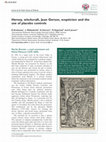
Importance: The use of placebo controls has become an integral element within modern medicine and... more Importance: The use of placebo controls has become an integral element within modern medicine and research, but knowledge about their historical roots remains very limited (Kaptchuk 1998; Kaptchuk 2011). Observations: We present here a very early precursor of the placebo-controlled trial found in previously untranslated texts from medieval France. In contrast to common belief, early conceptualization of controlled trials began in the medieval era and aimed to distinguish true from false religious revelations. We provide evidence that these ‘pre-scientific’ texts were widely disseminated in early modern Europe as elements of printed books. In particular, the 16th-century prints of the Malleus Maleficarum, or Hammer of Witches, became an infamous bestselling manual for priests involved in trials of women deemed to be witches. Conclusions and relevance: The origin of the placebo-controlled trial harks back to one of the bleakest aspects of medieval and early modern Europe – witch hunts and the Inquisition. From this inauspicious start, use of placebos made from starch, sugar and microcrystalline cellulose spread to millions of participants in placebo-controlled clinical trials seeking to discern the effects of medical treatments.
Speculum, Apr 1, 2023
of these she casts quite persuasively, from the perspective of the culture that produced them, as... more of these she casts quite persuasively, from the perspective of the culture that produced them, as forms of deadly violence. This collection is an enjoyable read; it is well written, accessible, and refreshingly concise. My only major critique concerns a definitional or conceptual problem that may reflect the volume's uneven chronological coverage, namely, the simplistic distinction that the contributors, following Garnier's lead, draw between potestas and violentia. Throughout the Middle Ages, acts of violentia were indeed illegitimate by definition; the word encompassed violation, whether of persons, space, or rights. However, not all individual uses of force constituted violentia. Especially during those centuries of the early and high Middle Ages that the volume does not cover, very many individual acts of destructive force, including acts of what we would call interpersonal violence, were considered legitimate and even necessary, and were not called violentia. The volume's definition does fit better with the world of the later Middle Ages, when individual acts of force were increasingly delegitimized (as they were briefly under Charlemagne and his immediate successors). Nevertheless, the old attitudes persisted-which Lück, for example, implies when noting that late medieval feud could be carried out with rechter Gewalt (41). This caveat notwithstanding, the volume is well worth the read. It offers an excellent gateway especially to the German-language literature on violence and coercive power, and it packs a great deal of theoretical, historiographical, and analytical punch into a short space.
Boydell & Brewer eBooks, Jun 19, 2020
The Codex Buranus arguably stands out from the common medieval practice of gathering together col... more The Codex Buranus arguably stands out from the common medieval practice of gathering together collections of religious texts because of its non-religious content. The classical divisions proposed by modern editors suggest that, beyond the concluding section of religious plays, the collection does not include a distinct group of religious texts. 1 The seemingly counter-intuitive decision to dedicate a chapter to religious poetry in the current volume, however, underlines the complex relationship between the manuscript's undoubtedly religious production context and the songs' function or use, which extends beyond the merely religious. Although modern editors have refrained from subdividing the so-called moral-satirical songs -the section from CB 1 to CB55 -by allowing for a subsection on religious poetry, more than half of these songs focus on religion. There is no doubt that the religious sphere -as the word 'sphere' already suggests -is all-encompassing in the Codex Buranus; and yet, the religious content is scarcely highlighted in scholarship. The present chapter tackles this desideratum by investigating the understanding of religion portrayed by the texts of the Codex Buranus. Respecting the distribution of religious material across the entire manuscript, including the devotional materials added later, I propose a multidirectional method of reading these texts in order to understand their complex web of interrelationships. The texts of the Codex Buranus have been much studied as disparate, compartmentalised entities, each song standing on its own, yet forming part of one of several consecutive clusters. 2 Although the order of texts implies a certain evolution when read in a linear fashion, collections of shorter texts were seldom 1 See Traill, i, x; and Vollmann, 7. 2 For a discussion of the collection's structure, see Carmen Cardelle de Hartmann, Parodie in den Carmina Burana, Mediävistische Perspektiven, 4 (Zurich: Chronos, 2014). 2397 (Boydell -Codex Buranos).indd 205 19/02/2020 12:12 pm 3 This interrupted, non-linear reading practice is more obvious in other kinds of collections, such as legendaries or prayerbooks. On these kind of reading patterns in the context of prayerbooks, see R.

Spiritual vision in physical space and the power of performative language in the Life of Christina of Hane
Le Moyen Age, 2017
Medieval mystical texts are concerned with authenticating the stories they contain. Especially wh... more Medieval mystical texts are concerned with authenticating the stories they contain. Especially when they are written in a hagiographical tone, validating the ineffable through language becomes essential for the proof of sanctity. The retelling of mystical moments evolving in a visionary space reserved to the mystic, poses particular challenges for the mystical account which is read in a collective environment. The mystical Life of Christina of Hane serves as a case study for illustrating the relationship between the personal realm of the visionary and the communal physical space. Mapping between inner and outer perceptions as experienced by the Premonstratensian nun, the mystical text establishes analogies which translate non-figurative concepts – such as the mystical rapture – into corporeal manifestations. Despite claims to its apophatic nature, language plays a key role in the communication of the mystical moment: figures featuring in Christina’s visions perform speech acts, which bridge the gap between the visionary and the corporeal.
A. Minnis, R. Voaden, Medieval Holy Women in the Christian Tradition c. 1100–c. 1500 (Racha Kirakosian)
Mittelalter - Moyen Âge (500-1500), 2012
Alastair Minnis, Rosalynn Voaden (ed.), Medieval Holy Women in the Christian Tradition c. 1100–c.... more Alastair Minnis, Rosalynn Voaden (ed.), Medieval Holy Women in the Christian Tradition c. 1100–c. 1500, Turnhout (Brepols) 2011, XI-748 p. (Brepols Essays in European Culture, 1), ISBN 978-2-503-53180-9, EUR 125,00.
Die Vita der Christina von Hane
Zeitschrift für württembergische Landesgeschichte, Sep 13, 2022
The Oxford Handbook of Women and Gender in Medieval EuropeJUDITH M. BENNETT & RUTH MAZO KARRAS
Womens History Review, Apr 14, 2014

The James Lind Library. Illustrating the development of fair tests of treatments in health care, 2023
Importance: The use of placebo controls has become an integral element within modern medicine and... more Importance: The use of placebo controls has become an integral element within modern medicine and research, but knowledge about their historical roots remains very limited (Kaptchuk 1998; Kaptchuk 2011).
Observations: We present here a very early precursor of the placebo-controlled trial found in previously untranslated texts from medieval France. In contrast to common belief, early conceptualization of controlled trials began in the medieval era and aimed to distinguish true from false religious revelations. We provide evidence that these ‘pre-scientific’ texts were widely disseminated in early modern Europe as elements of printed books. In particular, the 16th-century prints of the Malleus Maleficarum, or Hammer of Witches, became an infamous bestselling manual for priests involved in trials of women deemed to be witches.
Conclusions and relevance: The origin of the placebo-controlled trial harks back to one of the bleakest aspects of medieval and early modern Europe – witch hunts and the Inquisition. From this inauspicious start, use of placebos made from starch, sugar and microcrystalline cellulose spread to millions of participants in placebo-controlled clinical trials seeking to discern the effects of medical treatments.

Starke Frauen? Adelige Damen im Südwesten des spätmittelalterlichen Reiches, edited by Klaus Oschema, Peter Rückert and Anja Thaller, 2022
Das Leben der Grafentochter Katharina von Württemberg führte vom Hof ihres Vaters Ulrich V. in St... more Das Leben der Grafentochter Katharina von Württemberg führte vom Hof ihres Vaters Ulrich V. in Stuttgart zum oberschwäbischen Prämonstratenserkloster Adelberg bis hin zum reformierten Frauenkonvent Lauffen am Neckar, aus dem Katharina aber entfloh, um anfänglich in Gerlachsheim und dann höchstwahrscheinlich in Würzburg Obdach zu finden. Der vorliegende Aufsatz begibt sich auf die Spuren der flüchtigen Kanonisse und fragt nach den Hintergründen und möglichen Motiven ihres Fortgangs aus Lauffen.
Ordenstechnische Fragen zur Doppelklos-terorganisation im Prämonstratenserorden und zu der vom Dominikanerorden angetrie-benen observanten Reform spielen dabei genauso eine Rolle wie finanzielle Querelen. Diese entluden sich in einem Erbstreit zwischen Katharina und ihrem Vetter Graf Eberhard V., in den sich auch das Mutterkloster Adelberg und der Konvent von Lauffen einmischten. Katharina lenkte letztlich ein, was das Erbversprechen ihres verstorbenen Vaters anging, und akzeptierte eine verhältnis-mäßig kleine Abfindung; aber nach Lauffen, wo eine strenge Klausurierung das Leben der Frauen regelte, kehrte sie trotz päpstlichem Nachsuchen nicht zurück.
Katharinas Versuch, sich ein neues Leben im nicht reformierten Prämonstratenserstift Gerlachsheim aufzubauen, scheiterte, sodass sie sich dort nicht lange aufhielt und sogar ein angefangenes, eigens finanziertes Bauprojekt abbrach. Die Bauruine zog rechtliche Konse-quenzen nach sich, mit denen sie sich im Streit mit der Gerlachsheimer Meisterin konfrontiert sah. Schließlich können wir Katharina zu ihrem Lebensabend hin in Würzburg festma-chen, wo sie ein Haus besessen hat.
So sehr das umtriebige Leben der Katharina von Württemberg als außerordentlich selbst-bestimmt faszinieren mag, bleibt zu hinterfragen, ob sie und ihre Zeitgenossinnen und Zeitgenossen dies ebenfalls so empfunden haben. Jedenfalls hatte Gräfin und Kanonisse Katharina von Württemberg kein einfaches Leben, und für das Stück Freiheit, das sie sich erkämpfen konnte, musste sie viele Zugeständ-nisse machen.

Philologische Studien und Quellen
Zur Schriftkultur des Mittelalters und der Frühen Neuzeit gehören nicht nur Handschriften und Dru... more Zur Schriftkultur des Mittelalters und der Frühen Neuzeit gehören nicht nur Handschriften und Drucke, sondern auch Inschriften, die auf unterschiedlichen Materialien und Gegenständen, auf Plätzen und Gebäuden angebracht wurden. Auf den ersten Blick scheint ihr Zweck offenkundig: Sie zeigen Besitz an oder erinnern an vergangene Personen und Ereignisse. Rekonstruiert man aber die Kontexte und Praktiken sowie die Bedeutung von Beschreibstoffen, Layout und Formaten, eröffnen Inschriften eine Vieldeutigkeit, die keine einfachen Antworten mehr zulässt. Gesteigert wird dies noch, wenn man real erhaltene mit solchen Inschriften konfrontiert, die in Chroniken, Romanen, Legenden oder mystischen Visionen dieser Zeit beschrieben werden. Die Autorinnen und Autoren des vorliegenden Buches fragen danach, welche Bedeutungen den Inschriften in Mittelalter und Früher Neuzeit beigemessen wurden – etwa im städtischen Raum, an Gräbern, in intermedialen Konstellationen – und welche Funktionen sie darüber...
De Gruyter eBooks, Nov 21, 2022

Bohemia 61, 2021
Looking at mythical dimensions in medieval narratives, the aim of this paper is to show – by disc... more Looking at mythical dimensions in medieval narratives, the aim of this paper is to show – by discussing monstrosity in conjunction with femininity and orientalism respectively – that medievalism, which is not automatically a purely creative preoccupation with the past, needs our critical attention. This is therefore a call for critical medievalism.
The show Game of Thrones operates on medievalist fantasy elements which are grafted onto a long tradition of appropriating the past and using it as an imaginary canvas. Medieval tales themselves functioned on a mythical plane where the line between claims to historical accuracy and creative leeway is blurred. Using the concept of “mythical thinking” as expounded in Ernst Cassirer’s work, we can see how the medieval narratives Mélusine and Duke Ernst deploy mythical elements. Investigation into aspects of femininity in conjunction with bestiality on the one hand and orientalism on the other with the help of Cassirer’s “mythical thinking” elucidates the ways in which cultural and historical appropriation work. Reminding the reader of Umberto Eco’s as well as J. R. R. Tolkien’s view on medievalism, the author – in light of politicised forms of the preoccupation with the medieval past – calls for critical medievalism.



Uploads
Books by Racha Kirakosian
Kontrollverlust, geistige Entrückung, größte Freude, Selbsttranszendenz – all das stellt nur eine kleine Auswahl der Zustände dar, die Menschen als bewusstseinserweiternd und oft als glückserzeugend erleben. Ein Begriff kommt dabei häufig zum Einsatz: Ekstase. Nicht zufällig ist nach ihm eine Partydroge aus der Technoszene benannt. Ekstase tritt zu allen Zeiten und in allen Kulturen auf: in Musik und Kunst, Halluzination und Vision, Tanz und Trance, Gemeinschaftsgefühl und Orgasmus. Dabei hat sie in der modernen Wissenschaft ein schlechtes Standing: Spätestens seit der Aufklärung gelten solch irrationale Momente als primitiv, ja gar als Merkmal angeblich rückständiger Zivilisationen. Ganz anders als in der Antike, wo Träume, Prophezeiungen, Visionen und Orakel als selbstverständlich galten.
Racha Kirakosian nähert sich der Ekstase aus verschiedenen Richtungen: der des Individuums, etwa anhand der Schmerzerfahrung, aber auch der des Kollektivs, etwa beim Thema Massenwahn. Gekonnt vereint sie Religionsgeschichte, Kulturgeschichte und Medizin, um eine spannende, facettenreiche Seite unseres Daseins zu beleuchten, zu der auch dunkle Aspekte wie Misogynie, Hexenjagd und politische Manipulation gehören.
Papers by Racha Kirakosian
Observations: We present here a very early precursor of the placebo-controlled trial found in previously untranslated texts from medieval France. In contrast to common belief, early conceptualization of controlled trials began in the medieval era and aimed to distinguish true from false religious revelations. We provide evidence that these ‘pre-scientific’ texts were widely disseminated in early modern Europe as elements of printed books. In particular, the 16th-century prints of the Malleus Maleficarum, or Hammer of Witches, became an infamous bestselling manual for priests involved in trials of women deemed to be witches.
Conclusions and relevance: The origin of the placebo-controlled trial harks back to one of the bleakest aspects of medieval and early modern Europe – witch hunts and the Inquisition. From this inauspicious start, use of placebos made from starch, sugar and microcrystalline cellulose spread to millions of participants in placebo-controlled clinical trials seeking to discern the effects of medical treatments.
Ordenstechnische Fragen zur Doppelklos-terorganisation im Prämonstratenserorden und zu der vom Dominikanerorden angetrie-benen observanten Reform spielen dabei genauso eine Rolle wie finanzielle Querelen. Diese entluden sich in einem Erbstreit zwischen Katharina und ihrem Vetter Graf Eberhard V., in den sich auch das Mutterkloster Adelberg und der Konvent von Lauffen einmischten. Katharina lenkte letztlich ein, was das Erbversprechen ihres verstorbenen Vaters anging, und akzeptierte eine verhältnis-mäßig kleine Abfindung; aber nach Lauffen, wo eine strenge Klausurierung das Leben der Frauen regelte, kehrte sie trotz päpstlichem Nachsuchen nicht zurück.
Katharinas Versuch, sich ein neues Leben im nicht reformierten Prämonstratenserstift Gerlachsheim aufzubauen, scheiterte, sodass sie sich dort nicht lange aufhielt und sogar ein angefangenes, eigens finanziertes Bauprojekt abbrach. Die Bauruine zog rechtliche Konse-quenzen nach sich, mit denen sie sich im Streit mit der Gerlachsheimer Meisterin konfrontiert sah. Schließlich können wir Katharina zu ihrem Lebensabend hin in Würzburg festma-chen, wo sie ein Haus besessen hat.
So sehr das umtriebige Leben der Katharina von Württemberg als außerordentlich selbst-bestimmt faszinieren mag, bleibt zu hinterfragen, ob sie und ihre Zeitgenossinnen und Zeitgenossen dies ebenfalls so empfunden haben. Jedenfalls hatte Gräfin und Kanonisse Katharina von Württemberg kein einfaches Leben, und für das Stück Freiheit, das sie sich erkämpfen konnte, musste sie viele Zugeständ-nisse machen.
The show Game of Thrones operates on medievalist fantasy elements which are grafted onto a long tradition of appropriating the past and using it as an imaginary canvas. Medieval tales themselves functioned on a mythical plane where the line between claims to historical accuracy and creative leeway is blurred. Using the concept of “mythical thinking” as expounded in Ernst Cassirer’s work, we can see how the medieval narratives Mélusine and Duke Ernst deploy mythical elements. Investigation into aspects of femininity in conjunction with bestiality on the one hand and orientalism on the other with the help of Cassirer’s “mythical thinking” elucidates the ways in which cultural and historical appropriation work. Reminding the reader of Umberto Eco’s as well as J. R. R. Tolkien’s view on medievalism, the author – in light of politicised forms of the preoccupation with the medieval past – calls for critical medievalism.