Papers by Robert S Nelson
The Italian Appreciation and Appropriation of Illuminated Byzantine Manuscripts, ca. 1200-1450
Dumbarton Oaks papers, 1995
... Equipped with well-known portraits of Constantine IX Monomachos, the empress Zoe, and her sis... more ... Equipped with well-known portraits of Constantine IX Monomachos, the empress Zoe, and her sister Theodora, the manuscript was ... E. Laiou-Thomadakis, "The Byzantine Economy in the Mediterranean Trade System: Thirteenth-Fifteenth Centuries," DOP 34-35 (1980-81), 177 ...
Artificial Light in Medieval Churches , 2026
Later Byzantine art, it is argued, was made for the low light of churches and to enhance the effe... more Later Byzantine art, it is argued, was made for the low light of churches and to enhance the effects of candles and lamps put before them. Painters gradually preferred reds and yellows and especially reflective gold grounds and sometimes the color white. Human responses to low light account for these preferences. After considering different viewing conditions, the essay concludes with the color palette of El Greco in Crete and Spain. After his emigration, the painter executed large altarpieces for spaces brightly lit by broad windows and favored blue, which he had avoided earlier because it turns to black in low light.

Art and the Roman Viewer: The Transformation of Art from the Pagan World to Christianity. By Jaś Elsner. Cambridge, U.K.: Cambridge University Press, 1995. xxvi + 375 pp. + 85 plates and figures
Church History, 1997
Apollinaris. A third section of chapter 4 on Gaul concludes with another influential collection o... more Apollinaris. A third section of chapter 4 on Gaul concludes with another influential collection of Christian authors: Hilary and Honoratus of Aries, Ruricus of Limoges, Constantius of Lyon, Caesarius of Aries, Avitus of Vienne (who expounds significantly on the catholicus senator), Gregory of Tours, and Venantius Fortunatus. In the concluding chapters, Naf pursues the thesis during the same era, the late fifth and early sixth centuries, in Italy, through the writings of Ennodius, Cassiodorus, Boethius, and Gregory the Great; in a summary way with authors from Africa, Spain, and Noricum; and finally with more detail in the eastern Roman Empire beginning with Synesius of Cyrene and concluding with Procopius. This analysis notes the significant differences in senatorial attitudes between the West and the East, hardly surprising given the distinctive legal, political, and military situations. This informative monograph is completed by a historiographical essay, an extensive list of the printed editions of sources cited, a bibliography, and a serviceable index. The list of secondary studies includes only those works the author considered significant to the theme; as a consequence there are many publications in the footnotes and the "Literaturbericht" which are not included in the bibliography but nevertheless are not tangential. Naf has accumulated a body of evidence to demonstrate the degree to which Christianitas impacted an ancient bulwark of Romanitas (see also William M. Daly, " Christianitas Eclipses Romanitas in the Life of Sidonius Apollinaris," in Religion, Culture, and Society in the Early Middle Ages: Studies in Honor of Richard E. Sullivan, ed. Thomas F. X. Noble and John J. Contreni [Kalamazoo, Mich.: Medieval Institute Publications, 1987], pp. 7-26).
Folia Byzantina Schrift- und Buchkultur in Byzanz und in der Frühen Neuzeit. Festschrift zu Ehren von Erich Lamberz, 2025
Greek lectionaries in Cesena and Istanbul are shown to be virtually identical in text, script, an... more Greek lectionaries in Cesena and Istanbul are shown to be virtually identical in text, script, and decoration. Both were made in Constantinople in the later eleventh century and exemplify the phenomenon of twin lectionaries or the serial production of manuscripts by a workshop. Finally, both entered their respective libraries either shortly before or just after the Ottoman conquest of Constantinople and have remained in their different libraries to the present.
Art History, Mar 1, 1999
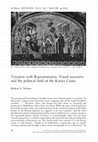
The setting and the prologue is familiar from every Christmas play or oratorio: `In those days a ... more The setting and the prologue is familiar from every Christmas play or oratorio: `In those days a decree went out from Caesar Augustus that all the world should be enrolled . . ..' Therefore, Mary and Joseph left their home in Nazareth and journeyed to Bethlehem, where Jesus was born. While the story of that birth has been told countless times, any representation of the actual inscription of the Holy Family in the Roman imperial tax registers is far less common. And the most detailed and original representation of the event in medieval art, a mosaic mural at the fourteenth-century church of Chora in Constantinople (plate 23), has been virtually ignored by a scholarly and popular discourse that has long privileged the conventionality of Byzantine art. The church itself, also referred to as the Kariye Camii, is well known ± thanks to its publication a generation ago in awardwinning volumes and through a more recent monograph on its architecture. 1 Its
The Old Testament in Byzantium
Dumbarton Oaks Research Library and Collection eBooks, 2010
... vii Page 14. This is the second volume in the series Dumbarton Oaks Byzantine Symposia and Co... more ... vii Page 14. This is the second volume in the series Dumbarton Oaks Byzantine Symposia and Colloquia. The first, published in 2009, was Becoming Byzantine: Children and Childhood in Byzantium, edited by Alice-Mary Talbot and Arietta Papa-constantinou. ...
Later Byzantine Painting: Art, Agency, and Appreciation
This Variorum Collected Studies volume brings together fifteen of Robert Nelson's articl... more This Variorum Collected Studies volume brings together fifteen of Robert Nelson's articles published over the past twenty-five years. It is a very useful volume, including some of his most important and thought-provoking essays of recent years. It is divided into three parts ...
Éditions de la Sorbonne eBooks, 2005
The relationship of the art of Byzantium with Western Europe has been a topic of scholarly inquir... more The relationship of the art of Byzantium with Western Europe has been a topic of scholarly inquiry since the mid-nineteenth century. The early scholarship, written by Western Europeans looking East, has several features in common. Byzantine art is understood to be early in date, different or foreign, and thus primitive. Because Byzantine art is assumed to be unchanging, it could provide important evidence, it was thought, about the origins of Christian art. As the Romantic antiquarian Adolphe..
The Chora and the Great Church: Intervisuality in Fourteenth-Century Constantinople
Byzantine and Modern Greek Studies, 1999
... essay, 'Tales of Two Cities: The Patronage of Early Palaeologan Art and Architecture... more ... essay, 'Tales of Two Cities: The Patronage of Early Palaeologan Art and Architecture in Constantinople and Thessaloniki', Manuel Panselinos ... less than what it had been during the reign of the previous emperor, much less those of the Middle or Early Byzantine periods, and ...
From Crete to Singapore via Rome and St. Louis
Res, Mar 1, 2022
Robert S. Nelson. Review of "Relics, Prayer, and Politics in Medieval Venetia: Romanesque Painting in the Crypt of Aquileia Cathedral" by Thomas E. A. Dale
CAA.reviews, Oct 1, 1998
The calendar of saints in Hodegon lectionaries
Studies in the Age of Chaucer, 1988

Wiener Jahrbuch für Kunstgeschichte, Dec 1, 1988
In their recent monograph on a group of late thirteenth-century illuminated manuscripts, H. Bucht... more In their recent monograph on a group of late thirteenth-century illuminated manuscripts, H. Buchthal and H. Belting juxtaposed a headpiece (fig. 1) from the Vatican Praxapostolos (gr. 1208), the masterpiece of their workshop, with an astonishingly similar design in a twelfth-century Gospel book in Melbourne (fig. 2). For the authors, the perceptive comparison served to demonstrate the debt that Palaeologan illuminated ornament owes to Comnenian models and to distinguish among different versions of the pattern by the atelier. As they explained, not all manuscripts reproduce the model faithfully. Closer to the Comnenian design is a headpiece (fig. 3) in Vat. gr. 1158, the deluxe Gospel book made for a female member of the imperial family, and hence the name sometimes given to the group, the Atelier of the Paleaologina 1 . Here the blue vines, set on the white parchment ground, are thick and substantial like those in the Melbourne volume. Leaves and stems form a dense web, whose horror vacui better imitates the earlier aesthetic than do the thin, delicate stems and ample spacing of the Praxapostolos headpiece (fig. 1). One stage further removed from the Comnenian source is the initial headpiece (fig. 4) in a Psalter in Paris, Bibl. Nat. gr. 21, where new palmettes, framed in a circle and set on a stark white ground, have been added to the four corners of the panel 2 . Here too, the thicket of large, *) The impetus for this paper came from a conversation with Hugo Buchthal over sixteen years ago. While he was working on a paper eventually to be published as ,Toward a History of Palaeologan Illumination' (in: The Place of Book Illumination in Byzantine Art, Princeton 1975, pp. 143-177), we talked about possible Islamic sources for Palaeologan ornament, and ever since, the problem has intrigued me, as it did him. So far as I know, he has been the only person to have commented on the matter, first in that article (p. 161). More recently he again evoked Islamic sources for the ornament in a manuscript of the earlier Decorative Style (Studies in Byzantine Illumination of the Thirteenth Century, in: Jb. der Berliner Museen, 25, 1983, p. 46). While I long thought his intuitions to be sound, this study helped me to understand how and why. Finally several years after the completion of my text, the long awaited book of A. Weyl Carr on the Decorative Style has appeared (Byzantine Illumination 1150-1250, the Study of a Provincial Tradition, Chicago 1987). I have incorporated references to it in my footnotes but have not adjusted the body of my text, since she is not directly concerned with the matter of Islamic influence. ') H. BUCHTHAL and H. BELTING, Patronage in Thirteenth-Century Constantinople, An Atelier of Late Byzantine Book Illumination and Calligraphy, Washington 1978, pp. 76, 89-90, 99. The headpiece for Mark in the Melbourne Gospels is not a standard design and occurs in no other twelfth-century manuscript known to me. Its rarity increases the likelihood that the artists of the Atelier may have known this very manuscript, although the three other headpieces in the Gospel book appear to have had no impact in the late thirteenth century. The remaining headpieces are published in H.
Heavenly Allies at the Chora
Gesta, 2004
Details of the garments of the saints in the vaults of the outer narthex of the fourteenth-centur... more Details of the garments of the saints in the vaults of the outer narthex of the fourteenth-century church of the Chora in Constantinople resemble contemporary aristocratic fashion and associate the heavenly and earthly courts. SS. George and Demetrios flanking the entrance to the nave, though among the most popular in Byzantium, were also important to the reigning Palaiologan dynasty and to the current emperor, Andronikos II, and his prime minister, Theodore Metochites, the patron of the church. St. Andronikos, third in the saintly hierarchy, never enjoyed such prominence in any other church and may be interpreted as a reference to the emperor himself. Located next to a scene of the Holy Family's Enrollment for Taxation, St. Andronikos lends heavenly approval to the necessary, but controversial, fiscal policies of the patron and is an integral part of a decorative program that is simultaneously religious and political.
The Journal of Aesthetics and Art Criticism, 2000
Visuality before and beyond the Renaissance : seeing as others saw / edited by Robert S. Nelson. ... more Visuality before and beyond the Renaissance : seeing as others saw / edited by Robert S. Nelson. p. cm.-(Cambridge studies in new art history and criticism) ISBN --- (hardback) . Visual perception. . Visual communication. . Art, Comparative. . Art and religion. I. Nelson, Robert S., -II. Series.

Art Bulletin, Mar 1, 1997
This is an essay about knowledges of space and time that aspire to be global but remain local, an... more This is an essay about knowledges of space and time that aspire to be global but remain local, and about their inscription in the discipline of art history. It proceeds from the microcosm to the macrocosm, from particular points on the spatial surface of art history to its broad, totalizing plane, and thence to an awareness of the jagged, gerrymandered divisions of art history itself. It wends its way from moments in the present and the lived past to distant pasts dimly remembered in a discipline that typically studies the histories of everything but itself, conveniently forgetting that it, too, has a history and is History. The intent is to examine noticns that exist, as Foucault suggests, at the level of a disciplinary unconsciousness and to argue that Order, History, Space, and Time do matter. Through them, art history is constituted and, in turn, constitutes objects, narratives, and peoples. Yet what is made can be unmade or re-sited, re-structured, and re(-)formed, and what has become tangible and reified can revert to mere heuristic category, if first consciously addressed. The argument takes for granted that contemporary art history, like any other academic subject or learned profession, is a practice, a discipline, a narrative, and a rhetoric with its own history, protocols, and institutional structures. In the admittedly small but growing body of literature about the
Technologies of Art History: Slides, PowerPoint, and Virtual Reality
De Gruyter eBooks, Dec 31, 2022
My essay explores the ways that art historians use images and words to inform their publics, base... more My essay explores the ways that art historians use images and words to inform their publics, based mainly on evidence from the United States. The performative aspects of lectures with photographic slides are studied from versions available on the internet. With the profession's change to digital images and Powerpoint, the larger aspects of oral presentations remained the same, but the possibility of multiple images and texts on Powerpoint slide greatly increased the amount of information imparted, but image quality declined. No longer tied to physical slides, the art historian could prepare anywhere and with Zoom lecture from anywhere, but the result was a decline in the shared community of the slide collection and physical interaction with audiences. Moreover, digital lectures imitated cinema in ways different from early slide lectures. As a teaching took, virtual reality can function without a lecturer, or if used in class, the teacher can not longer control what the class sees in when. It also changes the relation of audiences to images, for now spectators inhabit the image with results that once more recall cinema.
THE ICON. Kurt Weitzmann
ARLIS/NA newsletter, Feb 1, 1979
5. Dressing and Undressing Greek Lectionaries in Byzantium and Italy
De Gruyter eBooks, Dec 3, 2018



Uploads
Papers by Robert S Nelson