Videos by Robert T Lackey
Introductory lecture presented by Dr. Robert T. Lackey, Professor, Department of Fisheries, Wildl... more Introductory lecture presented by Dr. Robert T. Lackey, Professor, Department of Fisheries, Wildlife, and Conservation Sciences, Oregon State University, Corvallis, Oregon. A brief introduction to ecological policy and analysis. 18 views
Dr. Robert T. Lackey, Professor, Department of Fisheries and Wildlife, Oregon State University, C... more Dr. Robert T. Lackey, Professor, Department of Fisheries and Wildlife, Oregon State University, Corvallis, Oregon presents the California water storage challenge as a policy case study. 22 views
In 1857 Charles Darwin offered a blunt admonition to scientists: “A scientific man ought to have... more In 1857 Charles Darwin offered a blunt admonition to scientists: “A scientific man ought to have no wishes, no affections, — a mere heart of stone.” His advice was strict, uncompromising, and unequivocal, but spot-on for scientists, then and now, regardless of the type of employer. These days, regrettably, many scientists seamlessly substitute “normative” science (i.e., information that superficially appears to be legitimate science, but contains an embedded policy preference) for “policy neutral” science (i.e., politically and policy unbiased information derived following the scientific method) when communicating with policy makers, natural resource managers, and the public. Not only is such behavior a misuse of science, it is insidious because the consumer of normative science is often unaware of the hidden policy preference contained in the information being offered (i.e., “stealth policy advocacy”). 27 views
Plenary lecture presented by Dr. Robert T. Lackey, Professor, Department of Fisheries and Wildlif... more Plenary lecture presented by Dr. Robert T. Lackey, Professor, Department of Fisheries and Wildlife, Oregon State University, Corvallis, Oregon at the 15th Annual Banff Conference, Alberta Institute of Agrologists, March 28, 2019, Banff, Alberta. These days, scientists in environmental science, natural resources, ecology, conservation biology, and similar disciplines are often not trusted by the public and decision-makers to present policy-neutral science. One reason is that scientists advocating personal or organizational positions on ecological and environmental policy issues has become widely tolerated as acceptable professional behavior and is even encouraged by a segment of the scientific community. As a result, the scientific enterprise is collectively slipping into a morass that risks marginalizing the contribution of science to public policy. 38 views
Plenary lecture presented by Dr. Robert T. Lackey, Professor, Department of Fisheries and Wildlif... more Plenary lecture presented by Dr. Robert T. Lackey, Professor, Department of Fisheries and Wildlife, Oregon State University, Corvallis, Oregon. Most people expect that scientific information provided by interest and advocacy groups is infused with policy preferences, and for many people, the same skepticism exists for media-provided science. 19 views
Plenary Lecture presented by Dr. Robert T. Lackey, Professor, Department of Fisheries and Wildlif... more Plenary Lecture presented by Dr. Robert T. Lackey, Professor, Department of Fisheries and Wildlife, Oregon State University, Corvallis, Oregon at the Annual Meeting of the American Fisheries Society, September 5, 2011, Seattle, Washington. The basic message is that we should anticipate in upcoming decades two big changes: (1) first, as the theme of this annual meeting implies, there will be change, dramatic social, political, and environmental change. No one should be surprised. Don’t be overwhelmed. AFS members will be confronted with new frontiers and they should be expected. Prepare for them; and (2) decision-makers, fisheries managers, and the general public will continue to need cold, hard, scientific facts, and uncertainties, provided by sources they trust. If you want to be an effective scientist, become that trusted source. When it comes to science, I say: Shun pessimism. Reject optimism. Embrace realism. 46 views
Lecture presented by Dr. Robert T. Lackey, Professor, Department of Fisheries and Wildlife, Orego... more Lecture presented by Dr. Robert T. Lackey, Professor, Department of Fisheries and Wildlife, Oregon State University, Corvallis, Oregon (July, 2021) briefly summarizes the role that scientists should play in policy debates. Public confidence that scientific information is technically accurate, policy relevant, and politically unbiased is central to informed resolution of natural resource policy and management issues that are often contentious, divisive, and litigious. Scientists should watch for the often subtle creep of normative science (i.e., information that appears to be policy neutral, but contains an embedded preference for a particular policy or class of policies). Failing to do so risks marginalizing the essential role that science and scientists ought to play in informing decisions on important public policy questions. 25 views
Lecture presented by Dr. Robert T. Lackey, Professor, Department of Fisheries and Wildlife, Orego... more Lecture presented by Dr. Robert T. Lackey, Professor, Department of Fisheries and Wildlife, Oregon State University, Corvallis, Oregon briefly summarizes (May, 2012) the likely future of the Columbia River Basin through 2100. Human population growth, accompanied by development, economic expansion, and continued competition for scarce natural resources in the U.S. Pacific Northwest, is expected to continue to threaten already dwindling salmon and steelhead populations in the Columbia Basin. There are policy and management options to maintain fishable salmon runs in the Columbia, but they are highly constrained by competing resource interests such as hydropower, flood control, water withdrawals for irrigation and municipal use, urban development, and many others. 53 views
Lecture presented by Dr. Robert T. Lackey, Professor, Department of Fisheries and Wildlife, Orego... more Lecture presented by Dr. Robert T. Lackey, Professor, Department of Fisheries and Wildlife, Oregon State University, Corvallis, Oregon for the American Water Resources Association, May 4, 2016, Middleburg, Virginia. These days, scientists in environmental science, natural resources, ecology, conservation biology, water resource management, and similar disciplines are often not trusted by the public and decision-makers to present policy-neutral science. One reason is that scientists advocating personal or organizational positions on ecological and environmental policy issues has become widely tolerated as acceptable professional behavior and is even encouraged by a segment of the scientific community. As a result, the scientific enterprise is collectively slipping into a morass that risks marginalizing the contribution of science to public policy. 39 views
Plenary lecture by Dr. Robert T. Lackey, Professor, Department of Fisheries and Wildlife, Oregon ... more Plenary lecture by Dr. Robert T. Lackey, Professor, Department of Fisheries and Wildlife, Oregon State University, Corvallis, Oregon at the Fifth Annual Mat-Su Salmon Science and Conservation Symposium, November 7, 2012, Wasilla, Alaska. For Alaska, there are lessons to be learned from what has happened ― and is happening ― to wild salmon runs elsewhere. The primary goal of the Salmon 2100 Project was to identify salmon recovery options that have a high probability of maintaining biologically significant, sustainable populations of wild salmon in California, Oregon, Washington, Idaho, and southern British Columbia. 79 views
Lecture presented by Dr. Robert T. Lackey, Professor, Department of Fisheries and Wildlife, Orego... more Lecture presented by Dr. Robert T. Lackey, Professor, Department of Fisheries and Wildlife, Oregon State University, Corvallis, Oregon, presented to the Water Resources Graduate Program on October 21, 2009. Dr. Lackey evaluates the property role of scientists employed as scientists by government agencies. It is very easy for taxpayer-funded scientists to misuse their positions to advance personal policy preferences. "Advocacy masquerading as science" is becoming increasingly common, but the reasons why this is so are the subject of vigorous debate. 17 views
Dr. Robert T. Lackey, Department of Fisheries, Wildlife, and Conservation Sciences at Oregon Sta... more Dr. Robert T. Lackey, Department of Fisheries, Wildlife, and Conservation Sciences at Oregon State University, presents a talk to the legislative policy staff, State of Oregon, Salem, Oregon, on November 21, 2022. The "Legislative Policy and Research Office" (LPRO) provides professional nonpartisan analysis and research that supports and informs the policy-making process for the Legislature. 39 views
Risk assessment has become a popular tool to help solve ecological problems. The basic concept i... more Risk assessment has become a popular tool to help solve ecological problems. The basic concept is not new and has been applied to various decision problems. The application to ecological issues, especially complex ecological problems, is relatively recent and controversial. The fundamental and essential elements of the controversy revolve around two key points: (1) a person's implicit "world view;" and (2) the assumption of who (or what) receives the benefits and who (or what) pays the costs for ecological "decisions." A person's attitude toward risk assessment is, at least implicitly, defined by a worldview. It is this worldview that explains how each of us reacts to risk assessment applied to ecological problems. How the benefits and costs are defined also defines the appropriate use of ecological risk assessment. 23 views
Many current ecological policy problems are contentious and socially wrenching. Each possesses u... more Many current ecological policy problems are contentious and socially wrenching. Each possesses unique features, but several generalities apply to nearly all. I propose nine axioms that are typical of most current ecological policy problems: (1) the policy and political dynamic is a zero-sum game; (2) the distribution of benefits and costs is more important than the ratio of total benefits to total costs; (3) the most politically viable policy choice spreads the benefits to a broad majority with the costs limited to a narrow minority of the population; (4) potential losers are usually more assertive and vocal than potential winners and are, therefore, disproportionately important in decision making; (5) many advocates will cloak their arguments as science to mask their personal policy preferences; (6) even with complete and accurate scientific information, most policy issues remain divisive; (7) etc. 28 views
Plenary lecture presented by Dr. Robert T. Lackey, Professor, Department of Fisheries and Wildlif... more Plenary lecture presented by Dr. Robert T. Lackey, Professor, Department of Fisheries and Wildlife, Oregon State University, Corvallis, Oregon at the 35th Annual North American Meeting of the Society of Environmental Toxicology and Chemistry, November 9-13, 2014, Vancouver, British Columbia. A policy bias toward “natural” is a common misuse of science in policy and politics, but there are many other examples. Such policy biases in science are often subtle, and frequently the individual scientist is unaware. Having widely available, accurate, understandable, relevant, and unbiased scientific information is central to resolving the typically contentious, divisive, and litigious environmental policy and regulatory issues. 37 views
Dr. Robert T. Lackey, Professor, Department of Fisheries and Wildlife, Oregon State University, C... more Dr. Robert T. Lackey, Professor, Department of Fisheries and Wildlife, Oregon State University, Corvallis, Oregon presents the history of efforts to reverse the long-term decline of Pacific salmon in California, Oregon, Washington, Idaho, and British Columbia. This case study provides instructive policy lessons about how humans often respond to unpleasant realities. 39 views
Effectively tackling complex ecological policy problems requires something beyond traditional “en... more Effectively tackling complex ecological policy problems requires something beyond traditional “end of the pipe” or “command and control” approaches. Utilizing the concepts captured in various definitions of ecosystem health is one possible alternative to command and control. Increasingly, ecosystem health is heralded as a concept that will help clarify, evaluate, and implement 21st century ecological policy. As the concept has matured beyond vague explanation, it has become increasingly contentious because it is normative — it embodies a set of inherent values. At the core of debates over the utility of ecosystem health is a struggle over which societal preferences will take precedence. The foundation of the concept is the metaphor of human health, but this simple metaphor is both a strength and a weakness. 27 views
Lecture presented by Dr. Robert T. Lackey, Professor, Department of Fisheries and Wildlife, Orego... more Lecture presented by Dr. Robert T. Lackey, Professor, Department of Fisheries and Wildlife, Oregon State University, Corvallis, Oregon briefly summarizes the Cape Wind Project in a policy context (December 13, 2020). Many current ecological policy problems are contentious and socially wrenching. Each possesses unique features, but there are several generalities that apply to nearly all policy issues. The Cape Wind Project is an excellent case study for illustrating the general principles of policy analysis. All policy advocates in this case study use science and scientists to help pitch their policy preferences. 39 views
Lecture presented by Dr. Robert T. Lackey, Professor, Department of Fisheries and Wildlife, Orego... more Lecture presented by Dr. Robert T. Lackey, Professor, Department of Fisheries and Wildlife, Oregon State University, Corvallis, Oregon (December, 2020). These days, scientists in environmental science, natural resources, ecology, conservation biology, and similar disciplines are often not trusted by the public and decision-makers to present policy-neutral science. One reason is that scientists advocating personal or organizational positions on ecological and environmental policy issues has become widely tolerated as acceptable professional behavior and is even encouraged by a segment of the scientific community. As a result, the scientific enterprise is collectively slipping into a morass that risks marginalizing science's contribution to public policy. Public confidence that scientific information is technically accurate, policy relevant, and politically unbiased is central to informed resolution of policy and regulatory issues that are often contentious, divisive, and litigious. 39 views
Keynote lecture presented by Dr. Robert T. Lackey, Professor, Department of Fisheries and Wildlif... more Keynote lecture presented by Dr. Robert T. Lackey, Professor, Department of Fisheries and Wildlife, Oregon State University, Corvallis, Oregon at the Conference, "The Salmon 2100 Project: The Future of Wild Salmon," January 25, 2006, Portland, Oregon. The primary goal of the Salmon 2100 Project is to identify practical options that have a high probability of maintaining biologically significant, sustainable populations of wild salmon in California, Oregon, Washington, Idaho, and southern British Columbia. The Project does not support or advocate any particular policy or class of policies, but provides decision makers with a diverse set of independent, practical policy prescriptions that would have a high probability of restoring wild salmon runs to significant levels over the long-term. 24 views
Papers by Robert T Lackey
Searching for Sustainability: Interdisciplinary Essays in the Philosophy of Conservation Biology. Cambridge Studies in Philosophy and Biology.By Bryan G Norton. Cambridge and New York: Cambridge University Press. $85.00 (hardcover); $30.00 (paper). ix + 554 p; ill.; index. ISBN: 0–521–80990–8 (hc...
The Quarterly Review of Biology, Dec 1, 2003
The Quarterly Review of Biology, Sep 1, 1996
BioScience, Oct 1, 1997
and several African countries. Part IV, "Management," provides examples of management techniques ... more and several African countries. Part IV, "Management," provides examples of management techniques thar are sustainable within limits, such as forest gardens in Peru and Indonesia, forest patches in Guatemala, and community foresrs in India. The final chapter, "Challenges in Promoting Patches in Rural Development Efforts" (chapter 19, by Larry Fisher and Roland Bunch), is the only chapter that atternpts to address rhe challenge of developing programs and insrirurions that support and promote forest patch conservation. The authors suggest several programs, including agricultural intensifieation, reduction of migratory agriculture, agroforestry, use of forest products, and off-season labor. Program managementstrategies include developing farmer-centered programs, building nongovernmental organizations (NGOs), and coordinating government agencies. Poliey issues include land tenure, trade and marketing, infrastrueture development, subsidies and eredit, population problems, and eommunitr edueation. This book reneets whatmanyconservation ccologists have already realized: Eaeh situation is unique in time and spacc, not only eeologically, but also culturally, economieally, and politieally. To eHeet conservation, scientists mllstdeal with each oE these problems "on the ground," byworking wirh loeal people at various levels to hclp redirect harmful political acrions before they have a chance to damage forest reserves. Are scienrists frorn developed countries in a position to devote the neeessarytime? Can scientists be effective jf they visit their field site for a few months each year but then have to rush horne to write papers and participatc in aeademic acrivities? Thc narrow aeademic foeus of many seientists sometimes causes them to be counterproduetive. In ehapter l2,Janis Alcorn states (p.
Ecology and Our Endangered Life-Support Systems
Transactions of The American Fisheries Society, Nov 1, 1989
ABSTRACT
Protection, conservation, and management of threatened and endangered species in Egypt

PERSPECTIVE: If Ecological Risk Assessment is the Answer, What is the Question?1
Ecological risk assessment has become a commonly used tool in policy analysis, but its use is con... more Ecological risk assessment has become a commonly used tool in policy analysis, but its use is controversial. Opinions are diverse; they range from enthusiastic support to caustic dismissal. Much of the controversy with using risk assessment in ecological policy analysis revolves around defining the initial policy question or problem to be assessed. In formulating the "question" in ecological risk assessment, the nature of the analytical technique forces analysts to make assumptions of values and priorities; these assumptions may not be the same as those of the public or their elected or appointed representatives. Specifically, much of the difficulty with applying risk assessment is that, by definition, risk is adverse. Deciding which ecological changes are adverse (undesired) and which are beneficial (desired) is likely to be the primary political debate. Ecological conditions and changes are classified by the values and priorities of the person or administrative body doing the classification; ecological condition or change in itself is neither good nor bad, beneficial nor adverse, healthy nor degraded. One method often used to determine which ecological conditions or changes are adverse is to apply the human "health" metaphor to ecosystems or ecological components. However, application of the concept of ecosystem health is fraught with value-based requirements
Effects of Artificial Destratification on Zooplankton in Parvin Lake, Colorado
Transactions of The American Fisheries Society, Apr 1, 1973
ABSTRACT
Environmental Practice, Sep 1, 1999
For over a century, salmon technocrats (fisheries scientists and kindred technical experts) have ... more For over a century, salmon technocrats (fisheries scientists and kindred technical experts) have played an important role in Pacific Northwest salmon policy, but their involvement has caused them and others discomfort. The discomfort is summarized by the following observations: (1) the public, apparently, supports maintaining wild salmon runs, (2) there are competing societal priorities, many of which are partially or wholly mutually exclusive, (3) increasing numbers of people in the Pacific Northwest create additional pressures on all ecological resources (including wild salmon), (4) policy positions in the salmon policy debate are entrenched, (5) society expects salmon technocrats to help solve the salmon problem, (6) each of the many sides of the policy debate attempts to utilize salmon technocrats to bolster its argument, (7) it has proved nearly impossible for salmon technocrats to avoid being categorized as supporting a particular policy position, and (8) many policy advocates frame their policy views in scientific terms rather than value-based preferences. Involvement with salmon policy can be the professional undoing of a salmon technocrat unless his proper role is understood. From a technocrat's perspective, and in order to survive professionally, I propose several rules: (1) be honest, (2) focus on science, (3) accept that politicians covet legitimacy, (4) recognize that framing the policy question largely defines the analytical outcome, (5) avoid the allure of junk science and policy babble, (6) concede that societal values and priorities evolve, and (7) avoid technical and scientific hubris.
Options to Protect, Restore, and Enhance Wild Salmon: Insights from the Salmon 2100 Project 1
EPA Blog - Office of Research and Development - April 1, 2008
As a research scientist engaged in ecological research for more than four decades, I am concerned... more As a research scientist engaged in ecological research for more than four decades, I am concerned that some of us are heading down a path that risks marginalizing our scientific information, if not much of our scientific enterprise. Worse, I think many are on the path unknowingly. Those of us who provide scientific information to decision-makers and the public should become more vigilant, precise, demanding, and rigorous in distinguishing between policy-neutral and policy-inculcated scientific information. This seems simple, but it is often difficult.
For millennia, the geographic range of Pacific salmon has been the North Pacific and surrounding ... more For millennia, the geographic range of Pacific salmon has been the North Pacific and surrounding river basins. As climate changed, and it did many times, the geographic distribution expanded, and shrunk, especially at the southern ends, that is, on the eastern side, modern-day California, Oregon, Washington, and Idaho-and, on the western side, China, Taiwan, Korea, and Japan.
The Osprey: The International Journal of Salmon and Steelhead Conservation, 2023
The overall public policy goal of restoring runs of wild Pacific salmon in California, Oregon, Wa... more The overall public policy goal of restoring runs of wild Pacific salmon in California, Oregon, Washington, Idaho, and southern British Columbia appears to enjoy widespread public support. Billions of dollars were spent in a failed attempt to reverse the long-term, general decline of wild salmon. Anyone, even those slightly familiar with the decline of wild salmon runs, knows the direct and immediate causes of the decline. These proximal causes are “old news” to folks even marginally familiar with the wild salmon story. Rather, this article focuses on decisions about competing policy priorities that resulted in those proximal causes. There are no heroes or villains in this story, but rather a series of difficult and unappealing choices that society made over many decades. No one was ever out to eliminate wild salmon runs intentionally. This story is not analogous to the decline of wolves, grizzlies, and cougars. Many people wanted them gone, and the sooner, the better! So the wild salmon decline is all about competing policy priorities. Wild salmon runs are one of many competing priorities in the political world. Policy making is all about picking “winners” and “losers,” and this example is no different.
The Journal of Wildlife Management, 1976
Principles of Fishery Science undoubtedly will be one of the standard introductory texts on fishe... more Principles of Fishery Science undoubtedly will be one of the standard introductory texts on fisheries science. The authors possess the diverse and extensive professional backgrounds and experiences necessary to write a comprehensive textbook on fisheries science. The stated purpose of this book is to present the principles of fisheries management to readers assumed to have a firm foundation in the biological, physical, mathematical, and social sciences. The purpose of this book is roughly the same as Fisheries Science published 22 years ago.
Water Resources IMPACT (American Water Resources Association), 2022
From California to southern British Columbia, wild runs of Pacific salmon have universally declin... more From California to southern British Columbia, wild runs of Pacific salmon have universally declined and many have disappeared. Billions have been spent in so-far failed attempts to reverse the decline. The annual expenditure of hundreds of millions of dollars continues, but a sustainable future for wild salmon in this region remains elusive. Despite documented public support for restoring wild salmon, the long-term prognosis for a sustainable future appears problematic. Fisheries biologists and others continue to craft restoration plans, but an easy, effective approach has yet to emerge that will actually restore and sustain most runs of wild salmon in the region. For wild salmon, restoration options exist that offer both ecological viability and appreciably lower social disruption, but these options also tend to have more modest restoration objectives.
Blog - Oregon State University, 2022
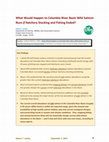
• I asked 58 well-known salmon scientists to predict (anonymously) how the overall abundance of C... more • I asked 58 well-known salmon scientists to predict (anonymously) how the overall abundance of Columbia River Basin salmon (including steelhead) would change after 20 years if fishing was stopped and hatcheries were closed.
• About 83% predicted that current (wild plus hatchery) salmon abundance (overall Columbia Basin run) would decline without hatchery stocking and fishing.
• About 12% predicted that the resulting overall wild salmon abundance would be greater than the current (wild plus hatchery) abundance.
• Most surveyed experts predicted that stopping fishing and closing hatcheries would not greatly change the current overall wild-only abundance in the Basin.
• Based on these results, salmon fishing and hatchery additions are not currently believed to be among the major drivers of the low abundance of wild salmon in the Columbia River Basin.
• The current overall abundance of wild salmon in the Columbia River Basin (roughly 2-4% of pre-1850s levels) is within the expected range, given the amount and availability of high-quality salmon habitat, past and current ecological changes, and overarching trends in oceanic and climate conditions. Thus, stopping fishing and closing hatcheries likely will not drastically change current wild salmon abundance in the Basin — and it may well drive wild runs even lower, according to many experts.
Mathematical Biosciences, 1975
A mathematical model is described for calculating the effects of several different types of inter... more A mathematical model is described for calculating the effects of several different types of interaction in an ecosystem. The model is based on queueing theory where the service discipline is governed by preemptive priorities. Graphical results of this approach are presented, as well-as an example of the model integrated into an ecosystem dynamics simulator as a subroutine.
Acknowledgment is made also to Victoria C. Esarey for editorial processing and typsetting and to ... more Acknowledgment is made also to Victoria C. Esarey for editorial processing and typsetting and to Pat N ickinson for paste-up.
Environmental Science & Policy, 1998
Science plays an important role in the resolution of environment and energy issues. Based on more... more Science plays an important role in the resolution of environment and energy issues. Based on more than 40 years of experience as agency representatives, analysts and science program managers during the 1980s and 1990s, the authors provide their perspectives on some aspects of the interplay between science and policy in the acid rain assessment process. The topics addressed include the setting of science-based policy questions, the establishment of`semipermeable barriers' between science and policy, oversight and governance, baseline scenarios, assessments, funding, and scienti®c products and peer review. Lessons to be learned from NAPAP have relevance to conducting other major environmental assessments.



Uploads
Videos by Robert T Lackey
Papers by Robert T Lackey
• About 83% predicted that current (wild plus hatchery) salmon abundance (overall Columbia Basin run) would decline without hatchery stocking and fishing.
• About 12% predicted that the resulting overall wild salmon abundance would be greater than the current (wild plus hatchery) abundance.
• Most surveyed experts predicted that stopping fishing and closing hatcheries would not greatly change the current overall wild-only abundance in the Basin.
• Based on these results, salmon fishing and hatchery additions are not currently believed to be among the major drivers of the low abundance of wild salmon in the Columbia River Basin.
• The current overall abundance of wild salmon in the Columbia River Basin (roughly 2-4% of pre-1850s levels) is within the expected range, given the amount and availability of high-quality salmon habitat, past and current ecological changes, and overarching trends in oceanic and climate conditions. Thus, stopping fishing and closing hatcheries likely will not drastically change current wild salmon abundance in the Basin — and it may well drive wild runs even lower, according to many experts.