Books by Stefan Schorch / שטפן שורש
Urtext and Variance: The Quest for the Texts of the Hebrew Bible, eds. Rey, F. M., Schorch, St., and Robert-Hayek, S. Leuven: Peeters, 2025. ISBN 9789042954687, 2025
Focusing at “Urtext”, “Variance” and further fundamental concepts of the textual history of the H... more Focusing at “Urtext”, “Variance” and further fundamental concepts of the textual history of the Hebrew Bible, the thirteen chapters collected in this volume provide analyses of their heuristic potential, methodological problems, and implications, proceeding from evidence emerging from a wide range of Biblical texts and textual witnesses.
Wissenschaft des Judentums in Hungarian Lands Institutions, Protagonists, Topics, Context, and Current Challenges, 2025
The volume covers multifarious aspects of Wissenschaft des Judentums in Hungarian speaking lands,... more The volume covers multifarious aspects of Wissenschaft des Judentums in Hungarian speaking lands, including the role of Jewish scholarship in modernizing Jewish life and the institutional background of Jewish Studies in Hungarian lands; the contribution of individual scholars to Wissenschaft des Judentums, particular themes in the work of Jewish Studies scholars with Hungarian background; and the legacy of Hungarian Wissenschaft des Judentums outside of Hungary. The volume is devoted to Tamás [Sinai] Turán, in recognition of his significant contributions to Jewish studies in Hungary.
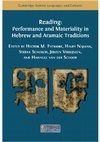
This volume contains the proceedings the 'Reading: Performance and Materiality in Hebrew and Aram... more This volume contains the proceedings the 'Reading: Performance and Materiality in Hebrew and Aramaic Traditions' colloquium, hosted at the University of Oxford in 2023, and jointly sponsored by the Oriel Centre for the Study of the Bible and the European Research Council project, 'TEXTEVOLVE.'
The aim of the colloquium was to investigate Jewish approaches to the reading of texts, with a focus on reading practices that were applied to Hebrew and Aramaic texts in antiquity and the early Middle Ages. It explored, in particular, how these were shaped by material and non-textual aspects (oral traditions, performative context, philological values, etc). Among the questions it addressed were: How did non-textual components determine reading? To what extent did materiality shape or limit readings? How did reading practices shape the texts themselves? What values guided how texts were modified and variant texts evaluated? What determined which form or version of a text was read and according to what conventions? The responses to these questions collected in this volume highlight the tensions between authority and creativity, preservation and innovation, understanding and misapprehension, knowledge and ignorance, which shaped Jewish practices of reading.
Samaritan Languages Texts and Traditions, 2025
The volume collects eighteen studies authored by specialists of various fields. The contributions... more The volume collects eighteen studies authored by specialists of various fields. The contributions gathered in this volume mostly originate in lectures delivered at the 8th Congress of the Société d’Etudes Samaritaines (Erfurt, 2012). In these studies, specialists of various fields deal with various aspects of Samaritan languages, especially Samaritan Hebrew and Samaritan Aramaic, with central Samaritan texts, mostly the Samaritan Hebrew Pentateuch, the Samaritan Aramaic Targum, as well as medieval Samaritan exegetical texts in Arabic, and also with traditions relating to the image of the Samaritans, as emerging from the New Testament and Rabbinic literature, to Samaritan theology and to Samaritan genealogy, and with magical traditions as found in Samaritan amulets, and with the contribution of Samaritan traditions to the literary history of the Pentateuch. The volume provides thus a multifarious reflection of the current status quaestionis in Samaritan studies.
The Samaritan Pentateuch / Genesis, ed. Schorch, Stefan Berlin: De Gruyter, 2021 ISBN 97831107095... more The Samaritan Pentateuch / Genesis, ed. Schorch, Stefan Berlin: De Gruyter, 2021 ISBN 9783110709506
(parts: Preface and Introduction, Edition of Gen 1).
The Samaritan Pentateuch/ Leviticus, ed. Schorch, Stefan
Berlin: De Gruyter, 2018
ISBN 978-3-11-0... more The Samaritan Pentateuch/ Leviticus, ed. Schorch, Stefan
Berlin: De Gruyter, 2018
ISBN 978-3-11-040287-2
Preface and Introduction (German, English, Hebrew), Edition of Lev 1 and Lev 27.
Die mündlich tradierte samaritanische Lesetradition ist neben dem masoretischen Text das wichtigs... more Die mündlich tradierte samaritanische Lesetradition ist neben dem masoretischen Text das wichtigste Zeugnis für die Vokalisierung der Tora. Unter Hinweis auf parallele Entwicklungen in Qumran wird ihre Entstehung ab dem 2. Jahrhundert v. Chr. als Teil der Bildung spezifischer Gruppenidentitäten innerhalb des Judentums begriffen und ihre Überlieferung untersucht. Zudem wird eine ausführliche Analyse der über 400 textkritisch relevanten Vokalisierungsdifferenzen zwischen samaritanischer und masoretischer Tradition im Buch Genesis geboten. Siehe:
http://www.degruyter.com/view/product/61635
1 Im einzelnen s. hierzu die Ausführungen in Abschnitt III. ("Überblick über Auslegungs-und Forsc... more 1 Im einzelnen s. hierzu die Ausführungen in Abschnitt III. ("Überblick über Auslegungs-und Forschungsgeschichte"), S. 22-32. 2 S. hierzu auch die einleitenden Bemerkungen zu Abschnitt VI. 1., S. 215. 3
The work of Egyptologists, scholars in Ancient Oriental Studies and in biblical exegesis concentr... more The work of Egyptologists, scholars in Ancient Oriental Studies and in biblical exegesis concentrates on texts which are translated, commented on, and used as sources. The production and reception of texts in these closely interrelated cultures hardly seems comparable to corresponding models in our world. The present volume resulted from a conference on those differences and commonalities, and addresses the question of what constitutes a linguistic "text" in the cultures referred to. It presents papers on the reconstruction of culturally specific concepts of text from the perspective of the disciplines concerned.
This volume, a Festschrift for Ernst-Joachim Waschke on occasion of his 65th birthday, provides a... more This volume, a Festschrift for Ernst-Joachim Waschke on occasion of his 65th birthday, provides a collection of 20 articles exploring different concepts of time in the Hebrew Bible and the influence of such concepts during its history of reception.
(Co-ed.) Biblical Exegesis and Hebrew Lexicography - 200 Years Gesenius' Handwörterbuch / Biblische Exegese und hebräische Lexikographie: Gesenius' Handwörterbuch als Spiegel und Quelle alttestamentlicher und hebräischer Forschung, 200 Jahre nach seiner ersten Auflage
Papers by Stefan Schorch / שטפן שורש
Urtext and Variance: The Quest for the Texts of the Hebrew Bible (Leuven: Peeters; Contributions to Biblical Exegesis & Theology 122), 2025
Walter Benjamin’s essay Das Kunstwerk im Zeitalter seiner technischen Reproduzierbarkeit (“The Wo... more Walter Benjamin’s essay Das Kunstwerk im Zeitalter seiner technischen Reproduzierbarkeit (“The Work of Art in the Age of Its Technological Reproducibility”), is generally regarded as one of the foundational texts of modern culture and media theory. The present article aims to demonstrate, in the vein of the perspectives opened up through Benjamin’s work, that the scholarly conceptualization of the textual history of the Hebrew Bible has been shaped profoundly and even determined by the historically contingent material means at the disposal of scholars at a given time, ultimately also influencing the editorial history of the Hebrew Bible.
Wissenschaft des Judentums in Hungarian Lands (Berlin / Boston: de Gruyter; Studia Judaica 133), 2025
Simon Bacher (1823, Liptau-Sankt-Nikolaus - 1891, Budapest) was a maskilic promoter of Jewish ema... more Simon Bacher (1823, Liptau-Sankt-Nikolaus - 1891, Budapest) was a maskilic promoter of Jewish emancipation in Hungary, and a prolific Hebrew poet. As part of his poetic oeuvre, he authored numerous translations of German and Hungarian poems into Hebrew. The present paper analyses his translations of Hungarian nationalist poems, which provide unique insights into Bacher's perspectives at Hungarian patriotism, during the years when Hungary became an independent state, in the second half of the 19th century. Rejecting the idea of Hungary as a national Hungarian state, Simon Bacher aimed to promote with his poems a Hungarian state providing equal rights for its Jewish citizens, and enabling the collaboration of ethnic Hungarians and ethnic Jews for the common good of the society and the state, within a multilingual and multicultural environment.
Schorch, Stefan (ed.), Samaritan languages, texts, and traditions. Berlin: de Gruyter, 2025 (Studia Samaritana, 8), 2025
MS M of the Samaritan Targum is not onyl one of the most important textual witnesses of this text... more MS M of the Samaritan Targum is not onyl one of the most important textual witnesses of this text, but also of great importance insofar it contains a great amount of scribal notes relating to variant readings. The article provides the editio princeps of a so-far unknown leaf of this manuscript.
Besides its considerable contribution to the textual history of the Samaritan Targum, the resurfaced leaf from MS M is also an important piece of evidence that helps to reconstruct and understand how different parts of this unique manuscript became dispersed into at least five libraries and collections since the mid 19th century. Moreover, the history of this leaf is of great significance for understanding the role Samaritan manuscripts and single sheets played as a means of communication in the dealings of the Samaritan community with the outside world, and specifically with Christian visitors and scholars from the West.
would be too simplistic to describe this role as that of a “souvenir”, from the nonSamaritan perspective, or as a source of income, from the Samaritan perspective.
Rather, in the course of these interactions, the manuscripts and parts of them became a currenc
Research Data Journal for the Humanities and Social Sciences , 2024
This article presents a dataset of the text of the Samaritan Pentateuch with word-level linguisti... more This article presents a dataset of the text of the Samaritan Pentateuch with word-level linguistic annotations. This dataset is based on a transcription generally taken from manuscript Dublin, Chester Beatty Library 751 (Genesis 1:1–Deuteronomy 32:36) and supplemented from manuscript Nablus (Kiryat Luza), Samaritan Synagogue, Garizim 1, where the former manuscript has not preserved the text (Deuteronomy 32:36b–34:10). The dataset is a Text-Fabric dataset. Text-Fabric is a Python package for processing annotated text corpora, which means that the dataset comes with an app, where the text can be inspected and queried using the annotations. It is also easy to perform textual and linguistic research using Python scripts and to make comparisons with other relevant textual datasets with the same annotation conventions. This is an open access article distributed under the terms of the CC BY 4.0 license.
Yahwism under the Achaemenid Empire: Professor Shaul Shaked in Memoriam, 2024
The paper aims to demonstrate the importance of the Samaritan Pentateuch for the reconstruction o... more The paper aims to demonstrate the importance of the Samaritan Pentateuch for the reconstruction of the transmission of the Pentateuch in
the Persian period.
1) The Samaritan Pentateuch, vis-a-vis the Masoretic text, seems to bear clear witness that the Pentateuch in the Persian period was conceptualized in a twofold manner, namely as a closed text, limiting the textual horizons to the Pentateuch alone, and as an open text, expanded by and potentially accessed through added paratexts, as for instance and most prominently in the framework of the so-called Deuteronomistic history. In the latter case, these paratexts became an important means for explicitly connecting the text of the Pentateuch with external traditions and at the same time subduing it to different and explicitly extrinsic hermeneutical perspectives. The concept of the Pentateuch as a closed text, on the other hand, lived on in the pre-Samaritan and Samaritan tradition. It implies strict intrinsic hermeneutic principles, i.e., the Pentateuch is to be read and understood on the sole basis of its own text.
2) The transmission of the Pentateuch in the Persian period should be understood as a cluster text rather than a unified text. The conceptualization of textual transmission in accordance with the cluster paradigm rather than the paradigm of a unified text can be studied on the basis of the textual evidence preserved in the Samaritan Pentateuch, which seems to have preserved this older paradigm of textual transmission and continuously followed it.
Samaritans Through the Ages: Studies on Samaritan History, Texts, Interpretation, Linguistics and Manuscripts. Berlin: de Gruyter (Studia Samaritana 14), 2024
The Samaritan-Aramaic term “tashqil” refers to a peculiar and characteristic phenomenon of the Sa... more The Samaritan-Aramaic term “tashqil” refers to a peculiar and characteristic phenomenon of the Samaritan manuscript culture. Serving to embed a paratext into a given Samaritan manuscript, the tashqil makes this paratext manifest through a salient page design that serves to highlight letters of the main text by placing them into a special part of the page. Although the phenomenon is well acknowledged in Samaritan studies, a comprehensive description is still a desiderate. The present article aims to fill this gap, approaching the topic under different perspectives, as follows:
1. Definition of “tashqil”
2. The term “tashqil”
3. The functions of tashqil texts
4. The graphical shape of tashqils
5. The placement of tashqils within the biblical text
6. The interplay between form, function, and placement
7. Language of tashqils
8. Tashqils in bi- and trilingual manuscripts of the Pentateuch
9. History and development of tashqils
10. Tashqils outside Hebrew Pentateuch manuscripts
11. Similar phenomena from other manuscript cultures
Linguistic and Philological Studies of the Hebrew Bible and its Manuscripts in Honor of Gary A. Rendsburg, eds. Vincent Beiler & Aaron Rubin, 2023
The article is devoted to the discovery of a leaf from a well known manuscript of the Samaritan T... more The article is devoted to the discovery of a leaf from a well known manuscript of the Samaritan Targum, known as MS M. It was copied in the mid-14th century by Abisha b. Pinhas from Nablus (1321–1364), and originally comprised ca. 200 leaves of parchment. Several later hands added variants to the original text, both at the margins and between the lines, besides some later corrections. Parts of the manuscript are nowadays dispersed in several European libraries, most notably the British Library in London, the Wren Library (Trinity College) in Cambridge, and the Russian National Library in St. Petersburg, but the whereabouts of at least half of the original manuscript are unknown.
The recently resurfaced "new" leaf was found together with several documents, most remarkably a letter by the Samaritan Jacob esh-Shelaby (b. 1829), a well-known Samaritan who traveled at least three times to England (1855, 1877, and 1888) and dealt with manuscripts. The fate of the leaf published in this article, together with esh-Shelaby’s letter, provides an insightful example how Samaritan manuscripts were given away and received within the cultural and economic dealings of the Samaritan community with European scholars and intellectuals during the last decades of the Ottoman empire both in the Near East and in Europe. Deploying the manuscript leaves piecemeal was an almost necessary consequence of conceiving them as currency within these interactions.
Testi e versioni dell’Antico Testamento, 2023
Testi e versioni dell’Antico Testamento. Dalla critica testuale alla critica letteraria. Seminario per studiosi e docenti di Sacra Scrittura, Roma, 23-27 gennaio 2023 (@biblicum 8), 2023
Il Pentateuco Samaritano è il testo del Pentateuco così come è stato trasmesso tra i samaritani. ... more Il Pentateuco Samaritano è il testo del Pentateuco così come è stato trasmesso tra i samaritani. Il Pentateuco Samaritano ha fatto la sua comparsa nel II secolo a.C. sulla base del cosiddetto testo pre-samaritano del Pentateuco, che ci è noto dai manoscritti di Qumran.
I più antichi manoscritti datati del PS che si sono conservati risalgono al XII secolo d.C. La trasmissione più antica del Pentateuco Samaritano – dalla sua comparsa in epoca asmonea fino alle sue prime attestazioni nei manoscritti in ebraico – può essere ricostruita sulla base dei Targumim aramaici samaritani e della Versione araba samaritana. Le peculiarità testuali del Pentateuco Samaritano, il suo significato e la sua trasmissione possono essere rivelati solo se si prende pienamente in considerazione la vocalizzazione trasmessa in ebraico samaritano. Il Pentateuco Samaritano non dovrebbe essere considerato un testo unitario, quanto piuttosto una combinazione di testi diversi



Uploads
Books by Stefan Schorch / שטפן שורש
The aim of the colloquium was to investigate Jewish approaches to the reading of texts, with a focus on reading practices that were applied to Hebrew and Aramaic texts in antiquity and the early Middle Ages. It explored, in particular, how these were shaped by material and non-textual aspects (oral traditions, performative context, philological values, etc). Among the questions it addressed were: How did non-textual components determine reading? To what extent did materiality shape or limit readings? How did reading practices shape the texts themselves? What values guided how texts were modified and variant texts evaluated? What determined which form or version of a text was read and according to what conventions? The responses to these questions collected in this volume highlight the tensions between authority and creativity, preservation and innovation, understanding and misapprehension, knowledge and ignorance, which shaped Jewish practices of reading.
(parts: Preface and Introduction, Edition of Gen 1).
Berlin: De Gruyter, 2018
ISBN 978-3-11-040287-2
Preface and Introduction (German, English, Hebrew), Edition of Lev 1 and Lev 27.
http://www.degruyter.com/view/product/61635
Papers by Stefan Schorch / שטפן שורש
Besides its considerable contribution to the textual history of the Samaritan Targum, the resurfaced leaf from MS M is also an important piece of evidence that helps to reconstruct and understand how different parts of this unique manuscript became dispersed into at least five libraries and collections since the mid 19th century. Moreover, the history of this leaf is of great significance for understanding the role Samaritan manuscripts and single sheets played as a means of communication in the dealings of the Samaritan community with the outside world, and specifically with Christian visitors and scholars from the West.
would be too simplistic to describe this role as that of a “souvenir”, from the nonSamaritan perspective, or as a source of income, from the Samaritan perspective.
Rather, in the course of these interactions, the manuscripts and parts of them became a currenc
the Persian period.
1) The Samaritan Pentateuch, vis-a-vis the Masoretic text, seems to bear clear witness that the Pentateuch in the Persian period was conceptualized in a twofold manner, namely as a closed text, limiting the textual horizons to the Pentateuch alone, and as an open text, expanded by and potentially accessed through added paratexts, as for instance and most prominently in the framework of the so-called Deuteronomistic history. In the latter case, these paratexts became an important means for explicitly connecting the text of the Pentateuch with external traditions and at the same time subduing it to different and explicitly extrinsic hermeneutical perspectives. The concept of the Pentateuch as a closed text, on the other hand, lived on in the pre-Samaritan and Samaritan tradition. It implies strict intrinsic hermeneutic principles, i.e., the Pentateuch is to be read and understood on the sole basis of its own text.
2) The transmission of the Pentateuch in the Persian period should be understood as a cluster text rather than a unified text. The conceptualization of textual transmission in accordance with the cluster paradigm rather than the paradigm of a unified text can be studied on the basis of the textual evidence preserved in the Samaritan Pentateuch, which seems to have preserved this older paradigm of textual transmission and continuously followed it.
1. Definition of “tashqil”
2. The term “tashqil”
3. The functions of tashqil texts
4. The graphical shape of tashqils
5. The placement of tashqils within the biblical text
6. The interplay between form, function, and placement
7. Language of tashqils
8. Tashqils in bi- and trilingual manuscripts of the Pentateuch
9. History and development of tashqils
10. Tashqils outside Hebrew Pentateuch manuscripts
11. Similar phenomena from other manuscript cultures
The recently resurfaced "new" leaf was found together with several documents, most remarkably a letter by the Samaritan Jacob esh-Shelaby (b. 1829), a well-known Samaritan who traveled at least three times to England (1855, 1877, and 1888) and dealt with manuscripts. The fate of the leaf published in this article, together with esh-Shelaby’s letter, provides an insightful example how Samaritan manuscripts were given away and received within the cultural and economic dealings of the Samaritan community with European scholars and intellectuals during the last decades of the Ottoman empire both in the Near East and in Europe. Deploying the manuscript leaves piecemeal was an almost necessary consequence of conceiving them as currency within these interactions.
I più antichi manoscritti datati del PS che si sono conservati risalgono al XII secolo d.C. La trasmissione più antica del Pentateuco Samaritano – dalla sua comparsa in epoca asmonea fino alle sue prime attestazioni nei manoscritti in ebraico – può essere ricostruita sulla base dei Targumim aramaici samaritani e della Versione araba samaritana. Le peculiarità testuali del Pentateuco Samaritano, il suo significato e la sua trasmissione possono essere rivelati solo se si prende pienamente in considerazione la vocalizzazione trasmessa in ebraico samaritano. Il Pentateuco Samaritano non dovrebbe essere considerato un testo unitario, quanto piuttosto una combinazione di testi diversi