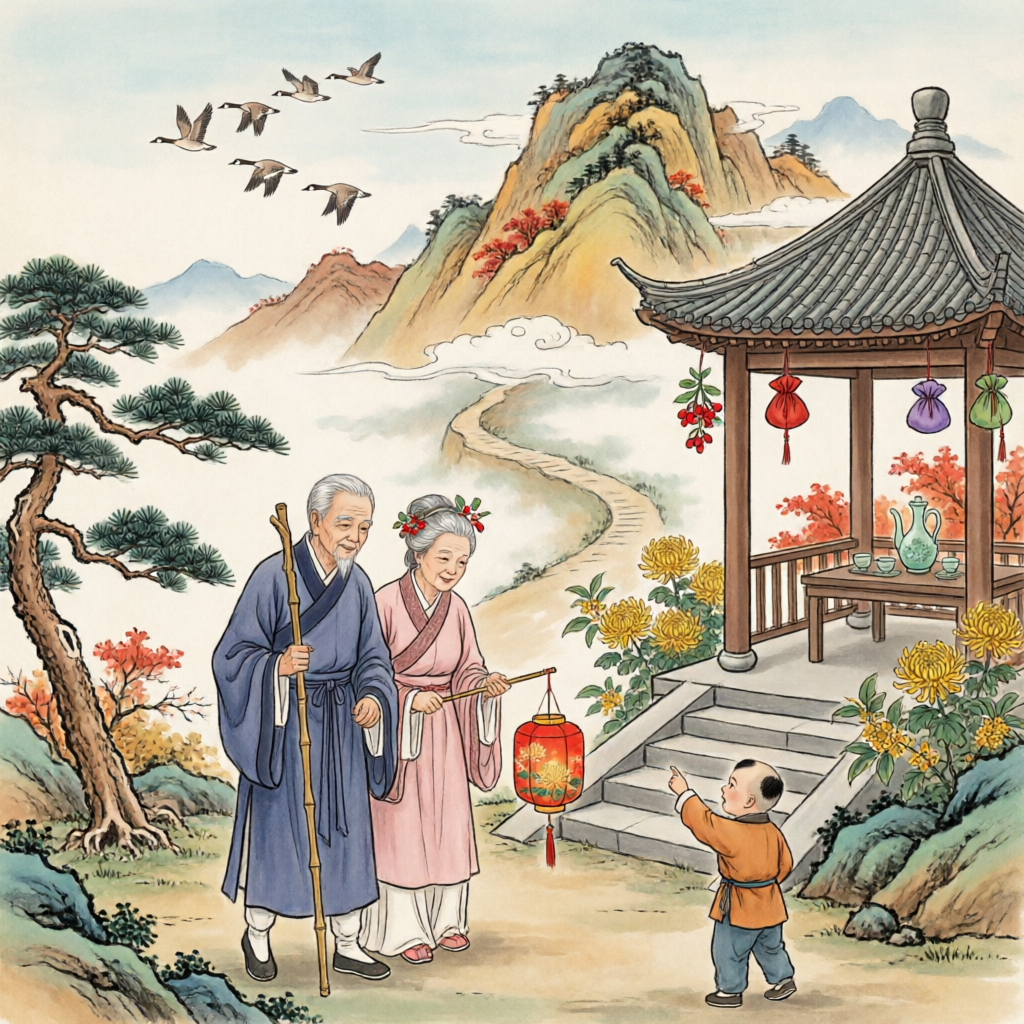
Overview
The Double Ninth Festival, also known as Chongyang Festival, is a traditional Chinese holiday celebrated on the ninth day of the ninth lunar month of the Chinese calendar. The festival derives its name from the Book of Changes (I Ching), where nine is considered a yang number (阳数), and the ninth day of the ninth month represents the repetition of this yang number, hence "double yang" (重阳). This festival has a history spanning over 2,000 years and incorporates various customs and cultural practices that reflect ancient Chinese beliefs about nature, health, and longevity.
History
The origins of the Double Ninth Festival can be traced to ancient China, with roots in pre-Qin dynasty rituals. The earliest written records related to the festival appear in the "季秋纪" (Late Autumn Record) of the Lüshi Chunqiu (Master Lü's Spring and Autumn Annals), which describes activities from the late autumn harvest period involving sacrifices to heaven and ancestors.
During the Wei-Jin period (220-420 CE), the festival began to take shape as a cultural celebration. Emperor Cao Pi of the Wei dynasty mentioned the festival in his "Letter to Zhong You on the Ninth Day" (九日与钟繇书), describing how people gathered for feasts and celebrations due to the auspicious nature of the date.
The Tang dynasty (618-907 CE) marked a significant period for the festival. In 788 CE, Emperor Dezong of Tang officially established the Double Ninth Festival as one of the three "令节" (official festivals) alongside the中和节 (Zhonghe Festival) and the上巳节 (Shangsi Festival), granting officials a day off with special monetary rewards for celebrations.
During the Song dynasty (960-1279 CE), the festival became even more elaborate. Historical records like the "东京梦华录" (Dreams of Splendor in the Eastern Capital) document grand celebrations in the capital city, with government offices and schools closing for observance. The customs also spread to northern ethnic minority groups during this period.
The Yuan, Ming, and Qing dynasties largely continued the traditions established in previous eras. In the Ming dynasty, the imperial court began celebrating from the first day of the ninth lunar month, with the emperor personally climbing the 万岁山 (Longevity Mountain) on the ninth day. The Qing dynasty maintained similar customs, with the practice of pasting chrysanthemum branches and leaves on doors and windows to "ward off evil and attract good fortune."
In modern times, the festival took on new significance. In 1989, the Chinese government designated September 9th as the "Seniors' Day" (老人节), combining traditional customs with contemporary values of respecting the elderly. In 2012, the Standing Committee of the National People's Congress passed the "Law on the Protection of the Rights and Interests of the Elderly," officially establishing the Double Ninth Festival as China's "Senior Citizens' Day."
Key Information
| Aspect | Details |
|---|---|
| Chinese Name | 重阳节 (Chóngyáng Jié) |
| English Name | Double Ninth Festival |
| Also Known As | 登高节 (Climbing Heights Festival), 茱萸节 (Cornelian Cherry Festival), 老人节 (Elderly Festival) |
| Date | Ninth day of the ninth lunar month |
| Type | Traditional cultural festival, also recognized as Senior Citizens' Day in modern China |
| Origin | Ancient harvest celebrations, ancestor worship, and nature worship |
| Key Activities | 登高 (climbing heights), chrysanthemum appreciation, drinking chrysanthemum wine, eating 重阳糕 (Double Ninth cakes), honoring the elderly |
| Symbolic Foods | 重阳糕 (Double Ninth cakes), chrysanthemum wine, various regional pastries |
| Significance | Celebrating harvest, honoring ancestors, respecting the elderly, warding off evil |
| Regions | Originally China, now celebrated in Chinese communities worldwide, with variations in Japan, Korea, and other East Asian countries |
Cultural Significance
The Double Ninth Festival embodies several important aspects of traditional Chinese culture. Numerology plays a central role, as the number nine (九) is considered the ultimate yang number in Chinese cosmology. The repetition of nine on this date (九月九日) symbolizes longevity and completeness, as "nine" (九) is a homophone for "long-lasting" (久) in Chinese. This numerical symbolism has led to the festival being associated with wishes for longevity and good health.
The festival's connection to nature is reflected in several customs. 登高 (climbing heights) is perhaps the most prominent activity, with people ascending mountains, hills, or tall towers. This practice has multiple explanations: it may originate from ancient mountain worship, the belief that "clear qi rises and turbid qi descends" during this time of year (making higher elevations more beneficial), or the desire to "bid farewell to autumn" (辞青) in contrast to the "treading on green" (踏青) custom of the spring outing.
Chrysanthemums hold special significance during the Double Ninth Festival. Known as the "flower of longevity," chrysanthemums are admired for their ability to bloom late in autumn when other flowers have withered. This resilience has made them a symbol of longevity and nobility in Chinese culture. The practice of drinking chrysanthemum wine, which dates back to the Han dynasty, is believed to promote health and ward off illness.
The festival also has strong connections to ancestor worship. Along with the Spring Festival (春节), Qingming Festival (清明节), and the Hungry Ghost Festival (中元节), the Double Ninth Festival is considered one of the four major traditional festivals for ancestor veneration in China. In many regions, especially in southern China, people visit ancestral graves to pay respects and offer sacrifices.
Modern Status
Today, the Double Ninth Festival continues to be celebrated in various forms throughout China and in Chinese communities worldwide. In mainland China, the festival's dual identity as both a traditional cultural festival and the official Senior Citizens' Day has created unique contemporary observances.
Modern celebrations often include organized activities for the elderly, such as health check-ups, cultural performances, and special events in community centers. Many families gather to celebrate with their elderly members, continuing the tradition of respecting and honoring senior citizens. Urban celebrations frequently feature chrysanthemum exhibitions, with cities like Beijing and Shanghai hosting elaborate displays in parks and public spaces.
In rural areas, some traditional customs persist. In regions like Huangling in Jiangxi province, the "晒秋" (drying autumn harvests) custom remains vibrant, with villagers drying crops on racks and rooftops, creating colorful displays that attract tourists. In other areas, local specialties like 九层糕 (nine-layer cakes) are prepared and shared among family members.
The festival has also gained recognition internationally. In 2010, Xixia County in Henan province was designated as the "Hometown of Chinese Double Ninth Culture," and the only "China Double Ninth Culture Research Center" was established there. Annual cultural festivals attract researchers and tourists interested in this aspect of Chinese heritage.
References
-
Berthier, B. (2008). "The Double Ninth Festival: Climbing Heights and Chrysanthemums." In Festivals of China: A Guide to Traditional and Modern Celebrations, edited by Liu, Y. and Zhang, W. (pp. 145-162). Oxford University Press.
-
Chau, A. Y. (2006). "Ancestors, Festivals, and Social Memory: The Double Ninth Festival in Chinese Communities." Journal of Ritual Studies, 20(2), 45-62.
-
Jones, R. & K. Smith (2014). "Cultural Continuity and Innovation: The Transformation of the Double Ninth Festival in Contemporary China." Asian Folklore Studies, 73(1), 123-145.
-
Li, W. (2012). "Seasonal Festivals and Cultural Identity: The Double Ninth Festival in Modern Chinese Society." Journal of Chinese Cultural Studies, 21(3), 89-112.
-
Wang, L. (2015). "From Ritual to Recreation: The Evolution of Double Ninth Festival Customs." In Traditional Chinese Festivals in the Modern Era, edited by Chen, H. and Zhang, J. (pp. 78-95). Springer.