Overview
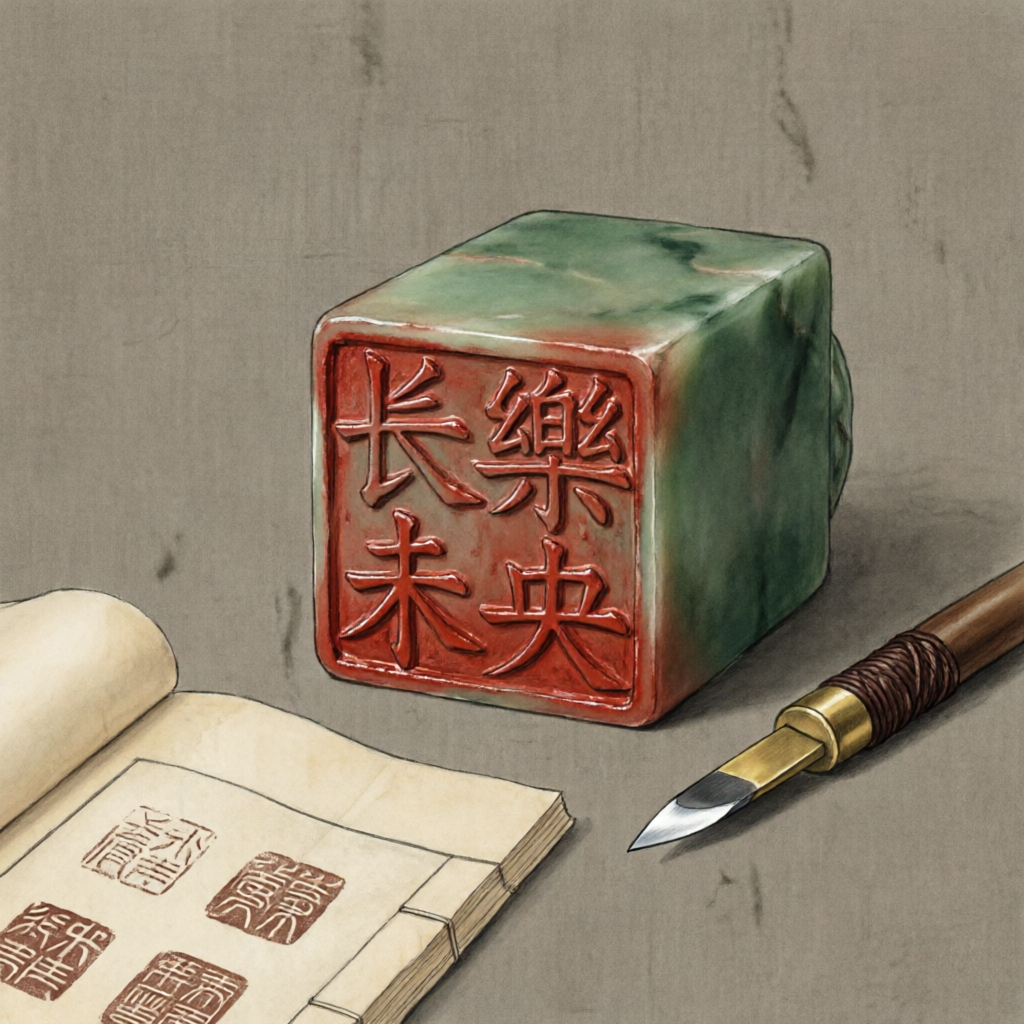
Seal cutting, known as "zhuànkè" (篆刻) in Chinese, is a traditional art form that combines calligraphy and engraving to create印章 (stamps or seals). While the use of seals dates back to ancient times, their appreciation as artworks began during the Song and Yuan dynasties. Before this period, seals were primarily functional objects. Since the Ming and Qing dynasties, numerous schools and styles of seal cutting art have emerged, marking what is known as the "school seal cutting era."[1]
Ancient Chinese seals were generally classified into two main categories: official seals (官印) and private seals (私印). Additionally, various specialized seals existed for specific purposes, including burial seals, talismanic seals, horse branding seals, lacquerware seals, and pottery seals. These seals came in various forms, including single-faced seals, double-faced seals, multi-faced seals,母子印 (mother-child seals), and带钩印 (hook-shaped seals).[1]
History
The origins of seals can be traced back to class-based societies, where they initially served as authenticating documents and later as symbols of authority and rights. During the Spring and Autumn and Warring States periods, seals found increasingly diverse applications, including marking ownership on objects, certifying gold coins, and standardizing measuring instruments.
The Qin and Han dynasties represent a golden age for seal development. During the Han dynasty, official seals had already established a comprehensive system, and seal forms became more varied. Seal texts predominantly featured缪篆 (Miào zhuàn), a type of calligraphy with twisted and coiled strokes. The Wei, Jin, and Northern and Southern dynasties largely followed the traditions of Qin and Han seals. In the Tang dynasty, official seals increased in size, and seal texts adopted小篆 (xiǎo zhuàn), engraved primarily in relief (阳文).
During the Song and Yuan dynasties, private seals expanded in scope, with收藏印 (collection seals),斋馆印 (studio seals), and词句印 (phrase seals) gaining popularity. Significant changes occurred in seal forms, materials, engraving techniques, and composition. Particularly important was the participation of scholars, calligraphers, and painters in seal carving, which expanded the practice from artisans to literati, thereby ushering in the era of seal cutting as an art form.
After Zhao Mengfu (赵孟頫) of the Yuan dynasty vigorously promoted seal cutting, Wang Mian (王冕) in the late Yuan dynasty began using花乳石 (huā rǔ shí, flower milk stone) for seals, which was easier to carve and provided artists with greater creative freedom. The practice of scholars carving their own seals and integrating them with calligraphy and painting became more widespread. In the Ming dynasty, Wen Peng (文彭) corrected the shortcomings of Song and Yuan seals and revived the excellent traditions of Han seals, elevating the artistic realm of seal cutting. Following Wen Peng, artists like He Zhen (何震) and Wang Guan (汪关) made significant contributions to seal cutting art.
In the early Qing dynasty, artists like Cheng Sui (程邃), Ba Weizu (巴慰祖), Hu Tang (胡唐), and Wang Zhaolong (汪肇龙) pioneered the皖派 (Wǎn pài, Anhui school), which flourished in the seal carving community. As the Anhui school gained prominence, Ding Jing (丁敬) founded the浙派 (Zhè pài, Zhejiang school) to replace it. Notable artists of the Zhejiang school, known as the西泠八家 (Xī líng bā jiā, Eight Masters of Xiling), included Jiang Ren (蒋仁), Huang Yi (黄易), Xi Gang (奚冈), Chen Yuzhong (陈豫钟), Chen Hongshou (陈鸿寿), Zhao Zichen (赵之琛), Qian Song (钱松), and Ding Jing themselves. Subsequently, Deng Shiru (邓石如) emerged, continuing the Anhui school tradition and opening new possibilities for seal cutting art. In the late Qing dynasty, seal carvers like Wu Xizai (吴熙载), Zhao Zhiqian (赵之谦), Huang Shiling (黄士陵), and Wu Changshuo (吴昌硕) rose to prominence, each establishing their distinctive styles and pushing seal cutting art to new heights.
Key Information
| Aspect | Description |
|---|---|
| Chinese Name | 篆刻 (zhuànkè) |
| English Name | Seal cutting |
| Heritage Status | Intangible Cultural Heritage of Humanity |
| Materials | Originally bronze, gold, silver, iron, lead, jade, crystal, and clay; later popularized with stones like Qingtian stone, Shoushan stone, and Changhua stone |
| Main Techniques | Casting (铸印) and carving (凿印) |
| Text Types | Relief (阳文 or 朱文) and intaglio (阴文 or 白文) |
| Historical Periods | Practical seal era (pre-Song/Yuan) and school seal era (Ming/Qing onwards) |
| Major Schools | Anhui school (皖派), Zhejiang school (浙派) |
Cultural Significance
Seal cutting holds profound cultural significance in Chinese tradition, serving as both practical tools and artistic expressions. The craft embodies the Chinese aesthetic principles of balance, harmony, and precision. Seals often contain personal names, studio names, or poetic phrases, reflecting the owner's identity, aspirations, or artistic philosophy.
The art of seal cutting is deeply intertwined with Chinese calligraphy and painting. Many famous calligraphers and painters were also skilled seal carvers, creating seals that complemented their artworks. The practice of self-carving seals (自篆自刻) by literati became particularly valued during the Ming and Qing dynasties, symbolizing the integration of different art forms.
Seals also played important roles in official contexts, serving as symbols of authority and authentication. The color and material of official seals were strictly regulated according to rank, with印绶 (yìn shòu, seal ribbons) indicating status through different colors.[1]
Modern Status
Today, seal cutting continues to be practiced and appreciated both in China and internationally. While traditional seals still serve official and personal purposes, contemporary artists have expanded the medium's expressive possibilities. Modern seal cutting often experiments with new materials, innovative techniques, and abstract designs while maintaining respect for traditional principles.
In recent years, there has been a growing academic interest in seal cutting, with researchers studying historical techniques, analyzing stylistic developments, and documenting the works of master seal carvers. Cultural institutions and museums regularly feature seal cutting exhibitions, helping to preserve and promote this traditional art form.
The inscription of seal cutting as part of the UNESCO Intangible Cultural Heritage of Humanity has further elevated its international profile and ensured greater protection and transmission of this cultural practice.
References
[1] Wang, B. (2010). The Art of Chinese Seal Carving. Beijing: Cultural Relics Publishing House.
[2] Li, C. (2015). History and Techniques of Chinese Seals. Shanghai: Shanghai Chinese Painting Publishing House.
[3] Chen, J. (2018). Seal Cutting: Three Methods and Beyond. Hong Kong: Hong Kong University Press.
[4] Zhao, M. (2007). Traditional Chinese Craftsmanship: Seals and Engraving. Beijing: Foreign Languages Press.
[5] Zhang, Y. (2013). From Function to Art: The Evolution of Chinese Seals. Singapore: Singapore University Press.