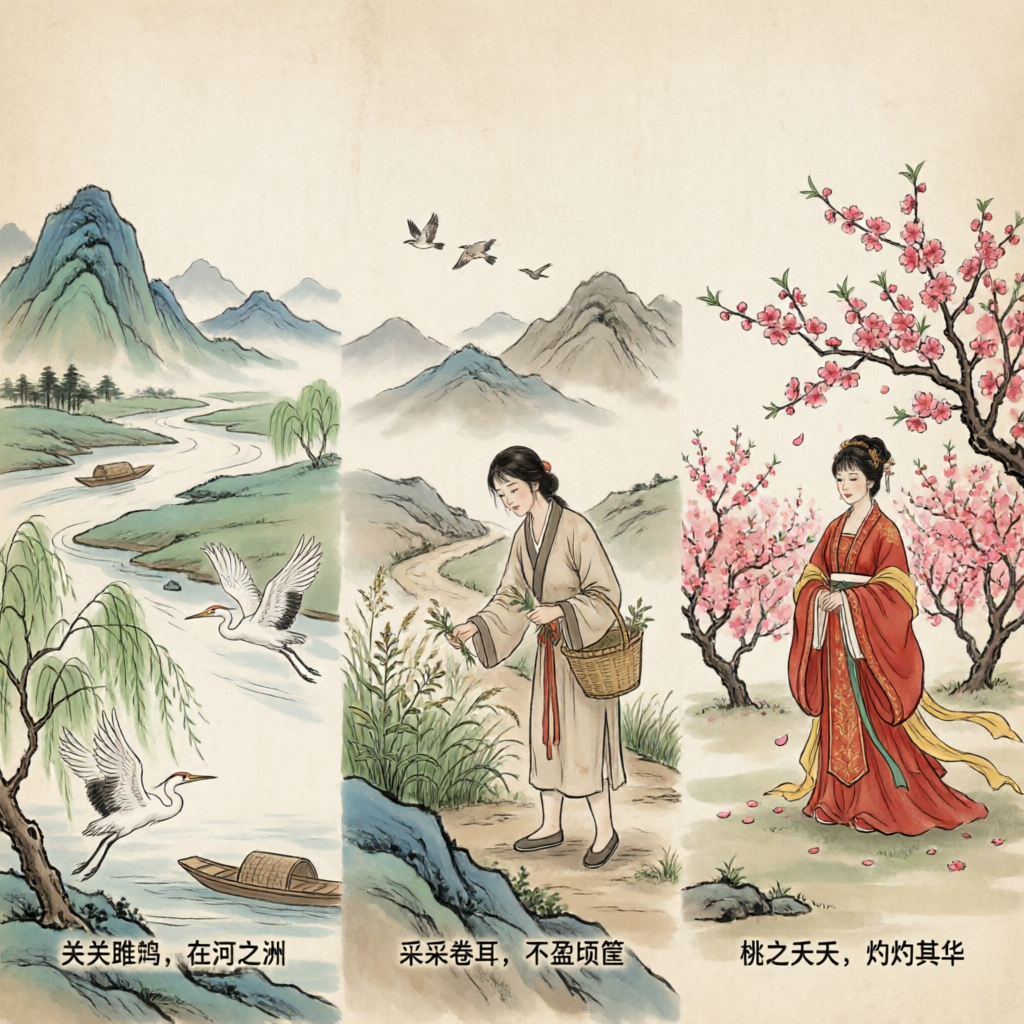
The Book of Poetry
Overview
The Book of Poetry (诗经, Shī Jīng), also known as the Classic of Poetry, is the oldest existing collection of Chinese poetry and one of the Five Classics of Confucianism. Comprising 305 poems (with an additional 6 titles but no texts), it was compiled over a period of approximately 500 years, from the early Western Zhou dynasty (c. 11th century BCE) to the mid-Spring and Autumn period (c. 6th century BCE). The collection offers a comprehensive reflection of Chinese society during the Zhou dynasty, capturing the social, political, and cultural life of the period through various poetic forms and themes.
History
Origins and Compilation
The Book of Poetry was initially known simply as "The Poems" (诗, Shī), as frequently mentioned by Confucius in his teachings. For instance, Confucius stated: "The three hundred poems, to sum them up in one phrase, may be said to have no improper thoughts" ("《诗》三百,一言以蔽之,曰:'思无邪'"). The collection was later referred to as "The Three Hundred Poems" (诗三百, Shī Sānbǎi) due to its approximately 300 poems. The current title, "The Book of Poetry" (诗经, Shī Jīng), emerged during the Han dynasty when Emperor Wu established the Five Classics (五经, Wǔ Jīng), which included the Book of Poetry, Book of Documents, Book of Rites, Book of Changes, and Spring and Autumn Annals.
The poems in the collection span from the early Western Zhou period, following King Wu's overthrow of the Shang dynasty (c. 1046 BCE), to the Spring and Autumn period. Geographically, they are centered in the Yellow River basin, extending as far south as the north bank of the Yangtze River, and covering present-day Shaanxi, Gansu, Shanxi, Shandong, Hebei, Henan, Anhui, and Hubei provinces.
Development of Sections
The collection is divided into three main sections: Feng (风, "Airs"), Ya (雅, "Odes"), and Song (颂, "Hymns").
- The Zhou Odes (周颂, Zhōu Sòng): The earliest section, dating from the early Western Zhou period, consists of aristocratic works primarily featuring temple hymns and songs praising deities, with some poems describing agricultural production.
- The Major Odes (大雅, Dà Yǎ): Produced during the prosperous period of the Zhou dynasty, these represent the only surviving epics of ancient China. Dating from the early Western Zhou period, they praise the achievements of the Zhou royal ancestors and kings like King Wen and King Wu.
- The Minor Odes (小雅, Xiǎo Yǎ): Composed from the late Western Zhou period through the eastward migration of the Zhou capital, these include both aristocratic and folk elements.
- The Lu and Shang Odes (鲁颂, Lǔ Sòng; 商颂, Shāng Sòng): Created after the eastward migration of the Zhou capital (770 BCE), these are regional odes.
Transmission and Preservation
According to tradition, the Zhou dynasty officials responsible for collecting folk songs would travel through the countryside each spring, gathering popular songs that reflected the joys and sorrows of the people. These were then passed to the Grand Music Master (太师, Tài Shī) who would compose music for them and perform them for the emperor as references for governance.
During the Spring and Autumn period, it is said that there were as many as 3,000 poems in circulation, but only 311 (including 6 with titles but no texts) survived. After Confucius compiled and edited these, his disciple Zixia (子夏), one of the "Ten Philosophers" and seventy-two disciples known for his profound understanding of the poems, became the first recorded transmitter of the collection.
In the early Han dynasty, three major schools of interpretation emerged: the Qi School (齐诗, Qī Shī), Lu School (鲁诗, Lǔ Shī), and Han School (韩诗, Hán Shī). However, only the Mao School (毛诗, Máo Shī), attributed to Mao Heng and Mao Chang, has survived in its complete form, forming the basis of all modern editions of the Book of Poetry.
Key Information
| Aspect | Details |
|---|---|
| Original Title | 诗 (Shī) |
| Current Title | 诗经 (Shī Jīng) / The Book of Poetry |
| Alternative Names | The Book of Songs, Classic of Poetry |
| Time Period | Early Western Zhou to mid-Spring and Autumn periods (c. 1046-771 BCE) |
| Geographic Origin | Primarily Yellow River basin, extending to north of Yangtze River |
| Number of Poems | 305 poems (plus 6 with titles only) |
| Main Sections | Feng (Airs), Ya (Odes), Song (Hymns) |
| Major Themes | Love, labor, war, agriculture, rituals, social criticism |
Cultural Significance
The Book of Poetry holds profound cultural significance in Chinese civilization as one of the foundational texts of Confucian scholarship. Confucius himself placed great importance on the collection, stating: "If one has not studied the Odes, one will not be able to speak appropriately." The poems served as educational materials for centuries, shaping Chinese literary traditions, aesthetic sensibilities, and ethical values.
The collection's three sections reflect different aspects of Zhou society:
- Feng (Airs): Comprising 160 poems from 15 regions, these folk songs capture the daily lives, emotions, and social conditions of common people. They include themes of love, labor, homesickness, and social criticism, often employing repetitive structures characteristic of oral traditions.
- Ya (Odes): Divided into Major Odes (31 poems) and Minor Odes (74 poems), these works primarily reflect the concerns of the aristocracy. The Major Odes celebrate the achievements of Zhou kings and ancestors, while the Minor Odes include more diverse content, including poems about war, labor, and social commentary.
- Song (Hymns): Consisting of 40 poems, these are ritual hymns performed at ancestral temples, celebrating the virtues and achievements of the ruling dynasty.
The Book of Poetry has significantly influenced Chinese literature, poetry, and cultural expression throughout history. Its themes, imagery, and artistic techniques have been emulated by countless subsequent poets and writers. The collection also provides valuable insights into early Chinese society, including agricultural practices, religious beliefs, political structures, and family relationships.
Modern Status
Today, the Book of Poetry remains a central text in Chinese literary and cultural studies. It is studied in schools and universities throughout China and the Sinophone world, and continues to be translated into numerous languages. Modern scholarship on the collection encompasses literary analysis, historical research, linguistic studies, and anthropological approaches.
In recent decades, archaeological discoveries have provided new perspectives on the Book of Poetry. The清华简 (Qinghua bamboo slips), unearthed in 2008 and dating from the Warring States period, contain texts that relate to some poems in the collection, offering insights into their early transmission and interpretation.
The Book of Poetry has also influenced modern Chinese literature and cultural movements. During the New Culture Movement of the early 20th century, scholars like Hu Shi drew upon the folk elements of the Feng section to advocate for vernacular literature. In contemporary China, the collection continues to inspire poets, artists, and cultural producers who find resonance in its ancient themes and expressions.
References
-
Legge, James. The Chinese Classics, Vol. IV: The She King, or The Book of Poetry. Oxford: Clarendon Press, 1871.
-
Yu, Pauline. The Reading of Imagery in the Chinese Poetic Tradition. Princeton: Princeton University Press, 1987.
-
Kern, Martin. The Stele of Inscribed Words: From the Earliest Times to the First Century AD. In The Cambridge History of Chinese Literature, Vol. 1, edited by Stephen Owen, 97-144. Cambridge: Cambridge University Press, 2010.
-
Wang, Aihe. Cosmology and Political Culture in Early China. Cambridge: Cambridge University Press, 2000.
-
Schaberg, David. A Patterned Past: Form and Thought in Early Chinese Historiography. Cambridge, MA: Harvard University Asia Center, 2001.