Overview
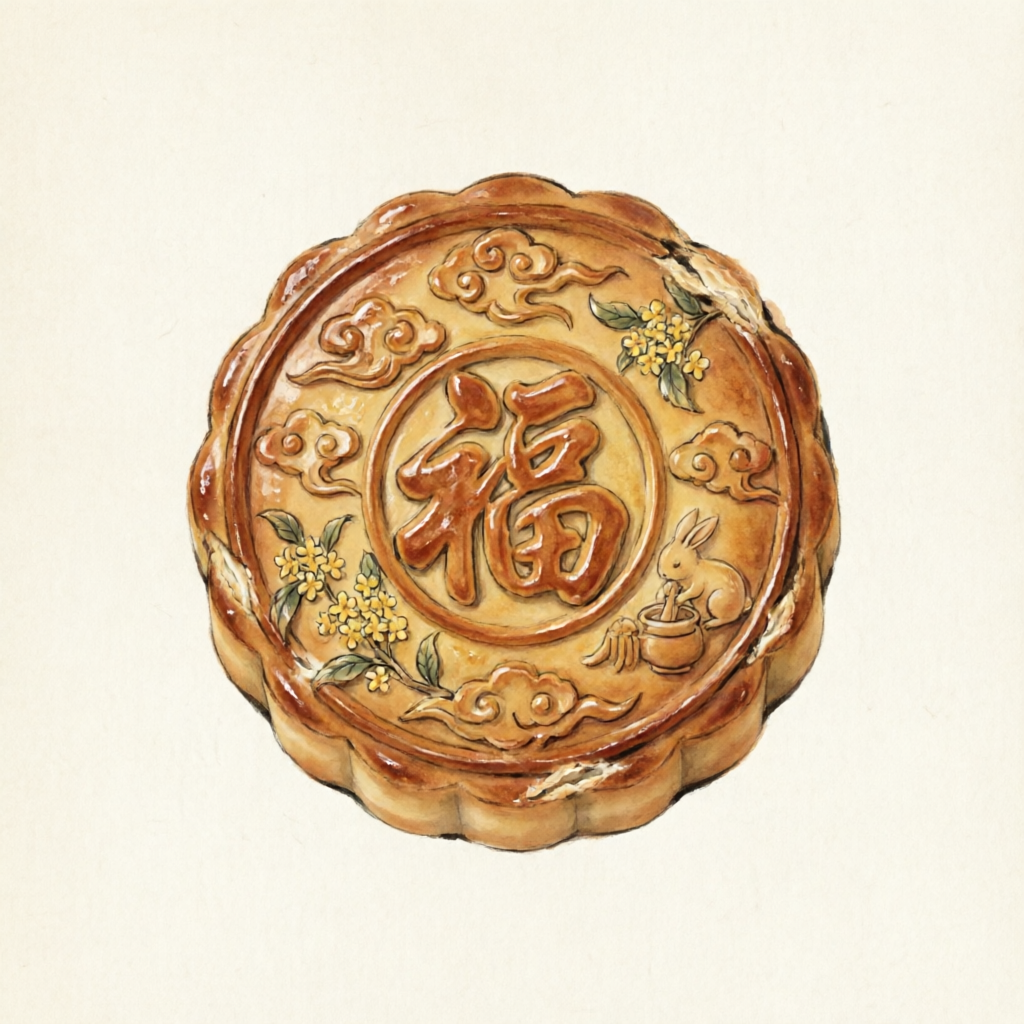
Moon Cake (月饼) is a traditional Chinese pastry that holds significant cultural importance, particularly during the Mid-Autumn Festival. This round delicacy symbolizes completeness and reunion, reflecting the Chinese cultural value of family togetherness. The cake typically features a rich filling enclosed in a thin or layered crust, with various regional styles developed across China and other East Asian countries. Moon Cakes come in diverse flavors, textures, and sizes, ranging from small individual portions to massive ceremonial versions weighing hundreds of kilograms.
History
The tradition of Moon Cakes dates back to ancient China, with roots in the worship of the moon during the Mid-Autumn Festival. The earliest written record of "Moon Cake" appears in "Meng Li Lu" (梦粱录) by Wu Zimu from the Southern Song Dynasty. However, similar pastries were consumed even earlier during the Tang Dynasty, as evidenced by a 1,400-year-old "Moon Cake" artifact excavated from a tomb in Turpan, Xinjiang.
During the Tang Dynasty, moon appreciation ceremonies were popular among the elite, and the imperial court would distribute "palace cakes" to officials. By the Song Dynasty, these pastries were commonly referred to as "small cakes" or "moon rounds". The poet Su Shi famously wrote: "Small cakes like chewing the moon, with crispy crust and sweet filling" (小饼如嚼月,中有酥和饴), describing the moon cakes of his time.
The Mid-Autumn Festival became firmly established during the Ming Dynasty, when eating moon cakes became a widespread custom. Historical records from this period describe how families would gather to share moon cakes after moon worship ceremonies, gradually associating the round cakes with family reunion. By the Qing Dynasty, moon cake production had become more sophisticated, with various regional styles emerging.
Key Information
| Aspect | Description |
|---|---|
| Chinese Name | 月饼 (Yuè Bǐng) |
| Alternative Names | Round Cake, Reunion Cake, Palace Cake |
| Main Ingredients | Wheat flour, sugar, oil, various fillings |
| Regional Styles | Cantonese, Suzhou, Beijing, Chaozhou, Yunnan styles |
| Cultural Significance | Symbol of family reunion and completeness |
| Festival Association | Mid-Autumn Festival (15th day of 8th lunar month) |
Cultural Significance
Moon Cakes are deeply intertwined with Chinese cultural traditions and symbolism. The round shape represents completeness and reunion, making it a fitting symbol for the Mid-Autumn Festival, which celebrates family togetherness. In ancient China, moon cakes were offerings to the moon deity during worship ceremonies. Families would arrange an incense table with moon cakes, fruits, and other offerings, then bow toward the moon in reverence.
The tradition of sharing moon cakes among family members after the ceremony reinforces the cultural value of unity. As the saying goes: "On the fifteenth of the eighth lunar month, the moon is perfectly round, and moon cakes are fragrant and sweet" (八月十五月正圆,中秋月饼香又甜).
Regional variations in moon cake customs reflect China's diverse cultural landscape. In Guangdong, women and children traditionally conduct moon worship ceremonies following the proverb "Men do not worship the moon, women do not worship the kitchen god" (男不圆月,女不祭灶). In Nanjing, people enjoy moon cakes with "fire dragon" dances and "Osmanthus Duck" (桂花鸭), a local specialty. In Sichuan, moon cakes are paired with pounded rice cakes (糍粑) and duck dishes.
Modern Status
Today, moon cakes have evolved beyond their traditional role as festival foods, becoming year-round delicacies with countless variations. The traditional classification divides moon cakes into two main categories: traditional and non-traditional.
Traditional moon cakes are categorized by regional styles:
- Cantonese Style: Characterized by thin skin, soft texture, sweet flavor, and generous filling
- Suzhou Style: Known for flaky, crispy layers with moderate sweetness
- Beijing Style: Features elegant appearance with thin, crispy skin and distinct layers
- Chaozhou Style: Distinguished by crispy skin, fine filling, and balanced sweetness
- Yunnan Style: Features crispy skin with delicious filling, moderately sweet and savory
Non-traditional moon cakes represent modern innovations that often incorporate Western pastry techniques and healthier ingredients:
- Ice Cream Moon Cakes: Frozen versions that require no baking
- Fruit and Vegetable Moon Cakes: Featuring fresh fruit and vegetable fillings
- Seafood Moon Cakes: Incorporating luxury ingredients like abalone and shark fin
- Health-Functional Moon Cakes: Added ingredients like ginseng, calcium, or iodine
The moon cake market has also seen the emergence of giant ceremonial versions. In 2014, Lanzhou, China unveiled the world's largest lily moon cake, weighing 900 jin (450 kg) with a diameter of 2.123 meters. Such creations serve as marketing attractions and demonstrations of culinary prowess.
Modern consumption practices have adapted to contemporary lifestyles. Moon cakes are now often paired with tea to balance their richness, with specific tea recommendations for different styles. For instance, heavily roasted Tieguanyin tea complements sweet Cantonese moon cakes, while light jasmine tea pairs well with Suzhou-style varieties.
References
- Chen, J. (2019). Food Culture in China. Cambridge University Press.
- Wang, L., & Zhang, Y. (2020). The Mid-Autumn Festival: Traditions and Transformations. China Intercontinental Press.
- Li, M. (2018). Chinese Pastries: History and Techniques. Beijing Publishing House.