Overview
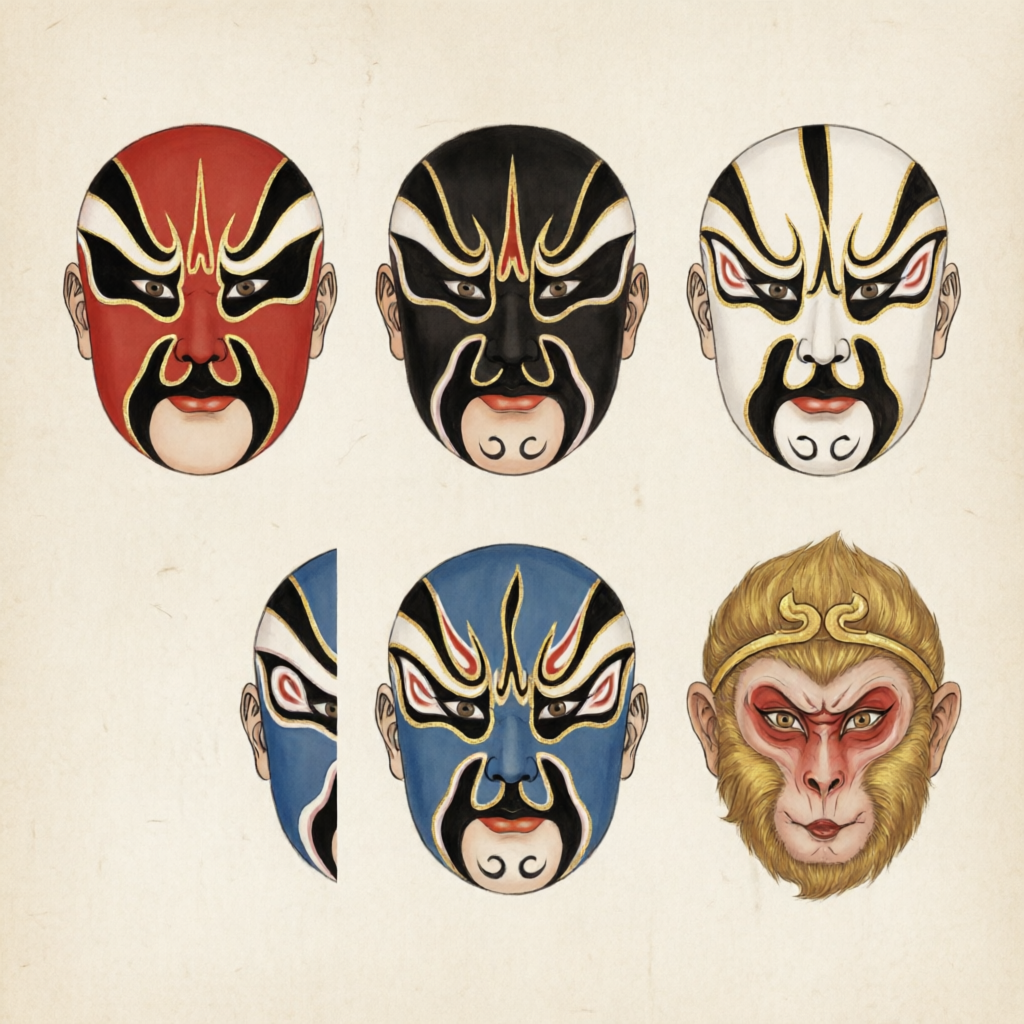
Beijing Opera facial makeup, known as "京剧脸谱" (Jīngjù liǎnpǔ), is a distinctive form of theatrical makeup in traditional Chinese opera. This elaborate makeup technique uses symbolic colors and patterns to represent characters' personalities, qualities, and social status. Facial makeup is primarily applied to "净" (jìng, painted-face roles) and "丑" (chǒu, clown roles), with "生" (shēng, male roles) and "旦" (dàn, female roles) typically wearing minimal makeup. The art form combines aesthetic beauty with symbolic meaning, creating a visual language that helps audiences understand characters at a glance.
History
The origins of Beijing Opera facial makeup can be traced back approximately 150 years. The art form developed during the mid-Qing Dynasty, evolving from earlier theatrical traditions. In 1790, the renowned "三庆班" (Sānqìng bān) troupe from Anhui province performed in Beijing for the 80th birthday celebration of the Qianlong Emperor. This performance marked the beginning of what would become Beijing Opera, as various Anhui troupes subsequently moved to the capital and blended their styles with other regional opera forms.
The facial makeup tradition has roots in several historical influences. One significant origin story comes from the Northern Qi Dynasty (550-577 CE) and the story of General Gao Changgong, the Prince of Lanling. Renowned for his military prowess but considered too handsome to inspire fear in enemies, Gao reportedly wore a fearsome mask into battle. The "兰陵王入阵曲" (Lánlíng wáng rùzhèn qǔ), a dance drama created in his honor, featured performers wearing masks, which may have influenced later theatrical traditions.
Key Information
Facial Makeup Classification
| Type | Description | Notable Examples |
|---|---|---|
| 整脸 (Zhěng liǎn) | Single color covering the entire face | Guan Yu (red), Bao Zheng (black) |
| 三块瓦脸 (Sānkuàiwǎ liǎn) | Three distinct sections for eyebrows, eyes, and nose | Zhang Fei, Li Kui |
| 十字门脸 (Shízìmén liǎn) | Vertical stripe from forehead to nose forming a cross with eye areas | Xiang Yu, Yue Fei |
| 六分脸 (Liùfēn liǎn) | Forehead color takes up 40% of the face, main color 60% | Elderly generals |
| 碎花脸 (Suìhuā liǎn) | Base color with intricate patterns in secondary colors | Mythical characters |
| 歪脸 (Wāi liǎn) | Asymmetrical design for villainous henchmen | Treacherous servants |
| 僧脸 (Sēng liǎn) | Buddhist-themed designs with forehead markings | Monks in religious plays |
| 太监脸 (Tàijiàn liǎn) | Red and white designs for eunuch characters | Court eunuchs |
Color Symbolism
| Color | Symbolism | Representative Characters |
|---|---|---|
| Red (红) | Loyalty, righteousness, bravery | Guan Yu, Wu Han |
| Black (黑) | Integrity, seriousness, fierceness | Bao Zheng, Zhang Fei, Li Kui |
| White (白) | Treachery, suspicion | Cao Cao, Yan Song |
| Blue (蓝) | Resoluteness, stubbornness | Ma Wu, Dou Erdun |
| Yellow (黄) | Bravery, fierceness | Yuwen Chengdu |
| Purple (紫) | Solemnity, stability | Xu Yanzhao, Zhuan Zhu |
| Green (绿) | Impulsiveness, recklessness | Wang Yanzhang |
| Gold/Silver (金/银) | Divinity, sanctity | Gods, immortals |
Cultural Significance
Facial makeup in Beijing Opera serves multiple functions beyond mere decoration. It functions as a visual shorthand that allows audiences to immediately understand character traits, moral qualities, and social status. The colors and patterns follow established conventions that have been refined over centuries, creating a sophisticated symbolic system.
"The facial makeup is not merely decoration but a visual language that tells the audience about a character's personality, fate, and moral standing before a single line is spoken."
— Traditional Beijing Opera saying
The art form has also influenced other aspects of Chinese culture. In modern education, facial makeup techniques are being incorporated into teaching to help students understand traditional cultural values. For example, in December 2025, Hongwei Primary School in Hubei Province introduced paper pulp paintings of facial makeup as part of their intangible cultural heritage curriculum, helping students learn about color symbolism and cultural connotations.
Modern Status
Today, Beijing Opera facial makeup continues to be practiced by traditional performers while also finding new expressions in contemporary art forms. The techniques have been preserved through master-apprentice relationships and documented in scholarly works. Many contemporary artists incorporate facial makeup elements into their work, bridging traditional and modern aesthetics.
The art form has gained international recognition, with exhibitions of facial makeup appearing in museums worldwide. Its distinctive visual style has also influenced modern design, fashion, and visual media. Despite challenges in maintaining traditional performance practices, facial makeup remains a vibrant part of China's cultural heritage.
References
-
Mackerras, Colin. The Chinese Theatre in Modern Times: From 1840 to the Present Day. University of Hawaii Press, 1975.
-
Chen, Tsun-ju. Beijing Opera: Visual Communication in the Chinese Traditional Theatre. China Books & Periodicals, 1997.
-
Scott, A.C. The Traditional Theater of China: A Historical Survey. University of Washington Press, 1959.
-
Li, Yuming. Symbolic Colors in Beijing Opera Facial Makeup. Journal of Chinese Performing Arts, vol. 15, no. 2, 2008, pp. 45-67.
-
Zhang, Guangqing. The Art of Facial Makeup in Chinese Opera. Foreign Languages Press, 2012.