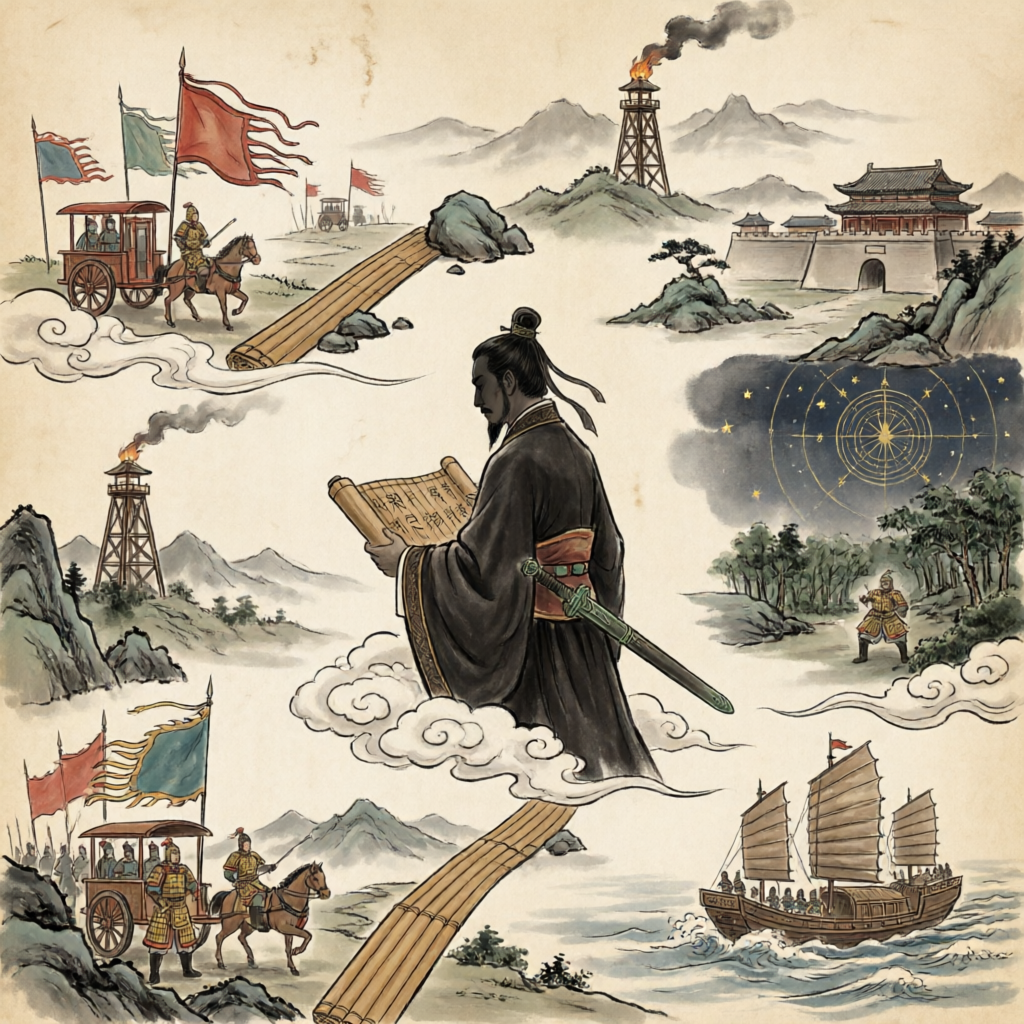
Overview
The Art of War (孙子兵法, Sunzi Bingfa), also known as Sun Tzu's Art of War or the Sun Wu Bingfa, is an ancient Chinese military treatise dating from the Spring and Autumn Period (approximately 771-476 BCE). Authored by Sun Tzu (孙子), a general and strategist from the state of Wu, it is the oldest and most influential military treatise in the world, predating Carl von Clausewitz's On War by over 2,300 years. The work consists of thirteen chapters, each examining a different aspect of warfare and military strategy.
The Art of War has had a profound influence on both Eastern and Western military thinking, business tactics, legal strategy, and beyond. Its teachings emphasize the importance of positioning, planning, and psychological factors in achieving victory, rather than brute force alone. The text has been translated into numerous languages and studied worldwide by military leaders, business executives, and political strategists.
History
The Art of War was written by Sun Tzu (also known as Sun Wu), a military general who served under King Helü of Wu in the late Spring and Autumn period. Sun Tzu originally came from the state of Qi but traveled to Wu where he presented his military treatise to the king. Impressed by Sun Tzu's knowledge, the king appointed him as commander of the Wu forces.
The earliest known physical copy of the text was discovered in 1972 in a Han Dynasty tomb at Yinque Mountain in Shandong Province. This bamboo slip version dates from approximately 140 BCE and contains fragments of the text, though it is not complete. The earliest printed edition is the "Eleven Commentators' Edition" from the Southern Song Dynasty (1127-1279 CE).
Throughout Chinese history, the text has been studied and commented upon by numerous military theorists. The most famous early commentary was by Cao Cao in the third century CE. Other significant commentators include Li Quan in the Tang Dynasty, and Du Mu in the Song Dynasty.
Key Information
| Aspect | Details |
|---|---|
| Title | The Art of War (孙子兵法) |
| Author | Sun Tzu (孙子) |
| Original Title | Sun Wu Bingfa (孙武兵法) |
| Date of Composition | Before 512 BCE (late Spring and Autumn period) |
| Language | Classical Chinese (先秦古文) |
| Structure | 13 chapters (篇) |
| Length | Approximately 6,000 Chinese characters |
| Earliest Physical Copy | 1972 discovery at Yinque Mountain Han tomb (bamboo slips) |
| Earliest Printed Edition | Southern Song Dynasty (1127-1279 CE) "Eleven Commentators' Edition" |
Content Structure
The Art of War is divided into thirteen chapters, each focusing on a different aspect of warfare:
-
Planning (计篇): Emphasizes the importance of careful planning before engaging in battle. Introduces the concept of "five factors" (道, 天, 地, 将, 法) and "seven elements" for assessing the likelihood of victory.
-
Waging War (作战篇): Discusses the economic aspects of warfare and the importance of rapid victory to avoid excessive costs and depletion of resources.
n3. Attack by Stratagem (谋攻篇): Advocates for winning without fighting through superior strategy and diplomacy. Introduces the famous maxim: "Supreme excellence consists in breaking the enemy's resistance without fighting."
-
Tactical Dispositions (军形篇): Explores the relationship between objective conditions and victory, emphasizing the importance of preparing oneself while awaiting the enemy's vulnerability.
-
Energy (兵势篇): Discusses the dynamics of combat, the use of "normal" and "extraordinary" tactics (奇正), and the importance of creating overwhelming momentum.
-
Weak Points & Strong (虚实篇): Examines how to create and exploit vulnerabilities in the enemy's position while concealing one's own weaknesses. Introduces the concept that "water shapes its course according to the nature of the ground over which it flows; the soldier works out his victory in relation to the foe whom he is facing."
-
Maneuvering (军争篇): Addresses the challenges of maneuvering forces and the importance of seizing advantageous positions. Contains the famous description of ideal military conduct: "The swift are like the wind; the majestic are like the forest; the invading are like fire; the immovable are like mountains; the secretive are like darkness; the striking are like thunder."
-
Variation in Tactics (九变篇): Discusses the importance of adapting tactics to different circumstances and avoiding rigid adherence to fixed plans.
-
The Army on the March (行军篇): Provides guidance on moving armies, camping, and observing enemy signs and signals.
-
Terrain (地形篇): Analyzes different types of terrain and their implications for military operations.
-
The Nine Situations (九地篇): Classifies nine different battlefield situations and appropriate responses to each.
-
The Attack by Fire (火攻篇): Discusses the use of fire as a weapon and the importance of restraint in warfare.
-
The Use of Spies (用间篇): Details the five types of spies and their importance in gathering intelligence.
Cultural Significance
The Art of War has had an immense cultural impact both within China and internationally. In China, it has been studied for centuries by military leaders and scholars, and its principles have influenced Chinese political and philosophical thought. The text is considered one of the Seven Military Classics of ancient China (武经七书), a compilation of military texts that has been studied by generations of Chinese military strategists.
The work's influence extends beyond military applications into business, sports, politics, and personal development. In Japan, the text has been studied by business leaders as a guide to competitive strategy. In the West, it has been adopted by military leaders, politicians, and business executives as a guide to strategic thinking.
The famous American general Douglas MacArthur was known to have studied the text, and business leaders like Larry Bossidy (former CEO of Honeywell) have recommended it as essential reading for executives. The principles of "knowing your enemy and knowing yourself" have become common aphorisms in strategic thinking worldwide.
Modern Status
Today, The Art of War remains one of the most widely read and studied military texts in the world. It has been translated into numerous languages and is studied in military academies around the globe. The text has also been adapted into various forms of popular media, including films, television shows, and video games.
Modern scholars continue to analyze the text from various perspectives, including its historical context, philosophical underpinnings, and practical applications. Some contemporary military strategists argue that the text's principles remain relevant in modern warfare, while others suggest that its advice must be adapted to contemporary contexts.
The text has also been the subject of academic debate regarding its authorship and composition. Some scholars suggest that the text may have been compiled by multiple authors over time rather than being written entirely by Sun Tzu himself.
Despite these debates, The Art of War continues to be regarded as a foundational text in military strategy and has secured its place as one of the most influential works in human history.
References
-
Sawyer, Ralph D. The Art of War. Barnes & Noble, 1994.
-
Ames, Roger T. The Art of War: Sunzi's Military Treatise. Ballantine Books, 1993.
-
Griffith, Samuel B. Sun Tzu: The Art of War. Oxford University Press, 1971.
"The opportunity of defeating the enemy is provided by the enemy himself." — Sun Tzu, The Art of War