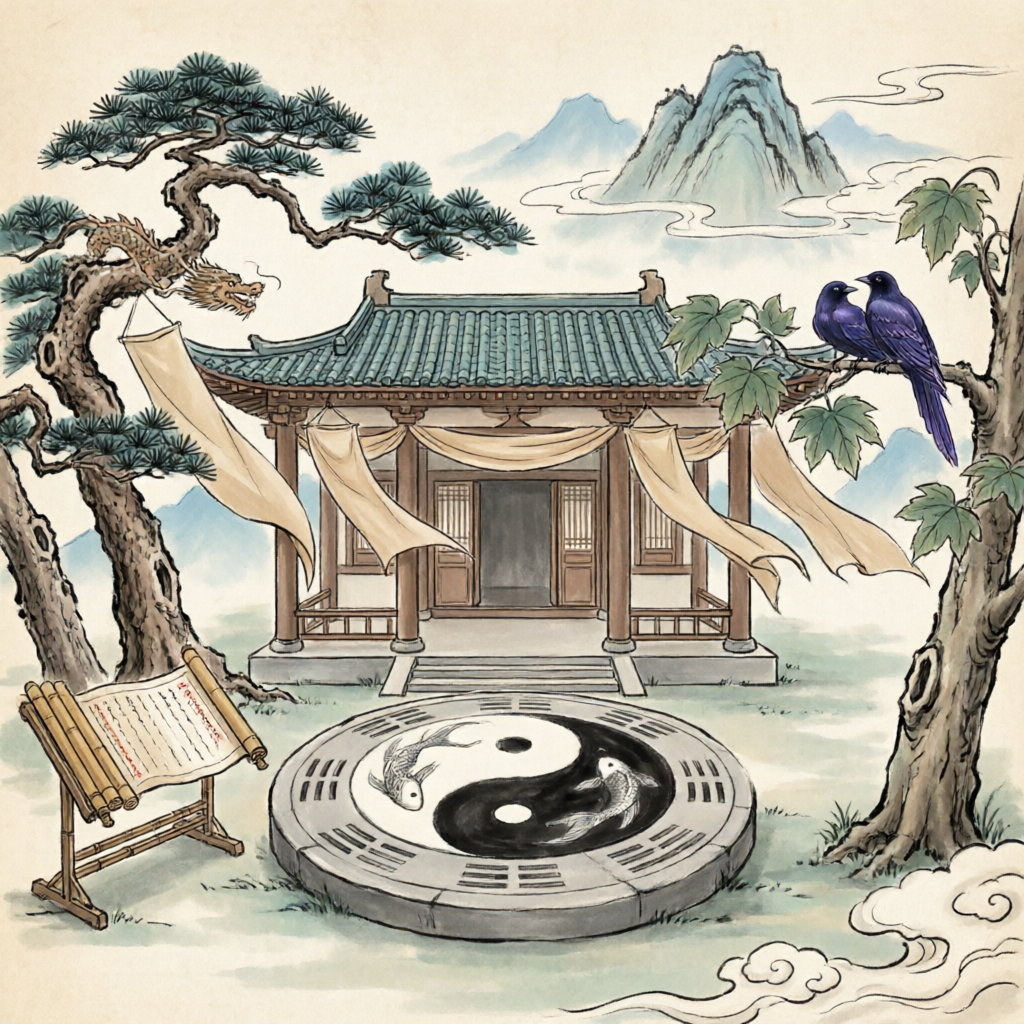
Yin Yang School
Overview
The Yin Yang School (阴阳家) was a philosophical and mystical tradition in ancient China that emerged during the late Spring and Autumn Period. As one of the Hundred Schools of Thought, it separated from Daoism to pursue what its practitioners considered more extreme applications of cosmological principles. The school specialized in yin-yang theory,五行 (Five Elements) philosophy, and various esoteric practices that influenced political, military, and cultural developments during the Warring States period and Qin Dynasty.
History
Origins and Separation from Daoism
During the late Spring and Autumn Period, the predecessors of the Yin Yang School broke away from Daoist traditions in pursuit of what they considered the ultimate understanding of the relationship between heaven and humanity. For five centuries, the school developed numerous powerful techniques and produced many talented practitioners. This separation marked a distinct philosophical shift, as the Yin Yang School focused more on practical applications of cosmic forces rather than the more metaphysical approach of traditional Daoism.
Warring States Period
The school's influence grew during the Warring States Period, with its members playing significant roles in the political landscape. Yan Dan, the crown prince of Yan, had a relationship with Yan Fei, who held the position of Dongjun (East Lord) within the Yin Yang School. Despite their initial connection being part of a scheme to uncover the secrets of the Seven Mansions of the Azure Dragon, Yan Fei and Yan Dan developed genuine affection for each other. Yan Fei abandoned her position in the Yin Yang School, escaping with Yan Dan under the name Fei Yan, eventually becoming his consort and bearing him a daughter, Gao Yue.
The school's involvement in political affairs extended to assassination plots and power struggles. When Yan Dan's assassination plot against Qin Shi Huang required assistance from the Mohist school, Yan Fei secretly used the "Six Soul Terror Curse" (六魂恐咒), one of the Yin Yang School's forbidden techniques, to assassinate the Mohist leader Six-fingered Heixia. This act created a rift between Yan Dan and Yan Fei, though the true circumstances of Heixia's death were concealed from the public.
Imperial Period
During the Qin Dynasty, the Yin Yang School gained significant influence at the imperial court. Jin elder Yunzhong Jun (Cloud Master) cured Qin Shi Huang of chronic headaches, earning the emperor's trust and establishing the school as a key imperial advisor. The school's left and right protectors, Moon Goddess and Star Soul, were appointed as the empire's two national protectors, responsible for both mystical and political affairs.
The school's most ambitious project was the construction of the "Mirage Tower" (蜃楼), a colossal vessel that combined the mechanisms of the Gongshu family with Yin Yang techniques. This massive undertaking required ten years to complete and enormous imperial investment. The Mirage Tower served as both a mobile fortress and a laboratory for creating elixirs of immortality, reflecting the school's central role in Qin Shi Huang's quest for eternal life.
Key Information
| Aspect | Details |
|---|---|
| Founding | Late Spring and Autumn Period, approximately 500 years before the Qin Dynasty |
| Founders | Unknown; separated from Daoist traditions |
| Core Texts | No specific surviving texts; practices likely transmitted orally |
| Main Practices | Yin-yang theory, Five Elements manipulation, curse techniques, divination |
| Political Alignment | Allied with Qin Dynasty during unification campaigns |
| Headquarters | Mirage Tower (蜃楼), a massive vessel combining mechanisms and mystical arts |
| Notable Members | Dongjun (Yan Fei), Moon Goddess, Star Soul, Yunzhong Jun, Da Si Ming, Shao Si Ming |
Cultural Significance
The Yin Yang School represents a fascinating intersection of philosophy, mysticism, and political power in ancient China. Its separation from Daoism reflects the diverse interpretations of cosmic principles during the Warring States period. The school's emphasis on practical applications of yin-yang theory and the Five Elements demonstrates how abstract philosophical concepts could be weaponized for political and military purposes.
The school's relationship with historical figures like Qin Shi Huang and its involvement in significant events like the fall of the Mohist stronghold illustrate the close connection between mystical traditions and political power in imperial China. The tragic stories of its members, such as Yan Fei's doomed love affair and the testing of young disciples like Shao Si Ming, reveal the human cost of pursuing mystical power within a hierarchical organization.
Modern Status
Today, the Yin Yang School exists primarily as a fictional element in Chinese popular culture, particularly in the animated series Qin's Moon (秦时明月) and its衍生作品 (derivative works). The series portrays the school as an influential organization with distinctive practices, hierarchical structure, and significant impact on historical events during the Qin Dynasty.
In academic contexts, the Yin Yang School is studied as part of the Hundred Schools of Thought, though historical records about the actual school are limited. Modern scholars often examine its philosophical contributions to Chinese cosmology and its influence on later traditions like Daoist alchemy and geomancy. The school's emphasis on the practical applications of cosmic forces continues to interest researchers studying the relationship between philosophy, science, and governance in ancient China.
References
-
Loewe, Michael, and Edward L. Shaughnessy, eds. The Cambridge History of Ancient China: From the Origins of Civilization to 221 B.C. Cambridge University Press, 1999.
-
Puett, Michael J. To Become a God: Cosmology, Sacrifice, and Self-Divinization in Early China. Harvard University Asia Center, 2002.
-
Lewis, Mark Edward. The Construction of Space in Early China. State University of New York Press, 2006.
-
Knoblock, John, and Jeffrey Riegel. Xunzi: A Translation and Study of the Complete Works. Stanford University Press, 1988-1990.