Oracle Bone Inscriptions
Overview
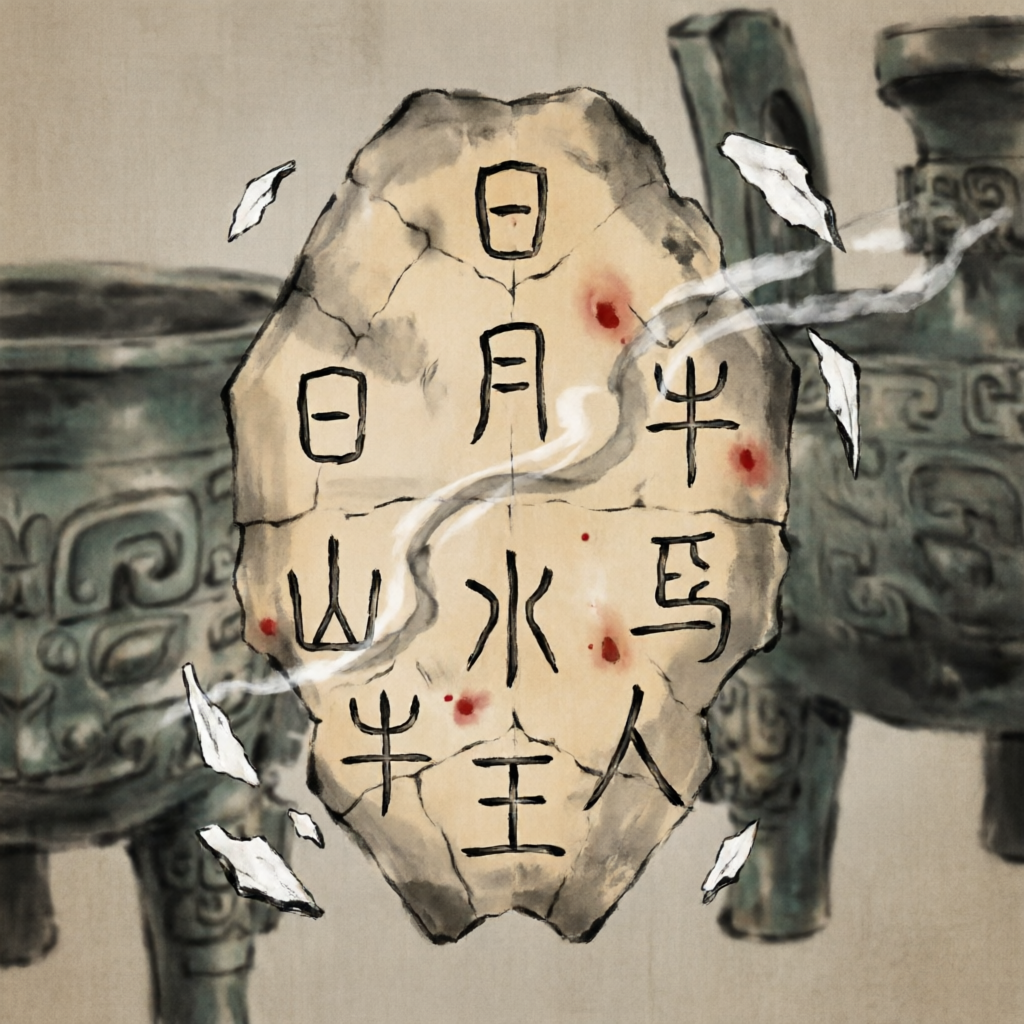
Oracle Bone Inscriptions (甲骨文, Jiǎgǔwén), also known as Shell and Bone Script, represent the earliest known systematic Chinese writing. These ancient inscriptions were carved on turtle shells and animal bones during the Shang Dynasty (c. 1600-1046 BCE), primarily for divination purposes. The discovery of Oracle Bone Inscriptions in the late 19th century revolutionized the understanding of early Chinese history, providing direct evidence of a mature writing system from over 3,000 years ago. Today, over 150,000 fragments have been discovered, containing more than 4,000 distinct characters, of which approximately 2,800 have been deciphered.
History
The exact date of Oracle Bone Inscriptions' discovery remains debated. Archaeological evidence suggests that oracle bones may have been unearthed in the Anyang area of Henan Province as early as the Northern Song Dynasty (960-1127 CE), as Shang Dynasty bronze vessels were frequently found there. However, these early discoveries did not attract scholarly attention until the late Qing Dynasty.
The widely credited discovery occurred in 1899 when Wang Yirong (1845-1900), a high-ranking official and scholar of ancient bronze and stone inscriptions (jinshi xue), noticed strange characters on "dragon bones" (龙骨) - fossilized bones used in traditional Chinese medicine. Wang, who served as the head of the Imperial Academy (Guozijian), recognized these markings as an ancient writing system. He began purchasing all marked bones he could find, eventually collecting over 1,500 pieces. Unfortunately, Wang committed suicide in 1900 during the Boxer Rebellion before he could conduct further research.
After Wang's death, his collection was acquired by his friend Liu E (1857-1909), author of the famous novel "The Travels of Lao Can" (老残游记). Liu expanded the collection to over 5,000 pieces and published the first book on oracle bones, "Iron Clouds Tortoise Shell Collection" (铁云藏龟) in 1903. This publication marked the beginning of formal oracle bone studies.
In 1908, scholar Luo Zhenyu (1866-1940) determined that the oracle bones originated from Xiaotun Village in Anyang, Henan Province - the site of the final Shang capital known as Yin (殷墟). Luo's research confirmed that these inscriptions were indeed Shang Dynasty royal records, establishing the foundation for modern oracle bone studies.
Key Information
| Feature | Description |
|---|---|
| Time Period | Late Shang Dynasty (c. 14th-11th century BCE) |
| Discovery | 1899 by Wang Yirong in Anyang, Henan Province |
| Materials | Primarily turtle plastrons and ox scapulae |
| Content | Divination records, royal announcements, economic activities |
| Characters | Over 4,000 distinct characters; approximately 2,800 deciphered |
| Major Collections | National Library of China (35,651 pieces), Palace Museum |
Cultural Significance
Oracle Bone Inscriptions hold immense cultural significance as they provide direct evidence of early Chinese writing, political organization, religious practices, and daily life during the Shang Dynasty. These inscriptions reveal a highly developed civilization with complex religious beliefs, extensive state rituals, and sophisticated administrative systems.
The inscriptions document the Shang kings' communication with ancestral spirits and deities, covering topics from weather forecasts and harvest prospects to military campaigns and royal health. This practice of "respecting spirits and serving them first" (尊神, 尊敬鬼神) reflects the central role of religion in Shang society, as noted in classical texts like the Book of Rites (礼记·表记).
The discovery of Oracle Bone Inscriptions also validated historical accounts of the Shang Dynasty, which had previously been considered semi-legendary. The royal genealogies recorded on oracle bones largely correspond to those found in later historical texts like Sima Qian's Records of the Grand Historian (史记·殷本纪), confirming the historical continuity of Chinese civilization.
Modern Status
Today, Oracle Bone Inscriptions are recognized as one of China's most important archaeological discoveries, alongside the Dunhuang manuscripts and Peking Man fossils. The study of oracle bones has developed into a specialized academic field known as "oracle bone studies" (甲骨学), with scholars worldwide contributing to decipherment and analysis.
Major collections are preserved in institutions such as the National Library of China, which houses the world's largest collection of 35,651 pieces, and the Palace Museum. These institutions regularly exhibit oracle bones to educate the public about ancient Chinese writing and culture.
Contemporary interest in Oracle Bone Inscriptions extends beyond academia. The characters' aesthetic qualities have inspired modern calligraphy and design. In 2017, the Chinese Ministry of Education included oracle bone characters in the primary school curriculum, recognizing their importance in cultural education.
The international recognition of Oracle Bone Inscriptions continues to grow, with exhibitions held worldwide and increasing collaboration between Chinese and international scholars. These ancient inscriptions continue to provide insights into the origins of Chinese civilization and the development of writing systems globally.
References
-
Keightley, D. N. (1978). Sources of Shang History: The Oracle-Bone Inscriptions of Bronze Age China. University of California Press.
-
Qiu, Xigui. (2000). Chinese Writing: Its Origin and Evolution. Translated by Gilbert L. Mattos and Jerry Norman. The Society for the Study of Early China and the Institute of East Asian Studies, University of California.
-
Bagley, R. W. (Ed.). (2001). Ancient Sichuan: Treasures from a Lost Civilization. Princeton University Press.
-
Chen, Z. (2003). Oracle Bone Collections in the United States. Yale University Press.
-
Li, X. & Cook, D. (2013). Oracle Bone Collections in the United States: A Descriptive and Bibliographic Guide. Society for East Asian Archaeology.