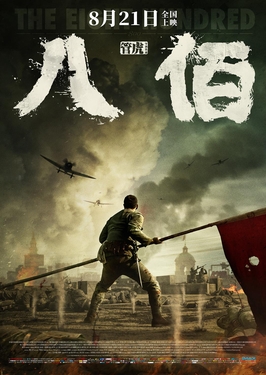
The Eight Hundred (2020)
Synopsis
Directed by Guan Hu, this 2020 war epic depicts the 1937 Defense of Sihang Warehouse during the Battle of Shanghai. With 3.1 billion RMB at the box office, it became the highest-grossing film worldwide in 2020 and the highest-grossing Chinese war film ever.
Overview
The Eight Hundred (八佰) is a 2020 Chinese war film directed by Guan Hu, released in mainland China on August 21, 2020. Starring Zhang Yi, Jiang Wu, Wang Qianyuan, Ou Hao, Du Chun, Wei Chen, and Li Chen, the film is based on the historical Defense of Sihang Warehouse during the closing stages of the 1937 Battle of Shanghai.
The story follows soldiers of the 524th Regiment of the 88th Division of the National Revolutionary Army -- approximately 400 men in reality but publicly claimed as 800 (hence 'Eight Hundred') -- who, under the leadership of battalion commander Xie Jinyuan, defended the Sihang Warehouse on the north bank of Suzhou Creek against the Japanese army for four days and four nights. On the opposite bank lay the Shanghai International Settlement -- one side a warzone, the other a glittering city of neon lights -- creating a profoundly striking visual contrast.
The film grossed 3.1 billion RMB, becoming the highest-grossing film worldwide in 2020 and the highest-grossing Chinese war film in history. It holds a Douban rating of 7.5 out of 10.
Historical Background
In August 1937, the Battle of Shanghai erupted -- one of the largest and bloodiest battles of the Second Sino-Japanese War. After three months of fierce fighting, Chinese forces were forced to retreat. To cover the withdrawal of the main force, the 524th Regiment of the 88th Division was ordered to remain in Shanghai and defend the Sihang Warehouse.
The Sihang Warehouse, named for the four banks (Gold City, China United, Continental, and Yien Yieh) that jointly owned it, was one of the most reinforced concrete structures in the Zhabei district at the time.
Commander Xie Jinyuan led approximately 420 officers and men (publicly claiming 800 to boost morale) into the warehouse. Facing Japanese forces several times their size, they held the position for four days and nights, repelling multiple Japanese assaults. Though small in scale, the battle greatly boosted the morale of the Chinese military and civilian population.
Cast
| Role | Actor | Notes |
|---|---|---|
| Lao Yangpi | Zhang Yi | Veteran soldier, battle-hardened |
| Lao Tie | Jiang Wu | Steady veteran |
| Yang Guai | Wang Qianyuan | Soldier with distinct personality |
| Duanwu | Ou Hao | Young Hubei militia soldier |
| Xie Jinyuan | Du Chun | Battalion commander |
| Zhu Shengzhong | Wei Chen | Hot-blooded youth |
| Shandong Soldier | Li Chen | Soldier from Shandong |
Production and Impact
Guan Hu spent nearly a decade preparing for this film. The production built a 1:1 recreation of the Sihang Warehouse at Qingdao Oriental Movie Metropolis, with filming lasting nearly a year. To achieve authentic battle scenes, the crew used IMAX cameras extensively -- it was the first Asian war film to be shot entirely with IMAX cameras.
The most striking visual element of the film is the contrast across Suzhou Creek: the north bank a blood-soaked battlefield, the south bank filled with spectators from the International Settlement. This 'one river, two worlds' concept is presented with tremendous visual impact.
Released on August 21, 2020, The Eight Hundred topped the box office for multiple consecutive weeks, ultimately grossing 3.11 billion RMB -- making it the highest-grossing film globally in 2020 and the first Asian film to top the annual worldwide box office.
References
- Douban - The Eight Hundred (2020): movie.douban.com/subject/26754233
- Baidu Baike - The Eight Hundred: baike.baidu.com/item/八佰
- Wikipedia - The Eight Hundred: en.wikipedia.org/wiki/The_Eight_Hundred
- Guan Hu director interviews
- 2020 Global Box Office Records
Stills & Gallery
Comments (0)