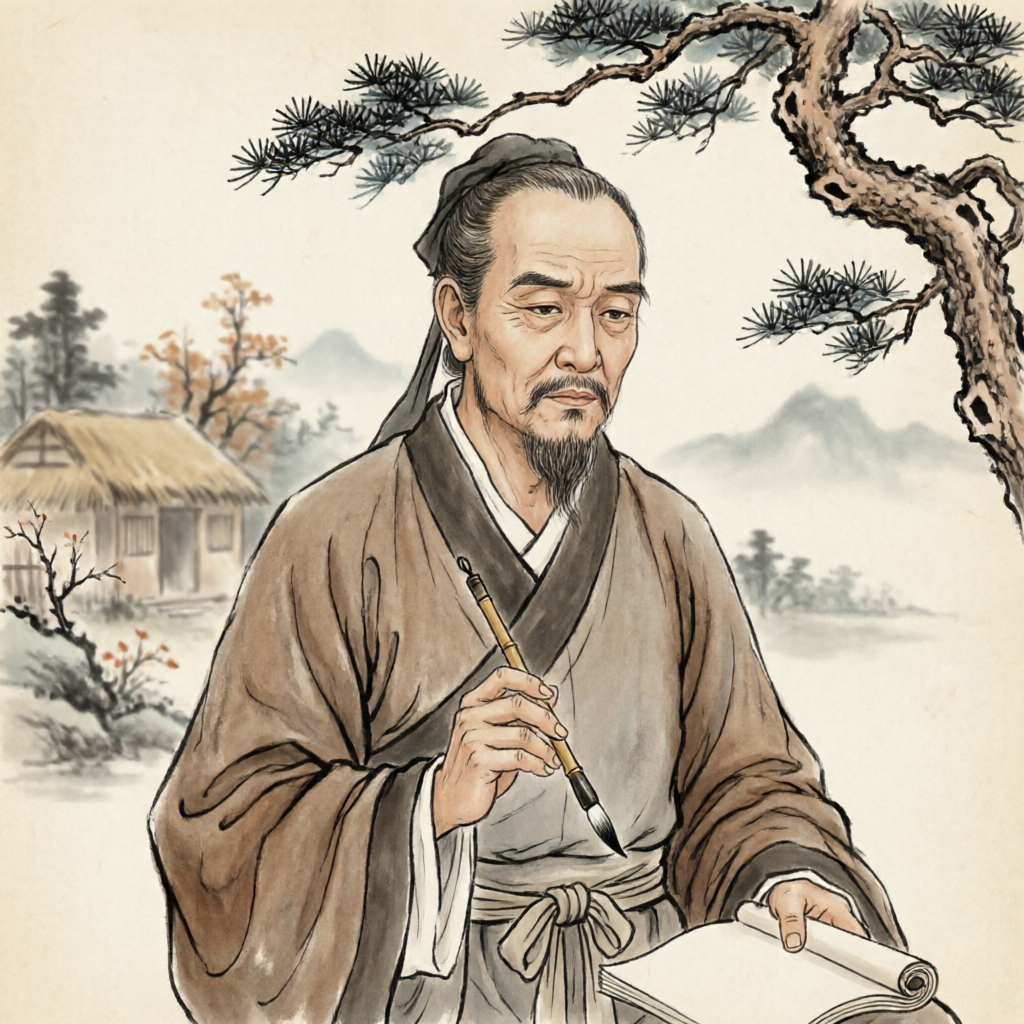
Du Fu
Overview
Du Fu (712-770) was a prominent Chinese poet of the Tang Dynasty, widely regarded as one of the greatest figures in Chinese literature. Born during the height of the Tang's prosperity, he lived through the devastating An Lushan Rebellion (755-763) and witnessed the dynasty's decline. His poetry, known for its profound humanity, technical mastery, and social consciousness, earned him the posthumous title "Poet-Historian" for his detailed documentation of his era's social and political realities.
History
Family Background
Du Fu hailed from the prestigious Du clan of Jingzhao, claiming descent from Du Zhou, a harsh official during the reign of Emperor Wu of Han. In his Sacrificial Text to the Distant Ancestor Lord Dangyang, Du Fu identified himself as the thirteenth-generation descendant of Du Yu, a famous minister of the Western Jin Dynasty. The Du family's ancestral home was Xiangyang (modern-day Hubei Province), but they had relocated to Gongxian (modern-day Henan Province) by the time of Du Fu's great-grandfather Du Yiyi, who served as the county magistrate of Gongxian.
Du Fu was born on the first day of the first lunar month in 712 (February 12, 712, in the Gregorian calendar) in Yaowan Village, two li east of Gongxian county town (modern-day Gongyi, Henan). His grandfather was Du Shenyan, who served as the Registrar of the National University and Direct Academician of the Xiuwen Academy during the reign of Emperor Zhongzong of Tang, ranking alongside famous poets Shen Quanqi and Song Zhiwen. His father, Du Xian, was Du Shenyan's eldest son and reached the position of Sima of Yanzhou.
Du Fu took great pride in his family's tradition of "upholding Confucianism and serving as officials, without abandoning the ancestral profession" and their poetic heritage. His mother, from the Cui clan, died when he was young. The Cui family was also a prominent lineage, and Du Fu frequently mentioned his encounters with various maternal uncles and cousins throughout his life. After his mother's death, Du Xian married a woman from the Lu clan. During most of his childhood, Du Fu was raised by his second aunt in Eastern Capital Luoyang, receiving careful attention and care.
Education and Travels
Thanks to his family's优越 (superior) circumstances, Du Fu enjoyed a stable and affluent life in his youth. He showed an early aptitude for learning, composing poems by age seven, as he later recalled: "At seven, my thoughts were already strong, opening my mouth to sing of phoenixes." By age nine, he could write large characters and had filled a bag with his compositions. He aspired to "help the ruler become like Yao and Shun, and once again make customs pure."
During his teenage years, Du Fu was exposed to various cultural and artistic influences that significantly shaped his future poetic endeavors. At ages five or six, he witnessed the sword-dance performer Gongsun Dainiang's performance in Yancheng, Henan. Later in Luoyang, he heard the singing of Li Guinian in front of the residence of Prince Qi Li Fan and in the hall of Cui Di, a favored minister of Emperor Xuanzong. He also admired paintings by the master painter Wu Daozi in the Temple of the Mysterious Emperor on the northern Mang Mountain in Luoyang. These experiences later found expression in his poetry.
When Du Fu came of age during the "Prosperous Kaiyuan Era," rural prosperity and developed transportation facilitated a tradition of nationwide wandering among ambitious young scholars. In 731, at nineteen, Du Fu traveled to Xunxia (modern-day Linshi, Shanxi). The following year, he embarked on a multi-year journey through Wu and Yue regions. In 735, he returned to his hometown to participate in the provincial examination. In 736, Du Fu took the imperial examination in Luoyang but failed to pass the jinshi degree. As his father Du Xian then served as Sima of Yanzhou, Du Fu traveled there to visit his family and subsequently journeyed with Su Yuanming and others to the plains of Qi and Zhao, embarking on his second wandering journey.
In Qi and Zhao, Du Fu spent four or five years in a "fast and unrestrained" life, leaving behind his earliest surviving poems. Ascending the Yanzhou City Tower was written during his visit to his father in Yanzhou. Painting of an Eagle and Horse of Captain Fang celebrated eagles and fine horses with youthful enthusiasm. His masterpiece Gazing at Mount Tai contained the immortal lines: "I shall climb to the summit, to behold all other mountains as small," revealing Du Fu's extraordinary ambitions in his youth.
In the fourth month of 744, Du Fu met Li Bai in Luoyang, who had been dismissed from imperial service by Emperor Xuanzong. The two traveled together to Liang and Song (modern-day Kaifeng and Shangqiu, Henan), meeting the poet Gao Shi. Du Fu later wrote in Past Journeys: "In former days with Gao and Li, we climbed the Shanfu Terrace at dusk." The following year, Du Fu met Li Bai again in Qi and Lu. Beyond drinking and composing poetry, they discussed alchemy and immortality and jointly visited the hermit Fan Ye in northern Yanzhou. They exchanged poems: Du Fu wrote to Li Bai, "I too am a guest of Dongmeng, cherishing you like a brother. We sleep autumn nights under the same quilt, and walk hand in hand daily." Li Bai replied, "Autumn ripples fall on the Si River, the sea's colors brighten the Culai peaks. Like flying tumbleweeds, we drift apart—let's finish the cups in our hands!" They never met again after this parting.
Hardship in Chang'an
Du Fu's "pleasurable" period of education and travel ended when he was thirty-four. In 746, he returned to Chang'an. Although the romantic and leisurely atmosphere of the capital had not completely faded, with nobles like the Prince of Hanzhong and the residence of the驸马 (imperial son-in-law) Zheng opening their doors to him, Du Fu's primary purpose was to take the imperial examination to secure an official position.
In 747, Emperor Xuanzong issued an edict summoning all those proficient in any art to Chang'an for examination. Du Fu participated, but due to a scheme orchestrated by the powerful chancellor Li Linfei in which he claimed "no worthy talent was left in the wilderness," all candidates failed. With the civil service examination path blocked, Du Fu attempted to achieve his political ideals by cultivating relationships with powerful officials and submitting his writings, but to no avail. He lived in poverty and frustration for ten years in Chang'an, as described in his Poem Presented to Left Minister Wei: "I state my ambition to help the ruler become like Yao and Shun, while also lamenting the bitterness and humiliation of seeking favors from the powerful."
In 751, Emperor Xuanzong planned three major sacrificial ceremonies. Du Fu submitted Three Major Rites Odes in advance of the ceremonies and gained the emperor's appreciation. He was ordered by the chancellor to compose additional texts for examination at the Jixian Academy, but the result merely granted him eligibility for official appointment. By 755, Du Fu was appointed as the Wei of Hexi, but declined this "humiliating" position. The court then reassigned him to the position of Adjutant of the Right Guard Commandery (or according to some sources, Adjutant of the Armor Bureau, though Du Fu himself noted in Amusing Poem After Official Appointment: "At the time, I was excused from the Hexi position and became Adjutant of the Right Guard Commandery.")
At forty-four and after more than a decade in Chang'an, Du Fu accepted this position of little practical use for his livelihood. In November, he traveled to Fengxian (modern-day Pucheng County, Shaanxi) to visit his family. Upon arriving home, he heard weeping—his youngest son had starved to death. Based on his experiences in Chang'an and observations along the way, he wrote the famous Five Hundred-Character Poem on My Journey from the Capital to Fengxian County. During this period, suffering from hunger, cold, and illness, Du Fu gained a clear understanding of the corruption within the ruling class and developed increasingly profound awareness of the suffering of soldiers and common people, as well as the crisis facing the nation. Besides Five Hundred-Character Poem, he also wrote poems addressing contemporary issues such as Song of the War Chariots and Beautiful Lady's Song.
Wandering Amid War and Rebellion
In November 755, An Lushan rebelled in Fanyang, triggering the An Lushan Rebellion. The following June, Tongguan fell, and Emperor Xuanzong fled west in haste. In July, Crown Prince Li Heng ascended the throne in Lingwu (modern-day Lingwu City, Ningxia) as Emperor Suzong. At this time, Du Fu was leading his wife and children north from Fengxian to Sanchuan and had taken refuge in Qiang Village, Fuzhou (modern-day Fu County, Shaanxi). Hearing of Emperor Suzong's enthronement, he arranged for his family's safety and traveled alone to Lingwu in August but was captured by rebel forces along the way and taken to Chang'an.
While imprisoned, Du Fu witnessed the occupied capital and created a series of "poetry-history" masterpieces including Lament for Chentao, Moonlit Night, and Spring View. He closely followed the development of the situation and wrote two essays: Memorial to Governor Guo of Huazhou on the Situation for Eradicating the Remnant Rebels and Five Questions for the Imperial Examination Candidates in Huazhou in the First Year of Qianyuan, offering strategies to suppress the An Lushan rebels and alleviate the people's burdens. When the elite troops led by Li Suye, the Jiedushi of Beiting, passed through Huazhou on their way to the capital, Du Fu wrote Two Poems Observing the Anxi Army Passing Through Guanzhong Awaiting Orders, expressing strong patriotic sentiment.
Imperial Service and Demotion
In April 757, as Guo Ziyi's army approached Chang'an from the north, Du Fu risked escaping through the Jingguang Gate in the west of the city, passing through the opposing armies to Fengxiang (modern-day Baoji, Shaanxi) to join Emperor Suzong. On May 16, he was appointed as Left Remonstrance by Emperor Suzong, hence known as "Du Shiyi" (Du the Left Remonstrance). As a minor official who had served in office for less than a year when war broke out, he was deeply moved to hold this position as a close advisor to the emperor. Having long held the grand ambition of "I foolishly dedicate myself to serve, secretly comparing myself to Ji and Xie; to help the ruler become like Yao and Shun, and once again make customs pure," Du Fu felt his moment had come.
However, within less than a month of his appointment, Du Fu encountered the major event of Emperor Suzong dismissing Chancellor Fang Guan. He submitted a memorial to save Fang. Believing that Fang was loyal only to Emperor Xuanzong and not to him, Emperor Suzong handed Du Fu over to the Three Judicial Offices for interrogation. Fortunately, the newly appointed chancellor Zhang Hao and Censor-in-Chief Wei Zhi interceded, saying: "Although Du Fu's words are reckless, he maintains the proper conduct of a remonstrance official." Du Fu was spared criminal punishment and was only ordered to return to Fuzhou to visit his family. During this home visit, Du Fu wrote two masterpieces: The Northern Expedition and Three Poems of Qiang Village.
While Du Fu was briefly resting in Qiang Village, the Tang army recaptured Chang'an in September and Luoyang in October. After Emperor Suzong returned to Chang'an, Du Fu also returned with his family in November to continue his service as Left Remonstrance. Although Du Fu had sensed Emperor Suzong's alienation during his home visit, he may not have realized that the sidelined Fang Guan remained a thorn in the emperor's side, nor that Emperor Suzong and his confidant Li Fuguo were fabricating a so-called "Fang Party" that included Jia Zhi, Yan Wu, Liu Zhi, and Du Fu himself. Thus, in the spring of 758, he still composed a eulogy poem In Response to Jia Zhi's Poem on the Morning Court at Daming Palace with Wang Wei and Shen Congshan. Shortly thereafter, Jia Zhi, Fang Guan, and others were successively demoted, and Du Fu was simultaneously demoted to Simo of Huazhou (modern-day Huaxian, Shaanxi).
Four Journeys
In September 758, Guo Ziyi, Li Guangbi, and other nine jiedushi led troops north to suppress An Qingxu. Shortly after the Tang army's departure, they achieved success by crossing the Yellow River and besieging Yecheng. That winter, Du Fu traveled to the Eastern Capital Luoyang, not far from the front line, to visit his former residence in Tlou Village, Yanshi, and inquire about the siege situation. The following spring, hearing that Yecheng would soon be captured, he excitedly wrote the long poem Washing the Weapons in anticipation.
However, while the court and public eagerly awaited the recapture of Yecheng and the capture of An Qingxu, the 600,000 Tang troops suffered a disastrous defeat outside Yecheng on March 3, 759 (see the Battle of Yecheng). Guo Ziyi led the Shuofang Army back to defend Heyang. Amid the chaos in the Eastern Capital, Du Fu traveled back to Huazhou via Xin'an, Shihao, and Tongguan. Along the way, he witnessed officials disregarding the people's welfare, forcibly conscripting soldiers and laborers, hearing only the laments and weeping of women, children, and the elderly. At the same time, he saw many people actively supporting the government army. These impressions left a deep mark on him, leading him to write six "new title Yuefu" poems later known as the immortal "Three Officials" and "Three Separations." These six poems not only depicted the price paid by the people for the war but also their spirit of selfless sacrifice.
Back in Huazhou, the threat of drought began, leaving the people with no way out under the dual pressure of natural disaster and war. Du Fu wrote Summer Lament and Summer Night Lament, lamenting the nation's suffering and the people's hardship. Faced with the turbulent political situation and uncontrollable famine, he abandoned his official post in July 759, leading his family far away to Qinzhou (modern-day Tianshui, Gansu) to seek a new livelihood.
In Qinzhou, Du Fu intended to find a place to settle in Dongke Valley or Xizhi Village, but this region, inhabited by Qiang and Hu peoples with expanding Tibetan influence, was not suitable for long-term residence. However, during his three months there, he added many new frontier-themed works to his poetry collection (Miscellaneous Poems of Qinzhou, Gazing at the Scene, etc.). By October, with the thought of "no food, I ask for a happy land; no clothes, I think of the southern regions," he led his family south to Tonggu (modern-day Cheng County, Gansu). After traveling for several days, they fell into a desperate situation of hunger and cold upon arrival in Tonggu. These painful experiences were recorded in Seven Poems Composed in Tonggu County During the Qianyuan Era. After staying in Tonggu for over a month, Du Fu set off for Chengdu in December.
Between Qinzhou and Tonggu, and then Tonggu to Chengdu, Du Fu systematically wrote twenty-four travel poems including Qingyang Gorge, Mupi Ridge, Feixian Pavilion, Wupan, and Jianmen. Each section contained twelve poems, documenting the actual appearance of the mountains and rivers he traversed step by step. During this year, Du Fu made "four journeys in one year"—from Luoyang to Huazhou, Huazhou to Qinzhou, Qinzhou to Tonggu, and Tonggu to Jiannan. This was a year of hard travel for him, but also a year of tremendous ideological change and unprecedented poetic achievement.
Residing in Shu (Sichuan)
When Du Fu's family first arrived in Chengdu, they lived in a sparsely populated ancient temple, supported by "old friends providing grain and vegetables, and neighbors sharing garden produce." Not only could the family's livelihood be temporarily maintained, but they also began building a thatched cottage west of the Huahua River the following year (later known as the "Du Fu Thatched Cottage" or "Huahua Thatched Cottage"). After years of wandering during the war, Du Fu finally had a place to live. Once settled, he busied himself planting trees, bamboo, and vegetables, while also visiting neighboring counties like Shuzhou, Xinjin, and Qingcheng to borrow money from friends and relatives. Walking or traveling by boat, he unintentionally wrote many pleasant and fitting small poems such as For the Farmer, Rural Dwelling, Two Poems of Water Railings, Guests Arrive, and *Entering the Boat.
Unfortunately, this peaceful period did not last long. In May 761, a 200-year-old pomelo tree beside Du Fu's cottage was uprooted by a violent storm. More不幸 (unfortunately), in August of the same year, his newly built cottage was damaged by another storm, leaving his family with "no dry place by the bed, raindrops like hemp without end." In sleepless nights, Du Fu extended his personal suffering to the countless displaced people throughout the empire, furiously writing the famous lines: "How I wish for millions of spacious houses to shelter all the poor scholars, keeping them happy and secure against wind and rain. When will this suddenly appear before my eyes? Even if my own cottage collapses and I freeze to death, I shall be content."
During this period, the court offered Du Fu the position of Sima of the Capital, but he did not accept it. In December 761, Du Fu's old friend Yan Wu was promoted from Prefect of Mianzhou to Jiedushi governing both eastern and western Sichuan. In the spring and summer of 762, Du Fu and Yan Wu visited each other multiple times. In their exchanged poems, Yan Wu encouraged him to take up official service again, while Du Fu hoped Yan Wu would understand his detached and lazy nature. In April of the same year, Emperor Xuanzong and Emperor Suzong died successively, and Emperor Daizong ascended the throne. In July, Yan Wu was summoned to the capital. Du Fu personally saw him off at Fengyi Station in Mianzhou, but unexpectedly, the military commander of western Sichuan, Xu Zhidao, launched a rebellion in Chengdu, blocking Yan Wu's exit from Jianmen. Du Fu could not return to Chengdu and had to turn to Zizhou, relying on new friends like "Li Zizhou" and "Yan Er Biejia." In August, Xu Zhidao's rebellion was suppressed by Gao Shi, but the turmoil continued, forcing Du Fu to move his family to Zizhou and consider leaving eastern Sichuan for the Three Gorges and then the Western Capital.
At this time, the military situation in the Central Plains had significantly improved. After ascending the throne, Emperor Daizong ordered his eldest son Prince Li Shi to be the commander-in-chief of the empire's forces and Pugu Huai'en as deputy commander-in-chief to attack Shi Chaoyi. In January 763, Shi Chaoyi was forced to commit suicide, and all prefectures in Henan and Hebei were recaptured. When this news reached Zizhou, Du Fu wept with joy and wrote what he called "my happiest poem in life," Heard That the Government Army Has Recovered Henan and Hebei. However, his family was still fleeing in Zizhou and could not return to their hometown. In the same year, Yan Wu returned to serve in Sichuan again. Overjoyed by the news of Yan Wu's return, Du Fu led his wife back to Chengdu in the spring of 764. In March, upon returning to Chengdu, Yan Wu recommended him as an advisor to the Jiedushi and concurrently as the Assistant Gentleman of the Ministry of Works, awarded with a red fish bag (a symbol of official rank). Henceforth, Du Fu was known as "Du Gongbu" (Du of the Ministry of Works). Back at the cottage, he had plans to beautify his surroundings and visit neighbors and friends, but upon entering the Jiedushi's office, he entered an atmosphere of military preparations. In July, Yan Wu personally went to the front line and wrote the poem Early Autumn at the Military City. Du Fu responded with In Response to Yan Wu's Early Autumn at the Military City, praising Yan Wu's victory over more than 70,000 Tibetan troops and the capture of Danggou and Yanchuan. After serving in the administration for half a year, with a constrained life and inevitable conflicts with colleagues, Du Fu resigned from his post on the third day of the first lunar month in 765 and returned to the Huahua River.
Wandering South
In April 765, Yan Wu died, and Du Fu had no support in Chengdu. In May, he led his family east along the Min River, ending his "five years as a guest in Shu Commandery and one year in Zizhou," beginning his "journey to the Xiao and Xiang rivers."
Accompanied by eastbound boats, Du Fu reached Jiazhou (modern-day Leshan, Sichuan) in May, Rongzhou (modern-day Yibin, Sichuan) in June, Yuzhou (modern-day Chongqing) in July, and Zhongzhou (modern-day Zhongxian County, Chongqing) in autumn. By this time, his illnesses of diabetes and malaria had flared up, so he stayed at the water pavilion of Prefect Yan Ming. In the spring of 766, he moved to Baidi City in Kuizhou (modern-day Fengjie County, Chongqing). In autumn of the same year, Bo Maolin, appointed as the governor of Kuizhou from Chengdu, frequently shared his monthly salary and occasionally sent melons and vegetables. In March 767, Du Fu bought forty mu of orchard land in the west of the Rang River, along with "a thatched cottage of eight or nine rooms." Bo Maolin also entrusted him with managing one hundred mu of rice paddy fields in Eastern Tun, making his life somewhat more prosperous than before.
From late spring 766 to early spring 768, when Du Fu was fifty-five to fifty-seven years old, he wrote over four hundred poems in less than two years—not only reaching a peak in quantity (nearly one-third of his surviving 1,400 poems) but also showing distinctive characteristics in content and form. He reflected on his life experiences and creative journey, writing autobiographical long poems such as Youthful Travels, Past Journeys, The Past, and Expressing My Feelings. The light and darkness of history merged with his own loves and hates, brewing boundless sorrow and bitterness. He remained a poet who "worried about the common people throughout the year," but his later poems, besides describing "a thousand families mourning in the wilds" and "a hundred nations at war," showed special concern for talented people, especially those who could restore order and truly love the country and its people, as evident in With Yuan the Envoy on His Chunling Journey and Parting with Li Fifteen Zhang. Poems like Sacrificial Text to the Late Chancellor Qinghe Duke Fang and Eight Lamentations reflected his views on talent. During this period, Du Fu also wrote many poems about the scenery, climate, local customs, and people's livelihood in Kuifu, striving to explore the artistic expression of the seven-character regulated verse form, creating works such as Five Poems on Ancient Sites, Five Poems to the Generals, and Eight Autumn Moods.
In January 768, Du Fu gave away the orchard and cottage he had bought the previous year to Wu Nanqing and led his family out of the Three Gorges by boat. When he reached Jiangling Prefecture, he had several literary gatherings with his closer acquaintances Zheng Shen and Li Zhifang, but his material conditions did not improve, and he continued to live a life of "relying on others' rice for food and worrying about cups everywhere." Later, Li Zhifang died, and a military rebellion occurred in Sichuan, gradually spreading to eastern Sichuan, making Jiangling unsuitable for long residence. Du Fu had to move south to Gong'an, staying there for two months. At the end of the year, he drifted to Yueyang and wrote his famous work Ascending Yueyang Tower. That winter, after a heavy snowfall in Yueyang, he also wrote the long poem Year's End Journey.
Due to financial difficulties, Du Fu continued southward in the spring of 769. In March, he reached Tanzhou (modern-day Changsha, Hunan). Although an "old man with a withered right arm and deaf ears," he still joyfully visited Lushan and Daolin temples. He then traveled south to join his friend Wei Zhijin, whom he had known since youth in Shanxi's Xunxia and who was now the Prefect of Hengzhou (modern-day Hengyang, Hunan). Unexpectedly, upon reaching Hengzhou, Wei Zhijin had been transferred to Tanzhou Prefect, missing Du Fu on the way. Soon after, news came that Wei Zhijin had died in Tanzhou, and Du Fu was deeply grieved, returning to Tanzhou.
Death on a Boat
In the spring of 770, Du Fu wrote several lyric poems in Tanzhou. He repaid in verse a poem Li Bai had given him ten years prior, with repeated emotional expressions mourning both Gao Shi and himself. He also conversed with swallows flying to his boat, feeling boundless about his own life's journey. Most admired is Meeting Li Guinian in Jiangnan. This short poem, spanning a long time, is filled with feelings of past glory and present decline.
In April of the same year, Zang Jie, the Military Commander of Hunan, killed the Hunan Observing Cui Gan and started a rebellion in Tanzhou. Du Fu's family fled again to Hengzhou. This was his final flight in life. His poems Entering Hengzhou, Fleeing from Danger, White Horse, and Suffering from Heat on a Boat Presented to Governor Yang and Briefly Communicated to All Officials in the Central Government described the outbreak of the rebellion, his family's escape, and Governor Yang Ji's cooperation with other prefectures to suppress Zang Jie. Subsequently, Du Fu led his family upstream along the Xiang River, planning to join his uncle Cui Wei in Chenzhou. However, when he reached Fangtian Station in Leiyang, the river flooded, forcing them to moor there. They starved for five days until Prefect Nie of Leiyang County sent beef and white wine to save them. Du Fu wrote Prefect Nie Sent Wine and Meat to Me Blocked by Water in the River, Curing My Hunger, and I Composed This Poem at the County, Which is Forty Li from Fangtian Station by Land or One Day's Journey by Boat, When the River Was Flooded and We Moored at Fangtian, expressing both praise and gratitude to Prefect Nie.
Since the boat could not proceed south, Du Fu had to return north to Tanzhou. In autumn, he successively wrote Returning to the Boat, Boarding the Boat to Go to Hanyang, and Late Autumn, Returning to Qin, Leaving Friends in the Hunan Administration, indicating his intention to go north to Xiangyang and the Qin region after leaving Tanzhou. In winter, while lying ill on the boat, Du Fu struggled to write his final work, Thirty-Six Rhymes Committed to Bed from a Boat Suffering from Wind Illness Presented to Friends in Hunan. Shortly after completing this poem, Du Fu passed away on the boat while traveling from Tanzhou to Yueyang at the age of fifty-nine.
After Du Fu's death, his family buried him in Yueyang. Forty-three years later, his grandson Du Siye had his coffin reburied in Yanshi, Henan (see "Later Commemorations - Du Fu's Tomb") and invited the poet Yuan Zhen to write the epitaph. In 1343, Emperor Shun of the Yuan Dynasty posthumously honored Du Fu with the title "Wenzhen".
Key Information
| Category | Information |
|---|---|
| Full Name | Du Fu (杜甫) |
| Alternative Names | Du Shaoling (杜少陵), Du Shi Yi (杜拾遗), Du Er (杜二), Lao Du (老杜) |
| Courtesy Name | Zimei (子美) |
| Style Name | Gongbu (工部) |
| Posthumous Title | Wenzhen (文贞) (conferred in 1343) |
| Birth Date | February 12, 712 (traditional: first day of first lunar month, Taiji era, Tang Ruizong's reign) |
| Birth Place | Yaowan Village, Gongxian (modern-day Gongyi, Henan) |
| Death Date | Winter 770 (traditional: seventh month, Dali era, Tang Daizong's reign) |
| Death Place | On a boat between Tanzhou and Yueyang (modern-day Changsha and Yueyang, Hunan) |
| Major Works | Five Hundred-Character Poem on My Journey from the Capital to Fengxian County, Spring View, Three Officials and Three Separations, Gazing at Mount Tai, Eight Autumn Moods, Heard That the Government Army Has Recovered Henan and Hebei |
| Highest Position | Left Remonstrance (左拾遗), Assistant Gentleman of the Ministry of Works (检校工部员外郎) |
| Literary Significance | Known as the "Poet-Historian" for documenting social conditions of the Tang Dynasty; master of various poetic forms, especially regulated verse; influenced generations of Chinese poets |
Cultural Significance
Du Fu's poetry has had an immeasurable impact on Chinese literature and culture. His works are celebrated for their profound humanity, technical mastery, and social consciousness. Known as the "Poet-Historian" for his realistic depictions of social conditions, his poems provide invaluable historical insights into the Tang Dynasty, particularly during the An Lushan Rebellion.
His famous lines "When I see the poor shivering in cold, I wish I could build them grand houses; when I see the world in chaos, I wish I could bring peace" reflect his lifelong concern for the common people. This spirit of compassion has made him a revered figure in Chinese culture, often contrasted with the romantic Li Bai as representing the more socially conscious aspect of Tang poetry.
Du Fu's influence extends beyond literature into Chinese philosophy and ethics. His commitment to social responsibility and moral integrity has made him a role model for Chinese intellectuals throughout history. His poetry is studied extensively in Chinese education, and many of his verses have become common expressions in the Chinese language.
Modern Status
Today, Du Fu is widely regarded as one of China's greatest poets. His works continue to be studied, translated, and appreciated worldwide. The Du Fu Thatched Cottage in Chengdu, where he lived for several years, has been preserved as a museum and cultural site, attracting numerous visitors annually.
Academic research on Du Fu's life and works remains active, with scholars analyzing his poetry from various perspectives including historical, literary, philosophical, and political angles. His works have been translated into numerous languages, making him one of the most widely read Chinese poets internationally.
In popular culture, Du Fu's life and works have inspired numerous films, television programs, and literary works. His poetry continues to resonate with modern readers for its timeless themes of social justice, human suffering, and resilience in the face of adversity.
References
-
Owen, Stephen. The Great Age of Chinese Poetry: The High Tang. Yale University Press, 1981.
-
Hightower, James R. "The Poetry of Tu Fu." In The Columbia History of Chinese Literature, edited by Victor H. Mair, pp. 291-323. Columbia University Press, 2001.
-
Egan, Ronald. The Burden of the Past and the Poets of the Present: Characterization in Traditional Chinese Poetry. Yale University Press, 1975.
-
Holzman, Donald. "Du Fu: China's Greatest Poet." Asia Major, Third Series, Vol. 8, No. 1, 1995.
-
Chaves, Jonathan. The Columbia Book of Later Chinese Poetry: Yüan, Ming, and Ch'ing Dynasties (1279-1911). Columbia University Press, 1986.