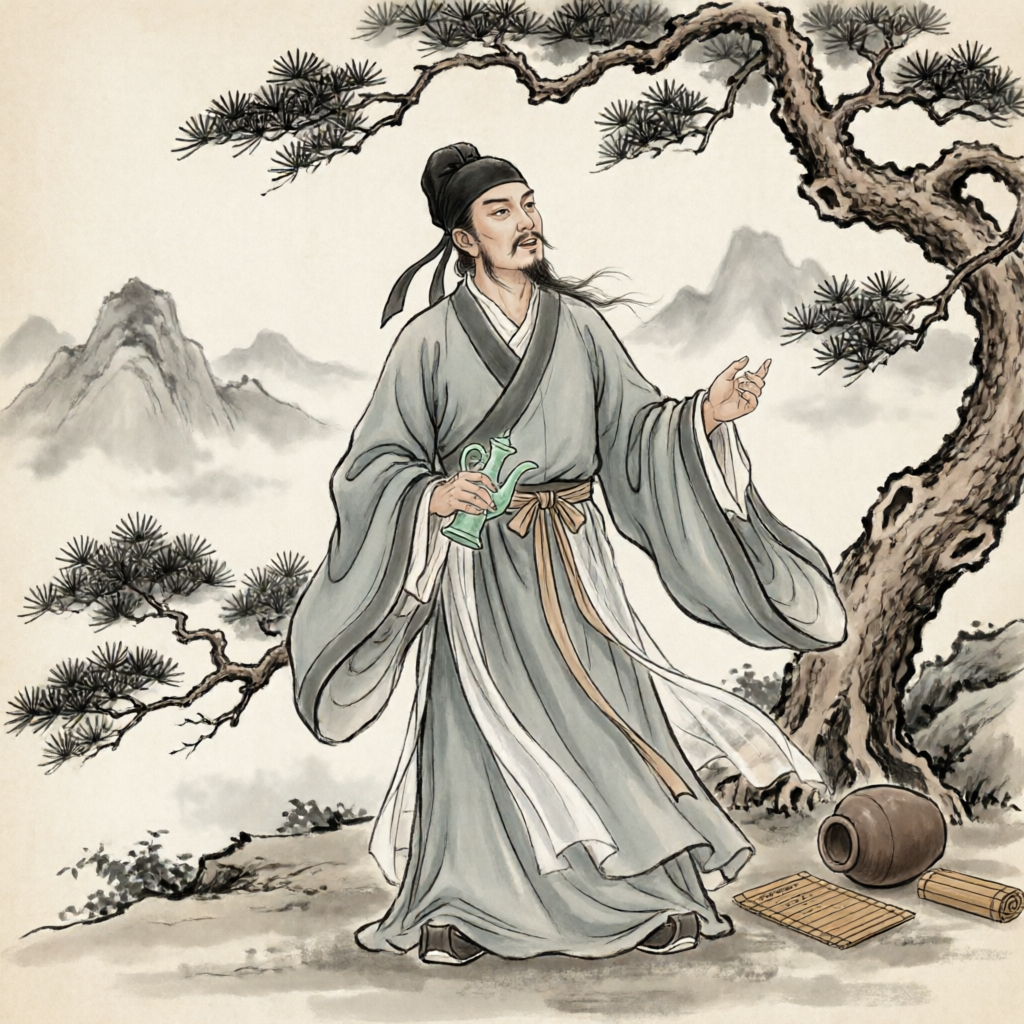
Li Bai
Overview
Li Bai (701-762), also known as Li Taibai, was a major Chinese poet of the Tang Dynasty, often regarded as one of the greatest poets in Chinese literary history. His poems, about 1,000 of which have survived, have been profoundly influential in both Chinese and world literature. Li Bai is best known for his imaginative and romantic works that celebrate the beauty of nature, friendship, and wine, often reflecting his Taoist beliefs and love for freedom.
History
Early Life and Talent
Li Bai was born in 701 in Changlong County, Mianzhou, Shu Commandery (modern-day Jiangyou, Sichuan Province), though some sources suggest he was born in Suye (modern-day Tokmak, Kyrgyzstan). His ancestors had migrated to Suye, but his father later fled to Shu, where Li Bai was born. His ancestral home was in Chengji, Longxi Commandery (modern-day Qin'an, Tianshui, Gansu Province). Little is known about his family background.
At the age of five, Li Bai began his education, memorizing the "liu jia" (six categories of characters), which were elementary literacy textbooks in the Tang Dynasty. By fifteen, he had composed numerous poems and gained recognition from some prominent social figures. He showed an early interest in swordsmanship and chivalrous behavior.
Travels and Early Career
In 724, at the age of twenty-four, Li Bai left his hometown and began his travels. He visited Chengdu, Mount Emei, and traveled east to Yuzhou (modern-day Chongqing). The following year, he left Shu, "bearing a sword, leaving his country, bidding farewell to his family and traveling far."
During his travels, Li Bai met many influential figures. In 726, he met Li Yong in Chenzhou and became friends with Meng Haoran. In 727, he married the granddaughter of former prime minister Xu Yushi and settled in Anlu. The following year, he traveled to Jiangxia (modern-day Wuhan) and met Meng Haoran again.
Seeking Official Position
In 734, Li Bai presented his "Mingtang Fu" (Ode to the Bright Hall) to Emperor Xuanzong, hoping to secure an official position. This work praised the magnificent beauty of the Bright Hall and the grandeur of the Kaiyuan era, reflecting his political ideals.
In 735, while traveling west, he presented his "Dalie Fu" (Great Hunt Ode) to the emperor, hoping to gain his favor. He also befriended Princess Yuzhen and presented her with poems expressing wishes for her to achieve immortality through Taoist practices. During this time, he met the poet He Zhizhang, who was so impressed by his "Shu Dao Nan" (The Hard Road to Shu) and "Wu Qi Qu" (Song of the Crows Roosting) that he exclaimed, "Sir, you are not of this world! Could you be an incarnation of the Star Tai Bai?" He thus became known as the "Banished Immortal." (xian ren zhe)
Service at the Imperial Court
In 742, due to the recommendation of Princess Yuzhen and He Zhizhang, Emperor Xuanzong summoned Li Bai to the palace. The emperor was so impressed that he personally welcomed Li Bai, offered him a seat on a precious inlaid bed, and even served him soup personally. Li Bai was appointed to the Hanlin Academy, responsible for composing poems and entertaining the emperor.
During his time at court, Li Bai wrote numerous poems for imperial banquets and outings. However, he grew weary of the life of a court poet and began to indulge in wine. He formed a group of "Eight Immortals of the Wine Cup" with other poets. His behavior, including allegedly asking the powerful eunuch Gao Lishi to remove his boots while drunk, led to resentment and slander. In 743, he was dismissed from his position and sent away with a gift of gold.
Friendship with Du Fu
In the summer of 744, Li Bai met Du Fu in Luoyang. This meeting between two of China's greatest poets was significant, as described by the scholar Wen Yiduo as "the sun and moon meeting in the blue sky." The two poets, despite an eleven-year age difference, established a deep friendship based on mutual respect.
That autumn, they met again in Liang Song (modern-day Kaifeng and Shangqiu) along with the poet Gao Shi. The three traveled together, discussing poetry and current affairs, expressing concern for the country's future. They visited Wangwu Mountain and sought out the Taoist master Sima Chengzhen, though they found he had already passed away. Li Bai composed the "Shang Yang Tai Tie" (Inscription on the Upper Sun Terrace) in remembrance.
Later Years and Death
After the outbreak of the An Lushan Rebellion in 755, Li Bai fled south with his wife. In 756, he joined the entourage of Prince Yong (Li Lin), who was rebelling against the emperor. After Prince Yong's defeat, Li Bai was imprisoned in Xunyang. He was rescued by Song Ruosi and Cui Huan but was later sentenced to exile in Yelai (modern-day Tongzi, Guizhou) for his involvement with Prince Yong.
In 759, due to a general amnesty, Li Bai was freed. He traveled downstream along the Yangtze River, expressing his joy in the famous poem "Early Departure from Baidi City." In his later years, he lived in poverty, depending on the generosity of friends. In 762, he fell seriously ill and entrusted his manuscripts to his relative Li Yangbing in Dangtu. He died shortly after, composing his final poem "Lin Lu Ge" (Song on the Road). The circumstances of his death remain uncertain, with accounts suggesting he died of illness, excessive drinking, or drowned while trying to embrace the moon in a drunken state.
Key Information
| Aspect | Details |
|---|---|
| Full Name | Li Bai (李白) |
| Courtesy Name | Li Shier (李十二) |
| Pseudonyms | Taibai (太白), Qinglian Jushi (青莲居士), Li Hanlin (李翰林), Li Gongfeng (李供奉), Li Shi Yi (李拾遗) |
| Birth Year | 701 CE (Chang'an era) |
| Birthplace | Changlong County, Mianzhou, Shu Commandery (modern Jiangyou, Sichuan) |
| Death Year | 762 CE (first year of Qianyuan era) |
| Death Place | Dangtu County (modern Dangtu, Anhui) |
| Ancestral Home | Chengji, Longxi Commandery (modern Qin'an, Gansu) |
| Major Works | "Quiet Night Thought" (静夜思), "Drinking Alone Under the Moon" (月下独酌), "Hard Road to Shu" (蜀道难), "The Song of Everlasting Regret" (长恨歌) |
| Highest Position | Hanlin Academician (翰林学士) |
| Literary Style | Romantic, free-spirited, imaginative, celebrating nature and wine |
| Influence | Profound impact on Chinese and world literature, considered a "Banished Immortal" (谪仙人) |
Cultural Significance
Li Bai's poetry has had an immense cultural impact in China and beyond. His works are celebrated for their romantic spirit, imaginative imagery, and emotional depth. He is often compared to the Romantic poets of Western literature for his emphasis on individual expression and emotional freedom.
His poems frequently feature themes of wine, friendship, nature, and the transient nature of life. The image of Li Bai drinking wine under the moon has become an iconic cultural symbol in China, representing the free-spirited scholar who finds inspiration in nature and companionship.
Li Bai's influence extends to various art forms. His poems have been illustrated in paintings, set to music, and adapted into films and television programs. The story of his friendship with Du Fu has become legendary in Chinese literary history, symbolizing the ideal relationship between two great artists.
Modern Status
Today, Li Bai is celebrated as one of China's greatest poets. His works are studied in schools throughout China and beyond, and he continues to inspire writers, artists, and scholars. The "Li Bai Cultural Park" in Jiangyou, his supposed birthplace, and numerous other sites associated with his life attract tourists and literary enthusiasts.
Modern scholars continue to study Li Bai's works, exploring their literary, historical, and philosophical significance. His poetry has been translated into numerous languages, making him one of the most widely translated Chinese poets. The themes of freedom, nature, and the human experience in his works remain relevant to contemporary readers worldwide.
References
-
Ebrey, Patricia Buckley. The Cambridge Illustrated History of China. Cambridge University Press, 1999.
-
Hightower, James Robert. The Poetry of T'ang China. Harvard University Press, 1970.
-
Yip, Wai-lim. Chinese Poetry: An Anthology of Major Modes and Genres. Anchor Books, 1969.
-
Owen, Stephen. The Great Age of Chinese Poetry: The High Tang. Yale University Press, 1981.