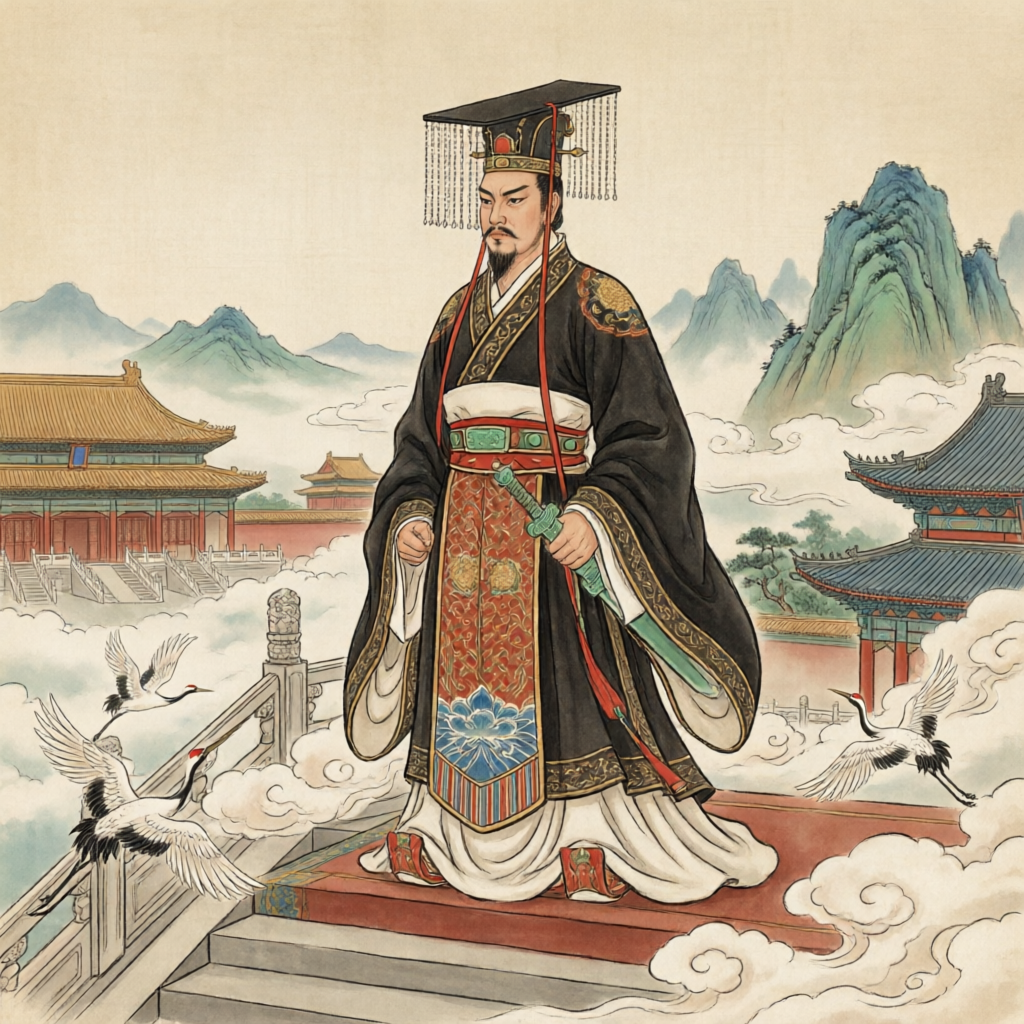
Emperor Wu of Han
Overview
Emperor Wu of Han (personal name Liu Che, 156 BCE – 87 BCE) was the seventh emperor of the Han dynasty of China, ruling from 141 to 87 BCE. His reign, known as the Wu era, marked a turning point in Chinese history as he transformed the Han dynasty from a relatively inward-looking state into a major imperial power with extensive territories and influence. Emperor Wu is remembered for his military campaigns that expanded China's borders to the north, west, and south; his promotion of Confucianism as the state ideology; and his centralized governance that strengthened imperial authority at the expense of feudal lords.
History
Early Life and Accession
Liu Che was born to Wang Zhi, one of Emperor Jing's consorts. Before his birth, Wang Zhi dreamed of a sun entering her womb, which Emperor Jing interpreted as an auspicious sign. Liu Che was born shortly after his grandfather Emperor Wen's death and Emperor Jing's ascension to the throne.
In 153 BCE, Emperor Jing made his eldest son Liu Rong (by Consort Li) the crown prince and Liu Che the Prince of Jiaodong. Liu Che's aunt, Princess Guantao, attempted to arrange a marriage between Liu Rong and her daughter Chen Jiao, but was rejected. Wang Zhi, however, promised the marriage to Liu Che, which caused Princess Guantao to slander Consort Li while praising Wang Zhi. When Consort Li made indiscreet remarks that angered Emperor Jing, the balance of power shifted toward Wang Zhi and her son.
In 150 BCE, after Empress Bo was deposed, Wang Zhi secretly arranged for the Minister of Ceremonies to recommend Consort Li as the new empress, which enraged Emperor Jing. He executed the minister, distanced himself from Consort Li, and demoted Liu Rong to the status of Prince of Linjiang. On April 17, 150 BCE, Wang Zhi was made empress, and on April 25, the seven-year-old Liu Che was named crown prince.
After becoming crown prince, Emperor Jing appointed Wei Wan as Grand Tutor and Wang Zang as Junior Tutor to educate Liu Che. On January 17, 141 BCE, Liu Che underwent the capping ceremony (coming-of-age ritual). Ten days later, Emperor Jing died, and Liu Che ascended the throne as Emperor Wu.
Early Reign and Confucian Reforms
In the early years of his reign, Emperor Wu was constrained by the influence of his grandmother Empress Dou, who favored Huang-Lao (Daoist) philosophy over the Confucian reforms he wished to implement. In 140 BCE, he replaced Chancellor Wei Wan and Censor-in-Chief Zhi Buwei with his maternal uncle Dou Ying (Marquis of Qi) and Tian Fen (Marquis of Wuan), both of whom supported Confucianism. He also appointed Confucian scholars Zhao Wan and Wang Zang as Censor-in-Chief and Gentleman of the Interior, respectively.
Emperor Wu summoned the renowned Confucian scholar Shen Gong to the capital, offering him honors and positions. Shen Gong advised that governance required "forceful action" rather than "mere words," which disappointed Emperor Wu who appreciated literary pursuits. Nevertheless, Emperor Wu initiated discussions about establishing a Bright Hall (Mingtang) for sacrifices, revising the calendar, changing ceremonial robes, and performing imperial tours and mountain sacrifices.
However, Empress Dou strongly opposed these Confucian reforms. In late 140 BCE, when Censor-in-Chief Zhao Wan requested that Emperor Wu no longer report state affairs to her, Empress Dou flew into a rage. She produced evidence of illegal activities by Zhao Wan and Wang Zang, demanding their imprisonment. Both died in custody, and Dou Ying and Tian Fen were dismissed. Emperor Wu was forced to abandon his Confucian reforms and return to a more conservative governance approach.
Consolidation of Power
After Empress Dou's death in 135 BCE, Emperor Wu finally gained full control of the government. He dismissed the sitting chancellors Xu Chang and Zhuang Qingdi, replacing them with his uncle Tian Fen as Chancellor and Han Anguo as Censor-in-Chief. Emperor Wu largely deferred to Tian Fen, allowing him to become arrogant and overbearing, until Emperor Wu reasserted his authority.
Emperor Wu gradually distanced himself from the Dou clan and eventually executed Dou Ying in 131 BCE following an incident involving General Guan Fu. Tian Fen also died soon after. Emperor Wu then began appointing officials based on merit rather than family connections, promoting even commoners to high positions. He broke precedent by appointing Gongsun Hong as Chancellor without first making him a marquis, establishing a new pattern of promotion.
Emperor Wu also elevated the position of Censor-in-Chief, allowing Zhang Tang to assume many of the Chancellor's functions, thereby reducing the Chancellor's ability to check imperial power. Meanwhile, he favored Lady Wei Zifu, a singer from his sister Princess Pingyang's household. When his empress Chen Jiao grew jealous and persecuted Lady Wei, Emperor Wu deposed Chen in 130 BCE on charges of witchcraft (wugu) and moved her to the Changmen Palace.
In 128 BCE, Lady Wei gave birth to Emperor Wu's first son, Liu Ju. Later that year, Lady Wei was made empress, and in 122 BCE, her son Liu Ju was named crown prince. Emperor Wu also appointed Lady Wei's brother Wei Qing and nephew Huo Qubing to expand the empire's borders, creating the new position of Grand Marshal to accommodate these military relatives.
Military Expansions
Emperor Wu abandoned the defensive posture of his predecessors and pursued an aggressive expansionist policy. His first targets were in the south. During his Jianyuan reign, he launched two campaigns against Minyue that ended without battle, boosting his confidence and resolve to expand in all directions.
Emperor Wu's most strategic objective was to "destroy the Hu" (Xiongnu nomads). To this end, he dispatched Zhang Qian to the Western Regions in search of allies against the Xiongnu. Although Zhang Qian was captured by the Xiongnu and eventually escaped without securing an alliance, his journeys opened up the Silk Road and provided valuable intelligence about Central Asia.
In 133 BCE, Emperor Wu approved the "Maigui Plot" to ambush the Xiongnu chanyu at Maigui, but the plan failed when the trap was prematurely sprung. The Xiongnu then broke off peace negotiations and increased border raids. In response, Emperor Wu promoted Wei Qing and Huo Qubing to lead repeated campaigns against the Xiongnu. By 119 BCE, these campaigns had driven the Xiongnu north of the Gobi Desert, though at considerable cost to the Han.
After securing the northern frontier, Emperor Wu turned his attention to other regions. In 113 BCE, he sent envoys to Nanyue to persuade its king to submit to Han authority. When the Nanyue prime minister Lu Jia assassinated the king and the Han envoys, Emperor Wu dispatched armies that conquered Nanyue, establishing nine commanderies in what is now Guangdong, Guangxi, Hainan, and northern Vietnam. In subsequent years, he also incorporated parts of Qinghai, northern Korea, and the Yunnan-Guizhou Plateau into the Han empire.
Later Reign and Internal Conflicts
Emperor Wu's later reign was marked by mounting social problems and internal court conflicts. His continuous military campaigns exhausted the state's resources, leading to widespread famine and peasant uprisings. By 107 BCE, over two million people were displaced, and reports described "empty cities and granaries" with "people fleeing in droves" and instances of cannibalism.
In the court, conflicts intensified between factions supporting Crown Prince Liu Ju and those favoring other potential heirs. As Liu Ju grew older and more vocal in opposing his father's military campaigns, a rift developed between them. When Emperor Wu's favored consort Lady Zhao bore him a son, Liu Fuling (rumored to have gestated for fourteen months, like the sage-king Yao), he named her palace gate "Yaomu Gate" (Gate of Yao's Mother), signaling his intention to replace Liu Ju with Liu Fuling.
These tensions culminated in the 91 BCE "Witchcraft Calamity" (wugu zhihuo), when accusations of witchcraft led to Crown Prince Liu Ju's rebellion. Liu Ju was defeated and committed suicide, and his mother Empress Wei also took her own life. The Wei clan was exterminated, and numerous officials were implicated and executed.
The following year, Emperor Wu discovered that Chancellor Liu Quzhi had conspired with Li Guangli (brother of his deceased favorite Li Yan) to install Liu Bo (son of Li Yan) as heir. He executed Liu Quzhi and Li Guangli's family, purging the anti-prince faction. He also built the Palace of Longing and the Terrace of Gazing Back to express remorse for his treatment of Liu Ju.
Final Years and Death
In 89 BCE, after a failed attempt to seek immortality at sea, Emperor Wu reversed course, dismissing the magicians and alchemists he had patronized. He issued the "Luntai Edict," rejecting proposals for further military campaigns and emphasizing the need to "end harsh policies, stop unauthorized taxes, focus on agriculture, and restore military preparedness." He also created the title "Marquis of Enriching the People" for his chancellor, signaling a shift toward restorative governance.
In 88 BCE, there was an assassination attempt on Emperor Wu by remnants of Jiang Chong's faction. The plot was foiled by his attendants Jin Midi, Huo Guang, and Shangguan Jie.
With his health failing, Emperor Wu began planning for succession. Having eliminated other potential claimants, he selected his young son Liu Fuling as heir. To prevent future court domination by Liu Fuling's mother Lady Zhao, he had her executed. He appointed Huo Guang, Jin Midi, Shangguan Jie, and Sang Hongyang as regents to ensure a smooth transition of power.
In early 87 BCE, Emperor Wu fell gravely ill and moved to suburban palaces. When "astrologers" detected "imperial aura" in the capital prisons, he ordered the execution of all prisoners, including Liu Ju's grandson. However, the official Bing Ji vehemently opposed this, and Emperor Wu relented.
On February 12, 87 BCE, on his deathbed, Emperor Wu formally named Liu Fuling as crown prince. The next day, the four designated regents received their final instructions beneath the emperor's bed. On February 14, Emperor Wu died and was buried in the Maoling mausoleum. He was posthumously known as Emperor Xiaowu, and later Emperor Shizong during the reign of his great-grandson Emperor Xuan.
Key Information
| Aspect | Details |
|---|---|
| Personal Name | Liu Che (刘彻) |
| Temple Name | Emperor Xiaowu (孝武皇帝), later Emperor Shizong (世宗) |
| Posthumous Name | Xiaowu Huangdi (孝武皇帝) |
| Era Names | Jianyuan (建元), Yuanguang (元光), Yuanshuo (元朔), Yuandi (元鼎), Yuanfeng (元封), Taichu (太初), Tianshan (天汉), Taishi (太始), Zhenghe (征和), Houyuan (后元) |
| Reign | 141–87 BCE |
| Predecessor | Emperor Jing (汉景帝) |
| Successor | Emperor Zhao (汉昭帝) |
| Major Accomplishments | Territorial expansion, promotion of Confucianism, centralization of power, establishment of imperial examination system |
| Tomb | Maoling Mausoleum (茂陵) |
| Consorts | Emp Chen (陈皇后), Emp Wei (卫皇后), Lady Li (李夫人), Lady Zhao (赵婕妤), etc. |
| Children | Crown Prince Liu Ju (太子刘据), Liu Fuling (刘弗陵), etc. |
Cultural Significance
Emperor Wu's reign had a profound and lasting impact on Chinese civilization. Politically, he established the pattern of centralized imperial rule that would characterize Chinese governance for the next two millennia. His creation of the imperial examination system, though initially limited, laid the foundation for the civil service examination system that would select officials based on merit rather than birth.
Culturally, Emperor Wu's adoption of Confucianism as state ideology transformed Chinese intellectual and political life. Under his reign, Confucian classics were standardized, and Confucian values became the foundation of the educational system and official ideology.
Militarily, Emperor Wu's campaigns expanded China's territory to unprecedented extents and established the Silk Road as a major conduit of cultural and commercial exchange between East and West. His policies toward the Xiongnu shaped Chinese relations with northern nomads for centuries.
Emperor Wu's reign also saw significant economic development, including the monopolization of salt and iron production by the state, the introduction of new coinage, and the establishment of a more sophisticated financial system.
Modern Status
In modern China, Emperor Wu is generally regarded as one of the most important emperors in Chinese history. His reign is often studied as a pivotal period in Chinese development, representing both the heights of imperial power and the challenges of maintaining such an empire.
Historians continue to debate Emperor Wu's legacy. While acknowledging his achievements in territorial expansion and cultural development, many also criticize his costly military campaigns and the heavy burden they placed on the population. His later reign, marked by the Witchcraft Calamity and social unrest, serves as a cautionary tale about the dangers of autocratic rule.
In popular culture, Emperor Wu appears frequently in literature, film, and television. His life and reign have been the subject of numerous novels, historical dramas, and academic studies, reflecting his enduring significance in Chinese historical consciousness.
References
-
Loewe, Michael. Emperor Wu: The Han Dynasty in Transition. Cambridge University Press, 1986.
-
Bielenstein, Hans. The Bureaucracy of Han Times. Cambridge University Press, 1980.
-
Dubs, Homer H. The History of the Former Han Dynasty by Pan Ku. Vol. 2. Baltimore: Waverly Press, 1944.
-
Twitchett, Michael, and Loewe, Michael, eds. The Cambridge History of China, Volume 1: The Ch'in and Han Empires, 221 B.C.–A.D. 220. Cambridge University Press, 1986.
-
Yu, Yingshi. Trade and Expansion in Han China: A Study in the Structure of Sino-Barbaric Economic Relations. University of California Press, 1967.