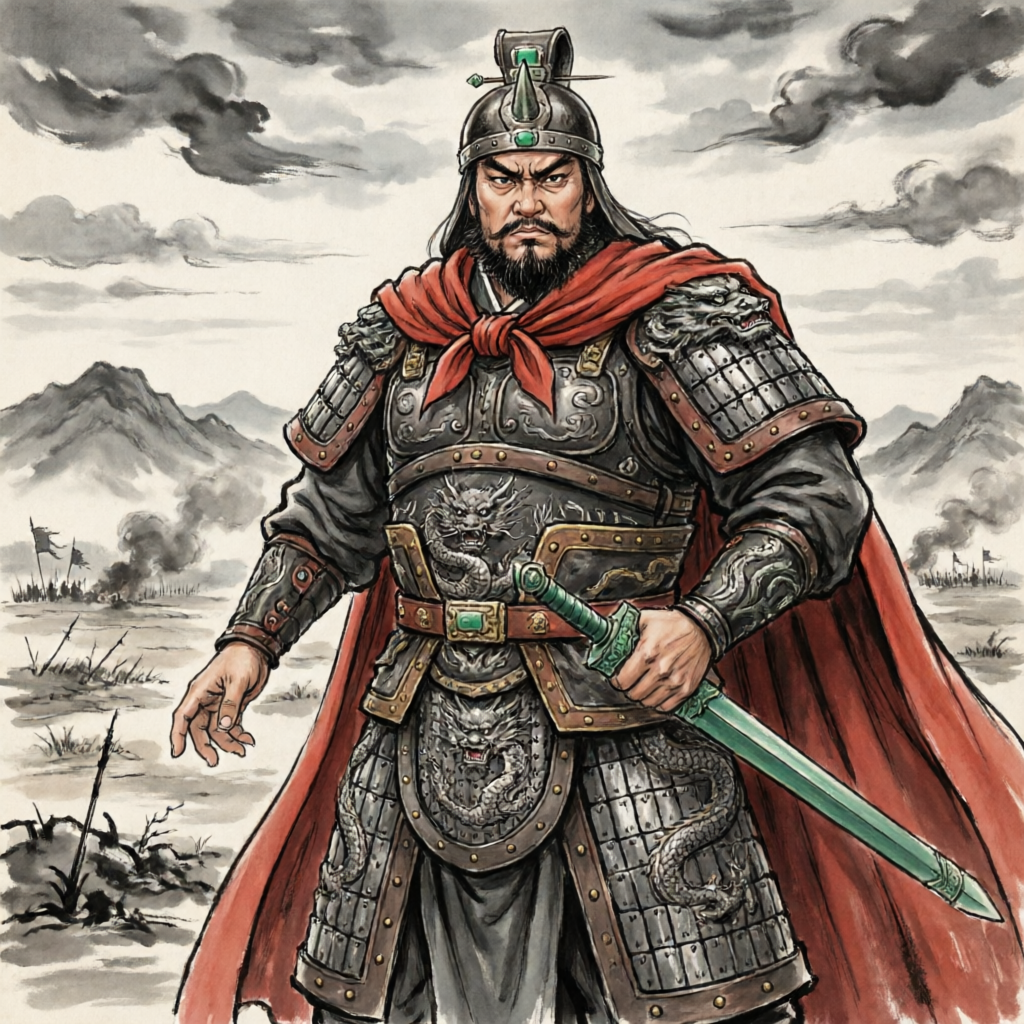
Xiang Yu
Overview
Xiang Yu (232-202 BCE), also known as Xiang Wang, Hegemon-King of Western Chu, was a powerful military leader who lived during the transition from the Qin Dynasty to the Han Dynasty in Chinese history. Born as Xiang Ji, he was the grandson of Xiang Yan, a renowned general of the Chu state. Xiang Yu rose to prominence during the rebellion against the Qin Dynasty, becoming one of the most formidable military commanders of his time. His military prowess was demonstrated in numerous battles, most notably the Battle of Julu, where he decisively defeated the main Qin forces. Despite his military achievements, Xiang Yu ultimately lost the Chu-Han Contention to Liu Bang, who would establish the Han Dynasty.
History
Early Life
According to historical records from the Tang and Song dynasties, Xiang Yu was descended from the royal family of the Xiang state, a vassal state of the Zhou Dynasty, bearing the Ji surname. The historian Sima Qian recorded in the Records of the Grand Historian (Shiji) that the Xiang family had served as generals of the Chu state for generations and were enfeoffed at Xiang, which became their surname.
Xiang Yu's original name was Xiang Ji, but he was known as Yu (his courtesy name). He was the grandson of the famous Chu general Xiang Yan and the nephew of Xiang Liang. In 223 BCE, during the Qin conquest of Chu, Xiang Yu's grandfather Xiang Yan was defeated by the Qin general Wang Jian and committed suicide. Xiang Yu was originally from Xiagian County in Chu, which was later incorporated into Sishui Commandery after Qin unified China.
In his youth, Xiang Yu showed little interest in academic pursuits and turned to swordsmanship, but also met with little success. When his uncle Xiang Liang expressed anger at his lack of progress, Xiang Yu declared that learning to read and write only allowed one to remember names, while swordsmanship only enabled one to fight a single opponent. He insisted on learning to command armies against ten thousand enemies. Xiang Liang then taught him military strategy, which Xiang Yu took to enthusiastically but never mastered thoroughly.
Xiang Liang had killed someone and was taking refuge with Xiang Yu in Wu County, the capital of Kuaiji Commandery. When Qin Shi Huang visited the commandery and crossed the Qiantang River (then known as Zhejiang), Xiang Yu observed the emperor and remarked to his uncle, "He can be replaced." Xiang Liang quickly covered his nephew's mouth, warning him not to speak such words lest they bring disaster to their family. From this incident, Xiang Liang began to view Xiang Yu with special attention. Xiang Yu was exceptionally tall (over eight Chinese feet, approximately 1.84 meters) and possessed immense strength, reportedly able to lift large cauldrons. His martial prowess and courage exceeded others, and even the young men of Wu County feared him.
Rebellion Against Qin
In the first year of Qin Er Shi's reign (209 BCE), Chen Sheng and Wu Guang launched an uprising at Dazexiang. In September of the same year, Yin Tong, the governor of Kuaiji Commandery, told Xiang Liang: "People west of the Yangtze River have all rebelled. This is Heaven's will to destroy Qin. I have heard that he who strikes first prevails. I intend to raise troops and want you and Huan Chu to be my generals." Huan Chu was then in hiding, and Xiang Liang replied that only Xiang Yu knew his whereabouts. Xiang Liang went out to instruct Xiang Yu to wait outside with his sword, then returned to sit with Yin Tong and suggested summoning Xiang Yu to be sent to find Huan Chu. After Yin Tong agreed, Xiang Yu, following his uncle's instructions, killed Yin Tong. Holding the governor's head and wearing his official seal, Xiang Yu caused panic among Yin Tong's retainers, killing nearly one hundred of them. The entire commandery headquarters was terrified, with no one daring to rise.
Xiang Liang gathered local strongmen and officials, explained the rationale for rebelling against Qin, and mobilized troops in Wu County. He dispatched men to take control of the counties under Kuaiji Commandery, raising a force of eight thousand elite soldiers. He organized local leaders and appointed them as colonels, captains, and lieutenants. Xiang Liang became the governor of Kuaiji Commandery, while Xiang Yu served as a deputy general, leading campaigns to conquer the counties under Kuaiji.
After Chen Sheng's defeat, his subordinate Zhao Ping crossed the Yangtze River and forged Chen Sheng's order, requesting Xiang Liang to attack Qin. Xiang Liang led his eight thousand men across the river westward, absorbing forces such as Chen Ying, Ying Bu, and Pu Jiang along the way. He also defeated the forces of Qin Jia and Jing Ju. Liu Bang and Zhang Liang later joined his coalition.
During this period, Xiang Liang sent Xiang Yu to attack Xiangcheng. The city resisted fiercely for a long time before being captured, after which Xiang Yu massacred its entire population and returned to report to Xiang Liang. After Liu Bang had been under Xiang Liang's command for over a month, Xiang Yu had already conquered Xiangcheng and returned. Upon confirming Chen Sheng's death, Xiang Liang summoned all his generals to a meeting in Xian County.
In the sixth month of the second year of Qin Er Shi's reign (208 BCE), Xiang Liang held a grand assembly in Xian County. Fan Zeng from Juchao came to advise him that if he did not establish a descendant of Chu as ruler but claimed power himself, his rule would not last long. Xiang Liang then found Xiong Xin, the grandson of the former King Huai of Chu, who was then shepherding for others. Xiang Liang installed Xiong Xin as king, continuing to call him King Huai of Chu to align with popular sentiment. Chen Ying became the Grand Pillar of Chu and was granted five counties as his fiefdom, following King Huai to establish the capital at Xuyi. Xiang Liang assumed the position of Grand General and styled himself Lord of Wu Xin. Xiang Bo, Xiang Yu, and other Xiang clan members, along with Liu Bang, Ying Bu, Pu Jiang, Lü Chen, and other allied leaders, participated in the installation of King Huai.
Xiang Liang learned that Tian Rong was besieged in Dong'e and led his troops to assist. Liu Bang and Xiang Yu followed with their forces. Xiang Liang attacked Yuanfu County, while Liu Bang, Xiang Yu, and the armies of Qi's Tian Rong, Sima Longju, and Chai Wu defeated the Qin forces decisively outside Dong'e. Zhang Han retreated westward, and Xiang Liang pursued him. After Tian Rong was rescued, he immediately led his troops back to Qi to seize power, attacking and driving away King Tian Jia, who fled to Chu. The prime minister of Qi, Tian Jiao, and the general Tian Jian fled to Zhao. Tian Rong installed Tian Jia's son, Tian Shi, as King of Qi.
Xiang Liang captured Dong'e and pursued the Qin army, repeatedly sending messengers to Qi urging Tian Rong to march west. Because Chu had given refuge to Tian Jia, Tian Rong refused to send troops, leaving only the Chu army to pursue the Qin forces. Xiang Liang sent Liu Bang and Xiang Yu with another army to attack Chengyang, where they massacred the entire city. They then marched west and defeated Zhang Han's Qin forces east of Puyang. The Qin army retreated into Puyang city, where reinforcements bolstered their strength and they breached dikes to flood the area surrounding the city. Liu Bang and Xiang Yu then attacked Dingtao but failed to capture it. After withdrawing, they marched west to Yongqiu, where they decisively defeated the Qin army and killed Li You, the governor of Sanchuan Commandery. They returned to attack Wuhuang County but failed to capture it.
At this time, due to the Chu army's consecutive victories over Qin forces, Xiang Liang became arrogant. Meanwhile, Qin had sent large reinforcements to Zhang Han, who, after receiving them, launched a surprise attack that defeated and killed Xiang Liang.
Xiang Yu and Liu Bang were attacking Chenliu when they received news of Xiang Liang's death. They discussed the situation, considering that Xiang Liang's defeat had caused panic and low morale among the troops, and decided to retreat, withdrawing eastward with Lü Chen's army. Lü Chen's army camped east of Pengcheng, Xiang Yu's army camped west of Pengcheng, and Liu Bang's army camped in Dang County.
Battle of Julu
After killing Xiang Liang, Zhang Han considered the Chu forces no longer a threat and led his army north across the Yellow River, where he decisively defeated the state of Zhao. King Xie of Zhao, with Chen Yu as general and Zhang Er as chancellor, retreated to Julu. Zhang Han, along with Wang Li and She Jian, besieged Julu with 400,000 troops.
In the ninth month of the second year of Qin Er Shi's reign (208 BCE), after Xiang Liang's death, King Huai of Chu (Xiong Xin) became alarmed and moved from his rear base at Xuyi to Pengcheng, personally taking command of Xiang Yu's and Lü Chen's armies. He established his capital at Pengcheng, reorganized his court, appointed Liu Bang as governor of Dang Commandery with the title of Marquess of Wu'an, and placed him in command of the Dang troops. He appointed Xiang Yu as Duke of Lu County with the title of Marquess of Chang'an. Lü Qing was made Chancellor, and his son Lü Chen became Minister of Education, forming the core of Chu's government with Xiang Bo, the former Grand Pillar Chen Ying, and the current Grand Pillar Gong Ao.
When Zhao was besieged by Qin forces, it repeatedly sent messengers to Chu for aid. King Huai promoted Song Yi to lead the army, titled "Champion of Nobles." He made a pact with his generals: "Whoever enters and pacifies Guanzhong first shall be king there."
Due to the successive failures of Chen Sheng and Xiang Liang, the Chu generals were pessimistic about being the first to enter Guanzhong. Only Xiang Yu, angered by his uncle's death, was eager to lead a western expedition with Liu Bang to enter the pass. However, the veteran Chu generals considered Xiang Yu reckless and cruel, recalling his massacre of Xiangcheng and his destructive campaigns. Ultimately, King Huai decided to send Liu Bang westward while appointing Song Yi as commander-in-chief, Xiang Yu as second-in-command, and Fan Zeng as advisor, leading troops north to rescue Zhao. Ying Bu, Pu Jiang, and other allied generals were placed under Song Yi's command.
After reaching Anyang, Song Yi's army halted for forty-six days without advancing. Xiang Yu urged rapid crossing of the Yellow River to attack the Qin forces from two sides, believing this would ensure victory. Song Yi countered that if the Qin army defeated Zhao, its soldiers would be exhausted and could be overcome; if defeated, the Chu army could march westward to surely defeat Qin. He advocated watching the Qin and Zhao fight while planning his strategy, claiming his approach was superior to Xiang Yu's direct tactics. Song Yi then issued strict orders against disobedience and sent his son Song Xiang to serve as chancellor in Qi, personally escorting him to Wuxian where he hosted a banquet. At the time of severe cold and heavy rain, the soldiers suffered from hunger and cold. Xiang Yu took the opportunity to denounce Song Yi in the army for delaying the campaign, neglecting the soldiers' welfare, and pursuing personal interests, declaring he was not a loyal minister. The next day, Xiang Yu killed Song Yi in his tent, claiming to be acting on the king's secret order to eliminate a traitor. The other generals, intimidated by his authority, acclaimed Xiang Yu as acting commander-in-chief. Xiang Yu then sent men to kill Song Xiang in Qi and sent Huan Chu to report to King Huai, who was forced to formally appoint Xiang Yu as commander-in-chief of the forces including Ying Bu, Pu Jiang, and others.
At that time, Song Yi and Xiang Yu commanded 50,000 troops, while Wang Li and Zhang Han had 400,000 elite Qin soldiers. After killing Song Yi, Xiang Yu's authority shook Chu and became known throughout the feudal states. He sent Ying Bu and Pu Jiang with 20,000 men to cross the Zhang River to aid Julu. Ying Bu achieved several small victories, and the Chu soldiers repeatedly cut off Qin supply lines, causing shortages in Wang Li's army. Chen Yu then requested reinforcements from Xiang Yu, who led his entire army across the Zhang River, breaking their cauldrons and sinking their boats, carrying only three days' rations. Upon reaching the front, the Chu army surrounded Wang Li's forces and engaged in nine battles, breaking through Qin's supply lines and decisively defeating them. They killed Su Jiao and captured Wang Li. She Jian refused to surrender and burned himself to death.
The fighting strength of the Chu army was unmatched among the feudal states. The armies of other states that had come to aid Julu had built more than ten camps but none dared to engage in battle. When the Chu army attacked the Qin forces, the feudal generals merely watched from their ramparts. The Chu soldiers fought with the strength of ten each, their battle cries shaking the heavens, while the soldiers of the feudal states were terrified. After Xiang Yu defeated Zhang Han, the feudal armies finally dared to attack the besieging Qin forces, achieving a decisive victory. The victory at Julu was entirely due to the Chu army's efforts. After the victory, Xiang Yu summoned the feudal lords' generals. When they entered his camp gate, each prostrated himself and crawled forward,不敢抬头直视 Xiang Yu. Through this military might, Xiang Yu became the supreme commander of the feudal lords, with all their armies under his command. From then on, Xiang Yu's prestige and power shook the world.
Surrender of Qin Forces
During the Battle of Julu, Xiang Yu annihilated Wang Li's forces while Zhang Han's army was repelled and stationed at Ji Plain. Xiang Yu's army camped south of the Zhang River, with both sides in a stalemate without engaging in battle. After several defeats, Zhang Han sent Sima Xin back to Qin's capital to request reinforcements, but instead faced condemnation and suspicion from Qin Er Shi and Zhao Gao.
Sima Xin, Dong Yi, and others persuaded Zhang Han to surrender to Chu. Zhang Han hesitated, secretly sending an officer to Xiang Yu's camp to negotiate peace terms. Before the peace talks were concluded, Xiang Yu initially agreed but then attacked, sending Pu Jiang to cross the Sanhu Ford day and night, camping south of the Zhang River, and again defeating the Qin army. Xiang Yu then led his entire army to attack the Qin forces at the Yin River, defeating them decisively.
In the seventh month of the third year of Qin Er Shi's reign (207 BCE), Zhang Han again sent envoys to meet Xiang Yu, seeking peace. Due to dwindling supplies, Xiang Yu agreed to Zhang Han's request for peace. They met at the ruins of Yin south of the Huan River to establish an alliance, and Zhang Han and others surrendered to Xiang Yu. When Zhang Han met Xiang Yu, he wept and accused Zhao Gao of various misdeeds. Xiang Yu then promised to make Zhang Han the King of Yong and placed him in the Chu army camp.
In the eighth month of the third year of Qin Er Shi's reign (207 BCE), Zhao Gao killed Qin Er Shi (Hu Hai). Xiang Yu appointed Sima Xin and Dong Yi as generals, leading the surrendered Qin troops as vanguard forces.
In the eleventh month (winter of 207 BCE), Xiang Yu's army reached Xin'an. The soldiers of the feudal armies had previously served corvée labor in the Qin heartland and had often been humiliated by Qin soldiers. Now that Qin soldiers had surrendered to the feudal lords, the feudal soldiers treated them as slaves, humiliating them and causing resentment among the Qin troops. At that time, Liu Bang had already broken through the Qin pass and entered Guanzhong, but the Qin soldiers had not yet heard this news. Many Qin soldiers privately believed that Zhang Han had deceived them into surrendering and worried that if Qin was not defeated, their families would be executed by the Qin court. When the feudal lords learned of this, they informed Xiang Yu. Xiang Yu gathered Ying Bu, Pu Jiang, and others to discuss the situation, concluding that with so many Qin soldiers, if they were not controlled after entering Guanzhong, they could cause great disaster. Consequently, Xiang Yu had all 200,000 surrendered Qin soldiers executed in a mass pit south of Xin'an in a single night, leaving only Zhang Han, Sima Xin, and Dong Yi to enter Guanzhong.
Feudal Lords' Enfeoffment
Xiang Yu marched to attack the Qin heartland. When he reached Hangu Pass, he found troops guarding it and could not proceed. Learning that Liu Bang had already captured Xianyang, Xiang Yu became enraged and sent Ying Bu to attack the pass. Ying Bu took a secret route, defeated the defending troops, and allowed Xiang Yu's army to pass. Another account states that Fan Zang became angry and threatened to burn the pass gate, which was then opened.
Xiang Yu led his 400,000 army into the pass and reached west of Xi County, camping at Hongmen. Liu Bang, with 100,000 troops, camped at Bashang. Cao Wushang, Liu Bang's left minister, sent someone to tell Xiang Yu that Liu Bang intended to become king in Guanzhong and would use Ziying as his chancellor, taking all the treasures. Fan Zang also advised Xiang Yu that while Liu Bang had been fond of wealth and women in Shandong, he had taken none after entering Xianyang, indicating his ambitions were great and he should be killed as soon as possible. Xiang Yu then prepared his soldiers to attack Liu Bang.
Xiang Yu's uncle Xiang Bo was friendly with Zhang Liang, who served Liu Bang. Xiang Bo secretly visited Zhang Liang in Liu Bang's camp, intending to persuade him to flee but was instead persuaded by Zhang Liang to remain. When Xiang Bo returned, he told Xiang Yu that Liu Bang had made great contributions by capturing Xianyang and attacking him would be unjust. Xiang Yu agreed.
The next day, Liu Bang came to see Xiang Yu with over a hundred cavalrymen. They held a banquet at Hongmen. After seating themselves, Fan Zang repeatedly signaled Xiang Yu to kill Liu Bang, but Xiang Yu remained silent. Fan Zang then had Xiang Zhuang perform a sword dance at the banquet, with the intention of assassinating Liu Bang. Xiang Bo also drew his sword and danced, blocking Xiang Zhuang. Seeing this, Zhang Liang went to the gate and found Fan Kuai to come.
Fan Kuai forced his way into the tent and made a speech to Xiang Yu, who was unable to respond. Liu Bang then took the opportunity to escape. He left Zhang Liang to present white jade bi tablets to Xiang Yu and Fan Zang while he himself went to the latrine, abandoning his chariot and horse and escaping with only Fan Kuai, Xia Hou Ying, and others via the Lishan road back to Bashang. Xiang Yu accepted the white jade bi tablets and placed them on the table, while Fan Zang threw the jade dou on the ground, broke it with his sword, and sighed, "The one who will take the world from Xiang Yu will surely be Liu Bang."
Afterward, Xiang Yu marched west, leading his army to massacre Xianyang, kill Ziying (the last Qin ruler), and burn the Qin palaces, which burned for three months without being extinguished. He collected treasures and women, preparing to return to Jiangdong. Someone advised Xiang Yu that the Guanzhong region was rich and could be used to establish a kingly enterprise. However, Xiang Yu saw that the Qin palaces were already destroyed and was eager to return to Jiangdong, so he ignored the advice. When the same person said, "It is said that people of Chu are like monkeys in hats, and it is indeed so," Xiang Yu had that person boiled to death.
Ignoring King Huai of Chu's (Xiong Xin) agreement that "whoever enters and pacifies Guanzhong first shall be king there," Xiang Yu elevated Xiong Xin to the title of "Emperor Yi" and planned to divide the realm among himself and the feudal lords. He declared himself the Hegemon-King of Western Chu and enfeoffed Liu Bang as King of Han, Zhang Han as King of Yong, Sima Xin as King of Sai, Dong Yi as King of Zhai, King Xiong of Wei as King of Western Wei, Shen Yang as King of Henan, Sima Ang as King of Yin, King Xie of Zhao as King of Dai, Zhang Er as King of Changshan, Ying Bu as King of Jiujiang, Wu Rui as King of Hengshan, Gong Ao as King of Linjiang, King Guang of Yan as King of Liaodong, Zang Tu as King of Yan, King Shi of Qi as King of Jiaodong, Tian Du as King of Qi, and Tian An as King of Jibei, among eighteen feudal kings in total.
Key Information
| Title | Name | Original Status | Original Lord | Reason for Enfeoffment |
|---|---|---|---|---|
| Emperor Yi | Xiong Xin | King of Chu | Himself | Xiang Yu wanted to be king, so he first feigned respect for King Huai as Emperor Yi |
| Hegemon-King of Western Chu | Xiang Yu | Chu general | King Huai of Chu | Hegemon of Western Chu, master of all, enfeoffed eighteen kings |
| King of Han | Liu Bang | Chu general | King Huai of Chu | Led western expedition against Qin, first to enter the pass, enfeoffed with Ba, Shu, and Hanzhong |
| King of Jiujiang | Ying Bu | Chu general | King Huai of Chu | Rescued Zhao, followed into the pass, enfeoffed with Jiujiang |
| King of Linjiang | Gong Ao | Chu general | King Huai of Chu | Led western expedition against Qin, captured Nanchuan, enfeoffed with Linjiang |
| King of Hengshan | Wu Rui | Chu general | King Huai of Chu | Led Baiyue in western expedition against Qin, followed into the pass, enfeoffed with Hengshan |
| King of Yong | Zhang Han | Qin general | Emperor Qin Er Shi | Surrendered to Chu, followed into the pass, enfeoffed with Yong |
| King of Sai | Sima Xin | Qin general | Emperor Qin Er Shi | Surrendered to Chu, followed into the pass, enfeoffed with Sai |
| King of Zhai | Dong Yi | Qin general | Emperor Qin Er Shi | Surrendered to Chu, followed into the pass, enfeoffed with Zhai |
| King of Liaodong | Han Guang | King of Yan | Himself | Original King of Yan, in Yan territory, enfeoffed with Liaodong after territory reduction |
| King of Yan | Zang Tu | Yan general | King Guang of Yan | Rescued Zhao, followed into the pass, enfeoffed with Yan |
| King of Jiaodong | Tian Shi | King of Qi | Himself | Original King of Qi, in Qi territory, enfeoffed with Jiaodong after territory reduction |
| King of Qi (of Linzi) | Tian Du | Qi general | King Shi of Qi | Rescued Zhao, followed into the pass, enfeoffed with Qi |
| King of Jibei | Tian An | Qi general | King Shi of Qi | Rescued Zhao, followed into the pass, enfeoffed with Jibei |
| King of Western Wei | Wei Bao | King of Wei | Himself | Original King of Wei, followed into the pass, enfeoffed with Western Wei after territory reduction |
| King of Yin | Sima Ang | Zhao general | King Xie of Zhao | Captured Henei, enfeoffed with Yin from Wei territory |
| King of Dai | King Xie of Zhao | King of Zhao | Himself | Original King of Zhao, rescued at Julu, enfeoffed with Dai after territory reduction |
| King of Changshan | Zhang Er | Chancellor of Zhao | King Xie of Zhao | Rescued at Julu, followed into the pass, enfeoffed with Changshan from Zhao territory |
| King of Henan | Shen Yang | Zhao general | King Xie of Zhao | Captured Henan, followed into the pass, enfeoffed with Henan from Han territory |
| King of Han | Han Cheng | King of Han | Himself | Did not follow into the pass, enfeoffed as King of Han according to Xiang Liang's previous system |
Cultural Significance
Xiang Yu has remained a significant cultural figure in Chinese history, literature, and popular culture. His dramatic life story, particularly his rivalry with Liu Bang and his ultimate defeat, has been immortalized in numerous works. The Records of the Grand Historian by Sima Qian provides detailed accounts of Xiang Yu's life, presenting him as a tragic hero whose military genius was ultimately undermined by his political naivety and personal flaws.
Xiang Yu is often depicted in Chinese opera, literature, and visual arts. His famous line "My strength could lift mountains, my spirit could overshadow the world" (力拔山兮气盖世) from his final song before the Battle of Gaixia has become iconic in Chinese culture. The story of his last stand, surrounded by enemies while singing this lament, has been portrayed countless times in various art forms.
In Chinese idioms and expressions, Xiang Yu has left a lasting legacy. The idiom "break the cauldrons and sink the boats" (破釜沉舟) refers to his decisive tactic at the Battle of Julu, symbolizing a commitment to victory without retreat. Another expression, "Hegemon-King of Western Chu" (西楚霸王), has become synonymous with a powerful but ultimately short-lived ruler.
Xiang Yu's character has been interpreted in various ways throughout Chinese history. Traditional Confucian historians often criticized his cruelty and lack of political wisdom, while more romantic interpretations emphasize his martial prowess and tragic fate. In modern times, he has been studied as a complex historical figure whose strengths and weaknesses contributed to the shaping of imperial China.
Modern Status
Today, Xiang Yu continues to be studied as a pivotal figure in Chinese history. His life and career are analyzed in academic contexts to understand the transition from Qin to Han dynasties and the nature of power in early imperial China. Archaeological discoveries related to the period continue to provide new insights into the historical context in which Xiang Yu operated.
In popular culture, Xiang Yu remains a compelling subject. Numerous films, television series, novels, and video games have depicted his life and campaigns. His dramatic story appeals to modern audiences as it contains elements of heroism, tragedy, political intrigue, and personal struggle.
Xiang Yu's hometown in modern-day Jiangsu Province has become a site of historical interest, with monuments and museums dedicated to his memory. The area where he fought his final battle near Gaixia is also commemorated, attracting both historians and tourists interested in this pivotal moment in Chinese history.
Xiang Yu's legacy extends beyond China as well. As one of the most significant figures in Chinese history, his story has been translated and studied internationally, contributing to global understanding of Chinese civilization and its historical development.
References
-
Sima Qian. (c. 91 BCE). Records of the Grand Historian (Shiji). Translated by Burton Watson. (Columbia University Press, 1993).
-
Loewe, Michael, and Edward L. Shaughnessy, eds. (1999). The Cambridge History of Ancient China: From the Origins of Civilization to 221 B.C. (Cambridge University Press).
-
Lewis, Mark Edward. (2007). The Early Chinese Empires: Qin and Han. (Belknap Press of Harvard University Press).
-
Puett, Michael J. (2001). The Ambivalence of Creation: Debates Concerning Innovation and Artifice in Early China. (Stanford University Press).
-
Yu, Pauline. (1984). The Reading of Imagery in the Poetic Works of Su Hsi. (Princeton University Press).