Overview
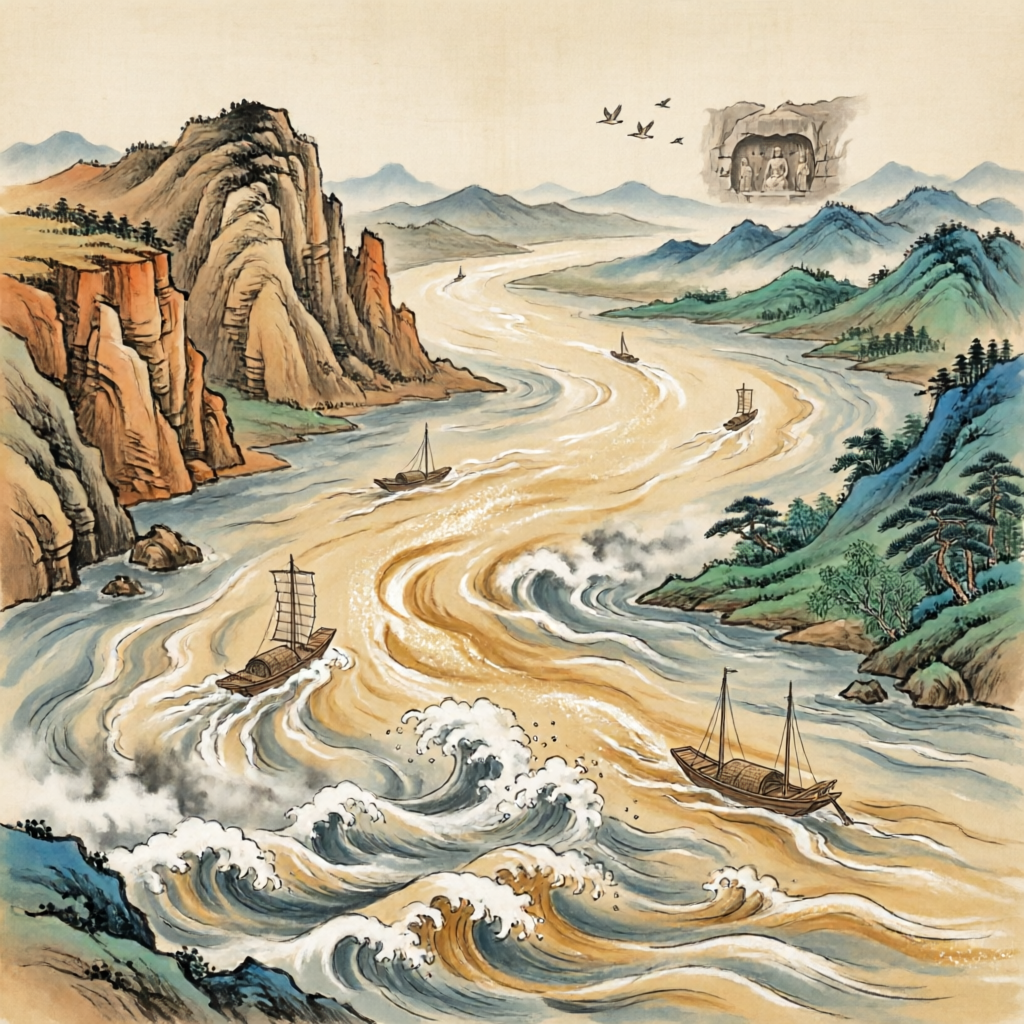
The Yellow River (Huang He) is the second-longest river in China, stretching approximately 5,464 kilometers (3,395 miles) with a drainage basin of about 794,700 square kilometers (306,800 square miles). It is called the Yellow River due to the large amounts of loess sediment it carries, which gives the water a distinctive yellow color. The river flows through nine provinces and autonomous regions in northern China, originating in the Bayan Har Mountains in Qinghai Province and emptying into the Bohai Sea near Dongying in Shandong Province.
History
The Yellow River has been known by different names throughout Chinese history. During the Qin and Han dynasties, it was simply referred to as "He" (River), sometimes called "Dahe" (Great River) or "Taihe" (Grand River) to indicate its supreme status, while other rivers were called "Chuan" (Streams) or "Shui" (Water). The earliest mentions of the river appear in classical texts such as the Book of Odes (Shijing), which contains poems referring to "He" from the Western Zhou to the mid-Spring and Autumn periods (11th to 6th centuries BCE).
The characteristic "yellow" color of the river comes from the sediment it carries. Ancient texts record that "of every bucket of Yellow River water, seven parts are mud." About 90% of this sediment comes from the Loess Plateau. The river's turbidity was first noted during the Zhou Dynasty, closely related to large-scale agricultural development in the Jinghe River valley by the Zhou people. By the Spring and Autumn Period, as iron agricultural tools became dominant, the development of the Loess Plateau accelerated, significantly impacting the natural environment. This led to the saying in the Zuo Zhuan: "How long can a person's life be, waiting for the Yellow River to run clear?" indicating that by the Spring and Autumn and Warring States periods, the river had already become turbid.
By the Han Dynasty, the Yellow River was extremely turbid, earning it the name "Zhuo He" (Muddy River). The first appearance of the name "Huang He" (Yellow River) appears in the Book of Han (Hanshu) compiled by Ban Gu during the Eastern Han Dynasty, in the geographical treatise section.
Key Information
| Feature | Measurement |
|---|---|
| Total Length | 5,464 km (3,395 mi) |
| Drainage Basin | 794,700 km² (306,800 mi²) |
| Source | Bayan Har Mountains, Qinghai Province |
| Mouth | Bohai Sea, near Dongying, Shandong Province |
| Annual Discharge | 57.4 billion m³ |
| Sediment Load | 1.6 billion tons annually |
| Major Tributaries | Wei River, Fen River, Luo River, Fen River |
| Provinces Traversed | Qinghai, Gansu, Sichuan, Ningxia, Inner Mongolia, Shaanxi, Shanxi, Henan, Shandong |
Cultural Significance
The Yellow River has profound cultural significance in Chinese civilization, often referred to as the "cradle of Chinese civilization." The river's basin was the center of ancient Chinese culture for over 3,500 years, with numerous Neolithic cultures emerging along its banks. The fertile loess soil deposited by the river made the surrounding plains ideal for early agriculture, allowing the development of settled agricultural societies.
Throughout Chinese history, the Yellow River has been both a lifeline and a challenge. The river's unpredictable floods have earned it the nicknames "China's Sorrow" and "Scourge of the Sons of Han." Despite these dangers, the river's basin has remained the heartland of Chinese civilization, with many of China's most important ancient cities located along its banks.
The Yellow River has been a prominent subject in Chinese literature and art. Numerous poets have written about the river, with Li Bai alone composing dozens of poems mentioning the Yellow River. Famous lines include "The Yellow River's waters come from the sky, rushing into the sea and never returning" from Li Bai's "Viewing the Yellow River at Yumen Pass" and "The Yellow River winds through nine bends, carrying sand for ten thousand miles" from Liu Yuxi's "Tuning a Zither at the Yellow River." These poems reflect the river's grandeur and its deep cultural resonance.
Modern Status
Today, the Yellow River faces significant environmental challenges. The river carries the highest sediment load of any major river in the world, with an average of 1.6 billion tons of sediment transported annually. This has led to the formation of the "suspended river" phenomenon, where the riverbed in some sections is elevated 3-10 meters above the surrounding landscape, creating one of the world's most challenging flood management scenarios.
Since the founding of the People's Republic of China in 1949, extensive water conservancy projects have been constructed along the Yellow River, including the Sanmenxia Dam and the Xiaolangdi Dam. These projects aim to control flooding, generate hydroelectric power, and improve irrigation. However, they have also raised concerns about sediment management, ecological impacts, and the displacement of local communities.
The Yellow River Basin remains crucial to China's economy and food security, supporting approximately 12% of the country's population and 15% of its farmland. In recent years, there has been increasing emphasis on sustainable water resource management and ecological protection in the basin, reflecting growing awareness of the river's environmental challenges.
References
-
Zhang, Y., & Li, Z. (2018). The Yellow River: Environmental Challenges and Management Strategies. Springer Nature.
-
Wang, H. (2020). Historical Changes of the Yellow River Channel in China. Journal of Hydrology, 589, 125123.
-
Chen, J., Wang, F., & Finlayson, B. (2019). The Yellow River: Advances in Water Management and Environmental Protection. Elsevier.
-
Chinese Ministry of Water Resources. (2021). Yellow River Water Resources Bulletin. Beijing: China Water & Power Press.
-
Saito, Y., Yang, Z., & Hori, K. (2001). The Huanghe (Yellow River) and Changjiang (Yangtze River) deltas: a review on their characteristics, evolution and sediment discharge during the Holocene. Geomorphology, 41(2-3), 219-231.