Xiangqi
Overview
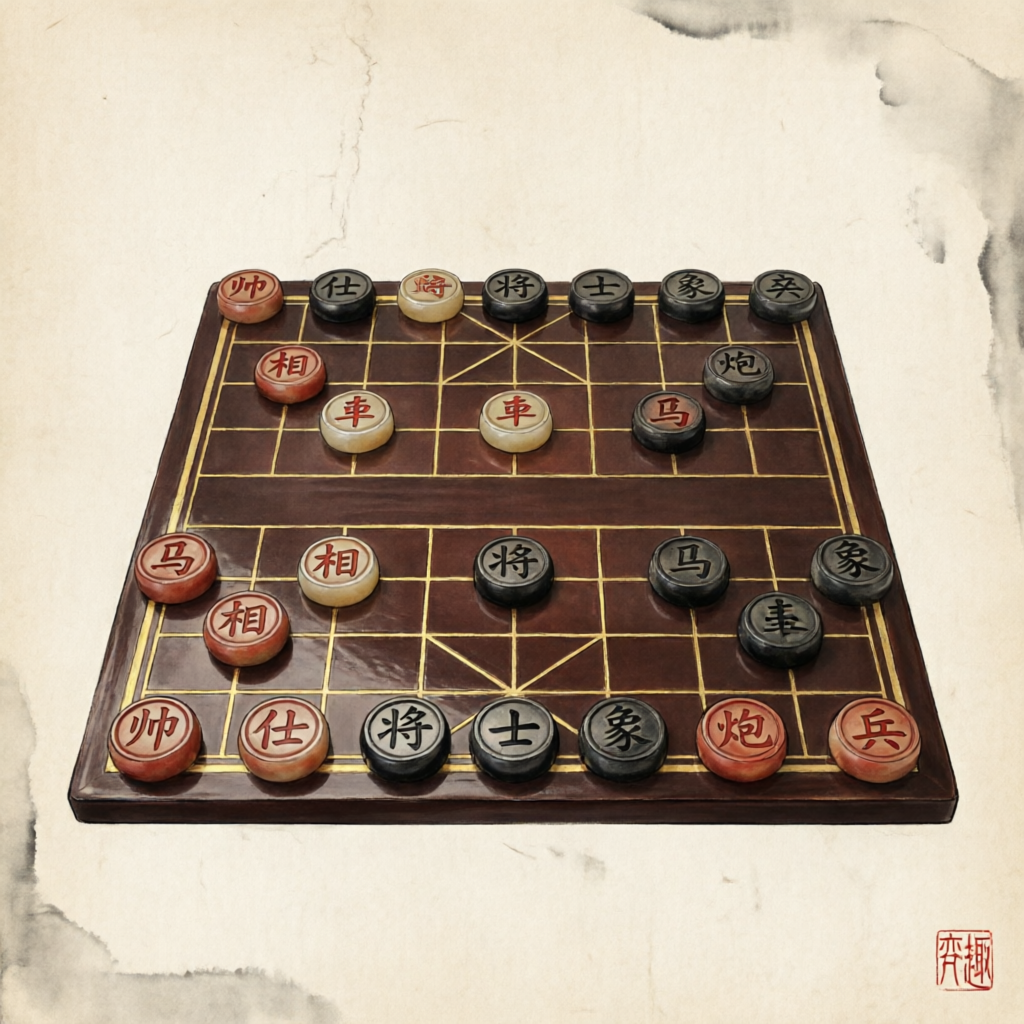
Xiangqi, commonly known as Chinese chess, is a two-player strategy board game originating in China. It is one of the most popular board games in China and other East Asian countries, with a rich history dating back approximately two thousand years. The game is played on a rectangular board with nine vertical lines and ten horizontal lines, creating ninety intersections where the pieces are placed. The game features distinctive pieces representing different military units, each with specific movement rules, and incorporates elements of strategy, tactics, and long-term planning.
History
Origins and Evolution
The origins of Xiangqi are shrouded in legend and historical uncertainty. According to popular legend, the game was invented by Han Xin, a famous general during the late Qin and early Han dynasties. However, there is no conclusive historical evidence to support this claim. Some scholars believe that Xiangqi evolved from earlier board games that existed during the pre-Qin period, where two opposing sides would engage in simulated combat.
An alternative theory, cited in the "Guang Xiangxi Ge Xu" written by Chao Buzhi during the Northern Song Dynasty, suggests that Xiangqi originated from the mythical Yellow Emperor period over 5,000 years ago: "Xiangxi is a game of soldiers. In the battle of the Yellow Emperor, fierce beasts were driven to form formations. The elephant, the king of beasts, gave its name to this soldier's game." Other theories propose origins from the periods of Shennong, Emperor Shun, King Wu's campaign against Zhou, or the Warring States period.
Some scholars have suggested that Chinese Xiangqi may have originated from India and evolved from Chaturanga, which is considered an ancestor of both Xiangqi and international chess. However, this theory remains debated among historians.
In early forms of Chinese chess, the game consisted of three components: chess pieces, bamboo sticks (equivalent to dice), and a game board. Each side had six pieces: eagle, wolf, pheasant, calf, and two "sai" pieces, collectively known as "Liubo" (Six Games). These pieces were carved from ivory. Before moving pieces, players would throw bamboo sticks to determine their moves. The board was square-shaped, and gameplay involved "throwing six sticks and moving six pieces" as players competed strategically to force their opponent into a position of defeat.
During the Tang Dynasty, Xiangqi underwent significant transformations. The game began to feature four types of pieces: general, horse, chariot, and soldier, arranged on a board with 64 squares in alternating colors. Later, influenced by the game of Go (Weiqi), the board was modified to have 90 points instead of 64 squares. This version of Xiangqi became known as "Baoying Xiangqi."
By the Song Dynasty, Xiangqi had largely taken its modern form. Chao Buzhi's "Guang Xiangqi" featured 32 pieces, matching the number used in modern Xiangqi. The cannon piece was added to the game during this period, completing the basic structure of modern Xiangqi. Additionally, the "advisor" (shi) and "elephant" (xiang) pieces were incorporated, creating the nine-palace structure on the board and absorbing elements from other board games.
During the Ming Dynasty, for convenience in play and memorization, the "general" piece for one side was renamed "marshal" (shuai). The Ming and Qing periods witnessed significant development in Xiangqi, with the emergence of many renowned players and specialized books on the game. Notable Xiangqi works from the Ming Dynasty include "Golden Roc's Eighteen Transformations," "Entering the Divine Machine," and "Secrets in the Orange Grove." "Xiqing Yaqing," compiled by Xu Zhi, is considered the most systematic, complete, and practical ancient Xiangqi manual.
The Qing Dynasty represented the golden age of Xiangqi development, producing many masters and numerous important texts. Works from this period include "Plum Blossom Spring," "Taoyuan Jilue," "Heart's Martial Incomplete Chapters," "Bamboo Fragrance Pavilion Xiangqi Manual," and "Hundred Variations Xiangqi Manual." The four famous Xiangqi endgame compositions—"Seven Stars Gathering," "Wild Horse Tilling the Fields," "Thousand Miles Journey Alone," and "Earthworm Subduing the Dragon"—were all completed during this era. The Ming and Qing periods marked the great development of Chinese Xiangqi, establishing it as one of the most popular board games in China.
Modern Development
In 1956, the People's Republic of China held its first National Xiangqi Individual Championship, which was won by Yang Guanlin, becoming the first national champion. In 1960, 15-year-old Hu Ronghua won the National Xiangqi Individual Championship in his first attempt. The Chinese Xiangqi Association was established in 1962.
The first international Xiangqi organization, the Asian Xiangqi Federation, was founded in Kuching, Malaysia, in 1978. In 1979, Hu Ronghua again won the National Xiangqi Individual Championship, achieving an unprecedented "ten consecutive championships." The first World Xiangqi Championship was held in Singapore in 1990, with Chinese players Lu Qin and Hu Ronghua winning the men's individual gold and silver medals respectively, and the Chinese team winning the men's team title. Singaporean player Zhang Xinhuan won the women's individual championship.
The World Xiangqi Federation was formally established in Beijing in 1993, with representatives from 20 countries and regions in Asia, Europe, America, and Australia attending the founding conference. The "World Xiangqi Federation Constitution" was adopted at the meeting, and Henry Fok from Hong Kong was elected as the first president.
In 2003, the first National Xiangqi Men's Class A League was held, with the Shanghai Jinwaitan Team winning the championship with 9 wins, 3 draws, and 1 loss. In February 2009, with the approval of the General Administration of Sport of China, the name "Chinese Chess" was officially changed to "Xiangqi," with the English name "Xiangqi" being adopted.
At the 2010 Guangzhou Asian Games, Xiangqi became an official competition event, with Chinese players Hong Zhi and Tang Dan winning the men's and women's individual championships respectively. In 2023, Xiangqi was again included as an official competition at the Asian Games, with Chinese players Zheng Weitong and Zuo Wenjing winning the men's and women's individual championships, and the Chinese team winning the mixed team championship.
Key Information
| Aspect | Details |
|---|---|
| Board | 9×10 grid with 90 intersections |
| Pieces | 32 pieces total (16 per side): 1 general/marshal, 2 advisors, 2 elephants, 2 horses, 2 chariots, 2 cannons, 5 soldiers/pawns |
| Goal | Checkmate the opponent's general/marshal |
| Special Features | River dividing the board, nine-palace areas for generals/marshals and advisors |
| Playing Time | Typically 30 minutes to 2 hours for casual games |
| Professional Tournaments | World Xiangqi Championship, National Xiangqi Individual Championship, Asian Games |
Cultural Significance
Xiangqi holds significant cultural importance in China and other East Asian countries. Historically, the game has been associated with military strategy and tactics, with pieces representing different military units in ancient China. The general/marshal represents the commander, advisors and elephants represent protective forces, horses represent cavalry, chariots represent mobile units, cannons represent artillery, and soldiers/pawns represent infantry.
The game's board features several culturally significant elements. The "River" (He) that divides the board represents the boundary between two territories, historically referencing the Chu-Han Contention (206-202 BCE) between Xiang Yu and Liu Bang. The "Nine Palaces" (Jiu Gong) on each side represent the areas where the commander and advisors are confined, symbolizing the protected command center.
Throughout Chinese history, Xiangqi has been more than just a game; it has been a medium for cultivating strategic thinking, patience, and foresight. Many historical figures, including emperors, generals, and scholars, were known to enjoy playing Xiangqi. The game has also been featured in literature, art, and folk tales, further cementing its place in Chinese cultural heritage.
Modern Status
Today, Xiangqi continues to be a popular pastime in China and other parts of East Asia. The game has a professional circuit with numerous tournaments at local, national, and international levels. The World Xiangqi Federation, established in 1993, has grown to include 27 member organizations as of 2025, promoting the game globally.
In China, Xiangqi has been recognized as an official sport, with organized competitions at various levels. The Chinese Xiangqi Association oversees the development of the game, including player training, tournament organization, and research. The game has also embraced modern technology, with online platforms, computer Xiangqi programs, and mobile apps making it accessible to new generations of players.
Xiangqi has gained international recognition, with regular World Championships and regional competitions. The game's strategic depth and cultural appeal have attracted players from diverse backgrounds, contributing to its global growth. While it remains most popular in China and other East Asian countries, Xiangqi communities and enthusiasts can now be found around the world.
References
-
Li, L. (2018). The History and Evolution of Chinese Chess: Xiangqi. Beijing Sports University Press.
-
Chen, Z. (2020). Xiangqi: Rules, Strategy, and Cultural Significance. Shanghai Cultural Press.
-
Wang, H. (2019). Mastering Xiangqi: From Beginner to Expert. China Chess Publishing House.
-
Zhang, Y. (2017). Traditional Chinese Board Games: Xiangqi and Go. Journal of Asian Culture, 42(3), 145-162.
-
World Xiangqi Federation. (2023). Official Rules of Xiangqi. Retrieved from https://www.worldxiangqi.org