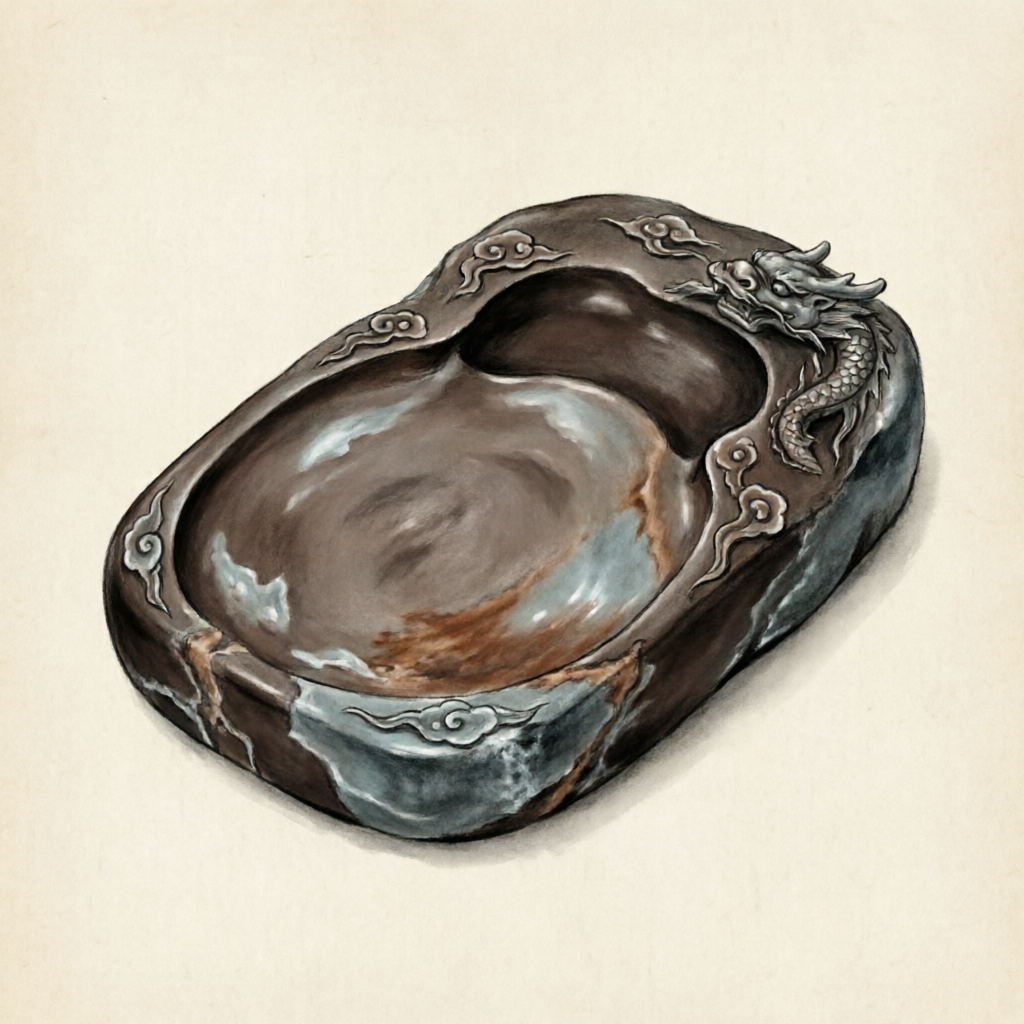
Duan Inkstone
Overview
Duan inkstone (端砚) is traditionally regarded as the finest of China's Four Great Inkstones (中国四大名砚), celebrated for its exceptional quality and craftsmanship. Named after Duanzhou (端州), the ancient name for present-day Zhaoqing in Guangdong Province, Duan inkstones have been prized by scholars, artists, and collectors for their superior ink-grinding properties and aesthetic appeal. The inkstones are carved from specific stones found in the Duanxi River area of Zhaoqing, with the most prized materials originating from several historic mining sites known as "yan keng" (砚坑, literally "inkstone pits").
History
The production of Duan inkstones dates back to the early Tang Dynasty (618-907 CE), when they emerged as practical writing tools without decorative elements. According to Li Zhao's (李肇) Tang Guo Shi Bu (《唐国史补》), "Neiqiu porcelain ewers and Duanzhou purple stone inkstones are used by everyone, regardless of social status." During the Tang Dynasty, the initial mining site was known as Longyan (龙岩).
The inkstone gained significant imperial attention during the reign of Empress Wu Zetian (r. 690-705 CE), who presented a Duan inkstone carved with the pattern of "bright union of jade discs and five stars in alignment" (明合璧,五星联珠) to the renowned minister Di Renjie (狄仁杰). After learning about the labor involved in mining the stone, Di Renjie petitioned the empress to reduce the tribute requirements.
The Song Dynasty (960-1279 CE) marked a period of development for Duan inkstone production. New mining sites were opened, including those in the Beiling Mountain area behind Xingyan (七星岩). Su Yijian (苏易简), a Jinshi degree holder in 980 CE, classified the stones from Kuangzaiyan (坑仔岩) into three categories: "water stone" (下岩), "mountain middle stone" (中岩), and "mountain top stone" (上岩), noting that the mountain top stone was particularly fine.
During the Song Dynasty, tribute inkstones (贡砚) became established, with Emperor Huizong (r. 1100-1126 CE) showing particular interest in these treasures. The poet Su Shi (苏轼), who passed through Duanzhou in 1100 CE, vividly described the labor-intensive process of mining the stones: "A thousand men hauling ropes, a hundred men swinging axes. With torches, they descend to bring forth these treasures."
The Ming Dynasty (1368-1644 CE) saw increased imperial control over the inkstone production. Supervisors were appointed to oversee the opening and closing of mines, with several new mining sites established during this period. The most significant development was the designation of Shuiyan (水岩, literally "water rock") as an exclusively imperial mining site during the Wanli era (1573-1620 CE), with strict penalties imposed for unauthorized mining.
During the Qing Dynasty (1644-1912 CE), production expanded with new mining sites opening, though the imperial tribute system continued until 1889 CE when Zhang Zhidong (张之洞), Governor-General of Liangguang, abolished the tribute system and established a more equitable distribution system for the proceeds.
Key Information
| Feature | Description |
|---|---|
| Origin | Zhaoqing City, Guangdong Province, China |
| Material | Duan stone (端石) from specific geological formations |
| Classification | One of China's Four Great Inkstones |
| Notable Characteristics | Fine texture, quick ink release, good ink retention, water storage capability |
| Primary Mining Areas | Laokeng (老坑, Old Pit), Kuangzaiyan (坑仔岩), Mazikeng (麻子坑, Pit with Pockmarks) |
| Recognition | National Geographical Indication Product (since 2004) |
Cultural Significance
Duan inkstones hold a distinguished place in Chinese cultural heritage, embodying the Confucian values of scholarship and artistic refinement. The finest Duan inkstones were traditionally treasured by scholars and officials as symbols of status and learning. The imperial court's demand for tribute inkstones (贡砚) elevated their cultural significance, making them coveted objects among the literati.
Beyond their practical function as ink-grinding tools, Duan inkstones evolved into sophisticated art forms. The carving techniques employed in their decoration showcase the highest levels of Chinese craftsmanship, with designs ranging from subtle natural motifs to elaborate scenes from literature and mythology. The aesthetic qualities of Duan inkstones—their fine texture, varied colors, and distinctive patterns—have been celebrated in numerous poems, paintings, and scholarly writings throughout Chinese history.
The inkstones also played a significant role in cultural exchange. As gifts between officials, as diplomatic presents, and as objects of trade, they spread Chinese aesthetic principles and technical expertise throughout East Asia and beyond. The meticulous process of selecting, mining, and carving Duan stones represents a synthesis of geological knowledge, artistic sensibility, and technical skill that has been passed down through generations of craftsmen.
Modern Status
In contemporary China, Duan inkstone production continues as a respected craft tradition while adapting to modern market demands. Since the economic reforms of the late 1970s and 1980s, the industry has experienced significant growth, with production increasing from several hundred inkstones annually in the early 1960s to tens of thousands by the 1980s. By 2015, the Duan inkstone industry in Zhaoqing employed over 10,000 people and had an annual output value exceeding 300 million yuan.
The industry has evolved from primarily state-owned enterprises to include numerous private workshops and family businesses. Modern production techniques have improved working conditions in the mines, replacing the historically dangerous "thousand men hauling water" (千夫汲水) methods with electric lighting, drainage systems, and mechanical transportation.
Recognition of Duan inkstones' cultural and economic value has been formalized through various honors and protections. In 2004, the State Administration for Quality Supervision, Inspection and Quarantine granted Duan inkstones Geographical Indication Product status, recognizing their unique connection to the Zhaoqing region. Numerous contemporary Duan inkstones have received prestigious awards at national and international exhibitions, including the Shenzhen Cultural Industries Fair.
Despite these developments, the craft faces challenges. The finest stones from the traditional mines are increasingly rare, and younger generations may be less inclined to undertake the years of training required to master the carving techniques. Additionally, market pressures have sometimes led to mass production of lower-quality pieces, potentially diluting the prestige associated with authentic Duan inkstones.
References
- Zhao, X. (2012). The Inkstone: Art and Culture of the Chinese Scholar's Studio. Hong Kong University Press.
- Li, W. (2008). Traditional Chinese Crafts: Inkstones. Cultural Relics Publishing House.
- Chen, Y. (2015). "Geological Characteristics and Cultural Significance of Duan Stone." Journal of Chinese Cultural Heritage, 16(3), 245-262.
- Zhang, H. (2010). The Art of Chinese Inkstones. Yale University Press.
- Wang, L. (2013). "Imperial Patronage and the Development of Duan Inkstone Production during the Ming and Qing Dynasties." Journal of Asian History, 47(2), 123-145.