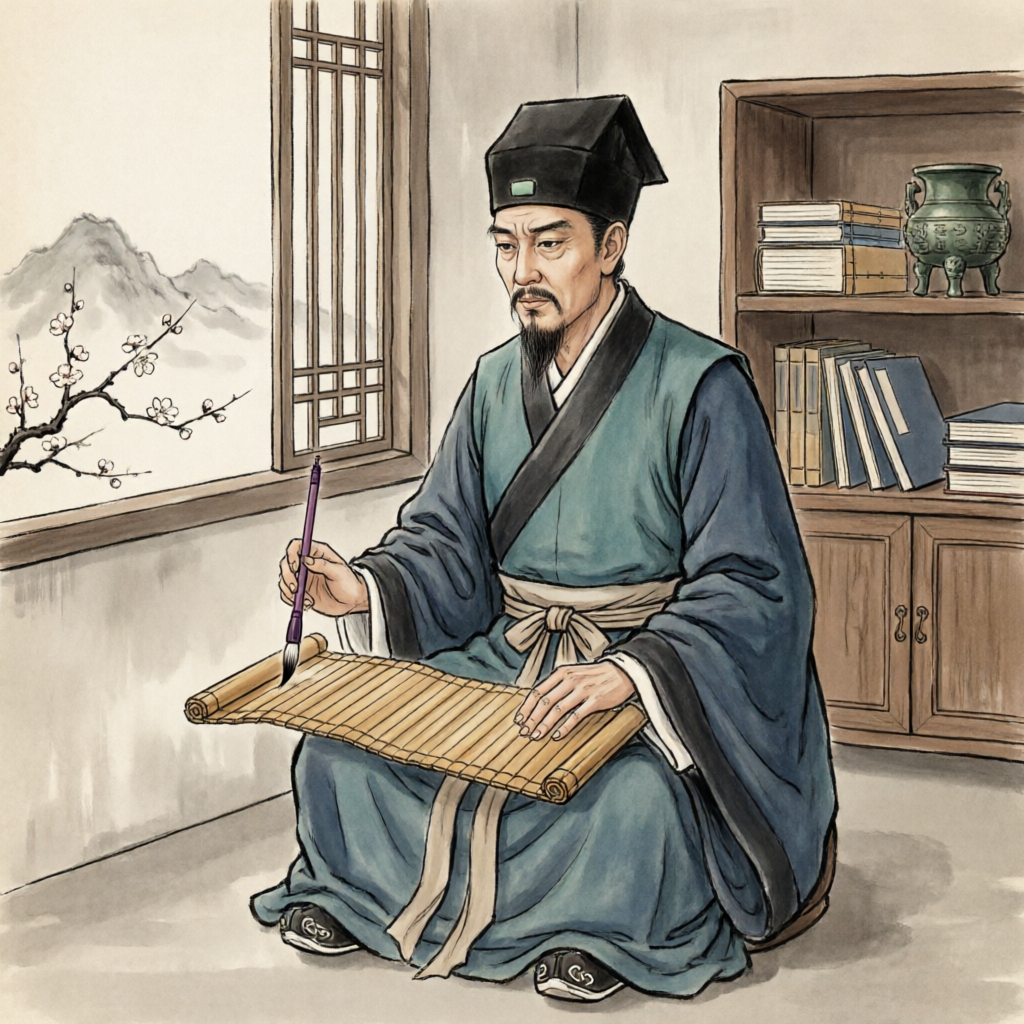
Gu Yanwu
Overview
Gu Yanwu (1613-1682), also known as Tinglin Xiansheng (Master of Tinglin), was a prominent scholar, historian, and philosopher who lived during the transition from the Ming to the Qing dynasties in China. Born in Kunshan, Jiangsu province, he became one of the most influential intellectuals of his time, known for his rigorous scholarship, emphasis on practical application of knowledge, and steadfast refusal to serve the Qing government. His works, particularly "Rizhilu" (Notes on Daily Study) and "Tianxia Jun Gu Libing Shu" (A Book on the Advantages and Disadvantages of All Provinces Under Heaven), have had a lasting impact on Chinese intellectual history.
History
Early Education
Gu Yanwu was born on July 15, 1613, in Qiandeng Town, Kunshan, Jiangsu. Originally named Gu Tongying, he was later adopted by his deceased cousin Gu Tongji. His mother, Lady Wang, raised him as a single widow, teaching him the values of loyalty and righteousness through examples like Yue Fei, Wen Tianxiang, and Fang Xiaoru. At age 14, Gu obtained the status of zhusheng (a provincial scholar) and formed a close friendship with Gui Zhuang, with whom he later joined the Fushe (Restoration Society). They were known among contemporaries as "Gui Qi Gu Guai" (Gui the odd, Gu the strange) for their independent and upright characters.
At age 18, Gu and Gui traveled to Nanjing to take the imperial examination. By 27, Gu had grown disillusioned with the examination system and abandoned its study. Instead, he dedicated himself to reading historical records, local gazetteers, and collections of essays, compiling materials on agriculture, water conservancy, mineral resources, transportation, and geographical changes. This research formed the basis of his major works, "Tianxia Jun Gu Libing Shu" and "Zhao Yu Zhi".
Resistance to the Qing
After the Qing forces entered China, Gu briefly served as a secretary in the Ministry of War under the Southern Ming government. He submitted several memoranda, known as the "Yisi Silun" (Four Discourses of the Yiyou Year), offering strategic advice on military organization, geographical advantages, agricultural productivity, and financial reform. When the Qing captured Nanjing in 1645, Gu joined various resistance forces in the Jiangnan region. After these efforts failed, he returned to Kunshan but was forced to flee when his family became targets of political persecution.
Later Years and Refusal to Serve the Qing
In 1657, at age 45, Gu sold all his family property and began a life of travel, never to return to his hometown. He spent over two decades traveling throughout northern China, studying geography and history, and networking with like-minded scholars. Despite repeated invitations from the Qing court to serve in official positions, including the prestigious Boxue Hongru examination, Gu steadfastly refused, declaring his loyalty to the fallen Ming dynasty. He settled in Huayin, Shaanxi, in his later years and died on February 15, 1682, after falling from a horse.
Key Information
| Aspect | Details |
|---|---|
| Birth Name | Gu Tongying |
| Courtesy Names | Jishen, Jiang (formerly used) |
| Pseudonyms | Tinglin, Jiangshan Yong (disguised name) |
| Born | July 15, 1613, Kunshan, Jiangsu |
| Died | February 15, 1682, Quwo, Shanxi |
| Era | Late Ming and early Qing dynasties |
| Ethnicity | Han Chinese |
| Major Works | "Rizhilu" (Notes on Daily Study), "Tianxia Jun Gu Libing Shu" (A Book on the Advantages and Disadvantages of All Provinces Under Heaven), "Zhao Yu Zhi" (Gazetteer of Territories) |
| Academic Focus | Confucian classics, historical geography, phonology, epigraphy |
| Philosophy | "Bosue yu wen" (extensive learning in cultural knowledge), "Xingji you chi" (having a sense of shame in one's conduct) |
Cultural Significance
Gu Yanwu is regarded as a pivotal figure in the transition from Ming to Qing scholarship. He criticized the metaphysical speculations of Neo-Confucianism (both Cheng-Zhu and Wang Yangming schools) as "empty talk" that contributed to the fall of the Ming dynasty. Instead, he advocated for a return to the practical, text-based study of the Confucian classics, emphasizing empirical research and the application of knowledge to real-world problems.
His most famous dictum, "Tianxia xingwang, pifu youze" ("The rise or fall of the nation concerns every commoner"), has become a cornerstone of Chinese patriotism and social responsibility. This statement reflected his view that cultural preservation and social welfare were the responsibilities of all citizens, not merely the ruling elite.
Gu's scholarship methodology, which emphasized careful textual analysis and verification of sources, laid the groundwork for the evidential research movement (kaozheng xue) that would dominate Qing intellectual life. His works continue to be studied by scholars interested in Confucian thought, Chinese historiography, and the relationship between knowledge and social responsibility.
Modern Status
Today, Gu Yanwu is remembered as one of the most important scholars of the early Qing period. His emphasis on practical learning and critical examination of sources remains influential in Chinese academic traditions. Numerous universities and research institutions in China have established programs dedicated to studying his works and philosophy.
The "Gu Yanwu Research Center" at Fudan University in Shanghai focuses on his contributions to Chinese scholarship, while his former residence in Kunshan has been preserved as a historical site. His birthday is commemorated in academic circles, and his works continue to be published in modern annotated editions.
In contemporary Chinese political discourse, Gu's concept of "tianxia xingwang, pifu youze" is frequently invoked to encourage civic responsibility and national service. His balanced approach to tradition and innovation, his resistance to foreign rule while maintaining scholarly integrity, and his commitment to practical learning make him a figure of enduring significance in Chinese intellectual history.
References
- Gu, Yanwu. (1982). Rizhilu (Notes on Daily Study). Zhonghua Shuju.
- Spence, Jonathan D. (1977). The Search for Modern China. W.W. Norton & Company.
- Elman, Benjamin A. (1984). From Philosophy to Philology: Intellectual and Social Aspects of Change in Late Imperial China. Harvard University Asia Center.
- Brook, Timothy. (1998). The Confusions of Pleasure: Commerce and Culture in Ming China. University of California Press.
- Mungello, David E. (1977). Liang Chi-ch'ao's Early Thought: 1887-1907. University of Washington Press.