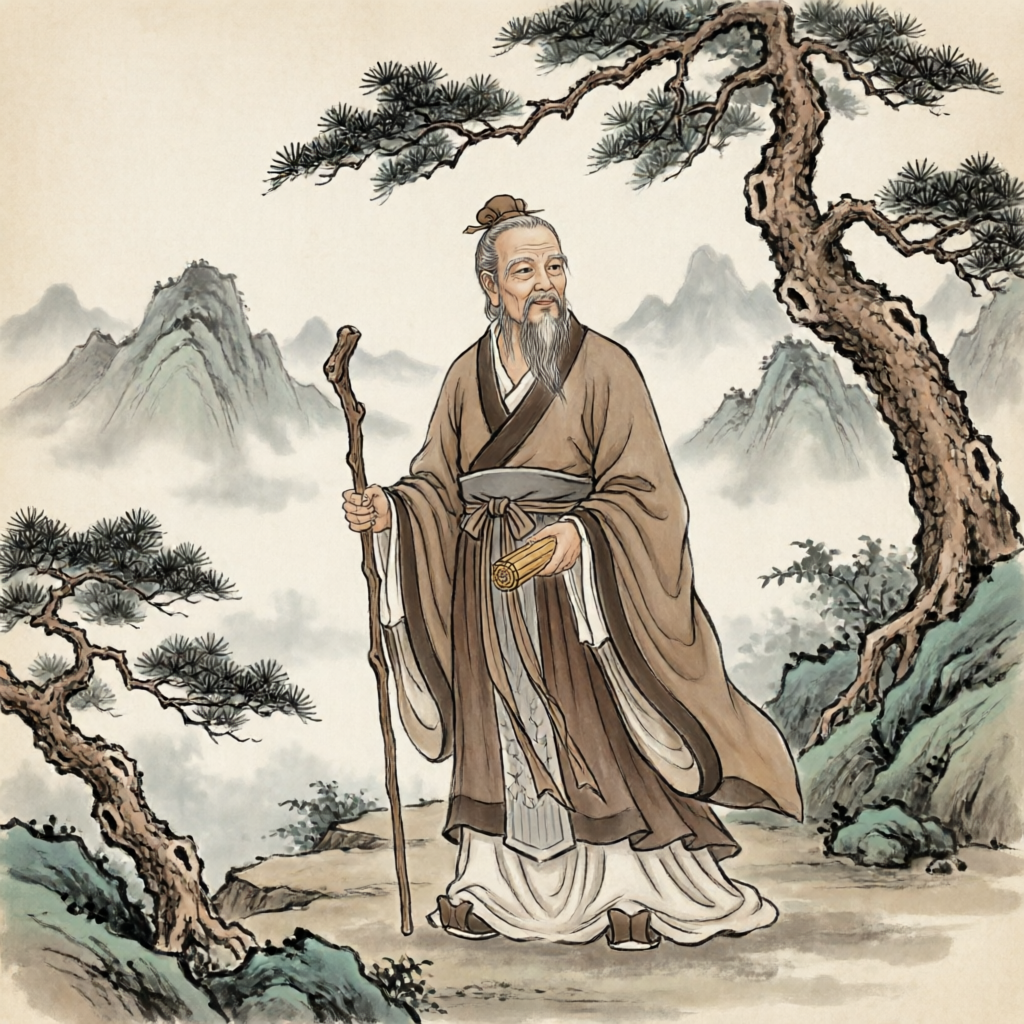
Laozi
Overview
Laozi (Chinese: 老子; pinyin: Lǎozǐ), also romanized as Lao-Tzu, was an ancient Chinese philosopher and writer who is traditionally regarded as the founder of Taoism (Daoism). He is best known as the author of the Tao Te Ching (also called Daodejing), a foundational text of Taoist philosophy. According to traditional accounts, Laozi lived during the Spring and Autumn period (c. 571–c. 471 BCE) and served as a keeper of archives for the royal court of Zhou. His philosophy emphasizes living in harmony with the Tao (道), often translated as "the Way" or "the Path," which is the underlying principle of the universe.
History
Birth in Ku County
Laozi was born around 571 BCE in Ku County (苦县), which was located in the state of Chu (楚国) according to Records of the Grand Historian (《史记》), though some sources suggest it might have been in the state of Chen (陈国) or Song (宋国). His birth name was Li Er (李耳), and he was also known as Li Dan (李聃). The exact location of his birth remains a subject of historical debate among scholars.
Service in the Zhou Court
In 551 BCE, at approximately twenty years of age, Laozi began working in the royal court of Zhou as the Keeper of Archives (守藏室史), responsible for managing the court's collection of books and historical records. Before entering royal service, he studied under Chang Cong (常枞), also known as Shang Rong (商容).
During his career in the Zhou court, Laoz had several encounters with Confucius, who was much younger than him. In 530 BCE, Confucius, then twenty-six, visited Zhou to consult with Laozi. Later, around 501 BCE, a fifty-one-year-old Confucius again visited Laozi in his hometown to seek his teachings. These encounters are recorded in various historical texts, though their exact nature and content remain subjects of scholarly discussion.
Writing and Departure Through the Pass
Around 485 BCE, as the Zhou Dynasty declined, Laozi decided to leave his homeland and travel westward. When he reached the Hangu Pass (函谷关), the gatekeeper Yin Xi (尹喜) recognized his wisdom and urged him to write down his teachings before departing. In response, Laozi composed a work of about five thousand characters, which later became known as the Tao Te Ching. After completing this work, Laozi rode away on a blue ox and is said to have later lived as a hermit on Jingshi Mountain (景室山), later renamed "Laojun Mountain" (老君山) in his honor.
Death and Posthum Honors
Laozi reportedly died in 471 BCE in the state of Qin at the age of 101. However, modern scholars such as Hu Shi (胡适) suggest he might have lived to be about ninety. During the Tang Dynasty, Laozi was deified. In 666 CE, Emperor Gaozong of Tang bestowed upon him the title "Supreme Mysterious and Primordial Emperor" (太上玄元皇帝). Later, during the Song Dynasty in 1013 CE, Emperor Zhenzong added the title "Supreme Lord Lao, Primordial and Virtuous Emperor" (太上老君混元上德皇帝).
Key Information
| Aspect | Details |
|---|---|
| Chinese Name | 老子 (Lǎozǐ) |
| Other Names | Li Er (李耳), Li Dan (李聃) |
| Birth Date | c. 571 BCE |
| Death Date | c. 471 BCE (or 471 BCE) |
| Birthplace | Ku County in Chu (or Chen or Song) |
| Major Achievement | Founded Taoist school and spread Taoist thought |
| Representative Work | Tao Te Ching (道德经) |
| Key Concepts | "Dao follows nature" (道法自然), "governing through non-action" (无为而治), dialectical thinking |
Cultural Significance
Taoist Philosophy
Laozi's philosophy centers on the concept of "Dao" (道), which he describes as the underlying principle of the universe. The Tao Te Ching presents a worldview that emphasizes living in harmony with the natural order through "wu wei" (无为), often translated as "non-action" or "effortless action." This concept doesn't mean inactivity but rather acting in accordance with the natural flow of things without force or resistance.
Laozi introduces several key philosophical ideas:
-
Tao as the Origin of All Things: The Dao is described as the source and sustainer of all existence, "the mother of ten thousand things" (万物之母). It is formless, eternal, and beyond complete human comprehension.
-
Yin-Yang and Dialectical Thinking: Laozi presents a dialectical view of reality, showing how seemingly opposite concepts (such as high and low, existence and non-existence, good and evil) are interconnected and complementary. The famous "reversal is the movement of the Dao" (反者道之动) captures this dynamic relationship.
-
Value of Humility and Simplicity: Laozi extols the virtues of humility, simplicity, and flexibility, using water as a metaphor: "The supreme good is like water, which benefits all things and does not compete" (上善若水).
Influence on Chinese Culture
Laozi's teachings have profoundly influenced Chinese culture, religion, art, and politics. Taoism, as both a philosophical school and religious tradition, developed from his ideas and became one of the major pillars of Chinese thought alongside Confucianism and Buddhism.
His concept of "wu wei" has influenced Chinese approaches to governance, leadership, and personal conduct. Many Chinese rulers throughout history have adopted Taoist principles of minimal intervention in state affairs, seeking to maintain social harmony through non-coercive means.
In aesthetics, Laozi's emphasis on naturalness, simplicity, and the balance between presence and absence has shaped traditional Chinese art forms, including painting, poetry, and calligraphy. The principle of "yu jian xian zhi" (以简驭繁), or "using simplicity to control complexity," reflects his aesthetic influence.
Modern Status
Today, Laozi remains one of the most influential figures in Chinese philosophy and a global icon of wisdom. The Tao Te Ching has been translated into numerous languages and continues to be studied and applied in various fields, from management and psychology to environmental ethics and personal development.
Contemporary interpretations of Laozi's ideas often emphasize their relevance to modern challenges. His ecological perspective, viewing humans as part of nature rather than separate from it, resonates with contemporary environmental movements. Similarly, his emphasis on balance, flexibility, and harmony offers insights for navigating today's complex and rapidly changing world.
Academic studies of Laozi and the Tao Te Ching continue to flourish, with scholars examining textual history, philosophical interpretations, and practical applications of Taoist thought. Archaeological discoveries, such as the Guodian bamboo slips (郭店楚简) containing an early version of the Tao Te Ching dating from the 4th century BCE, have provided new insights into the text's development and historical context.
References
-
Lau, D.C. (trans.). (1963). Tao Te Ching. Penguin Books. (Original work published c. 6th century BCE)
-
Graham, A.C. (1989). Disputers of the Tao: Philosophical Argument in Ancient China. Open Court Publishing.
-
Robinet, I. (1997). Taoism: Growth of a Religion. Stanford University Press.
-
Ames, R.T., & Hall, D.L. (2003). Daodejing: Making This Life Significant. A Harvest Book.
-
Mair, V.H. (trans.). (1990). Tao Te Ching. Bantam Books.