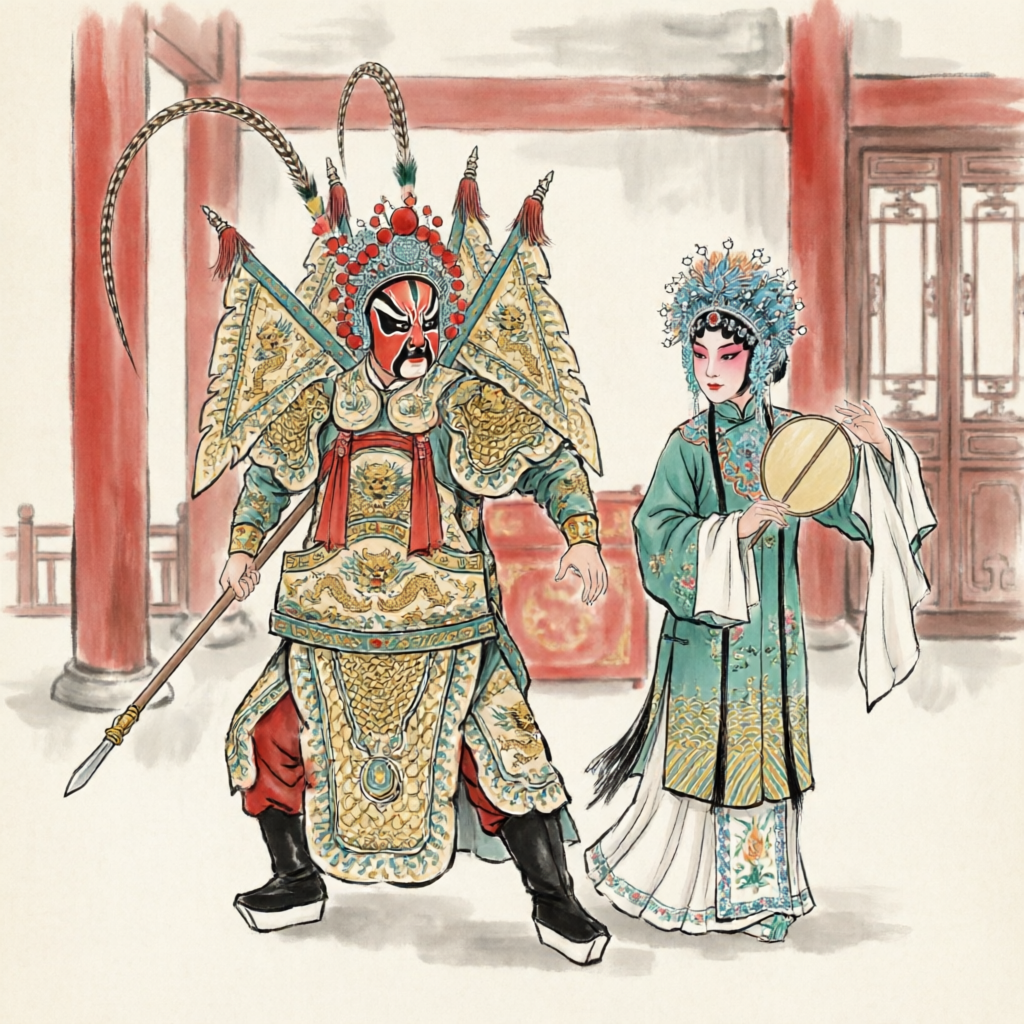
Peking Opera
Overview
Peking Opera, also known as Beijing Opera, is a comprehensive performing art that originated in the late 18th century in Beijing, China. It represents a synthesis of various Chinese theatrical forms and has become one of the most widely recognized cultural symbols of China. In 2010, Peking Opera was inscribed on the UNESCO Representative List of the Intangible Cultural Heritage of Humanity, recognizing its significant cultural value.
History
Origin Period (1790-1820)
The development of Peking Opera cannot be separated from the arrival of Anhui troupes in Beijing. In the history of Chinese opera, whenever local opera forms entered the capital, they often sparked new "fashion trends." From Kunqu to Yiyang腔 and Qin腔, the most popular singing styles in Beijing evolved progressively. The most significant of these trends was the "arrival of Anhui troupes."
Anhui troupes were opera companies primarily composed of artists from Anhui province (especially the Anqing region), which performed various styles including erhuang, Kunqu, bangzi, and lolo腔. Initially active in Anhui, Jiangxi, Jiangsu, and Zhejiang provinces, they were particularly renowned in Yangzhou for their "superior Anqing talents and skills."
In the 55th year of the Qianlong Emperor's reign (1790), to celebrate the 80th birthday of the Qianlong Emperor, the then Governor of Fujian and Zhejiang, Wulana, jointly with salt administration officials in Jiangnan, recruited the "Sanqing" Anhui troupe, led by the renowned opera artist Gao Lanting, to perform in Beijing. This marked the beginning of Anhui troupes' arrival in the capital. The Sanqing troupe was the largest and best troupe from the southern opera center of Yangzhou, performing both Kunqu and "luan" (various local styles), with emphasis on the latter.
Subsequently, other Anhui troupes including Sixi, Qixiu, Nicui, Hechun, and Chuntai also came to Beijing. Through performances and mergers, these six troupes gradually evolved into the four famous Anhui troupes: Sanqing, Sixi, Chuntai, and Hechun.
At that time, local operas were flourishing, and the Anhui troupes, while maintaining their foundation of multiple vocal styles, also incorporated Beijing and Qin腔 styles. They especially absorbed the essence of Qin腔 in terms of repertoire, vocal styles, and performance techniques to enrich themselves. To cater to diverse audience preferences and showcase the strengths of different troupes, they gradually developed distinct artistic styles: Sanqing's "zhouzi" (known for performing full-length plays), Sixi's "quzi" (renowned for Kunqu performances), Hechun's "bazi" (excelled in martial plays), and Chuntai's "haizi" (noted for child actors). This created a situation where "each of the four Anhui troupes excelled in their own field."
During the Jiaqing and Daoguang reigns, Han调 (also known as Chu调) artists came to Beijing to join Anhui troupes. The Anhui troupes incorporated the strengths of Han调, laying the foundation for the eventual fusion of erhuang, xipi, Kunqu, and Qin腔 styles into what would become Peking Opera. Therefore, the arrival of the four major Anhui troupes is considered the prelude to the birth of Peking Opera and holds significant importance in its development history.
Incubation Period (1820-1840)
In the early Qing Dynasty, Kunqu and Beijing腔 (Qingyang腔) prevailed on the Beijing opera stage. After the middle of the Qianlong reign, Kunqu gradually declined while Beijing腔 flourished, replacing Kunqu as the dominant form on the capital's stages. In the 45th year of Qianlong's reign (1780), Qin腔 artist Wei Changsheng came to Beijing from Sichuan. Wei performed Qin腔 plays such as "Gun Lou" and "Bei Wa Jin Fu" with the Shuangqing troupe. Wei's beautiful appearance, sweet voice, gentle singing style, and delicate performance techniques caused a sensation in Beijing with just one play "Gun Lou," earning the Shuangqing troupe the title "Number One in the Capital."
In the 50th year of Qianlong's reign (1785), the Qing court banned Qin腔 performances in Beijing, citing Wei Changsheng's performances as "harmful to public morals," and expelled him from the capital.
In the 55th year of Qianlong's reign (1790), after the Sanqing troupe settled in Beijing (located in Hanjaitai Hutong), other troupes including Sixi, Qixiu, Nicui, Chuntai, Hechun, Sanhe, Songzhu, Jinyu, and Dajinghe also established themselves in the Dashilar area for performances. Among them, the Sanqing, Sixi, Hechun, and Chuntai troupes were the most famous, hence the name "Four Great Anhui Troupes."
The Four Great Anhui Troupes had different performance styles and specialties, leading to the saying: "Sanqing's zhouzi, Sixi's quzi, Hechun's bazi, Chuntai's haizi." Besides performing Anhui调, they also used Kunqu腔, chui腔, siping调, and bangzi腔, demonstrating a comprehensive use of multiple vocal styles. In terms of performance art, they extensively drew from strengths of various opera forms and incorporated them into Anhui opera. With complete performing rosters and rich repertoires, they were highly welcomed by Beijing audiences.
Formation Period (1840-1860)
Between the 20th year of Daoguang and the 10th year of Xianfeng (1840-1860), Peking Opera was formed through the fusion of Anhui opera, Qin腔, and Han调, while also absorbing the strengths of Kunqu and Beijing腔. After Han调 artists came to Beijing, they incorporated Kunqu腔, Beijing腔, Qin腔, and even lolo腔, liuzhi腔, bangzi腔, and folk songs into their performances.
The formation of Peking Opera was marked by several developments: first, the melodic patterns became complete and rich, surpassing any of the three parent forms (Anhui, Qin, Han). The singing style consisted of both banqiangti and paipaiti structures, with erhuang (also written as "erhuang") and xipi as the main vocal styles. Second, the role categories became largely complete. Third, a collection of Peking Opera repertoires emerged. Fourth, Cheng Changgeng, Yu Sansheng, and Zhang Erkui became representatives of the early Peking Opera period, known as the "Three Great Senior Male Roles" or "Three Top Scholar-Laurates," with Zhang Erkui as "Zhuangyuan," Cheng Changgeng as "Bangyan," and Yu Sansheng as "Tanhua."
Maturation Period (1883-1918)
From 1883 to 1918, Peking Opera entered its maturation period, represented by the "Later Three Great Senior Male Roles": Tan Xinpei, Wang Guifen, and Sun Juxian. Among them, Tan Xinpei inherited the strengths of Cheng Changgeng, Yu Sansheng, and Zhang Erkui and further developed them, advancing Peking Opera to a new level of maturity. Through his extensive learning, Tan drew inspiration from Kunqu, bangzi, dagu (drum ballads), and various roles in Peking Opera itself, creating his unique "Tan School" singing style, leading to the saying "no singing style doesn't imitate Tan."
In the 1920s, Yu Shuyan, Yan Jupeng, Gao Qingkui, and Ma Lianli all developed their own distinct artistic schools based on the Tan School. Wang Guifen's art was based on Cheng Changgeng, with powerful and melancholic singing, simple and unadorned melodies, described as "roaring like a tiger and howling like a dragon." He was praised as "Changgeng reincarnated" for his ability to imitate Cheng so faithfully. Sun Juxian, selected as a military scholar at 18, was known for his powerful voice and effortless range. His spoken dialogue was not bound to Huguang dialect or Zhongzhou rhyme but often used Beijing pronunciation and words, making it sound natural and approachable.
Golden Age (1917-1937)
Since 1917, numerous outstanding Peking Opera performers have emerged, presenting a prosperous situation with various schools of performance, developing from the maturation period to a golden age. The representative figures of this period were Mei Lanfang and Yu Shuyan.
In 1927, Beijing's "Shuntian Times" held a poll for outstanding Peking Opera dan (female role) performers. The results of reader voting were: Mei Lanfang for performing "Taizhen Waizhuan," Shang Xiaoyun for "Modeng Jia Nü," Yan Xiucheng for "Hongfu Zhuan," and Xun Huisheng for "Danqing Yin," who were honored as the "Four Great Dan." The emergence of these Four Great Dan marked an important milestone in Peking Opera's prosperity. They created distinctive artistic styles, forming the "Four Schools": Mei Lanfang's elegance and grace, Shang Xiaoyun's beauty and strength, Yan Xiucheng's depth and subtlety, and Xun Huisheng's charm and softness, establishing a pattern where dan roles became dominant on the Peking Opera stage.
Changes and New Period (1937-Present)
In 1937, the "July 7th Incident" marked the beginning of the War of Resistance Against Japanese Aggression. Soon after, Beijing fell, and all theatrical activities ceased. The Four Great Dan—Mei Lanfang, Shang Xiaoyunc, Yan Xiucheng, and Xun Huisheng—used their art to resist the Japanese invasion. At the end of 1937, as anti-Japanese sentiment in Beijing ran high, the Japanese puppet authorities attempted to organize a charity performance under the pretext of "supporting the imperial army and donating airplanes." Yan Xiucheng firmly refused the invitation.
In 1938, Mei Lanfang gave his final performance at the Tianshan Stage in Shanghai before leaving for Hong Kong. In the spring of the same year, Mei's troupe arrived in Hong Kong. After performing for a period at the Li Theater, other troupe members returned north, while Mei Lanfang remained in Hong Kong. In December 1941, after the outbreak of the Pacific War and the subsequent fall of Hong Kong, to avoid being used by the Japanese invaders, Mei Lanfang resolutely grew a beard and mustache to express his determination, and left Hong Kong for Shanghai.
Key Information
| Aspect | Details |
|---|---|
| Chinese Name | 京剧 (Jīngjù) |
| Recognition | Listed as UNESCO Intangible Cultural Heritage in 2010 |
| Origin | Beijing, China (late 18th century) |
| Key Performance Elements | 唱 (singing), 念 (recitation), 做 (acting), 打 (combat) |
| Major Role Types | 生 (sheng, male roles), 旦 (dan, female roles), 净 (jing, painted-face roles), 丑 (chou, clown roles) |
| Famous Troupes | Four Great Anhui Troupes (四大徽班) |
| Representative Performers | Mei Lanfang, Tan Xinpei, Cheng Changgeng |
| Notable Repertoires | "Farewell My Concubine," "The Drunken Beauty" |
Cultural Significance
Peking Opera is particularly skilled in depicting historical themes, especially political and military struggles, with stories mostly drawn from historical novels and folk tales. It features both full-length plays and numerous zixi (short extracts from longer plays), as well as some connected series plays.
The four main artistic techniques of Peking Opera performance are singing (唱), recitation (念), acting (做), and combat (打), which constitute the four basic skills of Peking Opera performance. Singing refers to vocal performance, while recitation refers to musical spoken dialogue. These two complementary elements form one of the two main components of the "song and dance" nature of Peking Opera. Acting refers to dance-like physical movements, while combat refers to martial arts and tumbling techniques. These two combined elements form the other main component of the "song and dance" nature of Peking Opera.
Peking Opera performers must be trained in all four aspects from a young age, though some may specialize in one area—some in singing (singing sheng), some in acting (huadan), and some in martial arts (wujing). However, every actor must have solid basic skills in all four areas to fully express Peking Opera's artistic characteristics and better portray various characters in plays.
Peking Opera incorporates singing, dancing, dialogue, combat, and various symbolic movements, making it a highly comprehensive art form.
Modern Status
In the 1950s, Peking Opera entered a new period of development. In January 1950, the Central People's Government Ministry of Culture established the Experimental Opera School of the Opera Reform Bureau, with Tian Han as its first president. In 1955, the Beijing Peking Opera Troupe was formed, which later became the core predecessor of the Beijing Peking Opera Theater. In 1979, these two troupes merged to officially become the Beijing Peking Opera Theater, which later incorporated the Beijing Experimental Peking Opera Troupe in 1986.
However, since the late 1980s, the Peking Opera market has declined, with stagnant ticket sales and most troupes losing money. Many county and city professional Peking Opera troupes were either dissolved or "redirected" to become song and dance troupes, and many opera forms were left with only a single "number one troupe," accelerating their decline.
Despite these challenges, Peking Opera remains an important cultural heritage. In recent years, efforts have been made to preserve and promote this traditional art form through education, performances, and digital media. Younger performers are being trained to carry on the traditions while also exploring innovative ways to present Peking Opera to contemporary audiences.
References
-
Mackerras, Colin. The Chinese Theatre in Modern Times: From 1840 to the Present Day. Thames & Hudson, 1975.
-
Li, Siu Bun. The Rise of the Peking Opera, 1770-1870: From Imperial Entertainment to National Art. University of Washington Press, 1988.
-
Chen, Tsai-wei. "The Transformation of Peking Opera: From Traditional to Modern." Asian Theatre Journal, vol. 25, no. 1, 2008, pp. 1-28.
-
Goldstein, Joshua. Drama Kings: The Lives and Times of the Great Peking Opera Actors. University of Washington Press, 2007.
-
Wilt, Idema. The Chinese Peking Opera: A Guide to Its Repertoire and Performance. Oxford University Press, 2018.